Episode Transcript
[00:00:08] Speaker A: You're listening to faith in healthcare, the cmda matters podcast. Here's your host, Dr. Mike chubb.
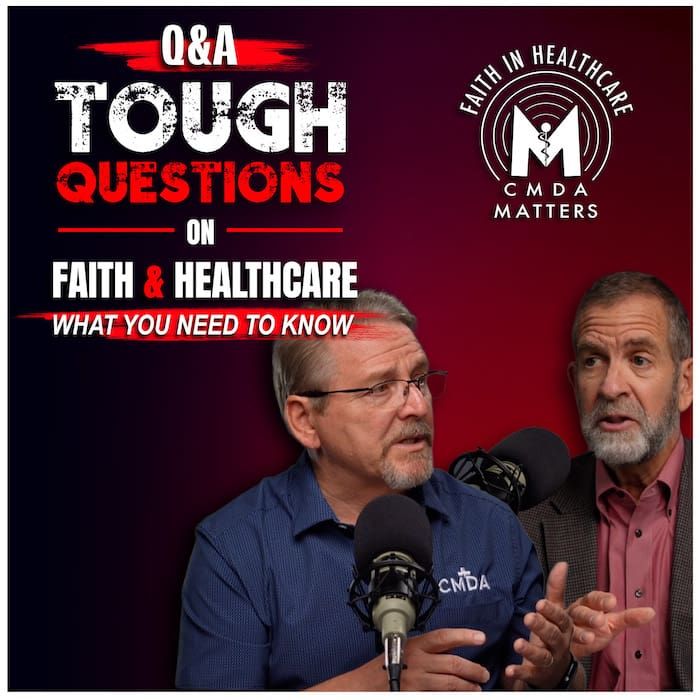
[00:00:20] Speaker B: Welcome, friends, to Faith in Healthcare. I'm joined today by my regular co host, Dr. Brick Lance, and we're going to answer some of your questions and we're going to cover a lot of ground. We work through real questions from both CMDA members as well as non members. You're going to hear us dialogue on everything from conscience protections for pharmacists, to how faith and culture collide in the exam room, to caring for patients who are dying as Christ would want us to, to our thoughts about the spiritual disciplines that keep us grounded.
At the end, we're going to sneak in a few book recommendations that we think will be worth your time. So let's get into it.
Well, welcome back to Faith and Healthcare. And I want to welcome to the studio today Dr. Brick Lance, who's a regular co host, and Rick, it was your idea suggestion to me many months ago that we should have a Q and A session between the two of us and maybe between myself and others at CMDA and talk about questions that we frequently receive. So you get a few questions from time to time, don't you?
[00:01:38] Speaker C: We get a lot of questions here at the national office of cmda. We get them from the ethics hotline.
We have this weekly posting of a discussion forum on the point of medicine with some really thoughtful questions, the articles there. But we have some new questions today.
[00:01:52] Speaker B: We do, because every three or four years, friends, we do a survey to our entire membership and then we throw in a number of people who are non members, some of whom have been members in the past and others who are on our mailing list, emailing list and a very extensive survey, isn't it?
[00:02:07] Speaker C: Yeah. And there's of course a comment section and we get some really interesting questions in that comment section. Definitely worth discussing.
[00:02:14] Speaker B: And one of my sayings over the years in hanging out with Christians a lot is that interesting Sometimes is not a very positive if we're hurt. So you've hand selected some of these questions.
[00:02:24] Speaker C: We're going to put a positive spin on them though.
[00:02:26] Speaker B: Yes, yes. We want to humbly try to respond even if it's a criticism, right?
[00:02:31] Speaker C: Yeah.
[00:02:32] Speaker B: So why don't you get us started?
[00:02:34] Speaker C: All right. So we do have a couple of questions off our ethics hotline and then we're going to go to some survey questions. And Mike, the reason that I included these two ethics questions that came in our hotline, they're really applicable to this conference that you and I just attended called the Colson National Convention. Interesting interaction there. We thoroughly enjoyed it.
[00:02:54] Speaker B: We do.
[00:02:54] Speaker C: We have a bunch of new members. And the reason I like interacting there at the Colson conference is it's not just physicians. Of course we have physicians, we have dentists, we have pharmacists, we have RNs, we have PAs, we have the whole walk of life of health care. And they're doing this Colson fellowship, but wonderful discussions with them. So the first question here that I have from our ethics hotline is from a pharmacist and this pharmacist. I'm not going to read the question directly, but this particular pharmacist was very concerned about conscience protections and not for their own sake, but for the sake of the profession of being a pharmacist. I thought it was a very interesting question. And so again, very three specific issues for the pharmacist. Chemical abortion, sex hormones, vaccines.
And this pharmacist is just curious how to improve and how to discuss the healthcare practice within pharmacy, you know, as Christ followers. So do you have some thoughts on how a pharmacist should respond when they're asked to, you know, give out medications against their conscience?
[00:04:01] Speaker B: It's a really good question. And in particular, pharmacists. Neither one of us are pharmacists, but we have worked with pharmacists. But I think we should start with some general principles. First of all, when we talk about protecting our conscience, we need to keep in mind that in general, we think of services and treatments or procedures that are done not in terms of groups of people. And yet I think sometimes that's where historically we've hurt ourselves because of discrimination against people groups. And so the mantra that I have used and shared on this podcast from time to time is we will take care of anyone. We will take care of them anywhere. Obviously there are some call coverage and things and we'll do it anytime, but we can't promise to do anything. So keep in mind this is services and treatments and you've mentioned a few, this question relates to those few. So that's great. But if we don't like, for example, the med acts that have been passed in at least nine states and we're
[00:04:57] Speaker C: working on getting more states to pass them.
[00:04:58] Speaker B: Yes, those med acts are tailor made. Each state is a little bit different. But again, it's about procedures and treatments. And so that's first and foremost in terms of abortion. And I almost feel like I'm sharing with a professor here because you're Our vice president of advocacy and Bioethics.
But as I understand it, and I guess I represent the common man, the common physician surgeon out there and other healthcare professionals for abortion, that's the one that has the most extensive healthcare. So in terms of for a pharmacist to offer, be forced to offer mifepristone for medical abortion, let's call it chemical
[00:05:42] Speaker C: abortion because it's not a medicine.
[00:05:44] Speaker B: Thank you. Thank you for that correction. See, that's why we've got you here to correct me. So you heard it. We have to be constantly reminded of these things. Yeah. Chemical abortion, the Weldon amendment, the church amendment, the Coates Snow, all of these are in place. And there are some state laws too, protecting their conscience and the ability. My thought, of course, is that as you get hired by, whether it's a national chain or a privately owned pharmacies to have these conversations well in advance.
Don't you agree?
[00:06:11] Speaker C: I agree. So if you're going to work for a corporation, be forthright up front and just tell them what you believe and why you believe it. And there's certain practices, if you will, that you cannot participate in. So make that very evident.
[00:06:25] Speaker B: So comprehensive federal laws. And also, I'll come back to this. But how we responded at CMDA to the transgender mandate of 2016 also throws in, you know, referral for treatment for abortion for any of our members or future members. So that's also that court case out of the fifth Circuit. Now, in terms of the so called gender affirmation treatments or sex rejecting procedures, that's a little bit less. There's not as much federal protection there. But again, going back to that court decision that was made out of the fifth Circuit, which the government did not decide to take to the Supreme Court, so it's finalized, that our members are protected by from having to do any kind of management of our treatment. And that includes our pharmacy members. We do have many pharmacists members.
And the third category was vaccines.
That's a little more complicated, obviously. Wouldn't you agree?
[00:07:23] Speaker C: Well, it's more complicated, but there's going to be differences of opinion on what's therapeutic or not with vaccines. And we can have our own personal opinions.
So it's a little different than the other two because the other two clearly are causing harm.
Not that vaccines can't cause harm, I'm not saying that. But if you're giving mifepristone, you know, for an abortion, that's causing harm. If you're giving a hormone to a teenager that wants to, quote, change their sex, which of course biologically can't do, that's causing harm. So there's definitely a. Right now there'll be questions of whether you're really causing harm, giving the vaccine. So again, we've learned a lot from COVID I don't think we want mandates. Okay. But we want to give recommendations. So a little bit different category there.
[00:08:09] Speaker B: I do have one caveat going back to even abortion. And I think I've shared this with you, but I want to share with our listeners the caveat that one of my favorite scriptures, Proverbs 3, 3 and 4, let love and faithfulness never leave you.
And so I've actually talked with Christina Francis, the CEO of applog, and she, as a practicing obgyn, one of the foremost voices of pro life in America, has faced this situation. And it deals with pharmacists. And that is a young woman very close to me in my family was having a spontaneous ab. She was having a miscarriage, and she was prescribed her OB misoprostol, and she went to the pharmacy and she had the pharmacist, who was a pro life pharmacist, wag her or his tongue at her, condemning her.
And so we have to be very careful. And so Christina, Dr. Francis told me that she's had to call pharmacists. Look here. This is Dr. Francis. I'm the CEO of Applog. And this woman is not. This is not an elective abortion. This was a spontaneous ab. So it's already an emotionally very difficult situation. And then to throw in saying, it's my right not to have to give you this drug. Be very careful.
[00:09:20] Speaker C: Yeah, be very careful. Mike. Sorry, it tickles my. You're tickling my brain here. But it reminds me of the article that I just had in our recent magazine, CMDA magazine, that if we were to advocate, and this falls in the realm of advocacy, we need to go with wop. We need to go with wisdom.
[00:09:35] Speaker B: I was hoping you'd bring this up.
[00:09:36] Speaker C: And prayer. So let's know the subject. And let's not fight a subject we don't know about.
Don't do it by yourself. That's why I love this question. So do it as your Christian realm, your Christian family within pharmacy. Okay. And. And don't forget to pray. Don't forget to pray.
[00:09:54] Speaker B: Great principle.
[00:09:55] Speaker C: Yeah. Well, and let me just add on there.
And we had a lot of conversations with RNs and PAs at this Colson conference.
And what you and I need to realize as physicians, you know, the buck stops here with physicians. And we're willing to even put our jobs on the line, if you will.
That is very difficult for these other professions. It's very difficult for the rn, very difficult for the PA that's working under a physician, and difficult for pharmacists, and even difficult for medical students. We get a lot of questions from medical students because they're under their attending.
So we need to be in prayer for all these other health care professionals, because sometimes it's very difficult, and support them.
[00:10:36] Speaker B: And before we forget, why don't you just again share with our listeners, our watchers, the very special arrangement that our members have with an attorney, an employment attorney in this regard, because pharmacists, if they're members, could use this service.
[00:10:50] Speaker C: Right? So, again, through the generous donation of adf, they have an attorney who will represent any CMDA member. But you have to be a CMDA member. Okay. And again, can be any healthcare profession. But if you're a member, this attorney, through the funds of adf, will represent us for free. And that's happening currently. I can think of two cases right now.
One is a pa, okay, that's having their conscience protection violated, so we're supporting him. But the others were now a plaintiff for adf.
Well, I'll just say it. The state of Colorado, where they're mandating these sex hormones and procedures in teenagers for all healthcare professions.
[00:11:30] Speaker B: Not every case will go on to litigation. Some will just be advice and consultation.
[00:11:34] Speaker C: Correct? Correct. Yeah.
[00:11:36] Speaker B: Well, let's go on to the next question.
Let me pass this to you, Brick. A physician as a patient.
So the physician is now a patient. Seeing another physician expresses concern of this physician having a pride flag displayed somewhere in their office. And so the patient, the doctor now speaks up and said that they're a Christian and offended by this pride flag and that it's inappropriate. And then obviously, this treating physician that was displaying was himself or herself offended and cut the patient, the doctor, off from care. And ADF's response? Apparently, this physician said, we don't want to take up this case, so talk about this scenario.
[00:12:19] Speaker C: Now, again, this is personal to me because, Mike, I may look healthy. Maybe I do. I don't. I don't know. But I've had 30 surgeries myself. I've had all kinds of diseases. I've seen dozens and dozens of other physicians. Sometimes we have a choice, and sometimes we don't. And I want to tell you a funny story, though. I think it's a funny story, but I have a warped sense of humor. I Get that.
But this is where there wasn't a choice. All right, so an atheist, I won't say an atheist, certainly not a follower of Christ. But a friend of mine, he's a cycling buddy, okay? And he's a retinal surgeon. He called me over a four day weekend, really was in September, his Labor Day, he was out on his bicycle and fell in wrecks. And doc, he called me up because we have each other's cell phone. You gotta look at my shoulder. So again, Monday was a holiday. Come in Tuesday morning, I'm gonna be there by 7am My X ray tech will be there, we'll X ray it. He had an AC separation, but not severe. And I said, you know, there's no surgery, you know, some abrasions, just, you know, ice on it, you'll be absolutely fine. Now he's a surgeon, so he has to rely on it, okay? So that was 7am I was starting to lose vision the night before. I had called my ophthalmologist, my personal ophthalmologist the night before. Can you see me? He says, come in at noon.
So, okay, I work all morning, go to the office at noon, and I've got a retinal detachment, which is real close to my optic nerve. And he, after he dilated my eyes, says, come with me. He walks me down to the retinal surgeon's office who I'd just seen five hours earlier, looks in my eye and says to the ER surgery, now, I didn't have a choice. He said, if that goes across your optic nerve, you can be blind. I just said, here's a guy with a bad shoulder that's going to operate on me.
It's just a funny story that I saw him and now he see me literally within five hours of each other. So sometimes we don't have the choice. But I tell you what we need to emphasize, what this questioner is asking is if we're reaching out to a lost world, it's Christ first, it's not morality. Okay? You know, for us followers of Christ, morality is important because we want to honor Christ, but they don't know Christ.
So let's lead them to Christ first before we force our morality on them. I hope that makes sense to some degree.
[00:14:24] Speaker B: Well, and I would think, I mean in Michigan, in my practice, certainly Mission Hospital, I'm in Kenya, it's a no brainer. But even in my practice, I want to be able to put pictures up of ministry to patients. We did my practice surgeons, we had pictures. All faith flags so pride flag, faith flag. If what's good for the goose is good for the gander. So I guess part of me doesn't understand the issue here, because the LGBTQ faith, if you will, it is a religion. It is a religion. So if I want the ability to have faith flags, then other flags of other faiths are going to have to be also okay. And we're there. Like you say, I would want to be able to have an opportunity with that doctor over time to share care first and love for that individual.
[00:15:14] Speaker C: And it's our personal decision. If we want to see someone in that specialty that's a follower of Christ, we can make that decision. We have a lot of freedom here in the United States, which we're blessed for. But you don't have to. Again, I have orthopedic partners that are absolutely technically outstanding. Great physicians, great surgeons, but they don't know Christ.
But that's our choice, which is fortunate. But I want to share two stories. So, you know, Dove Medical is the pregnancy center that I get the privilege of being medical director. And we get protests all the time.
So if they gather around, usually there's an OB gyn often that comes down from Portland to lead these protests, which I don't get it. I mean, all we're doing is caring for a woman. Beside the point. But what do we do? We don't go out and argue with them.
Actually, we order pizza, and we just take pizza out to them, and we even invite, say, if you want to have. If a couple of you want to come have a discussion, you know, come in. They usually refuse, but I'm happy to sit down and have a discussion with them. So that's one issue. Let's engage them in dialogue, and I'll read a scripture in a second. The other is if it's not just a specific doctor, but it's organization. So, again, I work at a Catholic hospital, largest Catholic hospital on the west coast, and they were celebrating Pride Month, and they do, and they put up the flags, and they sent out an email to all the physicians who had privileges at this hospital.
Very long paragraph. And I just called up the administrator. I said, well, why are we celebrating someone's identity in this when there's so many things that we can find our identity in? And I got just a very short, curt response. So I don't mind. If we can speak wisdom into an issue within an organization. Do it with gentleness. I don't mind doing that, but I'm not going to.
It's their choice. I'M not on the board, you know, I just work there, so I can't change that part. But let's engage in dialogue. In fact, this is how Paul tells Timothy to engage in dialogue. So I want to read this to you. I love this part of Scripture, but refuse foolish and ignorant speculations, knowing that they produce quarrels.
And the Lord's bondservant must not be quarrelsome, but be kind to all, able to teach patient when wronged with gentleness. Gentleness. Gentleness. Gentleness. Correcting those who are in opposition. Why, if perhaps God may grant them repentance leading to the knowledge of the truth, and they may come to their senses and escape the snare of the devil, having been held captive by him to do his will. So these that are, again, if you're a physician, placing a pride flag, go with them in gentleness, not quarrelsome.
See if you can release them from the snare of the devil.
[00:17:44] Speaker B: And would you agree those principles, Paul's teaching Timothy, apply to whether or not the individual or individuals are Christians or non Christians? It's the same. We shouldn't be quarreling with those who would identify with us in Christ versus the world.
[00:17:57] Speaker C: Right? Right. So I look at those. I look at these opportunities, at these situations as an opportunity. Okay. But let's do it with gentleness, not demanding.
[00:18:06] Speaker B: Yeah. And I could just imagine a scenario, having been part of a medical staff at a secular community hospital in Michigan, that if you do offend that physician with the pride flag, there's going to be discussions in the staff assuming that this physician is part of a big larger staff, and it's going to come back to bite. Bite, you think?
[00:18:26] Speaker C: Yeah. So let's go to our survey questions. Mike, here's a good question. What role can CMDA play in helping physicians navigate the growing loss of autonomy and challenges within modern healthcare systems while remaining faithful to their calling? And I'm just going to add on, Mike, I mean, you and I are in the older age range, so we've seen significant changes in our lifetime, in our career. But how would you respond to this questioner?
[00:18:52] Speaker B: Yeah, it's good. I was a member of Southwestern Medical Clinic in Michigan. And granted, most of my career was at Temek Hospital, but I was part of that practice when Southwestern was its own corporation and then when we became part of a healthcare system.
And I will tell you that administrative oversight, corporatization of America, it's not 100% bad.
I mean, frankly, we have some tendencies within the body of Christ because of niceness, to let Some things that are inefficient and not productive go.
Because it's to be Christian is to be nice and kind of not make people have excellence. So I will say that some things that we were asked to do now by the governing corporation made us more efficient and better.
So I think sometimes we push back in our libertarian way and say, this is bad. And yet they want us to be more efficient and to do a better job as physicians. So I think there's some of that, not all of it. Maybe some are listening like, oh, Chuck, you don't understand. It's really extreme now these days.
I grant that. But there are some bright spots in having corporatization make us work better. But in terms of how to deal with this, which is the real question, how to deal with this. First of all, coaching.
I think that sitting down, I've been through the coaching class myself and seeing the incredible benefit of having a very wise, insightful, experienced other physician who's been trained like an Anson or a Ken Jones or a Darlen Fouke to ask you questions and walk from point A to point B as to how to find more joy in practice. So coaching. And people can go to CMDA.org coaching
[00:20:37] Speaker C: and find that and mentoring, for that matter, too.
[00:20:39] Speaker B: Mentoring is part two, and both can occur at the same time. There's mentoring with a coach approach, which I think is a great combination.
But I think also, I think some of the burnout that's experienced is because of the removal of faith and spiritual ministry from practices.
And it's not like we have to figure out how to spend five or 10 minutes in spiritual ministry with every patient. And there's no way in my surgical practice up in St. Joe I could do that with every patient. But there's always some kind of small faith input with every single patient. The other thing is, I mean, thinking through transitions, driving to the hospital, walking from one building to the next, moving from one patient to the next. I think there are some habits that we can get in. We all have to wash our. As surgeons, wash our hands or go to the phone, whichever it is.
So the practice that I built in, whether it was at a mission hospital or in St. Joe, was as I'm washing my hands, my hands are together, and I prayed.
And then as my hands are up, walking through the operating room door brick is a lifting up my gaze. You know, our recent national convention theme, lift up your eyes, Lift up your eyes in a sign of humility and need and dependency.
And that just. That's just Like a bellows on the fire of our hearts. And so all these other things, these can be quite discouraging, the corporatization and productivity metrics. But if we can maintain that spirituality during our days and walk in the presence of Jesus, I think it's an anecdote for this burnout.
[00:22:25] Speaker C: It is. And I look back at something Carl Truman said. Carl Truman, by the way, you know, he spoke multiple times at our national convention, but he also spoke multiple times at Colton. I don't know how he does it. Yeah, it's an interesting statement, but the greater the desecration, the greater the opportunity for the gospel and consecration, which is the cure. And by the way, just make a little plug, not for myself, but for the content.
So at the Colson National Convention, we held a luncheon talking about how the house of medicine is broken. How do we rebuild trust in healthcare Again, I look at this change in medicine which again over four decades, I can relate to this question.
Medicine has changed. And I feel sad, if you will, for my younger partners, even Christ followers, because they fall in this trap of efficiency and it takes away from their joy.
We within unity again come back to that unity idea. We need to support, encourage one another, stimulate one another, pray for one another to bring that joy back, to bring faith back into healthcare. It's an opportunity, Mike.
[00:23:29] Speaker B: It's an opportunity and it's. Why is community so important, isn't it? Yeah, community.
That other faith practice that I wanted to talk about is a holy huddle.
And we had a guest on the podcast just a few weeks, Dr. Bill Claytor, who talked about every in his office, his practice, granted he's a dentist, he owned his own practice, have a holy huddle every single day with his staff. Not all of them were Christians, but they all accepted that. They humbly accepted there would be this holy huddle. He would offer up a word of prayer and boom, they were off with their day. And so doing that with other practitioners. Whether just find even a few Christians on a Monday morning or midweek to be able to just have 15 minutes of prayer together. Just another infusion of encouragement
[00:24:12] Speaker A: before we continue with this week's episode. Here's a special announcement for you.
What an honor it is to see how the Lord is working through your CMDA.
There are over 40 ministries part of CMDA and our fiscal year end goal of $1.1 million supports these ministries that serve others across the street and around the world.
In fact, last year 878 of you served on 62 mission teams bringing the love of Christ to 28 nations.
Your CMDA is there educating, encouraging and equipping healthcare students and professionals. Plus, we're protecting the vulnerable from the preborn to the elderly.
Your most generous gift by June 30th helps ensure that these ministries continue to thrive.
To give your gift today, visit CMDA.org give or call our stewardship team at 888-230-2637.
Together, we can continue to keep your faith in healthcare connected.
Something exciting is happening at cmda.
Healthcare professionals across the country are stepping up and becoming lifetime members of CMDA at record pace and we want to invite you to join them.
This is more than a membership. It is a declaration that your faith and your calling are permanently connected.
That you are committed to the mission to help bring the hope and healing of Christ to the world while being a champion to the next generation of believers.
To learn more and join a community committed to transforming healthcare For Christ, visit CMDA.org Lifetime to go even deeper with CMDA, let's jump right back into this week's episode.
[00:26:15] Speaker C: So I want to read one more scripture.
[00:26:17] Speaker B: Yeah, okay. Please do. Go ahead.
[00:26:18] Speaker C: And and the reason these scriptures mean so much to me that I'm reading because I have fallen into this trap. Read from second Timothy.
I used to be so quarrelsome and I think through the Holy Spirit he's changed me. And same for this thought that as we lose these freedoms, if we will, as healthcare changes and we are losing freedoms, we have this focus in the freedoms. For me personally, when Christ and the apostle Paul talked about freedom, it's completely opposite of what the world thinks. So I like my favorite definition of freedom comes from Galatians 5:13.
I love this verse. And again for you were called to freedom.
Brethren only, do not turn your freedom into an opportunity for the flesh, but through love serve one another.
We have the freedom to give of ourselves because we have Christ, we know the answer so we can just give of ourselves. And I need to remind myself of that.
[00:27:15] Speaker B: And I do want to thank you again for that talk in Knoxville at the Colson center meeting. And just for our listeners viewers, that presentation is going to be coming out in just a few weeks here on faith and healthcare. And people can get CE credit for that.
[00:27:30] Speaker C: Absolutely. So Mike, let's go to this next question.
What is your encouragement for healthcare professionals caring? Oh, I'm sure you're supposed to ask me this question.
[00:27:38] Speaker B: Yeah, this is yours, brother. This is yours.
[00:27:40] Speaker C: I got some answers.
[00:27:41] Speaker B: What is your encouragement to healthcare professionals who are caring for the elderly and those who are dying in the process of dying, whether it's six months, a year or so forth.
[00:27:52] Speaker C: Again, I'm an opportunistic person, so I look at this as an opportunity. It's an opportunity to pray with those patients because they're very receptive to prayer. Certainly an opportunity even to share. Share the gospel. You know, I look at Ben Sasse talking about the previous senator that's dying now from metastatic pancreatic cancer. And what about dying well?
So there's a huge difference between death with dignity, which those that espouse physician assisted suicide. That's what it's called in Oregon, versus dying with dignity. Two different things, little difference in words. Death with dignity versus dying. There is a way to die with dignity, and Ben Sasse is modeling that, if you will.
So I'm going to tell you a couple stories. My dad died well. And again, obviously I miss him dearly. But when he lived in another state and go to visit him every year in the summer, our evenings were filled. We just discussed theology and culture and Christ for hours and hours every evening. I loved it. It was great. And he said, you know, I'm going to be with the Lord soon, and I'm really looking forward to it. I know you are. Thank you for modeling that so well. And then it wasn't just very shortly after my last visit that he passed. Unfortunately, it was very quickly. But, yeah, he was in his 90s, so what a godly man. How to die. Well, there was another. This is a funny story.
So one of my pastors came up to me, as pastors do in church, and our listeners probably have had this experience. Hey, doc, look at my shoulder. You know, I think I have a rotator cuff tear. So I examined him and he's about my age, but this was quite a while ago, and it was clearly neurological. It clearly wasn't his shoulder. And I said, look, you got to get in, see a neurologist or your family. You're going to need some testing done. Clearly, he got an MRI of the brain. He had a glioblastoma, and he died six months later. So he's actually in the hospital now because it just.
The illness was so overwhelming, but still with it mentally. And I told his wife, who was a dear friend, you know, take the day off. This is Saturday in the fall. Take the day off. I brought a couple bottles of wine, watched college football, laughed, told jokes, drank the bottles of wine, and just had a wonderful time. And so his wife came back, you know, late afternoon And I just thanked him for letting me spend the day with him. Just a wonderful time. And then he goes, brick, before you leave, and I'm walking out the door. What? I'll do anything for you. What?
Because when you get to heaven, will you fix my rotator cuff?
And I thought, you know, he still has that sense of humor, that vision of what it means to be with Christ. And so there really is a way to die. Well, but again, it's an opportunity for us to be salt and light. I just look at it as that opportunity for those that are dying and we can come alongside them. Get away from this. The last question. Get away from this medicine that practices efficiency and such.
[00:30:37] Speaker B: And power of touch. You say alongside and touch. And I found that especially older patients, elderly, whether they were dying or not. But I mean, it just that power of touch. Christ touched people all the time.
[00:30:51] Speaker C: Yeah. And let's not forget the material that we have here at CMDA that people want to learn in this, the Standing Strong modules. We have one on dying. Okay.
[00:30:59] Speaker B: Yeah. End of life care.
[00:31:00] Speaker C: And also bridging the gap that was there years before. The module on the end of life, robust tools to help with this situation.
[00:31:11] Speaker B: Right. And with that, being proactive. What we are for as opposed to what we're against. We are obviously against assisted suicide, but what we are for is presence and
[00:31:22] Speaker C: compassionate, and we need to model that for the world.
[00:31:24] Speaker B: Absolutely.
[00:31:25] Speaker C: Yeah.
[00:31:25] Speaker B: Absolutely.
[00:31:25] Speaker C: Yeah. So, Mike, what practical spiritual disciplines have helped other Christian healthcare professionals remain grounded in their faith during the busy season? And I know you have some thoughts, but again, what you've modeled to me is your memorization of scripture.
And you and your wife chooses a new psalm every year just to focus on, memorize, meditate on, ponder it, and just make it part of your life.
[00:31:53] Speaker B: And I have to go there every morning. I mean, it just comes to me. Last year's was Psalm 145. I will exalt you, my God, the King. I will praise your name forever and ever. And so in prayer, I mean, those things just infuse.
It just comes like breathing. I mentioned earlier praying in the gaps in a busy, busy practice. But I think the key is the thought of first fruits, Brick, that at the beginning of every single day. Now, granted, some of my days in practice used to start, I was in the operating room already on call 6am and there are times which of course the Lord understands when you can't do it. But giving, even if it's only 15 minutes and if you only have a short time and if you're in training. I would suggest doctor's life support from icmda, a great devotional written by doctors around the world, including some of our own here. And one page, nice scripture. Great thought. And that shouldn't always replace our daily reading of the Word and getting through and trying as much as we can to read through the Bible in a year or in two years or whatever the program. But certainly. But memorization, absolutely. And John Piper, you know, prolific author, but I came across an article he wrote that if I had to choose, if there was only one spiritual discipline, John Piper says it would be scripture memorization, that God's Word just flowing through me, piercing my heart, the Holy Spirit using it to convict me. And the Spirit and the Word in the Book of John, multiple times, Jesus, I mean, it's the sword of the Spirit, but the Spirit and the Word are like one. It's amazing how often the Holy Spirit encourages teaching, rebuking, correcting, training in righteousness, as Paul said to Timothy. So I think, whatever, maybe you can't memorize a whole book of the New Testament, but certainly whether it's a psalm of the year, where navigators, you know, groups. There are tons of resources, aren't there?
[00:33:48] Speaker C: There are tons of resources, and I
[00:33:49] Speaker B: know you prioritize it as well.
[00:33:51] Speaker C: Yeah. And I do want to share another habit, which I've shared on your podcast for. But I want to bring it up with this question. But before I do that, and we should ask Bill Reichert this. But even our campus ministries, it's interesting, you know, medical students are in this transition of life. They're trying to figure it out. What am I going to do? What am I going to be, where do I want to go?
And what's the will of God is what they're trying to figure out. What is God's will for my life? And then often I will ask the student, well, are you in the Word daily?
Are you with other believers? Are you praying for each other, encouraging one another? When their answer is no, no, no, no to all these questions, no, then you can't know the will of God. I mean, it's just impossible. Right? But yes, if you're in fellowship, you're encouraging, you're asking questions, you're in prayer, you're memorizing scripture in the scripture on a regular basis, it'll become evident. I firmly believe that you will have choices, but then there won't be a wrong choice between the two choices if you're really following God's will.
I hope that makes sense.
[00:34:50] Speaker B: Oh, 100% it does.
[00:34:52] Speaker C: Yeah. And so the one discipline that a mentor, again, I was in my 20s, so even before medical school, and a mentor said, rick, I want you to make this a discipline in your life.
When you lay down at night, I want you just recount the day and just whatever happened in the day. Good, bad people you encountered give thanks to God.
And that is such a habit now, after 40, 50 years, they do it every night, no matter what. And it just, it makes me commune with God, makes me appreciative that by his grace, I'm part of his family. Only by his grace.
[00:35:25] Speaker B: Yeah. And I would guess that part of that prayer could be, and probably for you is from time to time, search me, O God, and know my heart, test me and know my point out anything in me that today, as you're reviewing, offended me. And I can't say that I do it every night, but I agree with you. Concur that sometimes the Holy Spirit points out a comment that I made or a response that was just not Christian.
[00:35:49] Speaker C: Oh, part of it is asking for forgiveness.
[00:35:50] Speaker B: Yeah, absolutely. And grieving over that and communing with the Father that way. That's great.
So how can those listening, how can our members and those who are constituents who listen on a regular basis, any ardent Christ follower who really wants their faith and their healthcare to be connected, how can they encourage other Christ followers in their community? Because, I mean, the reality is we know this in any community, even the most Christian community, most of the Christ followers in healthcare are not part of cmda. So what would be your elevator speech? It can be a little longer than elevator speech. But what would be your speech that you would encourage them to give to other Christ followers as to why they should become a part of this body?
[00:36:34] Speaker C: Well, first of all, I don't think you're going to do it with an elevator speech, to be honest. I think you're going to do it with a relationship.
[00:36:38] Speaker B: Okay, good point.
[00:36:39] Speaker C: Okay. So you need to know the person, know what their interests, what brings them joy, what brings them sorrow, you know, what their struggles are. It could be in their practice, could be family. And pray with them, encourage them, get them a flavor of what CMD is all about. So it is the relationship.
So that's very important. And again, let me go back again, second year in medical school, I was at University of Oklahoma medical school, but doing the Tulsa branch where my dad lived. And we had a conversation one time, I said, dad, we had this luncheon, it was sponsored by cms, this Christian Medical Society. That was really interesting. He goes, well, tell me more. Well, it's nationwide, of course. I didn't know about it at that time, but just found out about it in medical school. And it's this connection of medical students and doctors throughout the country to live out their faith. And my dad says, this is the national organization for physicians that follow Christ. I go, it is.
How do you get a lifetime membership? I'm buying it for you, you know. So again, my dad being a pastor, theologian, counselor, et cetera, he just knew, saw the vision. What Incredible. Yes, you need to be a part of this, Brick. So he really emphasized that unity, that body of Christ, even within your profession.
And I think that's what we ought to sell.
Be a part of something bigger than yourself. You have your church, I get it. You have your family. If you're followers of Christ, you have your personal faith, but let's live it out in your profession where God has called you, but be a part of something bigger as you do that to encourage one another, to stimulate yourself to grow your faith, you know, because the materials we have. But whatever God is calling you with. And again, as you know, we have so many 40, 50 different ministries under the umbrella of CNBA.
Find out what floats your boat and be part of it.
[00:38:25] Speaker B: Yeah. And I think a book that really impacted me big time was a book written by Christian Smith, a professor at Notre Dame, called Handing down the Faith and what Our Modern Times parents say, what it has come to is that faith is a personal identity accessory. You know, something like a thing that you just take off or you go in the hospital, you take off.
And it replaced what historically has been a community solidarity project.
And so that part of our lives, our professions, we just work lots of hours. When I came to cmda, people thought I worked too hard. And I said, this is not my.
This is a respite.
But it takes up so much of our lives. And so one way of connecting faith in healthcare is that community solidarity. And absolutely, there probably there could be other doctors in the church that we go to, but they may not even be part of the hospital or practice where we go to each so identifying Christ followers.
[00:39:21] Speaker C: And you just mentioned earlier in our discussion here that joy that comes from living your faith in healthcare connected, that joy that comes from it. And if your faith and your healthcare are not connected, you're not going to have joy. It's going to be difficult to have joy in your practice. But when it's connected, and it's connected with not only just within your own Heart and your own mind, but with fellow believers, what joy that brings.
[00:39:43] Speaker B: Yeah. And it may not just be other physicians. It may be the entire team. Right, right.
Christ followers who are parts of other disciplines within healthcare. They could be our greatest advocates and partners, co laborers.
[00:39:54] Speaker C: Yeah. So we had this last question multiple times, and that's resources, particularly for medical students. And again, when I get to go to a CMDA chapter of medical students, I buy them all.
Farr Curlin, Christopher Tollefson's book, the Way of Medicine.
[00:40:10] Speaker B: Great book.
[00:40:11] Speaker C: I love the book. Just from the basic principle of how you're going to practice caring those that need health, because that's what we're doing. People need health and we're going to practice that. And this modern medicine, which the first question alluded to, we can get distracted from that in this fee for service model. So I love that book. I know you have others you recommend. I want to hear those.
[00:40:30] Speaker B: Yeah. And just I think the takeaway from that way of medicine for me is the idea that we are professionals.
The way of medicine is to think about human flourishing. And there are things that don't lead to flourishing. We're not a vending machine. A provider of services.
Provider service model. Thank you. That's great. Healing Purpose Being Part of a Flourishing and Enjoyable Practice by Mark Tapazian, a book he published last year. I joked with Mark, who's a good friend, that's a book I wish I had written. Just so powerful. Real physicians, real faith, 25 short stories. It's a book that we send to anyone who becomes a new lifetime member. We gave it out free at the national convention. And it's a broad array. Men, women, younger, older, academics, missions, research, and so forth. We were just part of honoring Os Guinness in Knoxville, Brick and he got the William Wilberforce Award. And this book that I'm going to recommend called the Call is his bestseller of maybe 30 or 40 books he's written. And it has had an impact. And especially that concept of the audience of one audience of one. No matter where the presence of God in my life. And it's a protective. To guard my heart when I'm in a hotel room on my own, traveling away from Pam, that concept of the. Of he is there watching with encouraging and so forth. And then Oz said, consecration or calling equals everything I am, everything I do and everything I have is invested with a special dynamism and devotion lived out in response to God's summons and service. So the Call, I recommend it highly for all the freedom of self. Forgetfulness a little book that I try to read two or three times a year. And it's got a mirror with no face that's on the front cover. A mirror with no face. In other words, forgetting me. It's all about Christ, as you said earlier. And then finally, our good friend Dr. Ben Mitchell, who's not a physician, which
[00:42:28] Speaker C: we had in the podcast a few months ago.
[00:42:30] Speaker B: Yes. On this book. This book, Bioethics in Medicine. A short companion as I just became chair of the alliance for Hippocratic Medicine. Great section on Christian Hippocratism.
[00:42:41] Speaker C: Yeah, great, great suggestions, Mike. I love those. So, yeah, get into reading books. There's some great ones out there.
[00:42:48] Speaker B: Well, we've run out of time and I just wanted to close by a prayer that I send to every new lifetime member if you want to become a lifetime member. I'm so glad, Brick, that you put that in earlier, but CMDA dog join. And obviously it's scaled by decade of life and you could be like Brick and be an undergrad or in medical school, but it's going to over the long haul, it's going to save you trouble and time and money.
But every time we have a new lifetime member, I send a short video. And with this prayer is how I conclude. And it's my favorite Pauline prayer from probably his favorite to probably his favorite church. They were the church at Thessalonica and 2nd Thessalonians, chapter 1, verses 11 and 12. I probably prayed it a half dozen times in previous podcasts. Customize. So we at CMDA, Dr. Brick Lance, our VP of Advocacy, and I as your CEO, we keep on praying, asking our God to enable you to live a life worthy of his call. May he give you the power to accomplish all the good things that your faith prompts you to do. And then Paul says the name of our Lord Jesus will be honored because of the way you live and practice, and you will be honored along with him. This is all made possible because of the grace of our God and Lord Jesus Christ. And in his name, I pray for you today, Christ follower in health care. Thanks, Brick.
Great session, Mike.
[00:44:19] Speaker C: This was fun. Let's do it again.
[00:44:20] Speaker B: Yeah, we will. Next quarter. God bless. Bye for now.
You know, I always enjoy conversations with Bricklance, and I hope today gave you something practical to carry back into your practice as well as your calling. If you have a question you'd like us to tackle in a future Q and A, we'd love to hear from you. You can reach us at FIH. That's for Faith in Healthcare fihmda.org and just email us with your question or comment.
And if you're not yet a member of cmda, I'd like to encourage you to check us out at Our main webpage, CMDA.org join. You'll find a community of Christ followers in healthcare asking some of the same questions that you ask, walking the same road and committed to living out their faith in every corner of the healthcare profession that you're in. If this episode encouraged or equipped you, please consider sharing it with a fellow clinician who needs to hear it right now and subscribe so that you don't miss future episodes of Faith in Healthcare next Next week on Faith in Healthcare, I'm joined by doctors Janet Hurley, Megan Hicks and Dr. Joe Docherty and we're going to talk about the vision of the new American College of Family Medicine and what it looks like to preserve the principles of Hippocratic care in today's healthcare landscape.
I do want to thank you for listening to Faith in Healthcare Today, where I promise to you as a listener or better yet, a subscriber to this podcast, whether you're a healthcare professional or a patient who loves Jesus Christ, is this we will do everything that we can to keep your faith and your health care intimately connected.
We'll see you next time, Lord willing.
[00:46:29] Speaker A: Thanks for listening to Faith and Healthcare, the CMDA Matters Podcast. If you would like to suggest a future guest or share a comment with us, please email cmdamattersmda.org and if you like the podcast, be sure to give us a five star rating and share it on your favorite social media platform.
This podcast has been a production of Christian Medical and Dental Associations.
The opinions expressed by guests on this podcast are not necessarily endorsed by Christian Medical and Dental Associations.
CMDA is a nonpartisan organization that does not endorse political parties or candidates for public office.
The views expressed on this podcast reflect judgments regarding principles and values held by CMDA and its members and are not intended to imply endorsement of any political party or candidate.
[00:47:25] Speaker C: Sat.