[00:00:00] Speaker A: Foreign.
[00:00:22] Speaker B: Welcome, friends, to Faith in Healthcare.
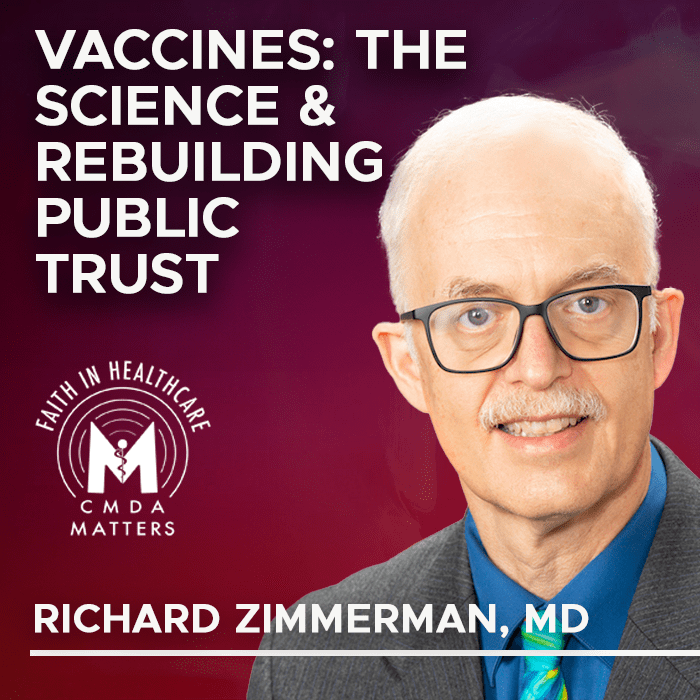
You know, vaccines raise hard questions for patients and clinicians alike. In today's episode, Dr. Brick, Lance and I are joined by Dr. Rick Zimmerman. He's a tenured professor at the University of Pittsburgh and former member of the CDC's Advisory Committee on Immunization Practices. We're gonna explore what vaccine science can tell us with confidence and how Christian clinicians can navigate questions of risk, conscience and trust in a post Covid world. So let's dive in.
We know faith in healthcare audience over the past few years, there have been very few issues that have tested our medical profession more than the issue of vaccines and vaccine science, especially the rapid development and the global deployment of MRNA technology. And many of us were amazed and admired at how quickly that scientific ingenuity came through and developed MRNA vaccines during the COVID pandemic. But then there was also this unease over shifting guidance and public messaging that often seemed either too certain or uncertain. And of course, there was a politically charged environment behind it all. Well, for us as Christian healthcare professionals, this tension, it goes beyond technical. We're called to love our neighbors as ourselves, as Christ loved us, to practice medicine with excellence and to tell the truth. Truth even when that truth is provisional or it's ongoing, developing, or frankly, when it's inconvenient.
We do care deeply at cmda, and our members care deeply about scientific rigor. But boy, do we care about humility and maintaining conscience, freedoms, and the moral weight of public trust in us. So today, our conversation, after all that is. It's not about scoring points with you, our listeners, or going back through old battles and picking off scabs and old wounds. But it's about clarity and it's about asking, what have we learned over the last few years scientifically, institutionally, and frankly, also ethically. It's about exploring how vaccine science, and particularly MRNA technology, moves forward with both confidence as well as that humility I mentioned. So our guest today is a leading expert in this field. My hope, joined today by Dr. Brick Lance, our vice president of advocacy and bioethics, is the that this discussion models something that our profession desperately needs.
And Dr. Lance, that is a willingness to discuss an issue that has produced divisiveness so much among healthcare professionals, including Christians, including those who are ardently following Christ sacrificially and a shared commitment to patient welfare above all else. So with that in mind, Dr. Lance, welcome. And would you introduce our guest today?
[00:03:24] Speaker C: Yeah, it would be my pleasure. Mike and I could not agree more. We do need to approach this with humility. But we get feedback at CMDA office frequently still on the issue of vaccines. So it's my pleasure to welcome Dr. Rick Zimmerman is a tenured professor and Vice Chair for Research in the Department of Family Medicine and Clinical Epidemiology at the University of Pittsburgh. His team's motto I love this great motto is Protecting people Vaccine policy to practice.
Dr. Zimmerman practices family medicine part time in a faith based federally qualified inner city health center since 1991 and he's co led short term missions with health care to Honduras and Guatemala. He has served as the board president of an international student ministry and serves as an elder within his church.
Dr. Zimmerman served on the CDC's Advisory Committee on Immunization Practices as a voting member in 2002-2004. He's published over 350 journal articles and Dr. Zimmerman, thank you. You put some on the Point of Medicine on our website, particularly in vaccines. But given as a career accomplishment, he was presented with the Harnes Career research award in 2016. And then most importantly Dr. Zimmerman, you are a CMDA lifetime member. Woohoo.
[00:04:43] Speaker B: Woohoo.
[00:04:44] Speaker C: Little shout out for that.
So I'm going to start out with a question on trust.
And trust is so important in healthcare. Trust is one of those founding principles for healthcare.
We hear this phrase over and over again, just trust the science and probably hear it too much. The question is who science? And the reason I ask that, because you see in the media and the debate today over this whole past year is childhood vaccine schedule.
And there's a lot of difference of opinions and there's a lot of difference all types of vaccines. So as a researcher, what does it mean to trust science properly? And what are the limits of scientific authority in complex public health decisions?
[00:05:24] Speaker A: That's a great question and it's a complex answer. But let me start with the source of truth, with epistemology, with God. Because with God we do know there is truth. And God has never committed an error. And whatever God has done has been truthful.
And so when God spoke, creation occurred, God spoke, the scriptures occurred, and God spoke. And providence is unfolded before us. And indeed the regularities of Providence are what the scientist relies on and what the physicians rely on in order to practice our arts.
So truth is part of God's truth, whether that truth is found by an atheist or a believer. And interesting quote from Calvin. But if the Lord has been pleased to assist us by the work and ministry of the ungodly in physics, dialectics, mathematics and similar sciences, Let us avail ourselves of it, lest by neglecting the gifts of God spontaneously offered to us, we be justly punished for our sloth.
His language is very colorful, but it's clear his respect that the truth via common grace that is there in science is truth and that we should use it. Now you hit the question, and what is truth? Where do we find that? And a couple of years ago, Burton Lee at the national conference did a wonderful talk on this whole issue of what scientific truth. And it's been pointed out that indeed about a third of scientific publications are not replicable.
And indeed, as we design, and I have run clinical trials as we design them, they often have a false positive error rate set at 5% and a false negative rate said at 20%. And of course, you know, just simple math, it's not quite that simple, but simple math, 20 and 5 is 25% error rate in the design of a clinical trial. And so we do have to take this into account that not everything that comes out.
But I think we also want some evidence based medicine because we don't want. I saw that. That'll work. And just to be flippant in our care of people, we want things that work. These are our brothers and sisters, either if they're in the kingdom already or potentially. And we want to make sure that the evidence that we are using is correct.
But let me also just say in, in summing up some of this, that because an atheist scientist finds some truth does not mean that their interpretation of that, indeed the worldview colors interpretation and where one person purport some finding which may be a truthful finding to be due to chance, to evolution, to whatever, we don't have to accept their interpretation of the data. As Christians, we need to be very thoughtful as to what the interpretation means.
[00:08:49] Speaker C: Yeah. Thank you, Rick.
[00:08:52] Speaker B: My next question. It's hard for me to ask this without the incredible background of the COVID pandemic and MRNA vaccines being front and center, but I mentioned we want to approach this with scientific humility.
And as you look back over these last four or five years, as someone that was just right in the heart of the pandemic and taking care of patients and having people come and ask you your advice, and in terms of the larger established scientific establishment institutions, where did we communicate well in terms of confidence that we had with data that we had, and where do we maybe kind of fall short and therefore lead to confusion and then maybe this loss of trust that Rick was asking you about?
[00:09:37] Speaker A: Sure.
Well, I, and I think all of us, it's easy to be proudful and to move out of our areas of real expertise.
And the expertise of a virologist is different than the expertise of an infectious disease clinician and different than the expertise of an infectious disease epidemiologist.
And all of those expertises were important in the pandemic. But it's easy for virologists to get out of their line and to talk in the expertise of another person and vice versa. So we really do need the humility from the spirit and we do need to think about data being replicated.
We did miss a few things.
For instance, I among others, and I was taught this by a virologist initially and certainly I'm an infectious disease epidemiologist. In flu epidemics, it is children who drive the epidemic. They have sialic acid receptors to which the flu binds. They drive it. But in Covid we didn't think through this carefully enough.
They children don't have the ACE receptors in the same number as adults. They did not drive the epidemic. And so if we close schools thinking that it was like flu, we missed the basic physiology that there was a difference. And so that's an example of missing a physiologic point.
The other one that I there's a lot of the vaccines don't work well. There's a lot of detail.
The randomized trials do show that the vaccines work, that they have worked against protecting hearts and lungs in particular.
But when you give an inactivated vaccine into a shoulder, you're producing mostly IgG and what protects the nose, mostly IgA. And so we were not producing that which protected the nose, but which protected the heart and lungs. Important we want to protect those. But we missed the point the transmission could occur.
We also underestimated the ability of this virus to mutate. Indeed, if you've ever
[email protected], you will see the incredible genetic variations that occur in this virus, making it hard for us to keep up.
But still we do see core protection.
So we have things we didn't understand, we have learned from them.
It's really nice when we have the humility to stay in our areas of expertise.
[00:12:22] Speaker C: Yeah. Thank you, Rick. And I think that's so important when we do admit, again with humility, maybe mistakes that we've made and even ask for forgiveness. Which brings me then back to the Bible because we started talking about the Bible and as you know, Mike and I Love scripture and Dr. Zimmerman, I know you love scripture as well.
So what is the biblical and theological basis of for Preventative health. That's my first question. And then how should theology and scripture inform our public health policies and vaccination programs?
[00:12:52] Speaker A: Well, in Deuteronomy, we have the command to put railings around the roof of a house. Now we have to remember this is the Middle east, when there were hot days and cooler nights, flat roofs and people would go to enjoy the cooler of the evening on a roof, but it's obviously dark and you can fall off and hence the exhortation to put a railing around it. We could also look at the, in Exodus, the protecting from animals that would gore to cage those animals. And so we do see the idea of prevention.
We see the love one another passages.
And who, you know, if you think of a grandparent wanting to protect their grandchild, who wants to bring to their grandchild or to their child an infectious disease from outside to inside the home.
Luther said this so well, you know, he says, I shall ask God mercifully to protect us, and I shall fumigate, help purify the air, administer medicine and take it.
Moreover, he who's contracted the disease and recovers should keep away from others, so act towards others that no one becomes unnecessarily endangered on his account, and so cause another's death. And I think Luther's concern that we not infect our others is so palpable there.
So I think we have the prevention basis in the Scriptures.
Your second question?
[00:14:25] Speaker C: Well, the second is how should that then form public policy issues, and particularly with vaccine programs?
[00:14:33] Speaker A: I see that we have to have several theologic issues that we think through some biblical issues. The cultural mandate in Genesis tells us to go, to conquer, to develop. And so medicine and science directly follow from Genesis. We also go to go very far along in Genesis and we see the fall and the noetic, the effect of sins in our capacities to reason, our capacities to interpret really need to be understood because all of us are susceptible, even believers, to the noetic effects of sin. It's been in our culture, it's been in our lives.
It has affected me. I mean, it's very easy.
That's my wife. How many times I said, and you know, I'll be so chagrin to find the answer.
At the same time, we see common grace. And this doctrine, I think, is often neglected, that every undeserved providential act of God's restraint, goodness, mercy towards this fallen world, and we get that of the Noahic covenant, Genesis 9 out of Matthew 5, the God causes the sun to rise on the good and the evil, and that Doctrine lets secular scientists find truth that can lead to the flourishing of people.
Bavik, famous theologian, wrote that the science, art, moral and societal life were derived from that common grace and acknowledged and commended with gratitude.
I think we do need to think carefully about the scientific areas.
There is a biblical basis. We also need a process. I believe process needs to be considered because there's a variety of gifts in the body and we don't all, none of us has it. And so we need the variety of viewpoints with the variety of expertise, as I had mentioned earlier.
And we need the checks on one or two of us doing this because of the noetic effects of sin.
[00:16:54] Speaker C: Yeah.
[00:16:55] Speaker B: You know, Rick, when my producer Kat Denton reached out to you and we wanted to set this up and talk to a practicing clinician scientist about vaccines, she pointed me immediately to an editorial that you wrote last August about measles and measles outbreaks and vaccine hesitancy. And she said, you got to read that, Mike. And I did read it. It was a very great piece.
So I'm a member of the ama, so I can get their daily communic that have been following measles outbreaks this year. And I think what I read just a couple days ago, 588 measles cases confirmed so far this year nationwide, which is more than usual for a year.
So I just, I'd like you to tell our listeners how can Christian healthcare professionals address vaccine hesitancy within, especially their faith communities?
Especially when concerns about moral complicity or people talk about God's sovereignty. It's just, you know, God's will is just going to happen.
How do we, as those who follow Christ, care deeply and have a level of trust by our faith communities? How do we address those issues?
[00:18:06] Speaker A: Well, lots of great questions.
One of the issues I think is thinking about how we frame the idea of vaccination.
You know, before some people may have used war motifs of the vaccine against the virus.
I think there may be better motifs that we can use to help understand one of those is that and particularly useful for a repeated vaccine of a software update. I want my phone protected. I want my iPhone protected against things. And so I have automatic updates set so that it gets updated.
The viruses, particularly flu and SARS CoV2, they mutate quickly. You need protection against them if you're going to use these vaccines to be updated. And similarly, these are updates for the immune system. They're giving the new information about what to expect and how to prevent an attack of a pathogen. So that's the one I find useful. The other one is the idea, and this might be for a vaccine that someone has not yet received so much of a flight simulator. None of us want to have a pilot who has never had experience with a storm. And we fly through a storm. You want your pilot to really know what to do because they have practiced by giving vaccines. We give the immune system on an inactivated, usually or weakened, in the case of measles vaccine virus. We give them the chance to practice, to develop their techniques for how to thwart an attack by a fully strong virus or fully strong bacteria. And it is that advanced information that allows a robust response and then helps protect. So I think the motifs are part of what I would suggest we change the framing a little bit.
[00:20:14] Speaker C: So, Rick, I want to touch on that same question on this vaccine hesitancy. And there's numerous reasons that individuals and groups of people can give for their hesitancy. And one, of course, is the fetal cell line and the use of that in the testing and or development of a vaccine. Do you have comments on that? I guess one of the specific questions, do you have an opinion on separating the rubella from the MMR vaccine?
[00:20:39] Speaker A: It would take a lot of work to separate them. They've been combined together for years.
And so one would have to separate them as a manufacturing process.
Late believer and perhaps the foremost Protestant bioethicist physician of our time was Bob Warr. And Bob developed several principles for addressing this issue of moral complicity. They included there were five criteria, but those included timing, proximity and intent among the others.
And for me, the fetal cell lines, the timing is remote. They were developed in the 60s and 70s.
[00:21:26] Speaker C: And those cell lines still exist that are used, Correct?
[00:21:29] Speaker A: Correct. Because they're perpetuating without any new abortions needed to keep them perpetuating. They were developed and they continue, you know, can I drive a car that was made by either a German or Japanese manufacturer that was in existence during World War II? Do I identify with atrocities committed by either of those countries by using a vehicle from manufacturer? I don't think so. And cell phones, many of us have cell ph. Unfortunately, there is, as you well know, some child labor. And that has been used often in the development of the chemicals, the minerals needed for those. So does that mean we endorse child slavery or child labor? No, of course not. And so I think there is a distance of remoteness.
Then there's the issue of Bob, of proximity. Well, certainly those researchers were separated from the abortionists, and I'm pro life, but those are Separated. The cell lines that were developed by the researchers are separated from manufacturers and many manufacturers use them for a variety of purposes and those are then separated from the physicians, you know, a chemistry teacher. Are they culpable if while teaching about students they have a student who leaves and later makes a bomb out of the knowledge they gained in a chemistry class? I don't think so. So I think proximity is distance and the.
Also I don't think vaccine refusal is going to change anybody's mind about abortion. And I'm pro life and disagree with abortion, but I don't think someone refusing vaccines is going to sway that debate a bit.
Obviously I do respect conscience and I know people who won't because of this. But I feel that the criteria that Bob War set out have been met that we can in good conscience use these vaccines.
[00:23:34] Speaker C: But then you would not object then it sounds like that last comment. If someone does have an objection because of the fetal tissue cell line, we should honor their own conscience.
[00:23:42] Speaker A: I think we have to.
You can't go violate conscience. And you know, I remember Bob teaching and so things I don't agree with the theology of the Jehovah's Witness, but there are some of them that believe that they would be eternally damned if they received a blood transfusion. I don't agree with the theology but if somebody really believes that I who would want to go against their conscience?
[00:24:17] Speaker B: I mean you know what's been very convincing to me, you two bioethicists where you have both have bioethics backgrounds has been. I've been almost 10 years around CMDA and I have not studied bioethics but I've paid attention to the conversations I think for the most part and articles I have yet to read any trained bioethicist, whether from a Roman Catholic background or a Protestant background who thinks that using these vaccine is complicit with abortion. I mean there's almost uniform agreement that I have read as I've listened in on these conversations. So I just want our listeners to know there really pretty much is. I mean help me to understand. Is there someone prominent out there that's speaking against what you have just stated with the understanding that if someone has legitimate conscience objections then we better at CMDA be listening to those objections.
[00:25:10] Speaker C: Yeah, I don't know of any bioethicists that would espouse otherwise than what you just said Mike. But, but the general public may have difference of opinions and, and yeah, I agree with. It's like the Jehovah Witness.
[00:25:21] Speaker B: Well, I do want to get to the topic of MRNA vaccines. But Dr. Zimmerman, we had a chance a little bit yesterday to talk by phone about some different topics. And one of the topics that I hope that you would address that Brick touched on very lightly at the beginning was changes in childhood vaccine regimens that have come out. And so as someone who's been practicing for a very long time, understands vaccines very well, vaccine science. Are there any of those recommendations that bug you that you wish they hadn't come out?
My wife said next time you get to talk on the program to a vaccine specialist, I want you to ask that question.
Are there any of these changes that. That make you nervous?
[00:26:04] Speaker A: Sure. Well, the thing that I appreciated about if we go back a year or three or four or five ago, is that the evidence to recommendations framework was very deliberate. You started out with a literature review on whatever the topic was.
Then that literature was graded for its strength of the evidence and how well it applied to this situation.
So there was a very careful looking. Okay, so here's the evidence. But as you know, randomized trials don't always, you know, the people chosen for them are not always the same as the general population. So how close is it? Did it have a racial representation? Did it have an age representation? Did it makes sense for the US in terms of that?
And then the policy also looked at side effects carefully. It looked at the resource allocation. Was this going to be costly? Was it feasible? Did you have to have a freezer or was it just refrigerator stable? What did the parents.
Or if it was a childhood vaccine or if it's adults, what did the adults think? The population, what did the clinicians and pharmacists think would actually be giving it? Could they do it? And so this was a very careful process.
It of course, had some times.
I, for instance, thought the decision on meningococcal vaccine made probably a decade ago, was not cost effective. Indeed, it is not cost effective. It was a very rare, terrible disease. But I thought that one should have been for high risk conditions.
More recently, as In January of 2026, there has been a release of a reduced childhood schedule fashioned after Denmark.
The problem with that is it's got several.
You know, Denmark is a fine country, but with a nationalized health system, single payer and complete records.
And does that quite apply to the U.S. i don't think so. We have a different health system, we have a different demographic situation.
And more fundamentally, if we have vaccines that help protect our children, why would a smaller number be the ideal? The ideal is what we want for Our children, it's not what's smaller, that's not necessarily it. Emulating Denmark. Well, France, Germany and Israel have 14 vaccines more than Denmark. You know, should we emulate France, Germany? What country is it? I think we need to do this for our people. Not necessarily emulating a European.
The another question that they, they had in this rationale was what about placebo controlled trials? Well, indeed, every vaccine that I know has had a controlled trial.
Now some of them were placebo controlled. When you have a placebo controlled control, you have the ethical issue.
You didn't give something to somebody and so sometimes what they'll do is the experimental vaccine versus another vaccine, perhaps hepatitis A or something that a child might not have had and will have so that the child or the adult, if it's an adult, they get some benefit and aren't just given salt water.
And so it's true, not everything is, but part of that is on the basis of what is good and how do we treat those in a trial.
And then the third area of things, and again the randomized trials, they're just not placebo control. But when you go from the initial Prevnar was a seven veil at pneumococcal. We went to 13 when we had already recommended and had a careful decision making process on 7. It would be unethical to deprive children of the 7.
Just test the 13 against placebo. No, you charge the 13 against the 7 to see is that better and that's what is ethical. And so this criticism that there was no placebo control. Well, there were trials and is it always ethical to do a placebo control and you actually can't do those in a timely way with a rapid mutating virus like flu. Can't do it.
You know, within six months the scene has changed. So I think there was, there's more to the story than that, that punchline.
And then there was the criticism. Well, the vaccine surveillance systems. We can always spend more money on vaccine safety surveillance systems. There were five already, including the granddaddy, the big one, which is for me the vaccine safety data Link, which has 3% of the U.S. population and large linked records. So do we look? We do look yet. Could we spend more money? Sure. That's a decision really for Congress and how money's allocated.
[00:31:26] Speaker C: So Rick, I have a question about re establishing trust. We started talking about just trust the science, but there's a lot of skepticism today and maybe Covid had something to do with that. And in your answer, maybe you want to touch on the historical perspective of vaccines, we can't go in a long soliloquy about the history, but there's some great history. Millions of lives have been saved by some of the original fathers of the vaccine technology.
But now healthcare professionals, they often feel dismissed or caricatured, particularly during this last pandemic, because they challenge Covid MRNA vaccination.
The assumptions and policies you alluded to, some, including closing schools.
So what practical steps can vaccine researchers and healthcare professionals take now to rebuild that trust, rebuild credibility and trust within the medical community. And again, when you answer that, what can we do now but base that maybe on a historical perspective as well?
[00:32:21] Speaker A: So I think we want to focus on the goal and that is to help patients to promote health for our country, for the families in that country.
We restore trust by first of all being humble, knowing what we do, know what we don't. And there may be things that we have to acknowledge as past limitations, but then is staying in our area of expertise. I'm not a virologist.
I know some virology, maybe more than the average doctor, but I'm not a virologist.
I am an infectious disease epidemiologist and I understand that field and I've been in that field for quite a few years and published significantly in that field. I'm not an infectious disease treatment expert because I practice family medicine. I'm not in the infectious disease treatment specialist in the hospital. And so we need to know where we have expiration expertise. There's biblical basis for this and those in the temple. God chose people with special expertise to do that and so choosing special expertise is biblical.
I also think we need to have, I and others have had the chance to serve on national policy boards. We should take that Christians should be engaged in the national policy boards.
And also I'll go back to this issue of common grace.
We need to understand that God has provided common grace for the flourishing of humanity, including the flourishing of his church.
And to again, I'm very careful on how we interpret the beliefs of the outcomes of the research, but not the data themselves.
Data can be found by non believers and be trustworthy. We just have to be careful how they interpret it.
[00:34:22] Speaker B: Dr. Zimmerman, just a few weeks ago, Brick and I had the opportunity to interview Dr. Francis Collins. And as he looked back on the pandemic and operation warp speed and what happened with the development of the MRI vaccines, he would just say it's one of the most incredible scientific feats in history, especially to do it in that time. So I wanted to ask now about ongoing development of MRA vaccines. Vaccines and what that looks like right now. What are you excited about? What are the hurdles? I know that there's been some pullback, some funding from some government agencies regarding ongoing research, but it just seems like it's there, it's going to happen, it's going to develop. So why don't you update our listeners for what is happening and what's ahead?
[00:35:08] Speaker A: Sure.
One of the great breakthroughs, and this was done by our NIH was with our and we had failed for decades in making an rsv, either vaccine or monoclonal. And one of the real breakthroughs was discovering that.
And that's because the virus is a little wily. The virus has one confirmation pre fusion and another post fusion. And we kept trying to do things that were post fusion after the virus had already united with the cell and that didn't work. And the big breakthrough for RSV, which then led to the whole field of really expanding was that it was the pre fusion construct that we should use.
And that's really the development of the breakthrough that has led to a lot of understanding of when we should target a pathogen.
And that same concept then was used for the SARS cov.
It's been used. The idea of flu vaccine, there are MRNA vaccines, as you may know. FDA refused to review Moderna's actually last week they refused that.
The data that I had seen is it was about 27% relatively higher in effectiveness than standard egg based flu vaccines.
So that may be a loss. We'll see what happens there.
But the MRNA technology is basically a code book that goes not to the nucleus, not to where the DNA is, but to the Golgi apparatus to program protein construction. According to the code book in the messenger rna, that's what it is. And so the fears of damaging the nucleus really should not be there.
This is our.
If we have another pandemic, it is the MRNA technology that will allow us quickly to produce that. If I recall the timeline, the first from the sequence being given to NIH to the development of a prototype was about five weeks.
I mean, incredible. Never has something been done of that speed.
And then obviously that was taken and used by the different manufacturers.
[00:37:44] Speaker C: So, Dr. Zimmerman, we have an ongoing discrepancy now with the vaccine world between the health and human services as well as medical societies. And there's disagreement on vaccine schedules now.
So is that resolvable? I guess. And how should we look at that? As healthcare professionals that are involved in the care of patients and recommending appropriate vaccines.
[00:38:08] Speaker A: Well, I think you start with going back where is your theologic principles? How do you develop truth, which is what we've been talking about throughout this whole interview and this whole discussion.
And I'm going to put a plug in for here because I've answered this question on Year of the Pointed blog site so CMDA's blog site the Point has my answers to this particular question in detail.
There is distrust and disunity and right now there's a split that I don't see how will be rectified in that the professional society's pretty much in block have refused to go along with the changes that dhhs, the federal government has made in the childhood schedule.
The American Academy of Pediatrics has produced its own, which has been endorsed by the Infectious Disease Society of American and the American Academy of Family Physicians, among others. Now we have two sets. Unfortunately, after decades of working at harmonizing the professional societies and the federal government, government were split. I don't know of an easy way to reharmonize because the positions are so polarized. I think doctors will have to look at them. I've given my thoughts on those particular issues some earlier today and some on the point and people have to make the decision of which they will go with. Some states have declared what schedule they will use and then that puts some onus on given that our licensure is by the state, whichever state one of your listeners is in, well, they will have to consider what their state is saying.
[00:39:54] Speaker C: Yeah, excellent. Thank you for that. And I would just encourage our listeners also to pray into the situation because that divisiveness still is exists and I think prayer is powerful. So I encourage all of us to pray.
So another personal question for you, Dr. Zimmerman.
So you've been in practice and researcher for a long time, many, many years, but who's been influential for you in the past to kind of to shape your thoughts in your theology and your beliefs in your practice?
[00:40:22] Speaker A: Well, there's been, there's, you know, the credit goes to many.
You know my call is in Matthew 10, 7 and 8 as you go preach, saying the kingdom of heaven is at hand. Heal the sick, raise the dead, cleanse the lepers freely you've received freely give.
So that's God's call. And I guess that's first and foremost.
I think we have been influenced by my studies in theology and thanks to Westminster for that. Really thinking about the noetic effects of sin, the issues of common grace and the long theologic traditions blessed by the Centers for Bioethics and human dignity.
I certainly learned from Bob Ohr and other luminaries there and found that conference so enriching. Some very different points of view at times, as you know, Brick, because we've talked there and there's some people who disagree, even in our brothers and sisters in Christ.
And so those are some of them.
I think we have to think about the whole issue of love.
And you know, if Paul speaks eloquently, if I have not love, you know, I have all these things in 1 Corinthians 13, but I have love, then I am noisy calling and whatever.
So love is pretty high up there. And in loving our brothers, I'd like to call attention to some words that the late Ron Dahlia and some of you will know because you have either read or read to your children some of his books like Charlie and the Chocolate Factory or Matilda. But his daughter Olivia, his oldest, caught measles when she was seven years old and he writes as the illness took its usual course. I can remember reading to her often in the bed and not feeling particularly alarmed. But then one morning I noticed that her fingers and her mind were not working together. She couldn't do anything.
Are you feeling all right? I asked her. I feel all sleepy, she responded.
In an hour she was unconscious.
In 12 hours she was dead.
The measles had turned into encephalitis. There was nothing that could be done for her.
That was in 62, before measles vaccine was available in her country.
But the suffering and the Imran, his life was influenced by the loss of his daughter.
He devoted the well known movie book the Big Friendly Giant very poignantly for Olivia.
And he went on and I know how happy she would be if only she could know that her death had helped save a good deal of illness and death among other children.
Ben Franklin wrote about the loss of one of his children out of fear of vaccine safety.
17:36 I lost one of my sons, a five year old lady by the smallpox.
I long regretted bitterly and I still regret that I had not given it to him by way of inoculation.
The pain in these parents voices of having lost is real.
And that's one of the things that motivates me because Jesus loved the children.
[00:44:31] Speaker C: Wow.
[00:44:31] Speaker B: Powerful testimony. Thank you. Dr. Zimmerman was not aware of either one of those stories actually, and probably many of our listeners were not aware as well. So Dr. Zimmerman, an issue that even family members of mine bring up to me is in previous interviews with Dr. Offit and Dr. Gifler is wait a second, what about this myocarditis that we've heard about? I'm impressed that laypeople now know the term myocarditis related to MRNA vaccine. Would you update us on what data show regarding its incidence and morbidity, even mortality related to the MRNA vaccine?
[00:45:09] Speaker A: Sure.
Glad to do it. First of all, we have evidence that the messenger RNA vaccines on rare occasion and particularly in young men, can cause myocarditis. It is found to be typically self limited. Most of the cases do not need to be in the ICU unit, many are handled in less intensive matters and most resolve well.
The damage caused by COVID virus, the wild virus on the heart, is substantial and far greater in number. And there have been comparisons and modeling done at the University of Michigan and and CDCs to look at the comparison. And the heart risks from lack of vaccination were far greater than the risks from vaccination.
And so that's been looked and of course there's the pulmonary and long Covid et cetera.
And in fact, in one year because of lack of vaccination, it's estimated that over 100,000American lives were lost due to the lack of use of the vaccine. So there's no question that it occurs. Whether it will be less with the new versions of the vaccine, we don't know. It is uncommon and fortunately, generally good recovery is expected and found.
[00:46:35] Speaker B: I want to thank you for joining us today on Faith and Healthcare and I really wish we had more time and maybe we'll double back at some point in time with Dr. Lance's help to have more conversations because these are the kind of conversations as we started off today that we desperately need to have and the picture is always evolving. We are always gathering more data and understanding more. And I've learned a lot today about even Covid 2 that I didn't know before. So thanks. Any final words?
[00:47:08] Speaker C: Brick? I want to thank Dr. Zimmerman also for writing for the Point of Medicine for our listeners. Listen, if you have an opinion, that's a great place to place it. So go to our website the Point of Medicine and if you have an opinion on vaccine that may differ from Dr. Zimmerman, that's great. Put it in writing, we'll be happy to discuss it.
[00:47:23] Speaker B: CMDA.org point I think that's the URL that would be used.
So thank you. God bless Dr. Zimmerman.
[00:47:32] Speaker A: Thank you, thank you for this opportunity and God bless you and the other members.
[00:47:36] Speaker B: I want to thank you for joining us today for this conversation with Dr. Rick Zimmerman. I personally learned some new insights about vaccine science through this discussion, as well as about the coronavirus, and I hope it was helpful for you as well.
Conversations like this allow us to reflect honestly on what we've learned and how we can move forward with transparency, scientific rigor, and a commitment to caring well for those that we serve.
If you felt the tension in this topic, well, you're not alone.
Vaccines, public trust and institutional credibility remain very complex as well as sensitive issues.
But as we heard today, Christians in health care we don't have to choose between scientific rigor and humility, or between caring for public health and honoring our conscience.
We can pursue all of these together, friends, because our ultimate confidence rests in the God who is truth and who calls us to serve our patients faithfully. I hope that this conversation today encouraged you friends. If it did, would you share it with with a colleague or a trainee?
These discussions matter, and your sharing helps extend their reach.
Be sure to subscribe to our YouTube channel and follow the podcast on your favorite platform so that you don't miss the next episode. And if you'd like to learn more about CMDA and connect with other Christian healthcare professionals who are wrestling with these same questions, just Visit
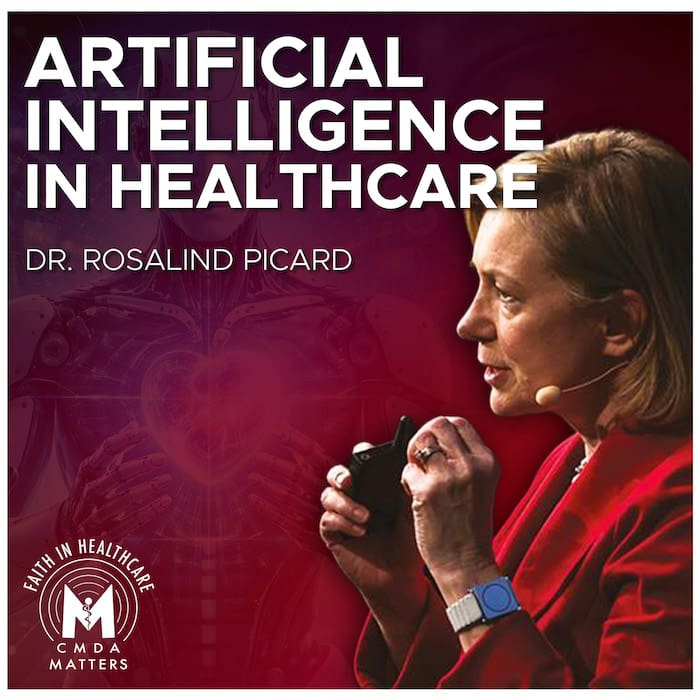
[email protected] Next week, MIT professor and artificial intelligence pioneer Dr. Rosalind Picard joins us to discuss how artificial intelligence is reshaping medicine and why the questions that it raises for healthcare are not just technical, but deeply human and ethical. You don't want to miss it.
Thank you for listening to Faith in Healthcare, where our mission is to bring the hope and healing of Christ to our world through committed Christ followers in health care.
So we'll see you next week, God willing.