[00:00:08] Speaker A: You're listening to faith in healthcare, the cmda matters podcast. Here's your host, Dr. Mike chubb.
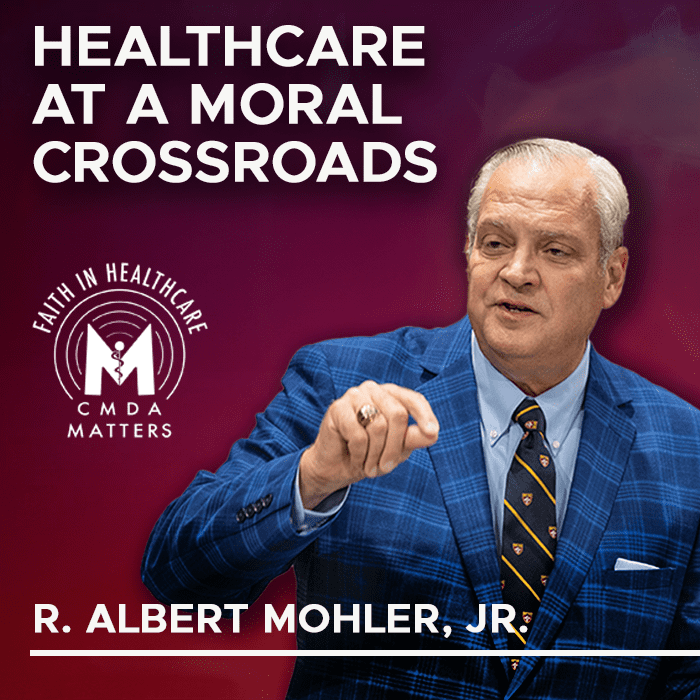
[00:00:19] Speaker B: Welcome, friends, to Faith in Healthcare. Today I have the great privilege of welcoming Dr. Albert Mohler to the program.
I'm guessing that many of you know him because he's the president of the Southern Baptist Theological Seminary and he hosts the Briefing podcast, which is all about news and events from a Christian worldview. My Regular co host, Dr. Brick Lance, and I, we're going to talk with Dr. Mohler about the moral direction of our culture and how it is shaping medicine in so many ways today.
We also discuss rebuilding trust in health care, the erosion of objective truth, conscience, freedoms, and in academic institutions in particular. And also why the image of God must remain central to how we think about our patients and our practices. I believe you're going to find this episode both insightful and deeply encouraging. So let's dive in.
Well, today on Faith and Healthcare, it is an immense privilege for me to welcome to the the program Dr. Albert Mohler, who's president of the Southern Baptist Theological Seminary and many of us around here at cmda. Many of you listeners I know listen on a regular basis to the briefing. Not only the briefing, thinking in public, in the library, not only president of Southern Baptist Theological Seminary, but also at Boyce College and also serves as editor of World Opinions. So it was, I think, in 2021 or 2022, Dr. Mohler, that kind of in Covid still, you gave us a nice video challenge at our modified national convention.
[00:02:00] Speaker C: That's right. It was a great honor to do so. I'm so thankful for CMDA and all that you do. I am very thankful for you.
[00:02:06] Speaker B: And with us is Dr. Brick Lance, our vice president of advocacy and bioethics. And Brick listens on a regular basis to the briefing. Also, Dr. Mohler.
[00:02:14] Speaker C: Well, I'm highly honored.
[00:02:15] Speaker B: Well, we do appreciate the briefing. And you help Christians interpret breaking news through a biblical worldview. So what do you think evangelical healthcare professionals right now need to understand about the moral direction of our American culture and how it will shape medicine over the next decade. And frankly, just tell us honestly, is there anything we can do to help shape that direction as healthcare professionals?
[00:02:39] Speaker C: Yeah, you know, I do think there's something kind of new going on, and it's not just about medicine, but medicine's pretty much at the center of it. But I would say the main stream of the great challenge to us has been into this massive shift of. Of personal autonomy into autonomy expressed in every dimension of life. And so I think we see this. And so that's a displacement, frankly, of any authoritative moral code, of any objective morality or understanding. And so I think that's the big thing. I think that the new thing on the cultural front right now is the destabilization of all authority. I see this, frankly, in medicine before I see it anywhere else. It does affect everyone else, every other authority, including pastors for that matter. But, you know, it is really interesting right now in a host of issues, patients are telling doctors what they believe to be the fundamental reality. The displacement of authority here and expertise and education, that's a big factor. And I think it's going to affect the church as much as the clinic.
[00:03:41] Speaker D: Yeah. In similar vein, Dr. Mohler, let's talk about rebuilding trust. And of course, it's important to us as healthcare professionals of rebuilding trust, even in the field of medicine. And you have talked, talked before about the erosion of objective truth. And I would, I tell my friends that relativism is alive and well today.
So my question in the healthcare setting for us, medical professions, science and medicine and morality, they all intersect together.
So how can we as Christian healthcare professionals, how can we establish unity? And is that even possible? Establishing unity with scientific rigor and, and biblical morality, certainly while maintaining, if not rebuilding trust that's so needed in healthcare?
[00:04:22] Speaker C: Well, that's an entire set of questions there, isn't it? But, you know, I think I have to start with the fact that we actually, as Christians don't believe there's any stable morality apart from the morality that is based in the character of God is revealed in God's word. And so I think we understand there are all kinds of moral systems and different schools of thought. And of course we can go all the way back to, you know, even say, the early 20th century when you had all these rival, different views of ethics. But it's interesting. Right now, the main division seems to be between those who think that ethics is simply a matter of politics or of self expression and those who believe there's genuine moral truth. And so, you know, Brick, I think the loss of moral truth is something that we can't survive. We can't get over it. We can't survive the idea that morality is either simply based in personal autonomy or it's simply based in some kind of political power claim.
But I do think when you look at how this is treated in the academic world, I mean, those two things are pretty much taken for granted. Those are the only two options.
And I think among Christians, there's frankly a download effect from the academy and from the elites to where I think a lot of this is seeped into popular Christian culture. And so, Dr. Lance, I would simply say we've got an enormous challenge here. And honestly, it's not just a challenge when it comes to ethics, although that's always frontline.
It's a challenge when it comes to doctrine and the Christian faith, the gospel.
One of the most interesting things is that people say, okay, I hold to the fact there's absolutely no objective morality. There's no objective moral truth.
The moral truth claims are simply disguised forms of political oppression, or they are just statements of self expression or personal autonomy. But then they'll turn right around and say, you just did something that's wrong.
And so the secular world around us can't live without making the moral judgments. It has increasingly, basically undermined and subverted.
So I hope that makes sense. But I do think we have to rebuild at the foundational level. And I do think, once again, we're at the antithesis, going back to classical Christian understanding. And similarly, Abraham Kuyper, the Dutch theologian and Dutch prime minister, who made very clear that it's Christianity and its antithesis and everything in between is just artificial. The truth claims, the ethical systems, are really only that which is based upon Christian truth, biblical truth, and the Christian tradition or something else that is imposed.
[00:07:11] Speaker D: Yeah, that makes total sense. And I think that's where the trust needs to come into play.
[00:07:15] Speaker C: Yeah. And one of the best things that we can continually say to people is we didn't come up with this. It's not my moral authority.
It's not just the Christian church's moral authority. It's not just the authority of the Christian tradition. We actually believe that this is God's own moral character revealed to us for our good and for his glory. And, you know, the thing even many Christians don't understand is that we actually believe the astounding truth that this entire system of moral reality that the Creator has given to us is actually for our good.
[00:07:49] Speaker B: Dr. Mohler, the timing of our conversation is just. It's such a great opportunity to talk to you today because you're at a top tier of involvement in a campaign that's been labeled the Greater Than Campaign.
And Katie Faust and them before us has gathered a number of very influential evangelical Christian leaders and organizations like yourself. And as Brick and I were getting started today, you told us you actually had a phone call earlier today with Katie Faust. And many of our listeners, busy healthcare professionals, may or may not even be aware of this campaign. Would you just talk to us about the campaign and to actually overturn or push back against Obergefell, the 2015 Supreme Court decision?
[00:08:30] Speaker C: Yeah. You know, let me start in a different place, if I may, for just a moment. When the Roe v. Wade decision was handed down in 1973, there was very little of an organized pro life movement. It was really the advent suddenly, by judicial fiat, of legalized abortion in all 50 states that coalesced into over time and a longer period of time than a lot of younger people would imagine, a comprehensive strategy and approach, frankly, to overturn Roe and to hold up the sanctity of human life. Now, obviously the latter is a battle that's going to be ongoing until Jesus comes.
But it took almost 50 years to reverse Roe. We're hoping it will take less time to reverse Obergefell. We're pointing to the fact that it's really about children. It's about them, it's not about us.
And we must underline the fact that children need a mother and a father. And when you look at Obergefell, the entire creation order is intentionally subverted. And it's children who are going to pay the greatest price for this. And we already see evidence of this.
So we're having to learn how to make these arguments. And I think what you're seeing is that after Obergefell In 2015, we really are trying to make an argument that will be compelling to the American people to help push back against what we see as the complete rejection of and subversion of creation order, which is going to do incredible harm, frontline harm to children.
[00:09:58] Speaker B: And it's a multi pronged approach. I mean, Katie had an article that just came out today in First Things the Law, the Culture and the Church. So we were very involved and had an amicus brief on the overturn, the Dobbs case. Is this primarily going to be to try to go through the courts or. It seems multi pronged? So it's not just hoping that something goes to the Supreme Court?
[00:10:19] Speaker C: No, this certainly does aim toward the Supreme Court eventually. But frankly, we want to get to the Supreme Court in a way that the right facts and the right circumstances are framed for the right decision. I mean, there were a lot of abortion cases that came before the Supreme Court before Dobbs. Dobbs came in God's providence with the right facts, the right circumstances and the right ability to make the argument. We're hoping it comes a lot faster on Obergefell. But the other thing we learned, and this is what a lot of Christians don't Take into account when we had the Roe v. Wade decision handed down, an enormous number, an astounding number of Christian physicians hadn't thought through the issue of abortion.
Everybody had to start rebuilding. I can remember some very brave physicians who helped to really start helping to make arguments in the medical profession. The same thing happened in the legal profession, but it had to do with the entire way the Constitution's read.
So one of the amazing things is that the reversal of Roe v. Wade really had to be subsequent to the recovery of a textual interpretation of the US Constitution and at the Supreme Court of the United States.
Now, because that big battle has made a lot of progress, we hope that on the reversal of Obergefell, things can go more quickly than they did with Roe. But we also understand that time's not on our side. And the longer you have something like the legalization of same sex marriage, frankly, it's not just the more established it becomes in the culture, but the greater the damage.
[00:11:53] Speaker D: Yeah, I'm going to flip back to those of us in medicine and as my role here at CMDA for advocacy and bioethics. I get emails every month from medical students, those in residency and those early in their practice with struggles. And let me kind of explain the struggles. So we operate in large systems, could be an academic institution, could be a corporation, you know, a for profit private practice. And we have all this government regulation and all this bureaucracy to work through. So here's my question. So how can we as Christian healthcare professionals think about our own conscience, cooperation within the field of medicine, tolerance for what we need to tolerate, but also resistance when those institutional policies conflict with biblical convictions, Particularly my state of Oregon, and then we're so fearful of the consequences.
[00:12:42] Speaker C: Dr. Lance, it almost makes you wish there had been some precedent in Christian history to think about this, right? Thankfully, there is. Okay, so, you know, the most interesting thing is that the way you frame that is very similar to the way Christians had to envision at the very earliest stages of the church and then subsequently the role of a Christian soldier in a military.
And so the way you framed that is just astoundingly parallel.
And so this came very early in the history of the Christian church and in particular after the imperial recognition of Christianity. And it came down to, can you serve in Caesar's army? But of course, this even happened in the early church. You see a figure like Cornelius, can a Christian serve in Caesar's army?
And so let's go before the recognition of Christianity by the empire, the fact is that Christians came to the conclusion that Christians can serve in the military. But then you have the harder questions, which is, under what circumstances must a Christian resist a Christian refuse an action or an order? Under what circumstances does the continued service of a Christian in this particular setting, when does that become antithetical to Christian faithfulness?
And you know, that continues until today. And so you have the entire development of Christian just war theory and the idea not only of the just war, but of the just soldier, the just warrior. And I think it really is very similar.
Doctor.
I think it comes down to the fact, number one, is soldiering a noble profession? And the early church came to the conclusion, well, yes, it is. In its essence, it is Romans 13. It is a noble service insofar as it protects the weak, as it serves righteousness and justice in a fallen world.
Being a soldier is a good thing. But there are questions soldiers are going to have to face of deep ethical and moral consequence.
So I think of the same thing with medicine. I think, number one, I want more and more Christian young people to go into medicine.
[00:14:51] Speaker B: Amen.
[00:14:51] Speaker C: I want them to go in as Christians. I want them to go in understanding their predicament is the same as a Christian soldier. There are limits when it comes to what Christians can faithfully do. There are places we can't go, there are orders we can't obey.
And frankly, there are a lot of complicated questions we have to figure out by the wisdom of Christ with fear and trembling.
And you guys are on the front line of that. But I hope I'm making sense. I'm very thankful that before your question, the Christian church has wrestled for millennia with the question of a Christian soldier. And so I think of the same thing when it comes to a Christian lawyer, when it comes to a Christian professor in a university, but particularly given the stature of medicine as a profession, I think you asked the right question. I hope that was helpful.
[00:15:37] Speaker D: No, Dr. Moore was very helpful. And what I envision is this body of Christ. So it's us healthcare professionals, you and the church, it's our attorney friends, it's those in higher education. So it's in the entertainment business coming together as the body of Christ. So we can stand in this together.
[00:15:53] Speaker C: Yeah, yeah. And you guys are in so many ways. I just finished a massive book project and so much of my book really deals with, with medical ethics, because that has been the transformative issue. I'm trying to show in this book how the secular rebellion has worked its way out in society. Inevitably, I'm dealing with euthanasia, abortion, coercive birth, Control, you just go down the list. And now designer babies and transhumanism and of course the gender confusion right down to what I'll just say are classified as sex reassignment or gender affirmation surgeries. All of this so deeply moral.
And I don't think there's any profession, even law, that has had the kinds of hard issues thrown at them as have doctors. And so I want you to know how thankful I am, by the way, for cmda, how thankful I am for Christian doctors. And I think one of the greatest need is for more Christian doctors who are actually both Christian and doctors. Wow.
[00:16:56] Speaker B: That leads perfectly into what I want to ask you. So I've only been listening to the briefing for maybe eight or nine years, and day after day I'll get a text from one of our other VPs or leaders will say, you gotta listen to Al today.
And it's like over and over.
[00:17:09] Speaker C: That's very kind.
[00:17:10] Speaker B: Over and over again, they're bioethical issues really related to what our members are facing out there. And I just wonder, did you have this level of frequency of discussions day after day on bioethical medical issues touching the medical profession? Let's say 15 or 20 years ago, for eight or nine years it's been day after day after day, the Russians invade, you know, and all these big picture issues. But you keep coming back to these bioethical issues.
[00:17:36] Speaker C: Well, I think in many ways they are the frontline issues. They're not the only frontline issues, but they're in so many ways the most urgent frontline issues.
And, you know, the intersection with medicine I don't think is accidental. It is because I think the rebellion in our society, which was, you know, epistemological, over what can, you know, and whether there's truth and all the rest of the. And deeply moral in every respect, it's now ontological. I mean, we're now down to a denial of creation order.
And so I think the average doctor right now, physician, is dealing with questions that they just couldn't imagine in the past. But you know, one of the things I like to remind people of is that the pro life movement as a movement in the United States, insofar as you can trace a history, it really began with physicians.
It began with physicians in New York city in the 19th century.
And so the fact that physicians on the front line, I guess Hippocrates could tell us that's not new. And I think it is because given the fact we're embodied creatures and our bodies are so essential to us, the practice of medicine is going to get to the marrow of the bone before a lot of other professions. Does that make. I hope that makes sense.
[00:18:50] Speaker D: Yeah, absolutely. Hey, so, Dr. Mohler, I am stoked. I am so excited. There's a very dear friend of mine. I'm sure he doesn't mind me mention his name. Dr. Russell Roberts. He's a radiation oncologist from Mississippi. Dear friend served on the board with me for cmda. But anyway, he is going to be in the first cohort of the Doctor of Educational Ministry and Professional Leadership there at Southern Baptist Theological Seminary. So give us some information about this program. What's your vision for it? What is Russell going to be trained to do, what's going to help him, and a little bit of the logistics, the time commitment, and who can enter.
[00:19:25] Speaker C: Well, Dr. Roberts really deserves a lot of credit. We put it that way for this entire program and we started talking even before he ended up joining the board of the Southern Baptist Theological Seminary. So I'm very thankful in God's providence all this came together.
You know, this is a program specifically for physicians.
It is a program to help prepare physicians to deal with many of these issues we're talking about.
So you could put it in the realm of bioethics, but it's also the theological and ethical dimensions of medical practice.
And it was really out of the urgency that we need more conversation between, let's just say the biblical worldview and theology side and the medical side. And the happy thing for me is that as an historian, I can just point out that's how it all began in the medieval university. The most important faculties were the faculties of theology and medicine and law.
And so that's really how it all started.
This is an effort to try to put it back together again a bit.
So I'm very excited about is a full doctoral degree. It's modular so people can come for some short periods of time. Because we're aiming this at medical practitioners, at practicing physicians.
And it's going to be top flight academically in every way. I'm just very excited about it.
It's really for physicians, first and foremost. It is for physicians. It is for physicians who have some experience.
And kind of like this degree is four practicing physicians. And so that's what makes it a bit different. And what we have now is the adaptability and very high quality doctoral degrees to come up with degree programs for people in practice. And that's what excites me.
[00:21:21] Speaker D: Well, I'm excited and, you know, many of us are foodies. There's certain foods we like. But I'm a truthy. I love truth. I love studying truth. I love being taught the truth. And it sounds like this is just a perfect fit for some of our physicians.
[00:21:34] Speaker C: Yeah, yeah. I think there's real urgency behind it. Dr. So, I mean, when I heard about this, I said to Dr. Roberts, the answer is going to be yes. Even before you fully flesh this out, the answer is going to be yes. I feel the urgency. Our entire faculty feels this urgency. And this is why we can strike as we have the opportunity. I think this is a matter of our stewardship and responsibility. So we are all in.
[00:21:59] Speaker D: Excellent.
[00:22:03] Speaker A: Before we continue with this week's episode, here's a special announcement for you.
If you're facing an ethical or advocacy concern, you can find CMDA's ethics resources and position
[email protected] ethics and you can reach our
[email protected] for guidance, including support when conscience rights are at stake.
If you're interested in learning more about the work that Southern Baptist Theological Seminary is doing and how it aligns with the ministry efforts of cmda, we've got some exciting news for you.
Southern Seminary is one of our silver sponsors for the upcoming 2026 CMDA National Convention, and they will have an exhibit booth for you to stop by and say hello.
This year's convention is in loveland, Colorado on April 23 through 26.
That means we're only a few weeks away from the convention, so now is the time to register.
For more information and to register, visit natcon.cmda.org.
Let's jump right back into this week's episode.
[00:23:24] Speaker B: Dr. Muller, I'm very interested in getting your wisdom on this next issue. You're around young people all the time.
Boys College Seminary makes me happy.
Well, I'm guessing you're asked about this all the time because what Dr. Lancet I've realized is that we bring up a president's name and say this such and so and so's administration that we're going to get some interesting emails because we're being told that we're so political and we just had a board meeting actually, and the student rep on our board was saying that at the national convention there were a number of speakers and it just felt like it was us against them and so political. And that, Dr. Chupp, is what turns off a number of our students from becoming members of cmda. So how do you. Because almost on a daily basis you bring up a president's name. Almost certainly heard it this morning. How do you respond to young people who are ardent followers of Christ but who say, you're getting too political, Dr. Mohler? And it turns me off?
[00:24:24] Speaker C: Well, I guess I should concede. I guess there are points at which we could become too political. So let's just concede. That could be a problem.
And so it's very easy, I think, to be seduced into a political situation where the next thing you know, you're passing out buttons and bumper stickers, and that's what you're talking about.
I don't think, however, that's a legitimate criticism of the kinds of conversations you're having.
You must have, and we must now have.
The other side of that, is that there is a severe limitation these days as to how unpolitical you can possibly be.
So, for instance, I was in conversation with a national secular reporter just in recent days, and I said, look, first of all, by the way, my favorite account of this is when I had a reporter for, I'll just say the most influential paper in the country who called me and asked me three questions and then said, why is this what you're always talking about? And I just stepped back and said, excuse me, but I think you called me. I don't think I called you. I think you called me and asked me three questions. Now you're asking me why I answered the three questions you asked me.
And one of the questions was political in terms of how this turns out. And I said, look, the point is that if you are talking about what marriage is, guess what? These days, that's political. If you are talking about whether a boy should be playing, a biological male should be playing on a girl's team, you're now political.
You can try not to be political, but this is political.
And it's not because our main concern is or ever has been political.
It's political because these days, these are matters of public policy and public debate. And so if you're going to talk about anything in public policy and public debate, you're going to be accused of being political. And let me tell you, the abortion issue is the perfect parallel to look at. There were those who said back in the mid-1970s, look, if we really affirm this, the sanctity of human life, and we really believe this should be put into law, we gotta be careful not to be too political. Now, I was. I was just, believe it or not, very young at that time, but I can remember hearing people say that. And I'm thinking, well, how can you mean these two things? We want to put this into public policy, we want to put this into law, but we don't want to be political.
Frankly, that's irrational.
And so I understand your question and I have to. I have the great privilege of talking about this with young people, Christian young people all the time.
And so I always ask them how unpolitical can you be? Or what would you have to put outside the bounds of your attention, your concern and your action? What would you have to put outside all of this in order to be as non political as you want to be? And the fact is, I think they come to understand we don't want to make any of this political. Politics has made it political. But if we are talking about public policy and there's no way medical doctors aren't gonna be talking about public policy, then that is politics by definition. That's what that is.
[00:27:28] Speaker B: Right.
[00:27:28] Speaker C: Again, I hope I'm making sense here. I wanna speak to say yes. I think we all understand there are lines we could cross that we would think would be wrong.
And I think the main thing would be when our ambitions are primarily political. I don't think for a moment your primary ambitions are political.
They do deal with policy.
[00:27:48] Speaker B: Yeah, and we're positional. I mean, we take position. We've had positions for years and years and years on those issues and we continue to stand by them, not by candidates.
[00:27:57] Speaker C: Yeah, no, and I appreciate when you say that. And I think it's important for organizations like CMDA to say, you know, this is a part of the reason why the organization was formed was to take positions on issues of public policy related to medicine and the morality of issues that are confronted. I think that's really important because I think a lot of people, it's like again, the abortion question, you know, I have people ask me, you know, why did the church start talking about this so much in the mid-1970s? I said the answer is the church didn't know it had to talk about it in the 1960s. It can't not talk about it, you know, after 1973.
[00:28:35] Speaker D: Well, this is going to lead to my next question. Dr. Mohler, and I'm very simple minded as a surgeon and a good friend told me politics matters because policy matters, because people matter. And I find that very simple. That's absolutely right to think about. So my question is about this symbiotic relationship between the church and the medicine which we've touched on. And I'm excited about your program, but I want you as a theologian to define first the church's responsibility and how medicine can help the church, if you will.
And the other way to say this is it, and I'm sure you see this within the church, we see this in medicine, that those that follow Christ, they keep their faith private to themselves.
We're called to be the church, and the church is a public institution.
So what's the church's responsibility in informing believers thought in life that is, you know, educating, discipling, praying for, encouraging in this complex world.
So I'm interested in, again, how we can form these young minds, both you and the church, and how can medicine help that? So, yes, our faith is very personal, but we need to be together as the church in the public sphere.
[00:29:46] Speaker C: Dr. Lance, let me say I'm going to begin in an unusual place here, and I do this intentionally because this question is now being more or less well discussed among evangelical Christians.
This question was discussed for a lot longer among Catholics.
And there is in the Catholic tradition a very strong structure and culture of, for instance, helping and assisting and directing very gifted young people into fields like law and medicine.
You had entire orders like the Jesuits, who basically were geniuses at this.
I think to our shame, we have been far less faithful in this than our Catholic friends. I think we've been far less faithful.
I think a part of the church's responsibility is first of all to understand that it is our responsibility to seek, by the way, in terms of following the model of Christ in healing and in concern for the sick and the moral dignity of the medical profession. I would say law. Similarly, we should be encouraging, pushing, doing everything we can to support Christian young people to go into medicine, to be Christian physicians. And so I'm not going to say not just to be physicians, and I appreciate so much the way you framed this, but Christian physicians and to be physicians out of a sense of Christian calling.
What Luther made famously clear is vacation, the calling. And Luther reminded us that the milkmaid is just as cold as the preacher. It's a matter of God's calling. There are different callings, and it's a part of God's glory that these different callings.
And so it was a Protestant responsibility understood in the beginning that we should help people to get into places of their maximum deployment, maximum contribution, and maximum good. Medicine is one of the most important of those roles. And we really need to encourage young people. But that also means their calling is not just to be physicians, but to be Christian physicians.
[00:31:53] Speaker D: Yeah. So that'll lead me to my next question. Let's talk a little bit about technology, but not technology. Focus for its sake. And when I say technology, I'm thinking of AI, genetic editing, reproductive technology, which includes ivf, organ donation, human enhancement, this digital medicine technology just changing rapidly. But here's my question for you as the theologian. Give us the core doctrinal truth, theological truth, biblical truth that we need to base our foundation on as we tackle these complex issues within the practice of medicine. What do we need to hang on to?
[00:32:27] Speaker C: You know, I'd say most importantly the imago dei, the image of God. The fact that every single human being is made in God's image, and thus human beings, every single one of us, every single human being is made in the image of God. And that comes with great moral and theological consequence.
We also have to put that in the context of a biblical theology that reminds us that, for instance, life is an unquestioned infinite gift, but death is also a reality. And so it is good to seek to serve, to heal, to heal the sick, to heal the injured.
But that's all within a frame of biblical theology, to the glory of God. And some of the things you raise are not efforts to affirm the imago dei, but to undermine it. Some of the transhumanist arguments, well, I mean, frankly, all the transhumanist arguments are basically subversive of the image of God. So many of the bioethical crises we now face, you mentioned some of the genetic manipulations, the germline therapies, a lot of these things are now even the trans species kinds of things that are going on, the practice of basically seeking designer children, both genetically sort and genetically manipulate in order to produce a race of designer children. All these things are just laden with, with moral and theological importance. But I think it all comes back to the imago dei. And you know, you're in the position to see better than I how on individual issues of medical practice and of the application of medicine to particular challenges, illnesses, injuries, medical situations and all the rest. The difference it makes when you understand that this is not just a body, this is not just a physiological reality. It's not just, this is a human being made in the image of God.
And that's a complete shift of categories.
[00:34:20] Speaker B: Dr. Mohler. One of my favorite day of the week is Friday to hear your Q and A as you wrap up the week. And I especially love how tender you get with some of the children who are writing questions with the help of their parents.
This is not a question that's going to be coming from a child, but I'm just going to represent our academic colleagues because frankly, It's a whole different ballgame. We've had theologians like Darrell Bock, who had a chance to speak to our academic section after it. He wrote to me and said, that is the most. One of the most persecuted groups in America that I've ever had a chance to talk to as he had a chance to interact with them. So as we wrap this up, what pastoral counsel would you give to those, especially those in the ivory tower? I've had friends in big places who, when we talk about some of these transgender issues, which don't make any sense for biological integr.
And they say, mike, I've gone to my chair and they say, we will not have this like of psychiatry at a big institution.
We will not have this discussion. And so just keep quiet. And that's not the way it's supposed to happen, of course. But what pastoral counsel, as we finish up, would you give to our many listeners out there in academic settings, some of them even, you know, chiefs of their departments, to remain spiritually resilient and joyful in that calling that God has given to them?
[00:35:39] Speaker C: Well, I have to go back, I think, to that reference, the metaphor of the Christian soldier.
It is because it has been such a long consideration in Christianity.
And, you know, one of the aspects of that question throughout the history of the Christian church has been, you know, when you are in the hardest situation, how in the world do you, let's just say, negotiate that as a Christian? How do you remain faithful as a Christian?
And one of the things that I would counsel, you know, changing the scene to medicine would be just like the Christian soldier. You've got to be deeply grounded in Christian truth, deeply grounded in Christian knowledge, because we have to operate out of an understanding of the comprehensive truth claims of Christianity. And other than that, within, then all of us, you know, will be lost.
The next thing I would say is that Christ gave us the gift of the church.
Upon this rock I will build my church, and the gates of hell shall not prevail against it. And I think faithful participation in a local church is an essential responsibility of the Christian. And I would say speaking to Christian physicians, as you mentioned, that particular predicament, I think being deeply grounded in a Christian, faithful Christian congregation where there are people who are in medicine and in law and in teaching, in the public schools and working for a Fortune 500 corporation, I get lots of questions from people in those contexts, too. How in the world do we remain faithful? I think that's very important. And I think the third level is getting Christian physicians together for the right conversations, for mutual encouragement, and frankly, for mutual discernment. That happens to be the organization to which I'm speaking now, cmda, in other words, that's a third level thing after the individual Christian discipleship in the context of the local church. I do think it's really important for Christian physicians to be in a lot of conversation together because honestly, you walk into a world that third level where non physicians are at a loss to even know sometimes what you're talking about and can't connect the dots you can connect together.
And so that doesn't replace the local church and it's based upon the individual Christian faithfulness and discipleship, but it does point to the need. And the same thing is true among lawyers and these days engineers and just you go down the list of professions. And so I'm thankful there are such organizations. They don't replace the church, they don't replace the responsibility of individual faithfulness, but they are really essential.
And so I'm asked to speak to Christian doctors and Christian lawyers and at medical schools and law schools, schools at times. And at least a part of what I want to say is there are some conversations you need to get ready to have with each other. And you need somebody, somebody, some brother or sister in Christ you can call when you're at a moment where you're not sure exactly how to think through these things. And you need to know who that person or person. You need to know who they're going to be before you have to call. And look, I will tell you, it works that way in ministry too. So let me just tell you that pastors and ministers also need colleagues we can call just to say, I want to make sure I'm thinking about this correctly. I want to make sure I'm seeing this right. And I've been in situations, I hesitate to say in a fallen world. I've been in situations where you have pastors and lawyers and doctors in the room to try to figure out how to obey Christ and glorify God and serve on the basis of the gospel in faithfulness in some very tough situations.
[00:39:29] Speaker D: Those are good words. And dialogue is so important. We should not be afraid of the hard questions because God's going to reveal
[00:39:34] Speaker C: the truth to us, you know, and there's a good sense in which we need to understand. At times we operate with fear and trembling.
We hope and pray that we are doing the right thing. And at the end of the day we understand that we are not the arbiters of whether it was right or wrong. We will face a day of judgment, and by the grace of God, we cling to Christ and hope to face that day of judgment. Having been found faithful, not perfectly faithful, we know that. That's why Christ's perfect righteousness alone is sufficient. But we do pray that in Christ's name and for his glory, we are found faithful.
[00:40:12] Speaker D: Amen.
[00:40:13] Speaker B: Thank you for those words, Dr. Mohler. Thanks for joining us today on faith and healthcare and I sure do hope that in a non pandemic setting that we can get you to our national convention in the future so you can be with us.
[00:40:25] Speaker C: I promise you I would make that a priority. And I need to tell you without going into any detail, that I have been in desperate need of physicians. At times I have faced some medical crises and I have to tell you that I have seen some of the most wonderful evidences of God's grace and mercy in the context of the practice of medicine. So here this theologian say what I want to say to you two brothers and to the entire association is thank you. Wow.
[00:40:53] Speaker B: God bless. Thank you, Dr. Mohler.
Doctor Mohler, thank you. Thank you for joining us today and for reminding us that faithful health care, it cannot be grounded in shifting cultural trends, but in the unchanging character of God and the dignity of every person who's been made in his image.
To those of you listening, I hope this conversation strengthens you. If it did, would you please share it with a colleague or a trainee?
These discussions matter and your sharing helps extend their reach.
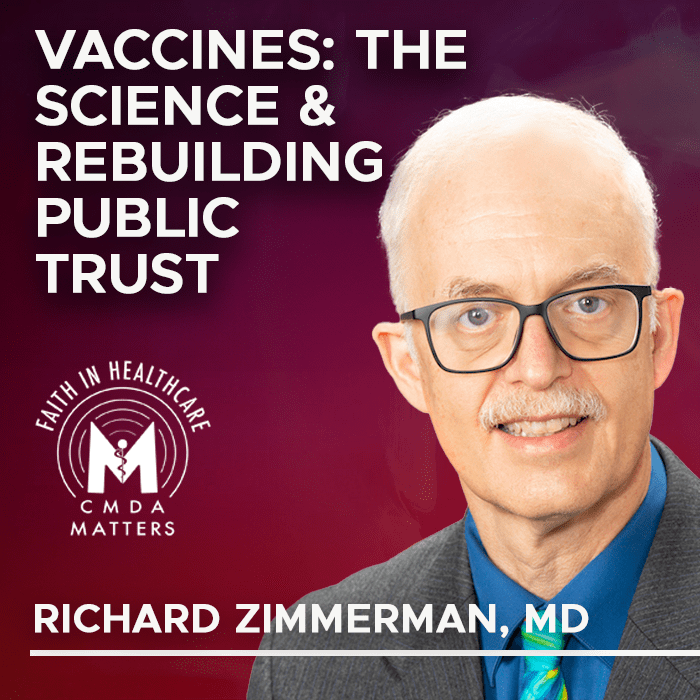
Be sure to subscribe to our YouTube channel and follow our podcast on your favorite platform so that you don't miss the next episode. And if you'd like to learn more about CMDA and connect with other Christian healthcare professionals who are wrestling with these same questions, just visit us by going to CMDA.org well next week we are joined by Dr. Richard Zimmerman. He is a tenured professor, physician, and nationally recognized vaccine researcher who's also a lifetime member of CMDA. Dr. Zimmerman is going to reflect on what we've learned since the COVID pandemic and we're going to explore how Christian healthcare professionals can navigate vaccine science with with clarity and conviction in a time, honestly of deep polarization and shifting public trust.
I want to thank you for listening to Faith in Healthcare, where our mission is to bring the hope and healing of Christ to the world through committed Christ followers in healthcare. We'll see you next time, Lord willing, on Faith in Healthcare.
[00:42:47] Speaker A: Thanks for thanks for listening to Faith in Healthcare. The CMDA Matters podcast. If you would like to suggest a future guest or share a comment with us, please email cmdamattersmda.org and if you like the podcast, be sure to give us a five star rating and share it on your favorite social media platform.
This podcast has been a production of Christian Medical and Dental Associations.
The opinions expressed by guests on this podcast are not necessarily endorsed by Christian Medical and Dental Associations.
CMDA is a non partisan organization that does not endorse political parties or candidates for public office.
The views expressed on this podcast reflect judgments regarding principles and values held by CMDA and its members and are not intended to imply endorsement of any political party or candidate.