[00:00:08] Speaker A: You're listening to faith in healthcare, the cmda matters podcast. Here's your host, Dr. Mike chubb.
[00:00:19] Speaker B: Thank you, Jamie. You know, putting our children first, it sounds so straightforward. I had a former chief of surgery who used to say something like, chup. The talk against that is like talking against motherhood and God.
But honestly, how do we recognize when our compassion for any particular adult circumstances may be overlooking a child's needs?
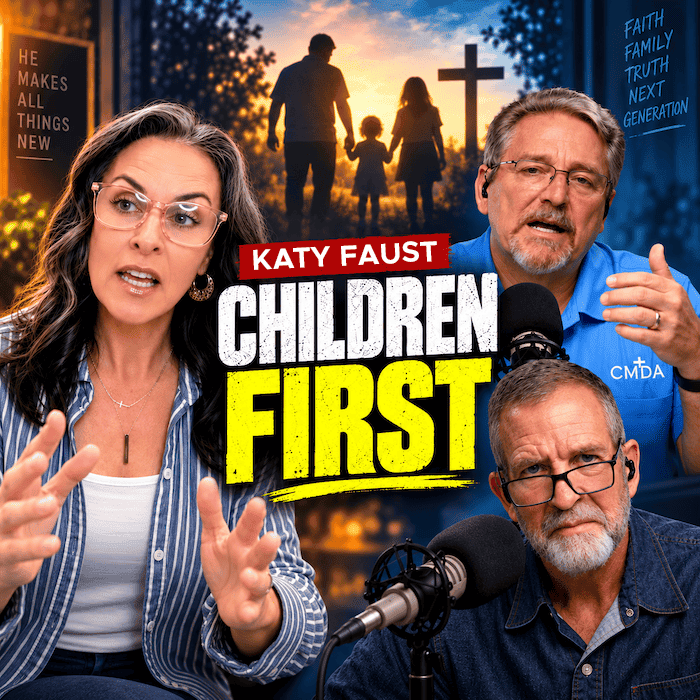
Well, in our episode today, Katie Faust joins Dr. Brick Lance and me to explore questions beneath some of our most difficult conversations about family and and reproductive technology.
We discuss what's driving her greater than campaign, the concerns that she raises about IVF and surrogacy, and why her message can be challenging even for people who share her convictions.
She also speaks personally about loving the people whose beliefs and choices differ from her own.
What does it look like to preserve those relationships without compromising what we believe?
And when disagreement turns out to be unavoidable, Katie reminds us how we treat one another. While it still matters. These questions reach into our healthcare specialty practices, into our families, into our churches.
I hope this conversation gives you plenty to ponder. So buckle up and let's dive in.
Well, today on Faith and Healthcare, I have invited back with us today IS Co host Dr. Brick Lance, our vice president of advocacy and bioethics, all the way from his home in Eugene, Oregon. Welcome, Brick.
[00:02:09] Speaker C: Well, thank you, Micah. It's always a pleasure and it's a joy to be with you on these podcasts.
[00:02:13] Speaker B: Well, Brick, since you became vice president, it doesn't matter whom I've known from the past. But even if you didn't know them before, you've become more acquainted and on a first name basis and email back and forth with all kinds of important people, including our guest today, whom you invited earlier this year to speak at Cannon beach, one of our regional conferences. And we are welcoming today to the program Mrs. Katie Faust, whose name recognition has gone through the roof, I think just in the last few years for a lot of reasons.
But Katie is the founder and president of Them Before Us, and this is now her third time on the program because we talked about her book after the obergefell case in 2015, then before us, a global movement defending children's rights to their mother and father. She publishes, speaks, including speaking at a national convention just a few years ago, and testifies widely on why marriage and family are matters of justice for children.
Articles in all kinds of different publications, magazines, newspapers, interviews, major networks.
And earlier this year, she launched a campaign that Dr. Lance, my co host told me about the first person I heard from that I thought, wow, what an incredible, incredible, big, holy audacious goal to overturn eventually Obergefell from 2015. So, Katie, without any further ado, welcome back to Faith and Healthcare.
[00:03:44] Speaker D: I'm really grateful to join you again. We love CMDA for so many reasons, mainly because we, we need Christians moving into the medical space and then showing everybody else how to respect human dignity. And there's so many ways where that is under assault in the name of medicine. And it's hard, it's hard for medical professionals to stand apart, to sanctify themselves by separating from what is happening in the mainstream. But the ones that do really are leading a host of captives in a lot of ways when it comes to threats to children, threats to the disabled, threats to the elderly. And so we love cmda. We are so grateful for your. We are so grateful that you are engaged not just with medical professionals, but in the culture when necessary. So it's a joy. It's a joy to anytime I get to hang out with you guys, my answer is yes.
[00:04:32] Speaker B: What an incredible core theme of your efforts of children's rights and protecting children. It's so hard for people to speak against with your motive, your heart being protecting children. And also want to say thank you for your participation in a big project from the Colson center and Focus on the Family, Truth Rising, where you tell your story very powerfully. So for our listeners, you may have heard of Truth Rising, if not, check it out. Incredible powerful program out of those two great organizations.
[00:05:02] Speaker C: Well, Mike, and that's free on YouTube, by the way. You just find it on YouTube and you watch it.
[00:05:07] Speaker B: Thank you. Thank you for pointing that out, Brick. Well, your book Then Before Us has been out 8 to 10 years and emphasizes that children and their needs must come before the needs of adults and our desires. And you launched a campaign, initially them before us, but now a different campaign in January called Greater than which, so many different institutions, organizations including CMDA have endorsed. So why don't you tell our listeners about this campaign and its objectives.
[00:05:37] Speaker D: So my nonprofit Then Before Us, seeks to defend children's right to their mother and father. Thankfully, we've got hundreds of organizations defending children's right to life from the scourge of abortion, then before us defends their rights on this side of the womb to be known and loved by the two people responsible for their existence. When you do that, you will maximize child development. You will anchor their biological identity. You will put them in homes where they are most likely to be safe, love connected to and invested in it is the pathway for child thriving, is to protect the natural family of mother and father married together, permanently raising their kids.
So that is the premise of my work at them before us that forces us to. To be involved in conversations about gay marriage, divorce, modern families, reproductive technologies, ivf, surrogacy, and adoption. In all of those questions, my nonprofit then before us is going to say, you must prioritize the rights and needs of the children.
The desires of adults should not be central to that conversation.
So because we believe that children have a fundamental right to their mother and father, and because they are harmed when they lose their mother or father, because adult desire is prioritized above their needs, we are spearheading a national coalition to overturn gay marriage.
Now, a lot of people think gay marriage, well, that's just about people having hospital visitations or tax benefits.
The answer is that most of those things that some in the LGBT activist wing said that they wanted from gay marriage, that was already available to them through powers of attorneys and other legal arrangements.
The goal, or at least the end result, of legalizing gay marriage was to make mothers and fathers optional in the parenting project.
So we've had 11 years, 11 years of nationalized gay marriage, and we have 11 years of receipts of how gay marriage has forced various states, a variety of states, to scrub the words mother and father from their parenthood statutes, to create new pathways for unrelated adults to acquire children. It has legitimized the buying and selling in the world of reproductive technologies and sometimes forced insurance companies and states to subsidize the manufacturing of motherless and fatherless children in the name of adult civil rights. It has flattened all the distinctions of the natural family, that there used to be two parents, that there was always a man and a woman, that they had those children biologically or in cases of a rescue operation through adoption. And it has now determined that anything an adult really wants, and if they have a state backed contract that is now a family and you cannot discriminate against them.
So we are working to restore a definition of marriage that defends the rights of children, that recognizes their innate need for their own mother and father, and rejects the idea that they can be commodified and purchased on the open market.
[00:08:27] Speaker C: Katie, I'm going to ask this question as a bioethicist, and I find it interesting that technology continues to create new dilemmas for define what it means to be human. And if you take that picture of God's creation of man and woman together, the Sexual relation and then children, the procreation part of it, technology has changed that. We've turned that upside down. You can have one without the other two. Or two without the other one or what? Whatever.
So is the church realizing what's happening in our world today? And the reason I ask that is how are Christian organizations, churches, Christian organizations, responding to this Greater Than campaign?
[00:09:07] Speaker D: The church is learning that they actually have a massive threat on their hands. It's happening slowly, but I do think that it is happening now. What do I, what do I mean? When I first started them before us in 2018 and I would go speak at conferences about how IVF is destroying more little lives than abortion and how it's functioning as a modern day eugenics project and it is a vector to separate children from their mom and dad not at birth, but at conception. And how all of these is of violation of the rights of children. And we as the people of God have to step in like we have all throughout history, to be defenders of the most vulnerable, even if it means alienating friends, even if that means that we ourselves have to do hard things.
People would lose donors because they had me on. People would get up and walk out of conferences when I was speaking because it was an unknown to a lot of Christians. But my organization and a few others have been beating the drum that actually IVF and reproductive technologies and the new ways that we have learned to sever children from their right to life or their right to their mother and father or their birth mother in the name of technological advancement actually is something that the church must either highly critique or completely reject.
What I have found is that when I can make a biblical case, a social science case, and share the stories of the children who have been impacted themselves through the abuse of these technologies, it doesn't take long for the church to say, actually yes.
And many of them already had this queasy feeling that they didn't like it anyway, but they couldn't figure out why they never felt great about IVF or surrogacy always struck them as something that wasn't exactly right. And after all, surrogacy is in the Bible, they were told. But no, once you understand the direct and significant threats to children that these technologies pose, and then you understand that it is our biblical job to not just defend the fatherless and the motherless, but to make sure that we're not manufacturing them, you can bring along the Christian community. You can see that if you go to them before us, or if you go to the Greater Than Campaign, Greater Than Campaign.com Go and look. Go look at all of the Catholic and Protestant organizations that we have that are supporting this effort because they understand that if we are going to protect children, we need to do it in that fundamental building block of securing their right to their own mother and father.
So I think that the way that them before us talks about this is helping people put a lot of pieces together and understand that if we genuinely care about children, we need to do more than just reject abortion. We need to scrutinize reproductive technologies. And then we need to move into the space where we say our culture, law and technology needs to defend their fundamental right to both their mom and dad.
[00:11:49] Speaker C: Yeah. So it just must be an encouragement to you personally and I would say to your whole team, the number of Christian organizations that are backing you up.
[00:11:57] Speaker D: I will tell you that when I first started talking with leaders and organizations a year ago, I thought I was going to be pulling teeth. I thought I was going to be twisting arms. And there were one or two people that said, nope, you're totally going to fail, and I don't want to be there when it happens.
But almost everybody else said, yeah, let's go. Enough.
And especially as it relates to gay marriage, enough of promoting mother and father loss in the name of constitutional non discrimination, enough of the direct commodification of children that stems from Obergefell because of how we have now restructured parenthood laws at the state level. And so I am really encouraged. I had to give the same Spiel, and about 300 times in terms of how it's not just necessary, but plausible that we're going to be able to do this through a child centric lens. We actually have a credible pathway, a credible judicial pathway for success. And that's not something that really anybody on the right had thought possible, but it is, yeah.
[00:13:07] Speaker B: Going back to 2015 and a minimal, minimal majority of five to four in that Supreme Court case, it boggles my mind that people would say that there was any kind of a mandate, a constitutional mandate that came from that decision in 2015. Well, Brick, ask you, Katie, about the church and Christians response, but how about let's flip the coin. You knew it was coming. That there would be a tremendous blowback from the LGBTQ community as well as churches that have a view that this community is part and parcel of a vital part of the body of Christ.
So in what kinds of venues, public square venues, have you had the opportunity to respond to accusations of hate and or dismissal of what you're trying to accomplish with greater than every day online.
[00:13:55] Speaker D: I'm currently, like, blocking phone calls as we speak on this interview because somebody leaked my private number to a bunch of activists.
Regularly we see threats that need to be taken seriously. There's definitely digital protections that we're going to need to put up and then also other kinds of logistical considerations moving forward.
You know, we recently put up some billboards across the Midwest that says no child has two moms and no child has two dads. And that has brought in all kinds of messages on various social media platforms and through email objections and threats and accusations. And the truth is that all of those things have worked for a long time. The reason why people do it is because they're effective, because people, especially Christians, want to be loved. We want to have a good reputation with unbelievers.
We want to be viewed as winsome and caring, because we are.
And so often that threat of you're actually hateful, you're excluding, you aren't loving, has stopped too many Christians in their tracks.
But what you have to understand is that your idea of being loving or tolerant or accepting of adults, especially bad ideas, has led to the victimization of children.
And so you just have to decide, what do I want? Do I want to be loved? Do I want less resistance? Do I want to not be hated? Or am I going to do what Christians throughout the pages of history and the pages of scripture have done, which is stand directly between the culture threatening children and the vulnerable kids that can't speak up for themselves?
So that's the trade off that every Christian has to determine and has to make.
It will cost you.
It will cost you.
But children and their defense is worth it.
[00:15:50] Speaker C: Katie, on that thought, I'm going to take some time here. I'm going to read some quotes. I just would like our listeners to know what is said about you personally and what is said about your organization, the people that work with you, so they can get a flavor of this. And the first comes from the Southern Poverty Law center, the anti LGBTQ hate group.
And that's their words. Then before us led the announcement of the Greater Than Campaign, an effort to repeal marriage equality. The campaign represents an alliance of at least a dozen anti LGBTQ hate groups and other allied organizations to promote the debunked claim that gay marriage resulted in child victimization.
Their quote there. In recent months, Katie Faust, president and founder of Them Before Us, has published a rhetorical strategy to reinvigorate discredited social scientists and anti LGBTQ ideologues that were Rejected by the courts during the 2010's legal fights over marriage equality, the Greater Than Campaign's reliance on falsehoods derived from the anti LGBTQ pseudoscience and conspiracy theories undermines its claims to represent what's best for children and families. Now, from Glad Glaad, the Gay and Lesbian Alliance Against Defamation, states, many of the organizations and spokespeople involved in this campaign have a lengthy history of targeting the rights of LGBTQ Americans and a robust current history of targeting transgender people specifically. The groups also have targeted reproductive rights and the rights of racial and religious minorities.
And then LGBTQ Nation quoted you saying. In an interview with the American Family Radio posted Wednesday, Faust described parenting by same sex couples as, quote, destructive, sanctified, gaslighting experiment on children, end quote, echoing language deployed by opponents of gender affirming care for minors.
There's a lot there in those quotes, and I know you read them all the time.
How do you respond both as an organization and how does it affect you personally? And what can we do to support you with these claims?
[00:18:00] Speaker D: Well, I'd like to say that unfortunately, I was not the recipient of any Southern Poverty Law center money.
They have been funding their opponents because there seems to be an undersupply of the racism that they say that they're fighting. So it was widely reported earlier this year that they actually were sending money to the KKK so that they could show that there was this big threat that they were fighting. Unfortunately, none of that money made it to me.
Too bad. Too bad. I will continue working on a shoestring budget to absolutely overturn every single mechanism that seeks to victimize children in the name of adult rights, which is exactly what they're doing. Do you hear what they're saying? They're saying you're against LGBTQ rights, you're anti trans. What am I saying?
My message is children have a right to their mother and father and they shouldn't be bought and sold. Why do you perceive that as an offense against LGBTQ rights? Is it because your supposed LGBTQ rights depends on separating children from their mother and father and normalizing a marketplace where they are bought and sold in the name of reproductive technologies? The answer is absolutely yes. Why is it that those organizations are so angry when I defend children's natural rights? It is because children's natural rights is one of the greatest blockades to their political advancement.
And all of this rhetoric about how we hate people. Absolutely not. I'm sorry. You know what's so crazy is my nonprofit has Children of Divorce Children with same sex parents or parents that identify as lesbian, children that are donor conceived to, children that have themselves struggled with same sex attraction or gender confusion. Many, you know, many of us have adopted children, have adopted siblings, experienced infertility. Like we are the spawn of the sexual revolution that has stood up and said no, I'm sorry, no. So this attempt to sort of paint us as like far right out of touch, pearl clutching religious nut jobs. Sorry.
We are the ones that have had a lot of close contact with everything that we are fighting against. So you can't paint us with this brush of, well, you're out of touch or you hate people. Sorry. Like I've been living with lesbians since before most of these blue haired activists were even alive. Nope, it's not going to work. So all of those threats, all of these accusations that we are anti, whatever the answer is, we are pro child and that is going to upset you, but we are not going to change our message just because you are breathing out threats and doxing us and sending threatening messages to our emails or to our homes. The answer is no, we are not going to bend even though you call us bad names.
[00:20:33] Speaker B: Katie, you describe yourself, your words, that you're a quote unquote hot potato. And so first of all, what do you mean by that? And second, I know that you love dialogue. You know, Brick was there at our regional conference in January and a number of students and described to me by not just Brick, but others who were there even on my board that it was a really productive discussion, getting questions from students in medical school or undergrad students and very respectful. I think you remind me just a little bit of Charlie Kirk and the way that he interacted with people and respected them for their questions, but did go straight to the heart of some of the problems with their perspective and the worldview. So what do you mean by being a hot potato? And does it discourage you that organizations want nothing to do with you? Conservative Christian organizations.
[00:21:25] Speaker D: I love people and if the world were not hell bent on child destruction, all I would do would be listen to especially women and the struggles that they're experiencing and seek the Lord with them and read the word with them until God gives them direction.
So at my heart I'm a pastor's wife and I want to bear people's burdens.
But if you are going to normalize or promote ideas or technologies or laws that victimize children, I will destroy your arguments.
Why?
Because mercy to bad ideals is cruelty to the innocent.
And I want to be the most gentle person that that encounters people who are suffering. But I want to be vicious with the ideas that have been advanced to such a degree that we are treating children as designer accessories to the detriment of their identity, their development, and their physical safety.
So I've been on a lot of podcasts, and much of the time the other hosts will say will spend 50% of the conversation saying, I understand that this is a really challenging topic and it's personal for all of us. And many of you have struggled, and we see you, we see you, and we know that you're carrying a great burden. I'm like, yes, okay, good. I understand that adults have some challenges here, but if that kind of qualification leads you to the place where you're going to make allowances for people to make choices that are going to be detrimental to children for their whole life, somebody has to draw a hard line. And I will draw that hard line. That is hard for a lot of people to handle. And some people will choose not to associate with us or have me on the podcast or feel like they will need to soften or qualify what I'm saying. And I don't. I'm not going to take that approach. There are times where we need to be black and white about things that are going to victimize children, which, by the way, gay marriage absolutely does. There was a few quotes in there that were total money quotes, and they were correct. Gay marriage does victimize children. And the promotion of same sex parenting is emotional gaslighting for children with two mothers or two fathers who told that you don't have a mom and dad when they themselves wonder about the identity of their own mom and dad every single day, but are completely isolated in it because they are being raised in a community that says they're so lucky to have two parents that love them. I will stand behind everything that I personally have said because it is true. It's hard to hear, but a lot of that is because we have so normalized this idea that love makes a family or that if the adults are happy, the kids will be happy, that it's even hard for us Christians to believe that. You know what, maybe there are some unbending principles that we just have to say, even if there's a social cost.
[00:24:26] Speaker C: Okay, that leads to my next statement and then follow up with the question. And knowing you personally, I know that you look at those in the LGBTQ community with compassion as imago DEI created by God. You don't hate them, but you have something bigger to think about, and I get that. And I enjoyed the gay and lesbian patients that I had in my practice. I had a thriving practice with gay and lesbian couples. And I always was interested in not only them as a patient, but their partner as well.
And I think that's part of why my practice thrived.
But my question is, then, how do you personally keep in mind that those in that community, yes, we understand we need to stand for the rights of children, what's best for children, but keep in mind that they are a mago day and that we do care for them. How do you keep that in mind?
[00:25:15] Speaker D: Oh, easily. Okay, easily. Because these people are precious. And then, you know, when we're talking here on this podcast, and when I'm arguing about something on X, we are talking about ideas.
No quarter.
You can allow no quarter for that kind of thing when you are dealing with somebody in front of you. And let me just say, it is not just the LGBT community that has objections to what I do. It is people that would like to seek an easy divorce or who went through a divorce themselves. And I'm critiquing no fault divorce. Or people that have been told that they are infertile and that IVF or surrogacy is the only way for them to have a child.
Or people that are single and want. They don't want to be single, and they would be an amazing mother or an amazing father, but they haven't found. Mr. And Mr. Right. This message that I have of all adults need to conform to the rights of children that makes demands of single, married, gay, straight, fertile and infertile. And there is no adult who, regardless of their backstory, their longings, their losses, even their God given desires, no amount of adult feeling should justify forcing children to sacrifice for you. So when I say I'm a hot potato, it's not just because of the LGBTQ issue.
It is because this worldview of putting children first is going to make demands of every adult. Demands that are highly personal and very costly. But that's how it's supposed to be. Because the alternative is children make sacrifices that are highly personal and costly to them for us. And that's an injustice. So with all of those people, people that have been diagnosed with infertility or struggling to have a baby, people that have same sex attraction or gender confusion, people that are in the midst of a struggling marriage, people that desperately want to be married. But I'll tell you, the dating world out there is just abysmal. Even for people that long to get married. Those people we need to draw near Every single one of us needs to draw near to the suffering. And to me, like I'm saying, that's the easy part of this for me, is to bear the burden of those who are burdened.
It's just that in the realm of ideas, we can't be compassionate with ideas. We need to direct that compassion to the people right in front of us. Our neighbors, our friends, our nieces, our nephews, our parents, our children who are burdened in all these different ways. Whether it's identifying as gay or lesbian, whether it is wanting to have a baby that's not coming easily through natural processes, whether it is in a struggling marriage that is your personal job is to empathize and pour out compassion on their behalf, to mourn with those who mourn and then hopefully rejoice when they are able to rejoice so personally. That is what you need to do in the role of friend, but in the role of policy.
This is where I think we have A lot of times Christians will confuse these two roles.
We are to judge rightly. We are to insist that there is justice in the public square. As it says in Isaiah, we are not necessarily supposed to bring that judgment and justice as the primary driver in our friendships. That is the place for empathy and compassion.
But neither do we take the empathy and compassion when we are talking about ideas and policy. That is the place for judgment and justice. So I think it's important for Christians to understand their two roles. Their role is a role of authority. When you are talking about public policy, cultural ideas, we are the authority, both from a biblical perspective, that we are bringing a moral clarity to that issue that no other worldview is going to bring. And then when you are talking about policy, the aim of policy, the aim of government is justice, especially for those who cannot secure justice for themselves. The role of friend is to get in it with them. I mean, so when you've got the same sex couple next door raising the nine year old, my recommendation is not distance.
My recommendation is get in as close as possible with them and love them in any way that you can without compromise. It will be messy, but I think biblically it's what we're required to do.
[00:29:34] Speaker A: Before we continue with this week's episode. Here's a special announcement for you.
Are you looking for ways to live out your faith with conviction and compassion?
Standing Strong equips Christians at every stage of health care to stand firm in their biblical beliefs amid cultural pressures while reflecting Christ's love to those they serve.
Visit cmda.org standingstrong to check out the three tiered curriculum and learn more.
Ladies, reconnect with your husband at the Women Physicians and Dentists in Christ marriage enrichment weekend, January 8th through 10th near Monterey, California.
Learn ways to strengthen your marriage while enjoying time set aside just for the two of you.
Reserve your spot
[email protected] events.
Keep growing professionally and spiritually with the CMDA Learning Center.
From CMDA event recordings to the Faith Prescription Series and other continuing education opportunities, you can explore it all from any device and CMDA members earn CE credits at no cost.
Visit CMDA.org learningcenter to get started.
Let's jump right back into this week's episode.
[00:31:13] Speaker B: You know, Katie, in line with the prophetic message that you've just given in Christian circle, you must have been asked this question hundreds of times. I don't find these words necessarily in this context in Scripture, but I understand why this question gets asked frequently. And that is the differentiation between the words acceptance, affirmation and our listeners need to know. You have a pretty extensive background, family background, in interaction with LGBT community. So this is not arising out of a pastor's wife or a product of the church that's distant from this community. You've been within this community, you understand this community. So talk to us about that differentiation. Is there any kind of a line through examples or otherwise that you could give to us between those two words?
[00:32:02] Speaker D: My mom has been in a relationship with her partner for 40 years, since soon after my parents divorce when I was 10.
And I've been in the LGBT community way longer than I've been a Christian. So like this, this is kind of, this was part of my world growing up. And I love them. I mean, I, I pray, I believe that when it comes to people that they can rely on, call in times of need, I'm like the top two. I mean, I work very, very hard to keep that open door, serve in sacrifice, and honestly genuinely delight in them. Like genuine delight, because they're delightful. So there's no conflict here in terms of loving those that disagree and holding fast to your principles. Both of them are a different manifestation of love, right? One, you are loving the person in front of you. The other one is you are loving your smallest neighbor. You are loving children, children that you may never meet but deserve to have your love manifest through great ideas and and justice driven policy.
So Christians, I understand, tend to fall on either the grace giver or the truth teller spectrum. We don't get to choose there. We have to do both and we have to do both with all our might. You do need to choose the context for that. It is okay to prioritize relationship with those in your life that identify as lgbtq, but never lie.
Never lie.
I don't think that you should start those conversations or harass them with your beliefs. But when they ask, you had better tell the truth.
Sometimes that means that the relationship may not endure. But, you know, our friends over at the Colson center say that you need a theology of getting fired. You know, what is it that you need to prepare to not do that you would be willing to lose your job over?
I think Christians probably have to develop a theology of losing friends.
What is it that I will not say, even if it means I lose the relationship.
And my opinion is that should never be lying about what you believe about the nature of God, the nature of man, the nature of imago dei, who children are, who makes life, who takes life, the nature of male and female, why that matters for marriage, why that matters for children. Get your theology straight and determine to tell the truth, or at least not lie, because sometimes you don't have to. I don't object to every single thing that I let an awful lot of things go. But when I am asked directly, what do you think about this? I will tell the truth.
You know, Luther, Martin Luther said, unity when possible, but truth at all costs.
We are not to elevate maintaining the relationship to the highest value. It is not God.
God is God.
His truth is real.
It must be defended.
You can do that without unnecessarily triggering. But if they are triggered by you telling the truth when they have asked you and you lose the relationship, that is an acceptable outcome.
[00:35:06] Speaker C: Let's go back to children's needs real quick. And this can be a brief question and a brief answer, if you will. But I understand the greater than campaign. So this is a policy issue that is driving this campaign.
But let's take go back to technology.
There are so many technologies that are new within your lifetime, my lifetime, in which children needs do get ignored. And you've mentioned them, but I just want to make sure that your organization is speaking into all these technological issues. Again, those with infertility is just one sphere of people. And again, we're talking about a male and female that are infertile because that term infertility gets transposed to people that really aren't infertile, fertile because they don't have the organs to actually make a baby. So that's a misconstruing of that word.
But there's other technologies we talked about some.
In fact, I would encourage the infertile couples to look for restorative reproductive medicine because there are other ways to treat that infertility. But you talk about ivf, freezing embryos, surrogacy, gamete donation, I mean you go down the line, do any of these support children or are they all just about adults rights and freedoms?
[00:36:14] Speaker D: Children have a right to life. Children have a right to their mother and father. Children have a right to be born free and not bought and sold.
The world of big fertility victimizes every single one of those rights.
It mass produces embryos so that they can be eugenically selected or sex selected out of existence.
There are now clinics and organizations that will offer the ability to map the total genome of your child. Your frozen children screen for up to 1200 different heritable or cosmetic traits.
And let's be clear, you know, this is not a crispr. We're going to like try to medically adjust some sickness in the child. This is a mass production of embryos, screening them so you can eliminate the undesirables. Okay, so children are losing their right to life at a pace of maybe 4 to 1 as it relates to abortion.
So if we believe that children have a right to life, we have a two front war on our hand. We have to fight the baby taking industry of abortion and the baby making industry of ivf.
And then our best estimate is of those lab made babies, only about 2 to 3% will be born alive because they will be subjected to this survival gauntlet, this eugenic screening that will probably lead to maybe only 10% being given a chance to be implanted. The vast majority are going to be discarded, donated to research or perpetually frozen.
So I would argue that freezing is off the table for Christians. If you, you know, really the question that you're asking is can we do ivf? That's what everybody wants to know. I'm struggling with fertility. Can I do IVF in a way that's ethical? And so what that means is like you are not mass producing children.
You are immediately going to implant any child that you create through in vitro, like in, in glass. You are not going to genetically screen any of them, you're not going to sex select, you're going to implant the poor grade embryos. You're not going to freeze any because once they go in the freezer, they, there's a really good chance they are never coming out again.
And then if those two embryos that you transplant, if one or both of them twin, you're not going to selectively reduce, which is another popular option for women who are carrying multiples, whether it's their own children or they are a surrogate. There are so many different ways that we eliminate these little lives before they make it onto this side of the womb. So it's just something that Christians need to be really honest about. And that's hard when we desperately want children.
And maybe, and definitely a lot of that is a God given desire. It's beautiful and wonderful to want children. It cannot be at the expense of children's right to life.
And then of those 2 to 3% of children that are born alive, there is a large percentage of them that will lose their mother or father or both in the process. It is very hard to get numbers on what percentage of people that go through IVF use somebody else's sperm or somebody else's egg. But we are talking about tens of thousands a year, very likely. And so these kids have to fight for their right to life.
And then if they're born alive, many of them are going to struggle with the identity issues of being conceived by a third party.
Many of them are going to be put in homes with unrelated adults who statistically pose a greater risk of abuse and neglect. Many of them are going to deal with mother hunger or father hunger because maybe they're being raised in home without a mother or father at all. And so we are inflicting this injustice on children there too, where we have, once you're making a baby in a petri dish, you can use somebody else's egg or somebody else's sperm just as easily as the people who are going to take the baby home. So big fertility violates children's to their mother and father. And then big fertility is the buying and selling of children.
Now, I can say that because I used to be the assistant director of the largest Chinese adoption agency in the world. And as you know, and I know because I'm also an adoptive mother, there are times where money changes hands. Oftentimes money changes hands in adoption. We, like many other adoptive parents, paid about $25,000 when all was said and done during our adoption.
But I'll tell you one thing that the money never went to. The money never went from my husband and I to my son's birth parents or genetic parents, so they would hand over their parental rights.
In the world of adoption, if that ever takes place. It's no longer adoption if the intended parents pay for the birth mother to relinquish her parental rights.
That is trafficking, that is baby buying. And the agency will lose its license.
What is happening in the world of big fertility is when you are using a third party, somebody else's egg, somebody else's sperm, somebody else's womb. In every single one of those cases, there is a contract, the contract that the sperm donor or egg donor or gestational carrier signs and guaranteed what's in every single one of those contracts is a promise to have nothing to do with the child. I promise to relinquish my parental rights. I promise to not seek to raise this child. I promise that I'm not going to be a mother or father to this kid. You are paying for them to hand over their rights to their own child, their birth child or their genetic child.
That is baby buying.
So in the world of big fertility that we very often think, well, this is just a way for our infertile friends to have a baby. Unfortunately, this industry is victimizing children on three different levels, all of which Christians have to oppose.
[00:42:18] Speaker B: You know, before we got started, Katie Brick was telling you about a gathering last night of our CMDA State American Academy of Medical Ethics Directors. And one of your team was going over a state grading system that you've come up with for how various states protect the needs of kids. And so just tell us briefly about that grading system. What are you hoping to accomplish with that grading system?
[00:42:44] Speaker D: Well, there are tools out there to help people understand what's happening across the country. We are in a laboratory of democracy here. So not every state is going to do things the same way. So there are other organizations that have developed maps around the country looking at, for example, pro life laws. We thought, who's doing that on the area of marriage, family, parenthood? And so Patience Sunny, our policy director, our engagement director, came up with this idea, designed it, sourced funding for it, and now we have this tool, the Children's Rights Scorecard, where you can go and click on your state and you can say, what does my state say about IVF reproductive technologies? What are their laws around surrogacy? What are their laws around the definition of marriage? Or how easy is it to get a no fault divorce here? What is it that we consider to be the gold standard as it relates to marriage and family laws? And we graded every state and the truth is like two thirds of them didn't get above a C.
And a lot of that is because almost all of these different areas, when you're talking about the definition of parentage or who has a right to IVF or should we have commercial surrogacy or how should we define marriage? Or should we advance laws that make it easy for a husband and wife to exit a marriage? All of those laws are being proposed, lobbied for, funded by and pitched by adults.
And it's just so classic that the children are the unwitting party that has to deal with the fallout the most.
So we decided to sort of flip it and say if we looked at all of these different marriage and family and parenthood statutes from the perspective of child protection, what would things look like? Because the truth is when you legalize commercial surrogacy or when you make it easier for people to get a no fault divorce, the adults are happy about it, the adults are getting what they want.
You often result in saddling children with lifelong loss and burden. So what we did is we said if we actually looked at these laws from the perspective of putting children first, how would these laws fare? And the answer is poorly, very poorly.
So we pray that this is a tool that is going to be helpful for lawmakers who genuinely want to take a child protective stance when they're looking at all of these different issues as it relates to reproductive technologies or the definition of marriage, or how do we keep families together and how do we protect the well being of children and then give them a way to know whether or not they are advancing or regressing. And we want them all to get up to the point where they're, they all have A's, where every state is saying we're going to put kids first and we're going to protect their rights.
[00:45:22] Speaker C: Mike, I have to say as the vice president of advocacy, I would encourage our listeners to go check out that map, interact with it. There is only one state that it was above a B grade. There's one A minus. Go find out if it's your state. I was surprised that we did not get an F. We're a D minus because there are actually a couple laws on the books of Oregon to protect children. So again, encourage your listeners to go look at that map that Patience has designed. Katie, I'm going to ask you about scripture. So Genesis 1 and 2, there is a mandate for man. There's some instruction for man. He created us man and woman, intentionally, in his image. He created the institution of marriage. He designed procreation.
This permeates all the rest of scripture in my opinion. Genesis 1 and 2. Of course things got distorted with the fall.
But to use the fancy words, the teleology of being man and woman and being married and procreation didn't change the teleology didn't change, but that has gotten distorted. So I guess my question is this mandate, does this guide your organization than before us?
[00:46:29] Speaker D: Justice guides our organization.
[00:46:32] Speaker C: Okay?
[00:46:33] Speaker D: Justice for children and the measurable, tangible injustice that results when we misunderstand the nature of man, the nature of woman, and thereby the nature of marriage, children are harmed.
Now, it should be a surprise to no Christian that the mission of them before us perfectly aligns with God's creation order and his very explicit commands for how to conduct ourselves as it relates to our sexual behavior. That there is total agreement there.
Often the way that I talk about what we're doing and how we're doing it is that we are going to make a case from the world of God. We are going to look at social science. We're going to appeal to natural law. We are going to source and share the stories of children that have endured family breakdown and mother and father loss. We're going to do that because even though I love the word of God, and I mean I have like Bibles coming out my ears and I carry one with me everywhere that I go tactically, if we are going to advance justice for children in the public square, we need to appeal to an authority that the public recognizes. And even though Scripture is my ultimate authority, if I walk in with a verse from Leviticus into a public testimony, it will not advance my argument. It will set back my credibility with the people in that audience. And I would rather win.
I would rather advance justice for children by doing the harder work of understanding what the social science actually says about the needs of children than thinking that I can drop a word from Genesis and say, God made Adam and Eve, not Adam and Steve.
[00:48:15] Speaker C: Boom.
[00:48:16] Speaker D: And pretend like I have proven myself to be more godly because I referenced Scripture.
Children need defending. And so we are going to argue from the world of God and it is going to be perfectly compatible and it's going to reinforce the word of God. Because both of those, the world of God and the word of God, they have the same author. It is the same truth that is going to be communicated through the same kind of decisions on behalf of adults. To reject all sexual behavior outside of marriage, to cleave to that one spouse, that husband or wife for life, and then to nurture and love the children that result from that union permanently.
And like you referenced a pre fall verse, let's go to Malachi, where God, this is the famous passage where he says, I hate divorce because he understands the rending especially that children have to deal with afterwards.
And he tells us something about why it is that marriage matters to him.
He talks about how in spirit and flesh they are one. Husband and wife are one in spirit, in spirit and in flesh. And then he asks the rhetorical question, what was the one God seeking in that one flesh union? And the answer is godly offspring.
Marriage has always had children at the center. That's not to say that marriages that can't have children are not marriages. But Brick, like you said, ontologically it is driving towards an end that that reproductive complementarity produces something. It produces new life.
God loves and cares about that new life. He doesn't just want offspring, he wants godly offspring.
And that involves hyper investment and involvement for life by both mother and father.
[00:50:15] Speaker B: Katie, as we wrap up the program because we're running out of time, thank you for what you've shared with us passionately today. We've got listeners around the globe. I met a national physician in Papua New guinea just a couple of weeks ago in South Korea who listens every week. We do have professionals as well as their family and friends who listen in, who are listening in right now.
What are the action steps for Christ followers in healthcare? You've been at our CMDA meetings. You've interacted and enjoyed interacting with our constituents and those who hang out with us at CMDA and Faith and healthcare, what can they practically do moving forward to do a better job protecting the rights and the needs of kids?
[00:50:57] Speaker D: You have to know more about this than everyone else.
When you say kids need a mom and dad and somebody says, really? Because 75 out of 79 studies say that children with two moms or two dads fare no different or even better than kids raised by a mom and dad. You need to know how to answer that. When somebody says, how could you not just fully support ivf? Don't you love babies?
You need to understand what actually goes into a lot of the recommendations in IVF clinics. You should be a total defender of the most vulnerable. And some of that may be hard to do because a lot of these topics are new. We've only had gay marriage nationally for 11 years. IVF is constantly morphing. I mean, we're now on the point at the verge of not just in vitro fertilization, but gametogenesis. Right where we are going to manufacture human egg cells from some other cell in the. I mean, we are about what is. What is on the horizon as it relates to child farming is so far beyond what I can even explain.
It's dystopic and devastating.
We have to have clarity now, and we have to, it's very hard to speak up about something that you don't feel confident in. So you must learn, you must be an expert so that you can confidently speak up. If a friend is considering being a single mother by choice or if there is something that comes to your state where they're arguing that commercial surrogacy should be legalized, you should know about this. You have to understand the intersection between the culture, law and technologies and that are undoing the natural family and child protection. So we've tried to lay that case out clearly using the best sociology, top level social science, the stories of about 120 children that grew up without their mom or dad in our first book, Them Before Us, why We Need a Global Children's Rights Movement. But we do that every week on our substack. So if you go to thembeforeus.com, just subscribe twice a week, I will deliver directly to your inbox answers to the questions that you are encountering in your world personally or professionally or online. You should know more about this than anyone else because the defense of the most vulnerable depends on it.
[00:53:18] Speaker C: Katie, thank you for our time today. This was wonderful. And I would encourage our listeners, yes. To go to your website then before us, easy to Google that and then check out the sociological research because it's very act well, I should say accurate. It's very well done and you have wonderful references. You have this new state map. You can look at your own state. And most importantly, I would ask our listeners to pray for you personally and for your organizations, those that work with them before us. So thank you. Katie.
[00:53:43] Speaker D: Thanks. Great to be with you guys.
[00:53:45] Speaker B: Yeah, thanks, Katie. God bless you.
My thanks to Katie Faust for joining us again today and to Dr. Brick Lance for helping us work through these very hard questions.
These issues, they reach into the lives of patients who are facing infertility as well as families who are navigating difficult marriages and working through painful disagreements.
May God give us friends wisdom to speak with clarity, the humility to keep on learning and the love that demonstrates to people in our lives that we genuinely care for them as Christ would.
Please join me in praying for Katie and her team, especially for their protection as she continues to courageously pursue this greater than campaign and for wisdom and faithfulness in our own opportunities to serve children and their families well. You can learn a whole lot more about Katie's work and explore the children's rights scorecard by going to thembeforeus.com if you'd like more information about the Greater Than campaign, you can visit GreaterThancampaign.com and if you'd like to learn more about CMDA or connect with a community of fellow Christian healthcare professionals, just Visit
[email protected] Hey, next week Dr. Matthew Loftus joins me to discuss the dangers of of our current therapy culture and how the church can offer compassionate, biblically grounded care while recognizing when someone needs professional mental health support.
I want to thank you for listening to Faith in Healthcare Today, where I promise to you as a listener or better yet, a subscriber to this podcast, whether you're a healthcare professional or a patient who loves Jesus Christ supremely, is this we will do everything that we can to keep your faith and healthcare connected. We'll see you next time, Lord willing.
[00:56:04] Speaker A: Thanks for listening to Faith in Healthcare. The CMDA Matters Podcast if you would like to suggest a future guest or share a comment with us, please email cmdamattersmda.org and if you like the podcast, be sure to give us a five star rating and share it on your favorite social media platform.
This podcast has been a production of Christian Medical and Dental Associations.
The opinions expressed by guests on this podcast are not necessarily endorsed by Christian Medical and Dental Associations.
CMDA is a nonpartisan organization that does not endorse political parties or candidates for public office.
The views expressed on this podcast reflect judgments regarding principles and values held by CMDA and its members and are not intended to imply endorsement of any political party or candidate.