Episode Transcript
[00:00:08] Speaker A: You're listening to faith in healthcare, the cmda matters podcast. Here's your host, Dr. Mike chubb.
[00:00:20] Speaker B: Welcome, friends, to Faith in Healthcare.
I think that most of us hope that we will stand firm when our convictions are tested, including in the healthcare workspace.
But what happens when the testing is no longer theoretical?
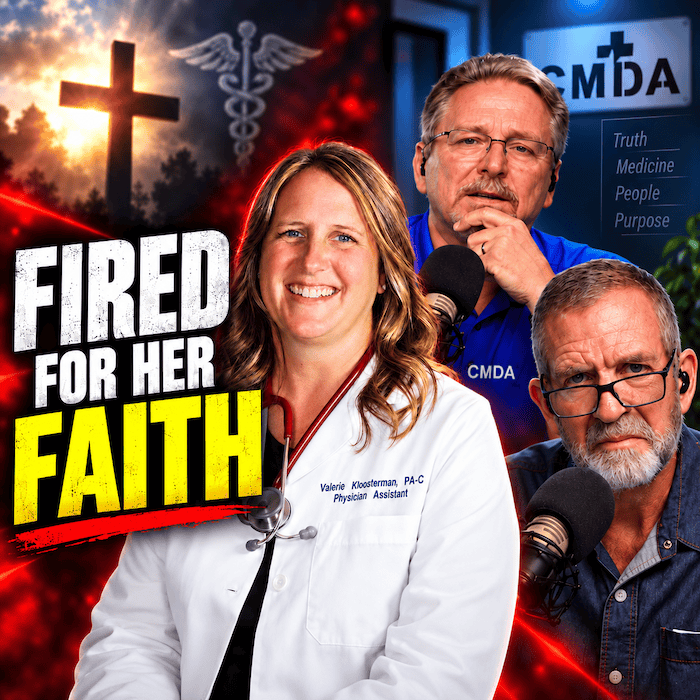
For physician assistant Valerie Kloosterman, holding to her Christian convictions, it meant losing her job and the professional community that she had spent 17 years building.
And that was in spite of exemplary performance reviews and no prior discipline.
In this episode, Valerie joins Dr. Brick Lance and me to share her story.
I appreciate so much, and I think you will, too, how candidly she speaks. And I think her words will stay with you well beyond this episode.
I invite you to listen in and be inspired by a healthcare professional who abided by Alexander Solzhenitsyn's admonition not to live by lies.
Well, welcome to Faith in Healthcare, and I have a question for you listeners.
What happens when your employer asks you to do something that you believe violates both your Christian convictions and your professional conscience, and your job is ultimately you believe on the line?
Well, our guest today is Valerie Kloosterman, who's a physician assistant who served for 17 years in the University of Michigan West Health system. Valerie found herself in just that situation when she sought a religious accommodation regarding the use of pronouns inconsistent with a patient's biological sex and participation in referrals for gender transition interventions.
That request ultimately led to the loss of her job and nearly four years in a legal battle. As it turns out that at the very beginning, Valerie reached out to us as a CMDA member immediately after she lost her job there and told us just a few minutes ago that what blessed her was when she called our office, one of our staff took the time to pray with her because she was under fire. And that is I believe that with all my heart because our staff love to pray for those who are in need among our members and others.
So Dr. Jeff Barrows and I, Valerie, we had an early conversation with you to encourage you and make your situation known to Christian legal groups. And we prayed for you a lot. Praise God. That four year battle recently ended with the help of some folks from First Liberty, and a significant settlement came your way. But today with Valerie, I have Dr. Brick Lance with me, our vice president of Advocacy and bioethics in a conversation with you to ask a few questions. We want to hear your story, Valerie, what it cost you to stand by your convictions. And then what lessons can we take away from this to encourage and challenge our listeners. So before we get going, I know that our listeners would want to hear you, hear from your voice and hear just a skosh bit, if you will, of your faith story. What led you to be a PA and how faith for those 17 years impacted your practice?
[00:03:42] Speaker C: Yeah, my mom was a nurse. My grandma was a nurse. They actually worked in the same healthcare system that I ended up in. It was the same office that I had seen as when I needed a pediatrician. And, yeah, there's their care and concern for people. The stories we would hear. You know, my mom would cry coming home, you know, just struggling with patients as they were at their most vulnerable, and actually wanted to be a teacher until my senior year of high school and got a couple skip days to just get out of school. And I took those days, and there was a PA that let me shadow him. And I thought, this is what I want to do. I'm teaching, but within the scope of medicine. And, yeah, I was following in my mom and my grandma's legacy. PA was kind of the route I took so I would have the ability to have some flexibility, to have a family. And I don't regret any of it. I love my career. I love what I'm doing. But, yeah, it gave me people a chance to serve the people in my community. And I honestly felt I was doing that every minute that I walked into the office.
[00:04:37] Speaker B: And your faith, I mean, in terms of how you applied that with patients and what sort of practices, obviously it had a big impact on your life because it led to you making a really tough decision, didn't it?
[00:04:49] Speaker C: Yeah, we were in a conservative part. And so, yeah, really, all my patients, I genuinely believed initially came from a religious background. And so there were conversations, somewhat casually. Some people, you know, that I knew were, hey, can I pray for you? Or they would ask, you know, if I had any needs. And so it was an open conversation of wanting to include, you know, faith in their care. And, yeah, if you look at 1 Corinthians 13, love is patient and love is kind. And that part, I felt was just as important as a diagnosis and a treatment, was caring for the whole patient. Because, yeah, I think we all know as providers, that definitely affects, you know, the disease and the diagnosis. So that I had a heart for that. And I felt that that was, you know, part of my calling, not just in taking the Hippocratic oath, but, yeah, being a Christian and. And then therefore a Christian physician assistant.
[00:05:37] Speaker D: Hey, Valerie. Thank you. And some of our listeners may not know it, but we Have a new tagline @CMDA, and it's called you'd Faith and Healthcare Connected. And I just wanna praise you. Thank you for living out this tagline before we even came up with the tagline.
[00:05:51] Speaker B: So a demonstration project.
[00:05:53] Speaker D: A demonstration. So take us back to the beginning of this ordeal. You had 17 years practicing as a PA, great professional record, great, great rapport with your patients. Your Christian convictions and your employment, though, were put on a collision course here.
So can you just tell us specifically what you were asked to do? And again, regarding pronouns and referrals and why you believed you could not do that within your conscience? And was this just a sudden demand? Did this come up overnight, or was this a gradual process?
[00:06:24] Speaker C: So the original system that I was a part of was bought out by the University of Michigan Health West, I think roughly around 2017. And there were noticeable changes at that point in time. It didn't touch us again, just because we were in a little bit more of a rural area. But there was stuff that, you know, you kind of see and you think, okay, just keep your guard up. But in May of 2021, there were questions on a questionnaire that we had been asked. The questionnaire had been out since I began working there, but this year there were two particular questions related to gender being fluid, and it was a yes or no. I could not just read the slide and move on. I had to affirm those statements. And if I didn' there was suitable evidence to know that either I would have my salary cut or potentially be terminated. And so I did. What I honestly thought, in a biblical sense is I asked my supervising provider, hey, I cannot answer these questions. They ultimately led me to dei, who had written the questions. And on that I said, I, as a Christian, cannot answer these statements. And these statements include me. If the university wants to have those statements, that's fine, but I cannot put my stamp of approval on them. And then it was. The discussion was going to continue. And that led to a meeting. Ultimately, that took a sudden turn where, yeah, I was called evil, I was called a liar. I was told that I could not bring my faith with me to work, or the Bible would. I know what would happen if they let all of their providers bring their faith to work with them, which I had replied. I said, yes, you would have an amazing workforce that truly cares for their patients. But that was not the answer they wanted to hear. I was told the conversation would continue. The that I assumed an accommodation would be easy. Again, initially was about the two questions on the questionnaire to know, I could not use preferred pronouns or refer for surgery. I gave a medical reason for that as well as a godly, you know, why? It went against my conscience. And really without warning, I was called in and handed my letter of resignation stating that I no longer worked at the University of Michigan.
[00:08:29] Speaker B: So, Valerie, I was talking to Dr. Lance before we got on this call, and I'm thinking there must be thousands of people across western Michigan, many of whom would identify with the Christian faith. And seeing those two boxes to tick two related but different issues of using preferred pronouns versus referral for gender affirmation, care, surgery, or sex rejecting procedures, as we often like to say around here. But so did anyone suggest to you, even among your colleagues, those maybe even maybe go to church with you? Hey, Valerie, just. It's an act of kindness to use those preferred pronouns. So how would you respond to that, to those who would reach out? Maybe even some of our listeners would say, I'm going with this preferred pronoun business. Maybe not the referral, but how do you respond to that?
[00:09:20] Speaker C: I mean, there's a uniqueness in Genesis and how God created us as male and female. We're made in the image of God. God does not make mistakes, and we're called to be faithful. And in contributing to their lie of what we would call as preferred pronouns was giving my approval of that. And I don't approve of that. I don't approve of that in healthcare, but I also don't approve that that is the best thing for them. And so love is doing that is speaking to them the truth in order that they have the best outcome. And you can do that respectfully, not being obnoxious, you know, not blaring across the room. And even in a general conversation, we don't use pronouns when we talk to each other.
So in a medical chart, to be medically accurate, I feel is very important. But ultimately in conversation, there's ways to respect a patient and still not use pronouns, which ultimately then is contributing to the lie that whether they believe or want to have for that day, if gender technically can be fluid according to their rules, that. Yeah. That to bear false witness would not be something I can participate in.
[00:10:31] Speaker D: Okay, thank you. Yeah, thank you, Valerie. And I know that's not easy. I know in my practice, because the patient may have an appearance of one biological sex and actually be a different biological sex, and it makes it difficult for the practitioner. So I appreciate your answer. Try to be honest. And I would always try to use their proper name and not a pronoun. But thank you for that. Let's talk about your referrals, though. You were asked then to actually give a referral for what at then was called gender transition care. Of course, gender transition is impossible, but for what we call sex rejecting procedures.
So this is morally unacceptable to you. So I understand that. But give us your medical reasoning behind that. And then did you ask for any accommodation in that before you were fired?
[00:11:17] Speaker C: So there's no patient involved in this case? There was nobody that I refused to see. There's nobody that complained about me. This, like I said, was initially about two questions and then them asking me in a room if I would refer a patient in a hypothetical situation.
And, yeah, I had answered that one consciously. For me, that is participation. Whether I was doing anything or not to help with that procedure, I was putting my stamp of approval that I really thought that that was what was best for the patient. And. And I did not. I think there's enough research that says that it's not appropriate for a patient. I think, in a rushed sense, at least, back in 2021, where there was very little time put on counseling or discussion, that it was almost an immediate process to look at a referral. I wouldn't do that with any other patient in any other situation.
So uniquely to this, I felt that there was more time that needed to be sent, even in discussion, which was not acceptable to them when I had said that I would not place a referral. I also think patients have autonomy. They are willing to see, can see whomever they want. So in a medical diagnosis or treatment suggestion, I could do that very lovingly and say, this is not something I do, and I do not feel like it is the best option for you medically, looking at the research and considering all the factors, but knowing that I would be participating in something that would do them harm ultimately was something I would never be able to either live with myself with or know that I had participated in and have regret.
And you can do that in a loving way. I mean, there is.
I believe that there is options to do that in a way that a patient would respect my medical opinion and still felt like they were cared for when they were in the office with me.
[00:12:59] Speaker B: Yeah. You know, Valerie, I remember very clearly our phone conversation that we had five years ago. And I remember, I think when you got choked up with me on the phone was when you shared with me that for 17 years, you had a very busy practice. You got high marks from your patients, including, I think you told me, some LGBTQ patients.
And what was striking to me is it sounds like you were never called before your peers in terms of a quality control, any kind of a physician panel or a clinician panel to review how you had cared for your patients. This was all an HR issue exclusively with the University of Michigan West. So in your interactions, even with the HR folks, did you try to communicate that your convictions did not mean you rejected patients and that you practice First Corinthians 13.
Did they hear that at all?
[00:13:52] Speaker C: And I had used First Corinthians 13 in the discussion we had, and they had stated, right, you cannot use your supposed power over patients or dominate your religion. And I said, that has never happened ever with me in a room with a patient. And I said, I don't even have to wear something that says that I'm a Christian, But I feel like there is a difference in how we treat patients. And truly by that, First Corinthians, love that. Yes, I will want what is best for the patients. And when I took that Hippocratic oath, I promise to do no harm. And that includes this. And yes, I had seen patients. I actually still see patients of the LGBT community. And there is no concern. There has never been a complaint. I've not had a patient come to me or go to a supervising provider to say I did not appreciate her care. There was something that was done wrong, and I don't want it to be said now that that is my desire to never see those patients. I think I have a genuine care and concern.
I think that all Christian providers, if they truly are faithful to God, would welcome any patient of any background so that we could care for them in any way possible other than going against what we know is truly God's will.
[00:15:05] Speaker B: And that reminds me, Dr. Brick, of that mantra that I think is excellent, anyone, anywhere, anytime, but I cannot promise anything.
[00:15:12] Speaker D: Yeah, yeah, absolutely true.
[00:15:14] Speaker C: For sure.
[00:15:15] Speaker D: So, Valerie, take us back in time here. So, as you alluded to, there's a time when you. The winds were changing. This was a concern. But then all things. This came all of a sudden, which you think that your job is going to be threatened. And then, of course, you were called into office and then were fired. So during that interval time.
Tell us about. You handled this spiritually and with your faith.
How was your personal faith challenge leading up to that firing and then subsequently being fired? And what was your prayer life like during that time?
[00:15:47] Speaker C: My husband is an amazing spiritual leader, and we had talked about it to some extent. I honestly never thought it would come to my termination.
I felt like it was going to Be an ongoing discussion. And I maybe would get an ultimatum that at that point I would have to say, no, I'm following God. But that never came. And we had talked about it with our kids. I have four kids, I have four high schoolers this year. And there had been some discussion around the dinner table of okay, what does it look like to be faithful? Right? What consequences will there be? And ultimately I think in right, we're called to bear the cross, but we don't live in Nigeria, we don't live in a persecuted country. That it was somewhat of a surprise, but I think we were. And God had worked in our lives to build us up in having a core group of godly Christian friends, right. We have a fellowship of believers that were with twice on Sunday people who had prayed for each other, not necessarily knowing the need, but in this particular time, you know, my sister in law had prayed for me the morning that I had the initial meeting.
Just may the words of my mouth and the meditations of my heart be pleasing to God who is my rock and who is also my redeemer. I'm not perfect, right? But God has given us a foundation that we can follow and trust and know. I would definitely say that I was not perfect in that moment. And I look back and think, oh, my faith could have been stronger, but we're called to give an answer. And I think God gave me the words when I needed them, when I of my own strength was not able to do that. I think in prayer reading, I did not get through a Sunday that I did not cry leading up to that and saying, okay, God, what does this look like? What is my future going to look like? And then ultimately when I was fired and I got back that day and my kids were waiting outside, you know, I said to them, which is just as much as what I needed to hear for myself was God is my God, not my job, not our employment, not even our health. God is my God and we're called to be faithful in his providence. He has set this will in front of us to follow. And I was faithful. I didn't know what the journey would look like. And it took five years to get to this day. But I think in that and hearing that in myself and what I told my kids was God is my God and that is all that I need for comfort and wisdom. And yeah, our faith was definitely built in these past five years around the dinner table and hopefully then creating at least in my kids, a sense of wanting to be strong, wanting to be bold, wanting to step forward and 1 share their faith, but 2 to be faithful to what God has called them to do. Whatever their calling is.
[00:18:26] Speaker A: Before we continue with this week's episode, here's a special announcement for you.
CMDA members have access to free legal consultations through our partnership with Alliance Defending Freedom.
If your conscience freedoms are at risk in the workplace, Confidential help is available exclusively for members.
Visit cmda.org legal to get started.
Looking to connect with other healthcare students and professionals near you?
CMDA has hundreds of student and community chapters across the country offering fellowship, encouragement and more.
Visit CMDA.org and search local CMDA groups to find a chapter in your community.
Keep growing professionally and spiritually with the CMDA Learning center, from CMDA event recordings to the Faith Prescription series and other continuing education opportunities. You can explore it all from any device and CMDA members earn CE credits at no cost.
Visit CMDA.org learningcenter to get started.
Let's jump right back into this week's episode.
[00:20:00] Speaker B: Five Year journey. Obviously your family, your husband, your kids surrounded you. I remember us talking about other employment options in southwest Michigan and I mentioned the group that I used to practice with. So when did you find more employment and how did you get connected with First Liberty?
[00:20:15] Speaker C: So when I had called and talked to Mike, you had given me some suggestions and had gone through some of the legal. I didn't know initially if that's what I wanted was the legal portion of it. And again in, you know, our family discussions and talking and speaking. Spiritual advice. Yeah, from my dad and my father in law, they said, yeah, this is a battle that we will walk with you. And was able to see that as God's desire as well.
And it took time, it took time for me to find a new job. I wasn't hired until a year later.
I had 17 years with co workers, with patients and I, I struggled stepping into something new and different. I would see patients at the grocery store and at the library and how do you start new? And I had hoped, I mean really honestly, even up to the final settlement, that maybe there would be a chance I could go back to that office. And I see that, you know, that's not what God is calling me to do. But I now work at an amazing family and pediatric office with a very diverse patient population and they were very welcoming and very encouraging and I love what I do. But I still drive by that office, like I said, to get to the grocery store and it's still emotional. You know, I would still like to step back to the day before I was fired and have nothing have changed. So, yeah, I think they'll always have a piece of my heart, my medical career, that, yeah. Will be hard to move on from.
[00:21:40] Speaker D: So, Valerie, at that time, I'm just curious, was there. And you have to know that Mike Chupp here, he loves scripture, he loves memorizing scripture. He quotes scripture to me all the time. Was there any particular scripture that you just dwelled in your heart and dwelled in your mind? And along with that, obviously your husband and your kids were great support. Was there an outside support for you at that time as well?
[00:22:02] Speaker C: Right in James, to count it all. Joy when you face many trials. Didn't really love that verse.
[00:22:07] Speaker D: James 1. Yep.
[00:22:09] Speaker C: You know, but to realize that when you seek wise counsel, they're like, there's a difference between joy and happiness. And joy is rooted in Christ. And from this you will move on and you will grow and God will use you.
So that, yeah, that verse held a special meaning in that my faith was seen and that was why I was fired. It was clearly laid out in my termination letter that although we appreciate that you're a Christian, you know, you don't belong here. And, yeah, there's a sense of confidence in knowing I was faithful, you know, and then in Romans, that I'm not ashamed of the gospel. Right. It is a power of God to salvation. And that in that, in the boldness in how I speak, which isn't always easy and witnessing isn't always easy, but being able to tell my story, to say, no, I am not ashamed of the gospel.
And then my daughter's favorite verse is 1 Corinthians 16, you know, 13 and 14, you know, be strong, be brave, but do everything with love. And I have to continually tell myself that just like I tell my kids, it's the way and how you do it, it just as much as the what you do, that hopefully others see you then as salt and light, that they see that you're different and how you do things, that, yeah, you're a witness to Christ, even going to the grocery store. And yeah, the scriptures become more real and alive when you live through it. So like I said, just hymns and songs and reading through, there's so many things in Scripture that are written truly for me, and I'm so thankful. I'm so thankful for that.
[00:23:36] Speaker D: And your faith community, how was it supportive of you?
[00:23:38] Speaker C: Yeah, absolutely. So grew up in the same church, got married in that church. I married my husband who went to that same church. And our pastor was so good and Godly. He came over and prayed with us initially. Yeah. Giving us Bible passages and verses. The extended community. To have cards in your church mailbox that just said, we're praying for you, we're thinking of you. Be strong. Yeah. We, our kids go to a Christian school and have people there say, how can we help? What can we do? And then ultimately answering to them is the best thing for you to do, is to stand up and to be strong and to see that encouraging other people to do that is just another layer of the foundation to be able to move forward and move on. So I would encourage anybody. You have to have a home and a church family that supports you, that knows you, that knows you by name and knows your family. So they know the situation and can pray, even if it's something you never hear about, but they're there to support you.
[00:24:35] Speaker B: You remember break last night we were talking about the chosen and about how Jesus saying, little James, I know that I can trust you with the fact that I'm not going to heal you. And Valerie, I think that God knew he could trust you with this trial because you were surrounded, as you say, by incredible support. So maybe you were the poster professional to undergo this trial. So I know it's easier for us to talk about it now that it's over. It would have been much tougher to talk about it two years ago.
[00:25:02] Speaker D: Yeah. Valerie, and I can hear in your voice and of course I can see you.
This was deep hurt at the time, but the joy that you have now of following Christ is so evident. And so for that I'm very thankful. But your decision to follow Christ has had a ripple effect. I just would like to read a part of the employment agreement now that exists that was changed again thanks to First Liberty. I'm sure they helped craft some of this as well. But let me just read this.
Because we respect our employees religious beliefs, we will not require them to act in ways that violate their religious beliefs. For instance, in trainings, employees will not be required to personally affirm statements about gender identity. For gender transition treatments, employees will not be required to participate in procedures, medications, or referrals. And for pronouns, employees will not be required to use pronouns in a way that violates their religious beliefs or conscience.
So your decision to be faithful probably was not on your life bingo card, by the way, but it has a ripple effect. And the reason I'm asking this question, as vice president of Advocacy and Bioethics, we get students, residents, fellows, those in practice, both academic, private practice, we get the same request for prayer that you came to CMDA four or five years ago.
So tell us, what do you hope that what you've lived through, how is this going to help the Christian physician, the pa, the nurse, other healthcare professionals that are going to fall in a similar situation that you fell into?
[00:26:40] Speaker C: I think in a simple sense, my accommodation would have been easy for them to do. And I think we self censor ourselves too much. We see these restrictions placed or the rumblings of conversation and we step back and we say, well, all I will kind of just do what I do or I'm going to answer or I'm going to, you know, just to not ruffle any feathers. And that honestly does nobody any good to live in that or for the patients that we see. So being truthful and honest in a loving way is ultimately the best decision for everybody involved in that situation.
And I will say that I was not necessarily prepared to give an answer. I think God gave me the words when I needed them. But, but building and being in the Bible constantly morning and evening and studying God's word, we will have that sense to be brave, to have that discussion, to not back down. And if I can encourage everybody to spend more time in the Word, no matter what you're reading, it is an encouragement that will build us to be stronger salt and light in the world so that we do live out that promise of being ready to give an answer always and to be brave and to stand firm. It's going to look different for everybody in a provider sense versus a medical assistant, versus somebody who answers the phone. It's going to look different. But we have that firm foundation. God, who is the builder is set up that there's nothing that they can do to me that's going to take away from his plan for my life. And if I knew that going in there might have been a little bit more confidence. And I think I have that now and I continue to work on that. But for those in any simplest situation like mine, be faithful to God and he will take care of you. You might lose your job, you might get a demotion, but God will take care of you. In that you will be blessed.
[00:28:33] Speaker D: And Mike, you and I frequently talk about how courage is contagious and we would love our listeners to get that courage. And so I'm so thankful that Valerie's here to discuss this with us. We want this contagious disease of courage to spread.
[00:28:51] Speaker B: Yeah. And it's going to be rhetorical to close up here, but I got to ask the question, if you could Go back five years and start all over again that day before, would you have changed anything about what you did on that particular day? And so our listeners. Because I don't think it's a matter of if, but a matter of when.
And maybe not dozens, but maybe hundreds and hundreds of our listeners are going to face a moment when they're asked to say or do something that they just know this is not going to please my Lord, my God, it's not going to please. So would you change anything? Would you have gone a different path, knowing what you know now?
[00:29:30] Speaker C: The easy answer is no, right? I see God working in so many things involved in the case at the office, where I was at leading up to that that I didn't see.
And so, no, there's nothing that I would have changed. Was I scared and fearful? Are there still moments now where I cry and am emotional? Absolutely. But there's nothing that I would have done different. I don't regret the discussions I had. I don't regret the statements that I made. And I truly think God gave me the words in love to say what needed to be said, to be a witness to those that were in the room in that meeting. I think even throughout the case scene, some conversation, even around this, to, like you said, make people be emboldened to say, I can do that. I wish there were more people that would have been in my corner at that time, but God gave me what I needed. Right? I can look back and wish there were different scenarios and situations, but God prepared me exactly as he saw fit. And so, yeah, in that meeting, in that day before, no, I know I was faithful. And that's what God calls us to do. And even through the hurt and the time, I know that I. That I was faithful. And that's what God calls. And that's the only thing that I can.
[00:30:40] Speaker B: Here I stand. I can do no other. Somebody famous once said, I'm just curious, are these new civil rights for the entire University of Michigan system or is it only for the Western arm?
Probably where more conservatives are. Do you know the answer to that? Is it for all of U of M? Because we have a lot of friends
[00:31:00] Speaker C: at U of M. It is only at U of M West, but I'm hoping that it's a framework that the University of Michigan can see and say, yes, we can implement this, we can abide by the law, we can respect our Christian employees and providers, and then maybe even a template that other universities and healthcare systems can use to say, yes, this is absolutely doable. But yeah. It is just for the U of M HealthWest system, which is where my heart is. So I'm so grateful that it's set
[00:31:30] Speaker B: up there for them, but some listening will be in the rest of the system. So, I mean, Brick, I think Michigan is not in a place where it's all that supportive from the laws are,
[00:31:39] Speaker D: along with other states, along with many other parts as well. Yeah.
[00:31:42] Speaker B: Well, Valerie, thank you for taking the time to be with us today. A voice of encouragement, a voice of courage, and who knows, maybe in a breakout session, one of these fine days, she can join some others and join a great cloud of witnesses who've been through the fiery trials that she's been.
So God bless you, and thanks, especially because I know that your attorney's listening in. Kayla from First Liberty. We appreciate the support that you got and grateful, because there's probably going to be some other battles down the road for some of our other listeners and constituents.
[00:32:14] Speaker D: Yeah. Valerie, thank you so much.
[00:32:15] Speaker C: And thank you to cmda. I think if providers are not using the resources that you guys have and the information that you have on the website to the conferences that you have, again, being in a community of believers, specifically in healthcare, is so encouraging. I pray for you guys all the time. I was part of the fcpa. I was on the board for them. They just do such good work. Yeah. If somebody hasn't delved into that, that's listening to the podcast. Please, please, please do. We need as much encouragement as we can get, but also just that foundation to help us grow. So, yeah, absolutely. Thank you to CMDA for the work that you guys do.
[00:32:50] Speaker B: And if people listeners will just go to cmda.org ethics and scroll down to the T Transgender identity. I was just looking at that statement the other night.
It's there in a nice flipping book PDF form to go through. It's very extensive.
[00:33:08] Speaker D: Yeah. And our group of PAs, I believe they meet monthly, Mike. And so the physician assistants that are listening join this group. It's a great group of folks.
[00:33:17] Speaker B: And one of our esteemed past board members, Jack pike, was chair of our governance committee. So we include PAs in our governance activities at the CMDA. So, without any further ado, thank you again, Valerie, and to your husband for his support through this fiery trial. We are encouraged. And I like what Brick said, that for those who aren't watching on YouTube, your face has exuded joy and trust in your maker.
[00:33:45] Speaker D: Thank you.
[00:33:56] Speaker B: I'm so grateful to Valerie for trusting us at CMDA with her story and speaking so honestly about what her decision cost and how God carried her family through it.
We also want to praise God for the outcome of her case, a settlement that brought a measure of restoration to Valerie after all that she had lost. And it led her former employer, the University of Michigan Health west, to adopt a brand new religious accommodation protection for its employees.
Courage can sound bold and fearless from a distance, but it can also look like tears at the dinner table and the choice to remain faithful one step at a time.
Her words ring in my ears.
God is my God, not my job.
And those words are something every one of us should take to heart before such a moment arrives.
We can prepare now, friends, by staying rooted in Scripture and surrounded by a strong community of believers both inside and outside healthcare.
And we can ask God for the courage and wisdom to speak the truth with love when that time comes.
Faithfulness may carry a real price, but our God can use one person's obedience to strengthen others and bear fruit for his eternal kingdom in ways that we may never fully see on this earth.
Well, you can find resources addressing transgender identity and other important ethical issues by going to CMDA.org ethics CMDA members facing conscience or religious freedom challenges can also contact us for support and we'll help point you to trusted legal resources. You can learn more about CMDA or connect with a community of fellow Christian healthcare professionals by visiting CMDA.org today.
Next week, Dr. Brick Lance and I will be joined by Katie Foust and we're going to discuss the Greater Than Campaign, why children's needs should come before adult desires, and how Christian health care professionals can help protect the welfare of children. Right now, I want to thank you for listening to Faith in Healthcare, where our promise to you as a listener, or better yet, a regular subscriber to this podcast is we will do at CMDA everything we can to keep your faith and healthcare connected.
We'll see you next time, Lord willing.
[00:36:47] Speaker A: Thanks for listening to Faith in Healthcare, the CMDA Matters Podcast.
If you would like to suggest a future guest or share a comment with us, please email cmdamatterscmda.org and if you like the podcast, be sure to give us a five star rating and share it on your favorite social media platform.
This podcast has been a production of Christian medical and dental associations.
The opinions expressed by guests on this podcast are not necessarily endorsed by Christian medical and dental associations.
CMDA is a nonpartisan organization that does not endorse political parties or candidates for public office.
The views expressed on this podcast reflect judgments regarding principles and values held by CMDA and its members and are not intended to imply endorsement of any political party or candidate.
[00:37:54] Speaker D: Sam.