[00:00:08] Speaker A: You're listening to faith in healthcare, the cmda matters podcast. Here's your host, Dr. Mike chubb.
[00:00:19] Speaker B: Welcome, friends, to Faith in Healthcare. In this episode, we're talking about a foundational issue for Post Dobbs, professionals who are influenced by faith.
One that quietly shapes every exam room or operating suite and hospital hallway, whether we acknowledge it or not. And that issue is bioethics.
Not as theory, but as a lived reality. How we see patients, how we practice medicine, surgery as nurse practitioners and PAs and other disciplines within healthcare and trust in a rapidly changing healthcare system.
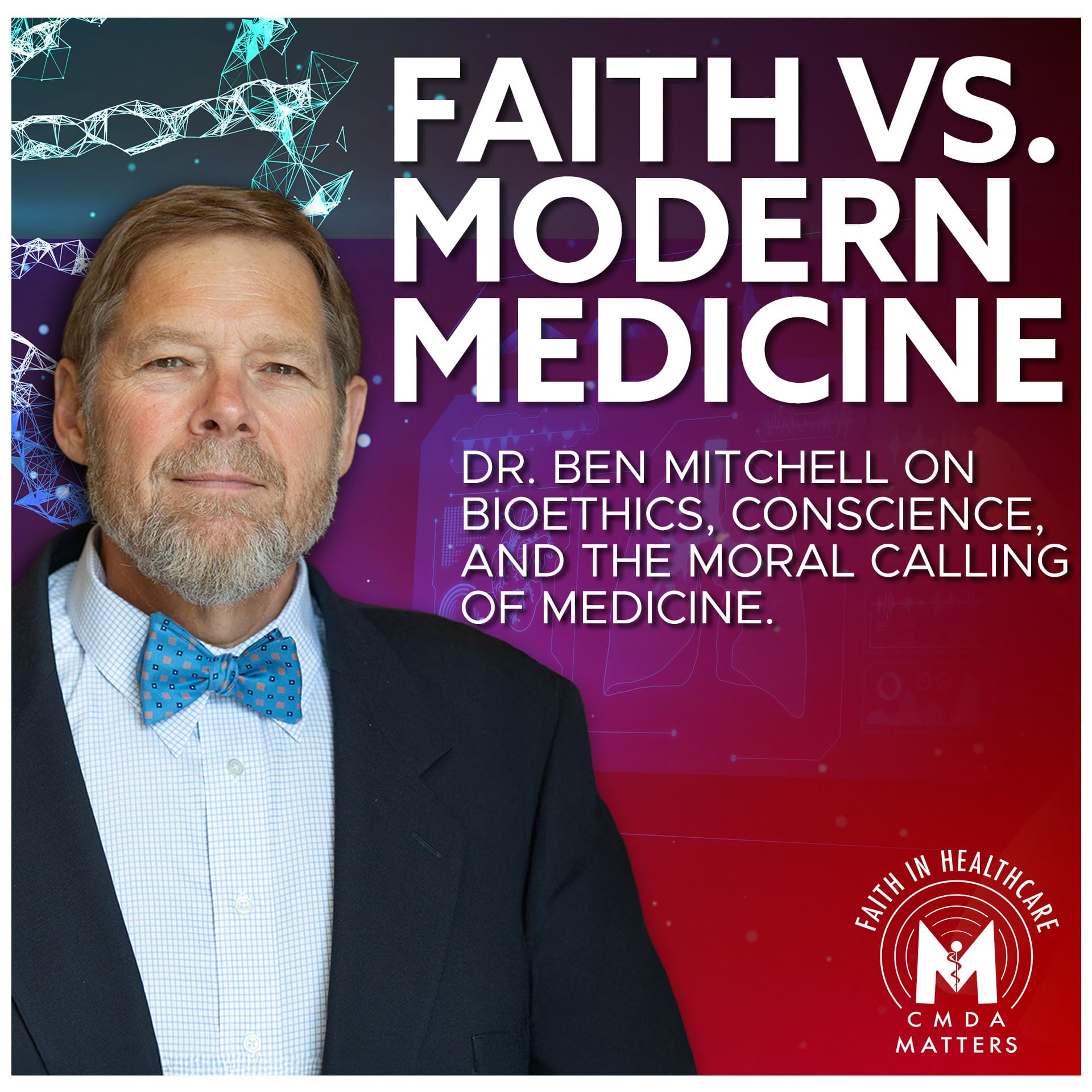
I'm joined by my co host, Dr. Bricklance and our guest, Dr. Ben Mitchell. He's a respected bioethicist and author of a new book, Bioethics in A Short Companion. His work has helped shape Christian thinking on healthcare, personhood and professional integrity for decades.
This conversation gets to the heart of medicine as a calling and why language, as well as conscience and covenant still matter. So let's dive in.
Well, today on faith and Healthcare, it's my pleasure to invite to the studio my co host, our Vice president of advocacy and bioethics, Dr. Brick Lance. Welcome, Brick.
[00:01:52] Speaker C: Thank you, Mike, for letting me be here with our guest because this is my passion.
[00:01:56] Speaker B: Yeah, well, that's why I asked you to join me today. I figured you'd probably throw rocks through my windows if I didn't ask you to invite me today because our guest today is a rather famous professor, doctor of bioethics, Dr. Ben Mitchell, who's currently professor and independent researcher but has been at Trinity Evangelical Divinity School, has been at Union College, has been Southern Theological Seminary a lot of different places and has been a huge, huge anchor and member of our ethics committee at CMDA for many years and gave me the privilege, Brick, about a year ago to read a manuscript on a brand new short companion entitled Bioethics and Medicine. So how long have you known Dr. Mitchell?
[00:02:41] Speaker C: Well, I just got to know him since I joined the ethics committee for cmda and of course that's part of my role here as the Vice President of Advocacy and bioethics. But I've sure enjoyed Ben. He is, he's got a wonderful mind, but he articulates for us simple minded orthopedic surgeons very, very well.
[00:02:58] Speaker B: We like short companions like this one on bioethics and medicine. So without any further ado, Dr. Ben Mitchell, welcome to Faith in Healthcare. And just to get us started, you've been influenced by some rather notable bioethicists in your career. Nigel Cameron, who I had not long ago to talk about C Everett Koop and his book, Dr. Edmund Pellegrino, Giant of Contemporary Bioethics. And Dr. Leon Cass, who played a huge role serving George W. Bush presidency. But who for you was instrumental in guiding you or coaching you toward a career of studying, teaching and advancing bioethics among Protestants and evangelicals in America today?
[00:03:38] Speaker D: Well, first, thank you for the opportunity to spend some time in conversation this afternoon.
Have been looking forward to this for a long time and I'm very grateful for the opportunity.
So my story is maybe a little different than many. I'm not a physician, as you know, but I became interested in the bioethics issues both personally and professionally as I was practicing ministry as a pastor.
My wife and I both experience infertility and we were wrestling with some of the infertility issues and some of the possible treatments, even though we were never offered something as sophisticated and exotic as, as in vitro fertilization at that time. But we grappled with the various options that were presented to us. And then I and in regular pastoral ministry was asked by church members, the doctors tell us, it's time to take Granny off the ventilator. What should we do? And I have to confess to you, at that time, I had no training in bioethics in seminary. I had no real resources. I think we had a pro and con debate on euthanasia Asia. So I was pretty sure we shouldn't kill Granny, but I wasn't sure beyond that what to do. And so I found a program not far from where I was living at the time where I could study clinical ethics and ethical theory in medicine in a philosophy program that also included clinical residency. So I rounded with physicians and nurses and pharmacists and social workers and others as part of the healthcare team. And my entree into that was as I began to get interested in maybe doing graduate work. I consulted a few friends, including the late Carl F.H. henry, he was called at that time the dean of evangelical theologians. And Dr. Henry was very encouraging about pursuing the work because I and he knew that there was a very robust Catholic literature in ethics and there was a growing secular literature in bioethics. And then there was a kind of mainline Protestant literature that somehow was neither. It was neither as robust as Catholic literature nor was it as, as secular as the secular literature. But it certainly wasn't representative of what an evangelical perspective on bioethics was. And so Dr. Henry encouraged me that there was a place for evangelical Christian and a faithful Protestant bioethics that needed to be developed. And it was really in that venue, that or that context that I started pursuing the doctoral work and then came across people like Leon Cass and Edmund Pellegrino in a variety of contexts, conferences, consultations, and other opportunities to meet with them and spend time with them. And they were encouraging as well.
I should also say that one of the things Dr. Henry told me when I got interested in this was because I'd asked him, do you know of any other evangelicals who are working in bioethics? He said, it just so happens that a young theologian from Scotland has ended up at Trinity Evangelical Divinity School.
His name is Nigel Cameron, and Nigel has a journal, and he has written in that area, and you need to get to meet him. And so, on a trip to Chicago one wintry January, I sat in the faculty lounge at Trinity Evangelical Divinity School and heard Nigel's vision for the center for Bioethics and a master's program in bioethics at Trinity Evangelical Divinity School.
[00:07:37] Speaker C: Nigel's an amazing person. And Mike, I would recommend our listeners go back and listen to your podcast a few months ago. So that was a wonderful podcast. I got to listen to him in person while I was pursuing my master's degree at at Trinity. And he is also just a wonderful teacher. So, Ben, you know, you're a little bit unusual, but you probably know that, you know, you pursued your seminary degree, your doctoral degree in philosophy, but then you added bioethics, like you alluded to. And I love your book because you're like a kid in a candy shop when you tell these medical stories, which is not necessarily true for all of us in medicine. But in your book Bioethics in a Short Companion, you state in the first chapter that you are pursuing this as your role as a pastor. So that part is a little bit unusual.
So we obviously hear your journey, but is this important for pastors around the country?
[00:08:28] Speaker D: Yes. I can't stress how important I think it is for pastors to have some training in a theology of medicine and certainly in what we call sometimes theological anthropology or the nature of what it means to be human. And then the application of that, those two arenas to the practical questions come up in the care of patients. Because, as I said, my first entree was really when someone said, should we take Granny off the ventilator? And I was in a position where I couldn't give them any guidance, any meaningful guidance on that, until I did two things. One, I read like crazy, but the other thing was I got to know some Christian physicians.
And in conversation with those physicians, I was able to begin to think more clearly about the options and offer some kind of pastoral counsel to those church members who were wrestling with those issues.
I will also say one of the things that I routinely did when I taught seminary was to tell pastors in preparation, those who are doing seminary degrees, when you enter a new church field as a pastor, the first thing you need to do, or at least one of the first things you need to do, is find a Christian physician that will be a counselor to you to help you. When you have questions about prognosis and diagnosis and all of that kind of Alphabet soup of words that are part of medical terminology, they need help in sorting those out. And a physician can be a counselor. And more often than not, I would point them to the CMDA website, both for the resources there, but also to identify a physician in their community who might have some interest in and training in bioethics and would be invested in the life of the church.
[00:10:33] Speaker C: And let me just add real quickly, so not just end of life issues, you're speaking of, you're talking about beginning of life, you're talking about gender dysphoria, you're talking about infertility, you're talking about all sorts of issues that the physician deals with on a daily basis.
[00:10:47] Speaker D: You know. Yeah, that's exactly right. I mean, again, my first glimpse at the questions was at infertility, the beginning of life, and then the questions about the end of life. And then as the Human Genome Project began to blossom, I became more and more interested in human genetics and genetic ethics.
And, I mean, it's almost endless, as you know, the number of ethical issues that arise in the medical setting, the clinical setting, and then the implications those have for Christian and pastoral care.
[00:11:25] Speaker B: Yeah, well, and that's why you've done such a great job on our ethics committee. There've been a lot of position statements I think, that you've been a part of drafting.
I appreciate the honor that you gave me to endorse your book. And I was just looking at it the other day on the back cover and reminding myself that, man, I wish I'd had this short companion when I was in medical school. And I recommend it for every medical student and resident. I can say that with total transparency that it would be of such great value to them. You spend a fair amount of time unpacking the Hippocratic Oath and then introducing me to a term that I should have been familiar with, but not Christian Hippocratism.
So then tell our listeners, why did the early church grab on to the Hippocratic Oath out of Greek mythology, clearly involving the gods, grab ahold of it and modify it, and then why aren't we using the oath today?
[00:12:13] Speaker D: Yeah, it's a great question.
So, yes, the Hippocratic Oath is an ancient kind of professional oath that has guided medicine since before Christ.
And when Christians, and I should say, the Jewish Christian tradition, when the Jewish Christian tradition saw the elements of the oath, they found a lot of resonance with their own theological commitments. First of all, the centrality of the patient. The patient who is ill, the patient who is sick, the patient who is feeling dis ease of some sort, and the role of the physician in caring for that patient. The focus was on the patient in the context of a blossoming professionalism, which is what we would call medicine now, a profession, not merely a job or not even just a vocation, but it's a profession. It's a certain type of vocation.
So the centrality of the patient, the nature of the values that informed the Hippocratic physician, would not perform abortions, would not contribute to euthanasia, would respect physician patient confidentiality, would not violate, through sexual abuse or any other form of abuse, violate a patient.
Those were values that were consistent with Christian values. And so in the second to fourth century, a Christian Hippocratic oath emerges, where Christians remove the polytheism of the Hippocratic oath, the promise made to the gods. And there were several of them mentioned to an oath or promise before the true and living God, in the same way that the marriage ceremony is a commitment made before the true and the living God.
So it just became kind of natural for Christians to embrace a tradition that had evolved to the place that it had because the values that were rooted in the Hippocratic tradition were consistent with those values.
I think, as you read in the book, not very many medical schools now use the original Hippocratic Oath. They certainly wouldn't use the Christian Hippocratic Oath. And many of the commitments of the original Hippocratic oath are not carried over into the contemporary oath. For instance, the prohibition against abortion is often removed.
Even, interestingly enough, even the prohibition against the relationship between a physician and his or her patient is removed from some versions of the oath. So the oath, when it is used, is watered down.
And in many medical schools, it's not used, or something more sort of like pablum is used for the oath. And more romantic than it is a binding kind of oath.
And I think that's partly a reflection of our growing pluralism in the American context, the Western context, in many cases, an Outright secularism and a relativism in ethics that we think that, well, no one could possibly establish a rule that would be meaningful for professionals. They need to kind of sort it out themselves. And what we end up with, especially in a litigious environment like ours, we end up replacing rules with laws. And then we only comply with the law because we have to, not because we think that there are moral values or ethical principles and virtues that are inherent in the practice of medicine. And that's what the Hippocratic tradition, that's what Christian Hippocratism affirms, is that in the profession of medicine there are inherent ethical principles and there are virtues that are being cultivated in the professional because of the nature of this sacred relationship between a physician and his or her patient.
[00:16:34] Speaker C: Yeah. So, Ben, that transitions to my next question, which you mentioned in the book of medicine being practiced with maximal efficiency. So if we are losing these moral values, then physicians and listen, I'm guilty of this practicing medicine simply, I don't want to say selfish reasons, but it's to make money and it's just another occupation. It's not a profession. So in medicine, we often will identify the patient as a diagnosis, their room number or their insurance carrier.
This is not only true in the United States, this is true across the world. And Mike and I can attest to this. I was just on a recent medical education international trip overseas. And so this is a universal truth even in medical schools across the ocean.
So my question for you is how can CMDA and how can Christian healthcare professionals change this idea in medicine? In other words, are we in a unique position to help medicine be a profession and not just a vocation?
[00:17:32] Speaker D: Yes. And then let me explain. So I think you're in a unique position and a strategic position to do that as an organization.
And it's because of your Christian values and Christian commitments. And here's what I, I want to say first, I want to be as generous as possible to physicians who are under the scrutiny of third party providers and under the scrutiny of healthcare institutions, sometimes where they have to see a certain number of patients every day and spend a limited amount of time with those patients, because that time spent affects the bottom line of the institution or the bottom line of the third party provider.
And not only that, but if you're under that kind of pressure, then spending time with patients, you want to really get to the meat of the issue, get them in, get them out, get them healthy. And so I think there are lots of compassionate physicians who are feeling trapped in the kind of habits, the bad habits that are part of, of contemporary healthcare these days.
The other feature that I think, or the other facet I should say of that, is that we have an increasingly consumeristic view of the physician patient relationship. Patients come in, they want you to take care of whatever their need is, whatever their perceived need is, and they bring you a stack of things they printed off the Internet and they say, I know what my problem is, and I want you to provide this drug for me or this medication or this treatment for me. And if you don't, then you're violating that principle that we know from the consumer world, the customer's always right.
And so patient autonomy drives medicine. And physicians are increasingly under pressure to both serve the healthcare industrial complex and meet the needs or wishes of their customers.
And so now we talk about healthcare providers or providers of services rather than professional physicians or physician professionals who inhabit a different way of life than somebody who's just providing services.
I can go to the supermarket and they'll provide me my potatoes, but my physician is someone with whom I'm in a light and sometimes a life and death relationship.
And this is not provision.
This is a relationship between someone who has particular art and skill and I come as a vulnerable person to request their best efforts to help me using their art and skill. And we enter this, this relationship.
So here's where I think organizations like Christian medical and dental associations and conscientious physicians can make a difference because they understand, and you understand as an organization that human beings are not widgets, that we just kind of move through a system like moving through an assembly line, but human beings made in the image and likeness of God.
Human beings whose life has been vested with God, with sanctity.
And so one's best efforts and one's most robust care should be offered to this person who is made in the image and likeness of God. And because CMDA holds that idea and theology high that human beings are made in God's image, then the practice of medicine can be constantly reminded and refined in ways that pay attention to the person, not just their problem. And you're right. I mean, you know, it's very easy to say that's the metastatic breast cancer patient in 3B rather than this is Mary.
Mary, the mother of three children, the wife of Bill. And she's hoping to see her son graduate from high school, her daughter get married, and her third child have a vocation that will serve him the rest of his life. And she's feeling the weight of this diagnosis and is just hoping to be able to see the future for her children. That's a very different perspective than she's a problem that we've got to solve or she's a diagnosis that we've got to treat. No, this is a person made in.
[00:22:32] Speaker B: God's image that hits pretty close to home. I'm sure most of those listening we're guilty of this, aren't we?
[00:22:37] Speaker C: Yeah, I've been guilty of this, particularly in the field of orthopedics, that it is a broken ankle, I just have to fix it. Rather than that's Joe, who has his passions, who has his occupation, who has his family. Ben's words that he just shared we need to spread widely.
[00:22:55] Speaker A: Before we continue with this week's episode. Here's a special announcement Announcement for you faith and healthcare listeners. We have great news.
We've extended our early bird registration for the 2026 CMDA National Convention.
Early bird rates are now available until midnight, January 19th, Eastern Time, giving you extra time to reserve your spot for this year's gathering April 23 through 26 in Loveland, Colorado.
Join us for a time to renew your spirit, recharge your faith and connect with fellow believers in healthcare.
We're thrilled to welcome John Stonestreet, President of the Colson center and co host of breakpoint Radio, a nationally recognized voice on faith, theology and Christian worldview.
Convenient lodging is available at the Embassy Suite by Hilton Loveland Conference center and Spring Hill Suites by Marriott, with special CMDA room rates reserved for attendees.
Learn more and Register
[email protected].
Saline Process Witness training is coming to Fairfield, Connecticut February 13th through 14th, 2026.
It's designed for healthcare professionals and students who want to care for patients more holistically.
This 10 hour interactive course equips clinicians to thoughtfully and respectfully engage patients spiritual concerns in real clinical settings.
Research shows that most patients want their healthcare team members, including physicians, to acknowledge their spiritual needs, yet many clinicians feel uncertain about how to do that well.
Saline process provides practical tools to help you respond with confidence, compassion and sensitivity, addressing both physical and spiritual care while honoring professional boundaries.
Learn more and
[email protected] events.
Let's jump right back into this week's episode.
[00:25:12] Speaker B: Well, something we share in common, Ben, is that you're joining us from Chattanooga, Tennessee and we're here in Bristol, Tennessee. And earlier this year I had my first opportunity to travel to Nashville to join a Chattanooga doctor, a surgeon in the Tennessee State Legislature before the Health Committee as they were debating a conscience protection bill And I shall never forget my first visit there.
The attorney on the front row, part of the minority. The Democrats are in the minority here in Tennessee. And I'll never forget him looking at our panel giving testimony, saying, good Doctor, what is this conscience that you're so passionately trying to defend? Tell me, what is it? I won't tell you what I said, but how would you answer that question, Dr. Mitchell?
[00:25:57] Speaker D: First, it's a great question and I'm glad he asked it. I'm worried a little bit about why he asked it, but I'm glad he asked it.
Our conscience is an expression of or the residence of our most deeply held moral beliefs, our deeply held ethical perspectives.
And I'll be the first to say that there's a Christian conscience and there may be a Muslim conscience and there may be a Jewish conscience. That conscience is formed both by the nature of what it means to be human. We know there is right and wrong. We know that there are some things that should and shouldn't be done. But it's also formed by our religious training or our background and family life, and then through our education as well.
And no one, whether they're Christian or not, should be forced to practice medicine against their conscience. Because that relationship between one's conscience, one's practice and one's patience is a sacred space.
And I'm thankful that you were there to help protect the conscience of medical professionals who should never be asked to practice against their conscience. First of all, it's a violation of their own religious or even non religious beliefs. And then secondly, it puts the patients at risk.
If you're doing something that you think you ought not be doing, then are you going to do it well? Are you going to do it conscientiously? Might you even know how to do it? Because it may or may not have been part of your training, depending on where you went to school and what the shape and fashion of that particular medical education might be.
The other interesting thing is that we are told that physicians should like taking off your lab coat, that you should take off all of your religious commitments and your Christian conscience when you step into the examination room or into the surgical suite or into the er, but no patient does that.
Patients bring their conscience, their deeply held religious convictions to the bed.
And why shouldn't and why can't a physician bring his or her deeply held ethical commitments and views to the bedside as well? It's not a battle. It is a recognition that we're human beings who actually have and should have principles that guide us in thinking about right and wrong, what we should and shouldn't do.
I worry that. That the question was asking you to ignore your conscience or pretend that there isn't a conscience.
But that's certainly not the case.
[00:28:59] Speaker C: Yeah, Ben, that actually leads to my next question, which is tying together a Christian theology with bioethics kind of at the beginning of our talk. So in your 2014 book that you authored, along with our dear beloved Dr. Joy Reilly, Christian Bioethics A guide for pastors, Healthcare professionals and families, you state, quote, understanding the goals of medicine requires a deep theological foundation. End quote.
And I just want to say that I loved pursuing my master's in bioethics. My hardest class, though, was the ethical theory class because we studied all the different theories about ethics. And to me it just seemed like these are folks just struggling to find what's ethical from a secular perspective. I almost told my professor I thought that secular bioethics was an oxymoron. That may be taken a little too far. But again, how can we have bioethics without Christian theology?
[00:29:53] Speaker D: It's a thin bioethics.
Again, it turns into a kind of principalism where I just have some rules that I'm going to follow because I've been told those are the rules that I should follow or a kind of compliance. I'm just going to comply with the law because if I don't, I get in big trouble or my institution will get in big trouble, and then I get in big trouble because of that. Or we commit ourselves a secular Bible that commits itself to seeing patient autonomy or patient self determination as the greatest good.
And one of the arguments that I try to make in the book, and I'm not the only one who's tried to do this, is that the Hippocratic tradition, as a tradition, leaned toward a very strong paternalism. The physician was the one who told everybody else what to do.
We have completely turned that on its head now. And now the patient is the one who tells everybody what to do and demands certain treatments or certain medications, et cetera.
But the patient is not capable of making those decisions, him or herself, without learning more, most patients anyway, without learning from the physician what the diagnosis is, what the prognosis is, what the treatment options are. There has to be education. We spend a lot of time in medical school. You spend a lot of time in medical school talking about patient education.
So back to your question.
A secular bioethics is a very thin bioethics, if it's bioethics at all.
Instead, every physician and every patient as I said earlier, brings with them a certain understanding of what it means to be human, what it means to be made in this kind of carbon based form, and what my aims, goals and passions are as a human being, whether I'm a Christian or not. A human being who has desires and hopes and fears.
And so that way of thinking about humanity evokes theological kinds of categories. What does it mean to be human?
Well, it means. Means not just to be a computer made of meat.
I'm not just a meat machine. I'm a physical, spiritual, emotional whole. W H O L E. I'm a whole being who has all of these different facets. And that's what Christian theology does. It tries to examine from Scripture and from theological reflection what the different facets are of the whole human being in relation to God and neighbor and in the context of medicine, in relation to health and wellness.
[00:32:49] Speaker C: Yes. Let me just clarify. Ben, I love that answer. Let me just clarify. Regardless of whether the patient has a Christian faith or not, that's not important to this discussion. It's me as the healthcare professional again, giving the care that, that influences my care for that patient, is what you're saying. I'm going to care for them no matter what their faith is because I know that they are made in the image of God.
[00:33:10] Speaker D: Yeah, right. And that one of the basic commandments of the Christian and Jewish tradition is to love the Lord, your God, with all your heart, mind, soul and strength and your neighbor as yourself.
And when a lawyer, it's always a lawyer. A lawyer asks Jesus, well, who is my neighbor?
He told a story, and he tells the story of the Good Samaritan.
[00:33:33] Speaker B: Right, right.
[00:33:34] Speaker D: And so our Samaritan obligation to care for those who are in need is at the, it seems to me, at the heart of the relationship between medicine and the care of patients.
[00:33:48] Speaker C: Yeah.
[00:33:49] Speaker B: And you've used the word sacred several times in this discussion and earlier when you talked about Christian apocritism. The other thing that seems to be Judeo Christian tradition is covenant. The word covenant is not exactly a term you're going to find in much in the secular world.
And I've read recently some books about sacred leadership, and they were written by atheists, basically from a secular what is the greatest good? That's how they defined sacred what is the greatest good?
So my question has to do with linguistics and the theft of linguistics and our favorite pastime.
Brick and I have probably gone down this path about a half dozen times just in the last couple months about how we're so Frustrated with the terminology that many Christians have just in practice have come to accept, they acquiesce very quickly. But we have had a victory, I think recently, specifically pushing back against gender affirming care. The eppc, with several organizations signing on, including cmda, that we were strongly recommending to HHS and other policymakers use sex rejecting procedures. And we're seeing that effort pay dividends.
[00:35:00] Speaker C: Yeah, they're incorporating that term, they're incorporating.
[00:35:02] Speaker B: That phrase, sex rejecting procedures.
But what can we do? What do you suggest in terms of how we can recapture some of this terminology other than just not acquiesce? What are some practical things that we can do as Christ followers in healthcare with a biblical ethic to take back language?
[00:35:21] Speaker D: So with respect to covenant, the nature of covenant in medicine, the opposite is contract.
And contract has all kinds of detrimental meaning for the practice of medicine. It means, for instance, that I only have to do for you what I've contracted to do. Our contract is only good for a certain period of time.
And when I'm off or when I'm not being held to my contractual obligations, I have no obligation to you. Well, that's not even a human relationship, because as I said, the Good Samaritan and many, even non Christians would talk about being a good Samaritan or just being a good neighbor. The Good Samaritan obligation means even if I've clocked out and you fall in front of me at the grocery store, collapse in front of me, I have a moral. I feel a sense of moral obligation to try to help you. And that's not my contract. That's a different kind of relationship.
So I think we can recover a kind of language that will more properly describe the relationship between a physician and patient as covenant versus contract. Now, the person who commands or who captures the language wins the fight, right?
So what you're saying is really important. And one of the things I think we have to do is one, use the clinical or the medical lexicon. Well, and words like sex are in the. There are written in the history of medicine to describe certain things that gender only later has been used to describe. So you can trace the history of those words and use the medical lexicon rather than the sociological lexicon, which gender does at best.
And we see this in a lot of, in a lot of areas in medicine. For instance, one of the great debates at the beginning of life issues is about when the human embryo is worthy of or should be respected, or in other words, when we should have moral obligations to unborn human beings. And so One term that was used in the early part of pregnancy was the pre embryo.
The pre embryo.
And so you might say, some would have said when that terminology was used, well, we have obligation to embryos, but not to pre embryos. So we should protect the life of the embryo, but not the pre embryo, because that's so early in the human developmental process. There's no, there's, there's no moral obligation. Well, I used to say if you run our tape backwards, our video backwards, but I think we have to say if you run our livestream backwards now, because nobody uses tape anymore, we run our livestream backwards. Are you a moral being whose life should be protected now against unnecessary harm? Yes. Were you when you were 12 years old? Yes. Were you when you were 12 days old? Yes. Were you when YOU were 12 minutes old? Yes. Were you before? 12 minutes before you were born? And that's when people start to waffle if we say, well, we have an obligation to care for you before you're. Sorry, after you're born, but not before you're born and you're still the same living member of our species. But the only difference is geographical. In the uterus, outside the uterus. It seems to be curious that we're now making those moral judgments based upon geography rather than the nature of this human life. The same is true if you continue moving the tape backwards. When does the pre embryo lose its moral status? And the answer is, of course it does. From conception through eternity, we have a life that's made sacred by God's investing or vesting that life with his image. So we need to call the revisionists to give an account for why they're changing the terminology.
And then we need to practice using the terminology that is either scientifically accurate or theologically accurate or both, to preserve those categories and ultimately protect human beings. The same is true at the other end of life. Persistent vegetative state.
Well, there's no human being who's vegetative.
We might be in a chronic coma or we might be in a condition where it's unlikely that we're going to survive, but we're still a human being made in the image of God. And. Yeah. So I don't know if that's helpful or not, but I think you're right that we have to use a proper lexicon if we're going to make a difference.
[00:40:23] Speaker C: Yeah. And Ben, Mike brought up this term covenant. And so I want to talk again a little bit about covenant versus contract, but I want to tie that into trust because I think it has a societal, cultural influence on that. And I will just say, flying back from overseas last week on my Mei trip, I get called to the very front of first class. The patient's passengers completely unconscious. And of course even an orthopedic surgeon can do their ABCs and did stabilize the patient. But the co pilot brought me into the cockpit saying we're flying over Iceland, do we need to land? Anyway, that was kind of a test to my ability to judge this patient. Anyway, patient recovered and doing well. But here's my question.
I did not approach that patient from a contract. I approached him, I will say with compassion. I'm not saying others can't do the same. But it seems like we've lost trust in this profession we call medical care.
And I guess the question is how did we lose trust and how do we regain the trust? And in your book you talk about establishing compassion and phronesis and you describe the term phronesis as prudence and practical wisdom. So how did we lose trust? How do we regain trust in the practice of healthcare as a society?
[00:41:38] Speaker D: I can't agree with you more that trust is a central facet of medicine and the physician patient relationship.
When I go to my physician, whatever the specialty is, I go as somebody who is suffering in one way or another. I may, may not know what my problem is. I may not be able to identify it, but I know there's something wrong.
And I don't go to my car mechanic because I wouldn't trust him to treat my body.
And I don't go to my grocer because I wouldn't trust him or her to know what's going on in my anatomy, in my body. I go to someone who has a long earned education and residency and who sees a lot of patients depending on the different specialty because of that, that idea of trust. I trust the educational system. I trust the person who has been through that educational system and it's because they are a medical professional, not just because they are a provider of services. Again, I think we've lost that trust for complex reasons. I don't know that there's any one reason for that.
In some cases because physicians have violated their sacred oath and so we no longer trust them. In other cases it's because we have turned medicine into this consumer good and now we demand that physicians do what we ask as customers. I think there is an erosion of trust of all of the professions and there are lots of reasons for that.
I think one reason is because we think we can all become experts just by consulting a YouTube video.
And all of a sudden, and all of a sudden we have years of medical knowledge at our disposal, so we don't have that trust.
So I think trust is hard fought to gain and easy to lose.
And the profession of medicine has spent millennia now earning that trust. And now because of the erosion of that trust, that trust has to be regained. And I think, you know, at minimum, at minimum, for a physician to regain trust and for the profession to regain the trust, physicians have to be at least minimally decent human beings.
You know, we talk a lot about bedside manner, and every physician has a different personality. So I don't expect every physician to have the same bedside manner. But expressing concern and care for the patient and listening to their story is one way to either gain or confirm the trust that patients put in their physician when they essentially ask that person, that physician, to care for their very lives in some cases.
So there's an enormous amount of trust. And I think regaining or cultivating or trying to recover that trust just means physicians using the art of medicine as well as being competent in the science of medicine and then bringing that to the bedside. I don't expect we use the term, the difference between an orthopedic surgeon or an orthopedic specialist and maybe your primary care physician, though the book will tell you why we shouldn't use that term. I want my cardiologist, for instance, to be a really good body plumber.
[00:45:25] Speaker C: Plumber, Yeah.
[00:45:26] Speaker D: I want them to be a really good body plumber. But because I'm asking that cardiologist to help me understand what's going on and to treat me, I would like to have a relationship with that cardiologist, even if it's, even if it's for 15 minutes relationship between one human being and another, and not just be a body plumber, but also be a human being offering human care to another human being made in God's image.
[00:45:55] Speaker C: Yeah. Regardless of specialty and regardless of what profession you are in healthcare.
[00:45:58] Speaker D: Absolutely, absolutely.
[00:46:00] Speaker B: And I do think that's why the vast majority of our members across the country are such highly respected individuals in their communities, because I do think they're trying to model Christ.
Dr. Mitchell, we've run out of time, but I did want to ask both you and Dr. Lance. Clearly, I said at the beginning, this is a book that I think our listeners ought to get. It's, it's relatively easy read two, three hours. I think they can get through it. What are some other classic one or two textbooks, maybe that go into more depth that would be an addition to your primer that you recommend for our listeners in terms of continuing to get a good grasp on Hippocratic oath and biblically based bioethics for either one of you.
[00:46:43] Speaker C: Well, I'll be interested for Ben, but of course, I actually buy Father Kurland's book and hand it out to medical students, the Way of Medicine.
I think it's a great book. You've had him on your podcast and I really do have enjoyed reading that book.
[00:46:56] Speaker B: Christopher Tollefson, Ben, your recommendation?
[00:46:59] Speaker D: No, I would add to that and I do the same. I think Mark Herlin and Chris Tollefson's book the Way of Medicine is a really important volume and I refer to it in my book.
One of the things I tried to do in the chapter titles was to highlight some of those books, like Paul Ramsey's the late Paul Ramsey's great book the Patient as Person.
But in addition to those, I would recommend Gilbert Milander, the emeritus professor at Valparaiso University, also served on the President's Council on Bioethics under George Bush. I would recommend his book A Primer. And also, if we're thinking about beginning of life issues, you can't do any better than Robert George and Chris Tollefson's book Embryo as a good primer on some of the issues about the beginning of life and at the end of life. I routinely recommend Bill Davis, who is a professor, philosophy professor, but Bill Davis's book, Departing in Peace, he's written a really practical and doctrinal book on end of life care and even takes up, at the end of that book, takes up living wills and advanced directives in a very practical and helpful way. So those are the kinds of things that I would recommend especially for a layperson.
[00:48:19] Speaker C: And Mike, you know, I'm going to add this in for all healthcare professionals. We need to saturate ourselves with the word of God. It's so important.
[00:48:25] Speaker B: Yeah. Yeah. Well, Dr. Mitchell, thank you for joining us today on Faith and Healthcare and just for our listeners, a personal touch. You had lost your father a few years back and stepped down, I think, from our ethics committee. And you had heard that I'd lost my father as well. And I just was so grateful for the very kind and caring pastoral letter that you wrote to me after I lost my father. So that was very endearing to me. I'm grateful to this day for that letter. So God bless you and ongoing work and hope that we get to be face to face not on zoom one of these fine days.
[00:48:57] Speaker D: I look forward to that. Look forward to that.
[00:48:59] Speaker C: Thanks Ben.
[00:49:00] Speaker D: Thank you, thank you.
[00:49:10] Speaker B: This conversation with Dr. Ben Mitchell reminds us why medicine was never meant to be just another service industry.
When patients become just a diagnosis, something important is lost, friends trust begins to erode, care suffers. And when language is distorted, truth becomes harder to see.
Still, we're called to something deeper, to practice medicine as a vocation shaped by compassion and wisdom and the unshakable truth that every single human life bears God's image.
Well, next time on the podcast, Dr. Christina Francis, who's the CEO of the American association of Pro Life OBGYNS or APLOG will join Dr. Bricklance and me and we're going to unpack what's really happening in a post Dobbs world. From the growing dangers of abortion, drugs and conscience, threats to OB gyns who are in training to why clear medical language as well as courageous advocacy and life affirming care matter now more than ever before.
I want to thank you for listening to Faith in Healthcare, where our mission is to bring the hope and healing of Jesus Christ to the world through committed Christ followers in healthcare. We'll see you next time, God willing.
[00:50:40] Speaker A: Thanks for listening to Faith in Healthcare. The CMDA Matters Podcast if you would like to suggest a future guest or share a comment with us, please email cmdamatters mda.org and if you like the podcast, be sure to give us a five star rating and share it on your favorite social media platform.
This podcast has been a production of Christian Medical and Dental Associations.
The opinions expressed by guests on this podcast are not necessarily endorsed by Christian Medical and Dental Associations.
CMDA is a non partisan organization that does not endorse political parties or candidates for public office.
The views expressed on this podcast reflect judgments regarding principles and values held by CMDA and its members and are not intended to imply endorsement of any political party or candidate.