[00:00:08] Speaker A: You're listening to faith in healthcare, the cmda matters podcast. Here's your host, Dr. Mike chubb.
[00:00:20] Speaker B: Welcome, friends, to Faith in Healthcare. You know, this conversation is one I've been looking forward to sharing with you for several weeks.
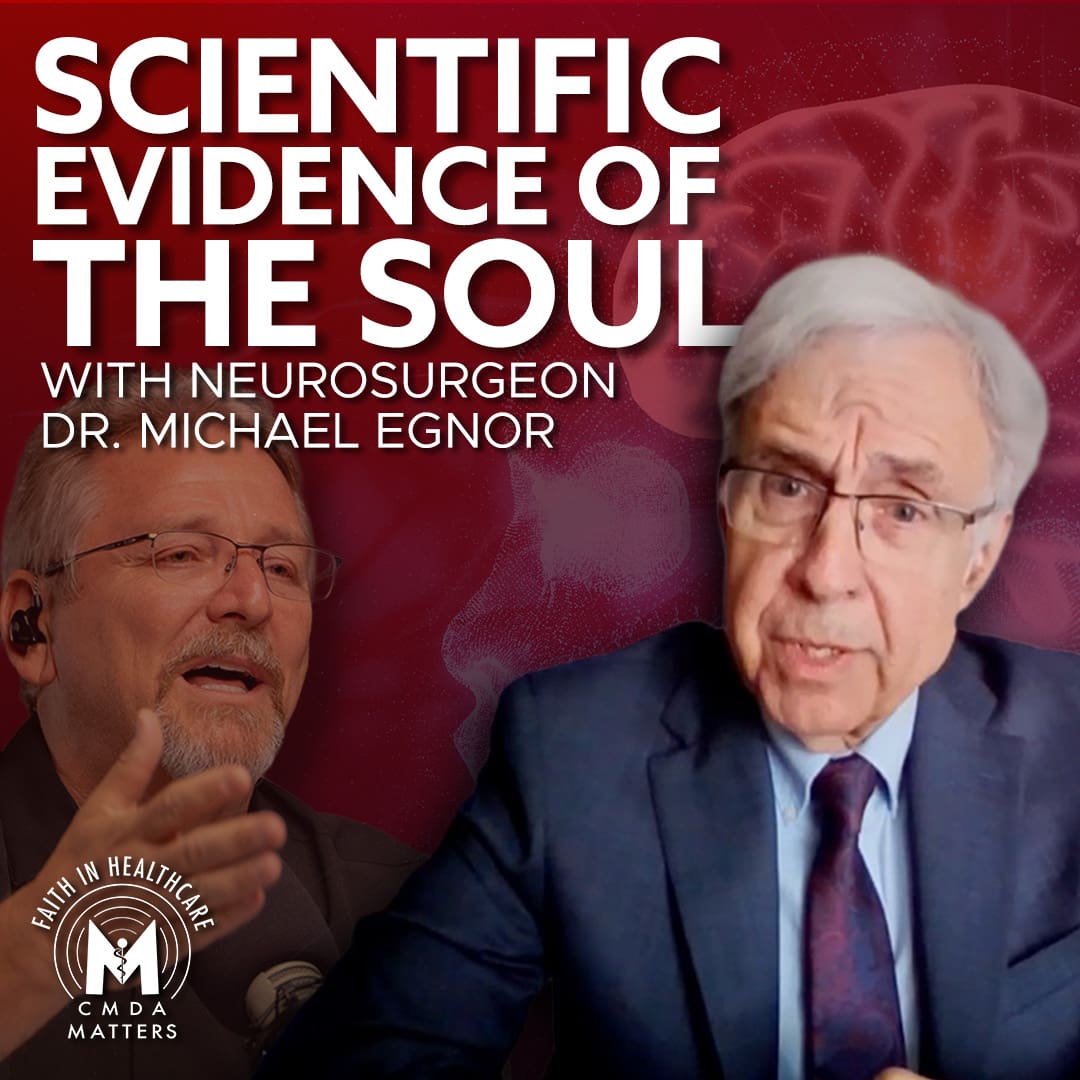
I'm joined today by Dr. Michael Egnor. He's a neurosurgeon, a professor and neurosurgery residency program director at Stony Brook University in New York. He's also the author of a new book titled the Immortal A Neurosurgeon Explores why Our minds are more than our brains.
Dr. Egnor shares his personal journey from atheism and materialism to faith in Christ.
And together we're going to explore some of the most fascinating questions at the intersection of neuroscience, philosophy and Christian thought. Drawing from real world evidence, like brain surgeries, that Dr. Egnor has done clinical experiments and near death experiences to ask what the brain can and cannot explain about the human mind. So let's dive in.
Well, today on Faith in health Care, I have been waiting several weeks to talk to our guest about a book that he wrote and put out there in 2025, a book that combines 40 years of experience in neuroscience neurosurgery with really a great mind that's thought a whole lot about ancient philosophy and modern philosophy and Christian thought. And my guest today is none other than Dr. Michael Egnor, who is a professor at Stony Brook University and has trained at Columbia and Miami. And Dr. Egnor, I've heard you being interviewed on another podcast and I've read some of your materials and I'll say your book was thick. And so it took me about eight to 10 weeks to get through, but I did get through it, including the very interesting last chapter on artificial intelligence. So thanks for joining us today on faith and healthcare.
[00:02:22] Speaker C: Thank you, Mike. It's a privilege to be here.
[00:02:24] Speaker B: Your book's entitled the Immortal Mind and A Neurosurgeon Explores why Our minds are more than our brain. So when did it occur to Michael Egnor's mind that you should write a book like this?
[00:02:38] Speaker C: Well, I started out life as a materialist and as an atheist when I was a kid. I was brought up in a secular environment.
I went to college, I majored in biochemistry.
I was fascinated by science, but I saw everything from a materialist perspective.
And I went to medical school, fell in love with the brain. I, I thought that if I understood the brain, I could understand what it meant to be human, that I could understand the human mind and that all I really had to do was study the brain hard enough, you know, study the anatomy and the physiology, and it would all make sense. It would all come together.
So I decided to become a neurosurgeon. And as I finished my residency and began practicing, I came to see that there were things about the mind that really the brain couldn't account for. I had a number of patients who were missing major parts of their brains, either from congenital problems or because of trauma, who functioned surprisingly well. They had a young girl who was missing about two thirds of her brain. We diagnosed when she was born, and she grew up entirely normally. And she's now in her mid-20s. She's a businesswoman. She functions beautifully. She's smarter than I am, and I've got a number of patients like that. It doesn't mean it's good to be missing a part of your brain. But there are people out there who function surprisingly well, and that wasn't in any of my materialist textbooks. What really struck home was an operation I did about 30 years ago on a woman in her early 40s who had a brain tumor, a benign brain tumor in her left frontal lobe. But it was infiltrating in various parts of the frontal lobe, and I had to remove it in a way that wouldn't damage her speech.
In order to do that, I had to do an awake brain operation, which is an operation where you give local anesthesia so that patients feel no pain, and you expose the brain and can stimulate the brain, find out exactly where the vital areas are so that when you remove the tumor, you don't cause any permanent damage. And as I was doing this, I was talking with her during the surgery as I took out the tumor and removed significant parts of her left frontal lobe. And she never turned to hair. She was perfectly normal. We talked about the cafeteria food, about the weather, about her family, and it went on for hours. And after the surgery, I thought, well, there's no textbook on neuroanatomy, neurophysiology, that says you can take out, like, two thirds of the left frontal lobe in a person while you're talking to them and have them be perfectly normal.
So I really began to say that the mind brain relationship isn't what I was taught that it was.
[00:05:16] Speaker B: Well, I really want our audience to hear. Sometimes our own lives, even as professionals, accomplished surgeons, get in the way and bring us to a crisis moment. And you describe being on the floor of a hospital chapel at the such a crisis moment. Tell our listeners just a little bit what got you there. And what happened at that moment?
[00:05:38] Speaker C: Sure. I have four kids. And when my youngest son was born, we noticed that he wasn't making eye contact. When he was a young infant, he wasn't smiling.
And I became concerned that he might be autistic. And that really terrified me because I knew that in children who had very severe autism, they found it difficult to make interpersonal connections. And the thought that I would have a child who I loved very much, who had difficulty knowing me, was very painful. My wife had the same fears. We took him to a neurologist who said, it's too young to know. He was a few months old.
And by the time he was almost six months old, he still wasn't making much eye contact and still wasn't smiling. It was really difficult. So one night I had a consult I was seeing at an outside hospital, it was a Catholic hospital.
And I saw the patient. And then as I was leaving the hospital, it was near midnight, there was a chapel in the hospital. And I figured, well, at this point in my life, I was an atheist and very much materialist. And I said, well, it can't hurt to stop and pray, you know. So I went in the chapel and I knelt down and I said, lord, I don't know if you exist. I suspect you don't, but I don't have a lot of other options right now.
Please, I can't take my son. Not knowing me, I can't.
I, I can't deal with severe autism in my child. I, I. To have a son who doesn't know me is breaking my heart.
And I heard a voice. Only time in my life I've ever heard a voice. And the voice said, but that's what you're doing to me.
And so I collapsed on the floor.
I, I told him I wouldn't do it to him anymore and that I was sorry and that he had made his point perfectly adequately and how if he would give me my son back. So a coup later, at my son's six month birthday party, he was smiling and making eye contact. A perfectly normal baby. And he's a healthy, happy, thriving young man right now.
So I went to the local church. I said, when can I get baptized? I said, well, you got to go through a little process here. And so I got baptized along with a lot of my family. And I promised the Lord that I wouldn't be autistic to him anymore.
[00:08:03] Speaker B: Wow. Well, we were talking before we got going here about the fact that you know and are a good friend with Professor J.P. moreland out of Biola and I had him on the program a couple of years ago and he introduced to me a concept I hadn't thought about much, didn't know about, called substance dualism.
So you've said you were raised as a materialist and atheist. So talk to our audience about what is this substance dualism that you spend a lot of time in your thesis saying it's real.
[00:08:32] Speaker C: Yeah, there are various ways of understanding the relationship between the mind and the body or the soul and the body, and materialism is one of them.
We're just meat machines. Dualism is another in which there is a physical part and there's a mental part. And there are different kinds of dualism. Substance dualism is Platonic in nature. It stems a lot from Plato's understanding of the human person.
It was expressed probably most clearly in more modern times by Rene Descartes, a philosopher in the 17th century who proposed that human beings were composites of two separate substances. One substance is our body and the other substance is our soul. And our soul was a mental thing he called res cogitans, and our body was a physical thing he called res extensa. And that's one way of understanding the relationship between the soul and the body. And Dr. Morland, I believe as a substance dualist, there are other varieties of dualism, Thomistic dualism, which is more along my way of looking at things, and it goes back to Thomas Aquinas and it understands the soul as the principle of life. It's sort of the intelligible form of what it is to be a living human being. And there are other kinds of. There's a property dualism that sees the mind as a prized properties of the body. There's different ways of looking at it.
[00:10:02] Speaker B: Well, you've done many thousands maybe, I think in your book you say you've done over 7,000 brain operations and you alluded to earlier, you've seen all sorts of developmental and post surgical situations on MRI for brain scans. And so is there any way that you can correlate brain anatomy with consciousness? Even the most ardent brilliant materialist, is there any way that they can correlate brain anatomy with consciousness? Or I suspect where we are right now that there was a bet you described by a materialist who said, I bet you within 25 years I'm going to find we will find the center of consciousness within the brain. And I guess he lost the bet.
[00:10:42] Speaker C: Yes, yes. The correlation of course, is a separate thing from causation.
But there have been a number of very interesting studies done on correlating mental states with brain states.
The first study of this nature that I think is particularly relevant to our questions was is really an observation by Wilder Penfield, who was one of the pioneers in neurosurgery Back in the early to mid 20th century. And Penfield was fascinated with the treatment of seizures and really developed neurosurgery for epilepsy. And the first thing he did as a young neurosurgeon was he studied the nature of seizures, what happens during seizures.
And he realized that there are only certain things that happen during a seizure.
When a patient remains awake, a number of seizures, perhaps half of seizures, People remain awake during them. And he observed that there were only four things that people do during awake seizures. They can have an uncontrollable movement of a limb or something. The muscle group twitches. They can have a sensation or perception. They can see flashes of light or feel a tingling on their skin or have a funny smell.
They can have memories.
You can have kind of a haunting, recurrent memory as part of a seizure, or you can have a powerful emotion.
Seizures that cause an emotion of fear. There are seizures that cause an emotion of humor and laughter.
But Penfield said there are no intellectual seizures. No one ever has a seizure that makes them do calculus or makes them even do simple math or do logic. He said, that's awfully odd. I mean, if rational thought and also free will come from the brain, you ought to have seizures occasionally that evoke that. He said, it never happens.
And that's what I found, too.
So that got me to thinking. And Penfield asked early on in his career, and like me, he started out as a materialist. He said, does the brain explain the mind completely Was sort of the guiding question of his entire scientific career.
And at the end of his career, he wrote a book called Mystery of the mind, where he said, no, it doesn't.
The brain explains some things, and in my view, it explains six things.
Six things about us come from our brains. Homeostasis, which is the regulation of the body's internal environment, Heart rate, breathing, metabolism, Things like that clearly are organized by the brain.
Arousal, the capacity to be awake, to be alert, to pay attention to things, comes from the brain. Movement, the ability to move a limb comes from the brain. Sensations like tactile sensation or vision or hearing come from the brain. Memories come from the brain very, very clearly, and emotions come from the brain.
But two things don't seem to come from the brain. Both from Penfield's research, From my own experience, there's A lot of science behind this, and that is reason and free will don't seem to come from the brain. There have been, over the past century, about 400,000 AW brain operations performed in the United States. They're done sometimes for epilepsy, sometimes for tumors. I have a colleague who does quite a few of them. I don't do a lot of them. I do some. And of these 400,000 awake brain operations, there are several hundred stimulations of the brain that take place during each brain operation. And that amounts to tens or hundreds of millions of individual stimulations. But there's not a single report in the medical literature of anyone ever stimulating the brain and evoking reason or evoking free will.
Penfield tried actually to find a place in the brain where evocation of reason or free will would happen. And he was unable to do it. And no one else has been able to do it either.
So his conclusion was, and it's my conclusion, that there's a spiritual capacity of the human mind, of the human soul that does not come from the brain and particularly its reason and free will.
[00:14:57] Speaker B: And you describe many times, I don't know how many times you've divided the corpus callosum because of seizure activity and not found reasoning changed, capabilities changed. And you state later in the book, if you did that to a computer, those who try to liken the brain to a computer, there's no way you're going to divide. There's no way you're going to divide that hardware and be able to have the same level of function.
[00:15:21] Speaker C: Yeah, there are very few complex things that you can cut in half and have them work essentially just as well as they did before you cut them in half.
If I do it to my microwave or my television set or my computer or my car, they're just not going to be the same. There's an operation called a corpus callosotomy in which we cut the connection between the brain hemispheres to treat a particular kind of seizure. It's a rather radical thing to do, but it does help people quite a bit. And there have been tens of thousands of these operations performed over the past century.
What I observed and what other people have observed is that after the surgery, people are perfectly fine. That is, you've basically cut their brain in half and they feel just the same as they felt before, except their seizures are better. And I was amazed by that, as a number of people have been. Roger Sperry, who's a neuroscientist, worked in the mid 20th century, was fascinated by These patients as well, and he studied them in great detail. And he won the Nobel Prize, actually, for his studies.
And what he found was, when you study these people very, very carefully, you can find abnormalities of perception, and they're all perceptual issues. For example, the left hemisphere of the brain is the. In most people, the speech hemisphere that allows us to speak.
So if you present a picture of an object to the right hemisphere, which you can do using the visual fields, in a patient who's had the corpus callosum cut, that information can't get from the right hemisphere to the left hemisphere. So the person knows what the object is, but he can't say the object. He can't say the name of it, of it. So all kinds of interesting little perceptual things. People don't notice it in everyday life if they've had that operation, but it exists.
But researchers following Sperry have looked in much more detail at the disconnection problems that people have when you cut the brain in half. And what they found is an absolutely fascinating thing. That year, Pinto, who is a neuroscientist from the Netherlands, described as unified consciousness with split perception was the term he used for it. And what they find is that certain things are split, like the ability to transfer information about an image from one hemisphere to the other, but other things are not split. And what's not split is reason and making concepts. A very good example of this was research done by Alice Cronin, who was a neuroscientist at MIT who looked at patients who had had very radical splitting of their hemispheres. And she would present to one hemisphere a picture of an object, like, for example, a violin.
To the other hemisphere, she would present three pictures. One would be like a picture of an artist palette, and then a picture of a toilet plunger and a picture of a stethoscope. This is actually one of the experimental setups she used. And she would ask the patients, compared to the one picture, which of the three pictures is conceptually similar to the violin? Is it the artist palette, the toilet plunger, or the stethoscope? And patients with split brain surgery would invariably say, well, the artist palette, because music and art are similar. They're both kinds of art. And she would do with all kinds of pictures, and they always could connect the concepts from between the two hemispheres. But keep in mind, and this gives me chills, even many years after knowing about this, it gives me chills.
No part of the person's brain has seen both sets of pictures. One hemisphere saw the violin. The other hemisphere saw the artist palette, the toilet plunger and the stethoscope. No part of their brain saw both sets of pictures. So how can they compare the them?
How can you make a comparison, a rational comparison, when no part of your brain has seen the things that both things that you're comparing.
Other researchers have looked at similar experimental setups and they found exactly the same thing. That you can make concepts without both hemispheres having access to the things necessary to make the concept.
So. And there appears to be consistently, in many, many different kinds of experimental setups, evidence that reason and free will aren't in the brain in the same way that perception and movement and emotion and memory are in the brain. And in fact, reason and free will don't seem to come from the brain at all. They may come through the brain.
That is, for example, my ability right now to describe these experiments is coming through my brain. In a sense, I'm talking about them. Therefore my speech area, my brain is involved. But reason and free will don't seem to come from the brain. And that points to the reality of a spiritual soul.
[00:20:20] Speaker B: Well, a fascinating part of your book that I'm sure a lay audience of even non medical people would find fascinating is we're always fascinated by NDEs, near death experiences. And you tell the story of a woman, Pam Reynolds, who had basically a planned near death experience.
Tell our audience about that case briefly and what clearly was taken away from that by those who operated on her for I think, I believe a very large brain aneurysm.
[00:20:48] Speaker C: Pam Reynolds case is probably the paradigmatic example of a near death experience in modern times, because near death experiences are almost always, are almost always occur in a chaotic setting. It's a setting where nobody planned to do an experiment. It's just the guy's heart stopped and you're desperately trying to save him.
But in her case, doctors stopped her heart deliberately to do an operation.
She had an aneurysm of her basilar artery at the base of her brain. And it was a very critical artery. And the aneurysm was by ordinary means inoperable. It was too dangerous to try to operate on it.
What was needed was that they had to go in and to rebuild the artery basically to get rid of the aneurysm. And you can't rebuild the artery when the blood is flowing, blowing, and you can't clip off the artery under normal circumstances because she'd have a stroke.
So she went to a neurosurgeon in Phoenix, Dr. Robert Spetzler. Who's sort of the world's expert on aneurysms. And Dr. Spetzler had developed an operation he called the standstill procedure for this kind of aneurysm. And what he did is he took her to the operating room, put her under anesthesia, put brain monitors on. She was monitoring her brainwaves, all that, that stuff. He did surgery to expose the aneurysm and he cooled her body down to about 60 degrees Fahrenheit and he put her on a heart lung machine and then he stopped her heart.
And when he stopped her heart, there was no longer any blood flowing through the aneurysm. Then he tipped the operating table head upward so the blood drained out of her brain so he could open the artery and fix the aneurysm. And basically she was dead. I mean, her, her heart was stopped. And what kept her capable of being resuscitated was that her body was so cold that he was able to do this for about 30 minutes before permanent brain damage started.
[00:22:44] Speaker A: Before we continue with this week's episode, here's a special announcement for you.
Early bird registration rates for the 2026 CMDA National Convention are available through January 13th.
Now is the perfect time to reserve your spot for this year's gathering, happening April 23 through 26 in Loveland, Colorado.
It's a time to renew your spirit, recharge your faith and connect with fellow believers in healthcare.
We're thrilled to welcome John Stonestreet, president of the Colson center and co host of Breakpoint Radio, a nationally recognized voice on faith, theology and Christian worldview.
Convenient lodging is available at the Embassy Suites by Hilton Loveland Conference center and Spring Hill Suites by Marriott, with special CMDA room rates reserved for attendees.
Learn more or
[email protected] events.
If you're looking for a winter reset in the middle of a demanding season, we'd love to invite you to the West Coast Winter Conference in Cannon Beach, Oregon, January 15th through 18th, 2026.
Come join your medical and dental colleagues for four days of refreshment and renewal, including worship, biblical teaching, meaningful conversations, and the beauty of one of the most iconic coastlines in the country.
You'll enjoy eight teaching sessions and extra sessions for those who can come in a day early.
It's the perfect place to step away and be renewed in community with others who share your calling in healthcare.
Learn more and
[email protected] events CMDA is hosting a special Donor Appreciation webinar with Carl Truman on January 10, 2026.
During this one hour webinar Dr. Truman will offer a focused preview of his upcoming book, the Desecration of How the Rejection of God Degrades Our Humanity.
And he will explore how Christian healthcare professionals can faithfully respond to today's loss of moral clarity and be part of the solution.
If you would like to join us and have missed our previous communications about this webinar, simply email stewardshipmda.org and request a registration link. It's free and we'd love for you to join us.
Let's jump right back into this week's episode.
[00:25:31] Speaker C: So he did the operation, he reconstructed the artery, and 30 minutes later, they, they warmed her body back up, they restarted her heart, took her off the heart lung machine. And during the surgery, he had detailed studies using eeg, electroencephalogram, using brain waves to make sure that she was brain dead when this was happening.
And after the surgery, he asked her how she was doing. She made a great recovery. And she said, well, it was wonderful. And I watched the operation.
And he said, you couldn't have watched the operation. You were brain dead. And then she described to him exactly what he did. She described to him what his instruments looked like. She described to him the conversations he had in the room, word for word, what the other doctors did and said, so what, what she said happened was that, and she was a musician, that when her heart stopped, she heard a natural D. It was like a, it was like a hum sound.
And she felt herself pop out of her body.
[00:26:32] Speaker B: Amazing.
[00:26:33] Speaker C: It was almost an audible pop. And she said she floated to the ceiling, watched the operation. She could move around the room. She said her sensation, her ability to see and to hear was incredibly acute. It was like it was kind of a supervision. And she was able to see things with much greater clarity than she could see ordinarily.
And she then saw a tunnel. And she felt herself being pulled down the tunnel. And there was a little light at the end of the tunnel. And she said it was very pleasant experience. And she got to the other end of the tunnel and it was a beautiful world, a beautiful landscape.
And she saw her relatives there, she saw grandparents who had died. And she wanted to stay on the other side. She didn't want to come back. And they said, no, you got three kids to raise. You got to, you have to get back.
So she goes back down the tunnel, goes back into her body, says it felt like diving into ice water because her body temperature was 60 degrees Fahrenheit. So it's probably the best documented near death experience ever. And Bob Spetzler has been interviewed on television multiple times about it. Pam Reynolds wrote a book about it. It was, there was the television specials on it, documentaries. And Spetzler said, hey look, I have no explanation. She knew exactly what happened during that operation and there's no way she could have known it through any natural means.
[00:27:51] Speaker B: Is he a materialist, Dr. Egger?
[00:27:53] Speaker C: I don't honestly know. I don't honestly know what a powerful.
[00:27:56] Speaker B: Testimony to someone who is a materialist if that's the case.
[00:27:59] Speaker C: Well, he, I, from what I gather and I've never spoken to him personally about it, but I've seen, I've seen him interviewed. He just says, look, I'm just reporting the facts. She saw what happened during the operation. That, that's all I can say.
[00:28:11] Speaker B: It was not fabricated. It was real.
[00:28:12] Speaker C: Was not fabricated.
[00:28:13] Speaker B: Wow.
You mentioned dark tunnel light. What are the other in your book you explore what are some of the commonalities between these NDEs?
[00:28:23] Speaker C: I've discussed this quite often with atheists and materialists and so on and who challenge the reality of near death experiences.
So I give them what I call the Pam Reynolds challenge. And the Pam Reynolds challenge is that there are four things about near death experiences that any theory that purports to account for them has to explain. The first is that near death experiences are generally very clear, very coherent, very rational.
They're not the kinds of things that happen when your brain is dying. When you don't have enough oxygen or you have too much carbon dioxide or there's metabolic problems going on, you don't get better, your brain doesn't get sharper, you get worse.
So a person who doubts that near death experiences are real has to explain how it is that perception and cognition get so much better during the near death experience.
The second characteristic of near death experiences that have to be accounted for is a significant fraction, maybe 20% of them involve an out of body experience where the person can see what's going on around them in a way that they could not have have seen with their ordinary vision. And that's what Pam Reynolds had. And these out of body experiences can be confirmed and there are thousands of out of body experiences that have been confirmed where the only way a person could have known what was going on around them is if they could see things and know things in ways other than with their brain and their body.
The third characteristic that fascinates me, and I think that is underreported in terms of people don't realize this, is that there are virtually no reports in the medical Literature of near death experiences in which people meet living people at the other end of the tunnel.
That is that when you go down the tunnel and you run into people at the other end, they're always dead people.
And if, if, if this were a, a hallucination or, or a dream, or a dream or a dream you're going to run into, you know, occasionally, you know, you're your spouse or friend who's still alive. They don't see living people.
And fascinatingly, There are about 20 reports in the medical literature of people having near death experiences, encountering dead people on the other end of the tunnel who they didn't know were dead.
They were people who had died either right before they died or for example, there are several reports of people in car accidents with multiple people in the car. They're all taken to different hospitals. One person has a near death experience at a hospital and that person meets another person in the car who died at the other end of the tunnel but doesn't meet the people who lived at the other end of the tunnel.
And the fourth characteristic, which is very important is that near death experiences are transformative.
Most people who have them lose their fear of death. They're very different people afterwards.
So there's all kinds of theories, materialist theories, theories about how near death experiences happen in an effort to deny their reality, the reality of life after death. But I always challenge people who make that argument. You have to explain those four things. You have to explain the clarity, you have to explain the out of body experiences. You have to explain the fact they only see dead people at the other end of the tunnel. And you have to explain how it is that it so radically transforms their lives.
[00:31:42] Speaker B: And I'm sure many of them are motivated to figure out, out how to answer those four dilemmas. You mentioned reason and free will, not being able to locate it in the brain. And you talk quite a bit about free will and how so many neuroscientists want to say, ah, it doesn't exist. Why do they work so hard?
I'm thinking of that Greek word, Dr. Egnor Phronesis, practical wisdom. I find it fascinating that neuroscientists want to deny free will, but and it just seems like how can you argue. We see our children grow up and students of these professors in these universities.
I think you mentioned something about students challenging the professors about this idea of not having free will.
So talk to us about free will and modern neuroscience.
[00:32:32] Speaker C: Free will is a fascinating topic.
Neuroscience clearly supports the existence of free will, but so does Logic. If you think about it, I, I think there are four reasons that, that I conclude that free will is real. The first reason is that every human being who's ever lived and every human being living now believes in free will. Even people who say they don't believe in free will, even people who write books saying that free will isn't real, they believe in free will too. The reason for that is, is, is actually straightforward.
What you believe in is much more than just what you say.
Say, for example, you, you, you meet somebody who's, who's an embezzler, who's stolen billions of dollars from people and he's in jail and you ask him, do you believe in being an honest man?
Well, quite a few of these guys probably say, yeah, yeah, yeah, I live my life entirely honestly. I believe in being an honest man. But of course he doesn't believe in being an honest man because he stole billions of dollars from people. People. So it's what you do in your life that shows what you believe, it's not merely what you say. And everyone, every human being who's capable of any kind of rational thought believes in free will because we believe in moral accountability, both for ourselves and for other people. If someone walked over and poured coffee on the laptop of someone who was denying free will, that person would say, what are you doing to my laptop? You just ruined my laptop. That's a terrible thing to do.
And you say, hey, I had no choice, I don't have free will. You might as well blame my coffee cup.
So everybody lives their life believing in moral accountability. And if you don't have free will, you don't have moral accountability.
So everyone believes in it to begin with.
Second of all, the denial of free will, as you were implying earlier, is self refuting. That is that free will means that you can make a rational choice, you think things through, you have a reason choice, and you act on that choice. That's what free will is. And if you don't have free will, then you can't act on reason.
Then you're just a knee reflex. You're just a chemical that is a chemistry set.
And so why would we pay any attention to the opinion of someone who said that they were just a chemistry set? If all we're doing is listening to what their hormones are saying, what their neurotransmitters are saying, saying that I'll just ignore what they say.
So if, if you make an argument that free will isn't real, you have to use free will to choose to use reason to make that argument. The third reason to endorse free will is that almost all denials of free will are based on the idea that determinism in physics is true. That is that the state of the universe at this moment completely determines the state of the universe one second in the future. It's all just locked in.
And it's very clear now from, from, from modern physics that determinism is not true, that is that the universe is not locked in. In fact, the 2022 Nobel Prize went to three physicists who determined that or who showed that there is no determinism, at least on a, on a local level in physics. So determinism as a physical theory is gone.
And the fourth reason that free will is real is because there are quite a few experiments in neuroscience that are quite consistent with free will being real.
[00:35:53] Speaker B: Wow. So this is not just from what you've seen, but certainly from many decades, maybe hundreds of years of neuroscience research that you've explored. Dr. Egnor? Well, you introduced me to a term I'd never heard before, which I had to laugh at several times as I'm reading through the material but eliminative materialist.
And I want to ask you, is my summary fair that those who are proponents of this, which dominates, you say, current theory about the mind? Well, we don't understand the mind. We can't scientifically explain it either. So, hey, let's ignore it. It just doesn't exist. Is that a fair summary of eliminated materialism?
[00:36:33] Speaker C: Yes, yes, yes.
Actually, it's pretty good.
There have been maybe four, four materialist or quasi materialist general theories to explain the mind brain relationship in the past century. Behaviorism was the first one that only behavior matters. Just ignore the mind. Behavior is all that counts. That went by the wayside of the 1950s and 60s. It was just sort of useless.
How can you do psychology without paying attention to the mind? There's a theory called identity theory where the mental state is identical to a brain state, just understood from a different perspective. Well, that doesn't make any sense either, because to be identical, they have to be the same, and they're not the same. Obviously, a mental state is in some ways a different thing than a brain state. There was a theory called computer functionalism in the late 20th century that the mind brain relationship was like the relationship between software and hardware and a computer. And. And there are lots of reasons to say that that's not true.
The mind is not a kind of computation.
The mind has creativity and free will. That computation can never Have. And the fourth way is eliminated materialism. And eliminated materialism was pioneered by two philosophers, Paul and Patricia Churchland, who are materialists and atheists. I actually have some respect for them because in some sense they're honest. What they're saying is there's no way that you can explain the mind by using the brain. They just don't work. Then all these theories are crazy, so they say. So let's just say the mind doesn't exist.
So they something has to be eliminated. And instead of eliminating materialist philosophy, which is what they should eliminate, they just say, okay, well, then the mind isn't real.
Essentially, the mind is a misunderstanding that the only thing that's really going on is brain processes. And we mistakenly believe that there's a mind and it's just an illusion. But you get into all kinds of sticky questions like how can you have an illusion if your mind isn't real?
How can you have a belief if your mind isn't real?
So eliminated materialism is honest in. The point is that they admit that materialism cannot explain the mind, but they eliminated the wrong thing. They should have eliminated materialism, not eliminated the mind.
[00:38:56] Speaker B: One of those you quoted was like, it's a snake eating its own tail. This whole thing, it eliminates itself.
If it were true, it eliminates itself.
[00:39:05] Speaker C: Precisely.
[00:39:06] Speaker B: A Duke philosophy professor. I just, again, one of these incredible things to read from really, really smart people from Duke, Alex Rosenberg. On the questions about purpose in nature, the meaning of life, the grounds of morality, the significance of consciousness, the character of thought, the freedom of the will, and blah, blah, blah. Naturalism, or materialism forces us to say no in response to the many questions to which most everyone, our students, hope the answer is yes. They should eliminate, as you say, the naturalism, because all of us know that the answer should be yes. There is a different explanation to it, but the professors can't get there. I guess.
[00:39:49] Speaker C: There's a guy named, I think it's Henry Frankfurt, I believe is his name, wrote a book entitled on bs Although he used the long form of bs but it's a great book, actually. It's become a very popular book. And he points out that there are two ways to evade the truth.
One is lying, and the other is what he calls bs.
And lying is when you. You know the truth and you just try to misrepresent it. You try to get around it, but you know, the truth.
Said BS is when you don't care about the truth.
You're just trying to push an ideological agenda, and you don't really care whether what you're saying is true or false, as long as it serves the agenda. And I must say that when you listen to atheist American materialist arguments about the mind and brain and the soul, a lot of it is just bs. A lot of it is they don't really seem to care about the actual facts, the actual logic. They're just pushing atheism and materialism and they'll say anything they can think of to do it.
[00:40:54] Speaker B: You push toward the end of your book that after incredible efforts by many, many, many hundreds of brilliant people to find a center of conscience that this is not a failure of science, this is actually a success of science, and not lament that. Can you unpack that what that means that not finding this is actually success?
[00:41:17] Speaker C: Well, I think some of the most important research results in scientific history have been negative results. That is that what typically I think happens when there's a paradigm shift in our understanding of the natural world is that a lot of scientists assume something, they do an experiment and it doesn't work.
And when it doesn't work, that should encourage scientists to rethink the problem, to think differently about things.
And materialism as a, as a conceptual guide for neuroscience just doesn't work.
It doesn't explain reason, it doesn't explain free will, it doesn't explain, you know, hundreds of thousands or even hundreds of millions, billions of different individual little experiments that have been done on seizure patients, on brain stimulation, on split brain surgery, the whole field of near death experiences, which is a, there's a lot of science there. Materialism fails again and again and again.
And the failure of materialism is a very, very important thing in science. And I think neuroscientists need to just come to graduation with the fact that the theory doesn't work and they need to look at other ways of understanding the human person.
[00:42:37] Speaker B: Well, there's so many reasons why our audience should buy your book because you go in depth on so many of these topics that we're just touching superficially, Dr. Egnor, but I think one of the most valuable parts of your book is at the end you do a nice treatise, evaluation of artificial intelligence. And so I'd like you to talk to us.
Are robots ever going to achieve consciousness? Are they ever going to be self aware, in your opinion?
[00:43:01] Speaker C: No, no, they're never going to be self aware because to be self aware you have to have a soul and robots don't have souls. Computation is very different than the mind. Computation is just a simple mechanical process in which you have an input, a pattern, like a pattern of electrons.
You have an output which is another pattern of electrons, and you have an algorithm which is a rule based system within the device that transfers the input to the output. So it's kind of a matching thing. It's a little calculator.
And the mind is not at all like that.
Not at all. The mind has creativity, has free will, has reason, all kinds of things that cannot be replicated in a computer.
One way of kind of looking at it that I think it just kind of helps to get a feel for it is my watch. I have a cheap little Casio watch that I love. It tells great time, but my watch doesn't know what time it is. I know what time it is using my watch. If I get a smartwatch, a more expensive, sophisticated watch, it still doesn't know what time it is. It's just a watch. If I get an atomic clock, I go to some research lab with this incredibly accurate clock. It doesn't know what time it is either.
No timekeeping device knows what time it is. It's just a tool that we use to know ourselves.
A book that contains Shakespeare's plays doesn't understand the plays. It's just a book. It's just ink and paper.
So there's no computer or robot or mechanical device that will ever have a mind. Because to have a mind, you've got to have a soul. And God creates souls. And he didn't give computers and robots souls, so they don't have minds.
[00:44:50] Speaker B: But thankfully, he gave a wonderful mind to a certain Dr. Michael Egnor. And thank you for bridging the gap for many of our listening audience, physicians who maybe don't think a whole lot about philosophically as you have and as you do, to kind of bring these disciplines together. I like the endorsement by Sean McDowell. Like, I've been studying philosophy for 30 years, but this is a different kind of book. Bringing neuroscience, neuroanatomy, physiology to bear by Dr. Egnor. So thank you for the investment in this book. I do want to recommend it highly.
So glad that God got ahold of you all those years back through, you know, some tense times with you and your wife, with your firstborn, your son. So God bless you. Dr. Egnor, any final comments about the immortal mind?
[00:45:38] Speaker C: Well, just thank you. Thank you so much for those kind words.
The whole purpose of the, of the immortal mind is to tell people that real science, real neuroscience is not the enemy. Meaning that the truth is out there. And if you look objectively at the science Our Christian faith, our Christian worldview is strongly supported by the real nature of the scientific evidence.
[00:46:03] Speaker B: So don't shy away from these discussions or interactions with our atheist colleagues.
[00:46:09] Speaker C: Don't shy away.
The atheists, by and large do really, really bad science and hopefully they will learn the error of their ways.
[00:46:20] Speaker B: All right, God bless you and thank you. I hope we get to cross paths again. Maybe have you come and speak at our national convention someday because it's a great, great topic.
[00:46:29] Speaker C: I'd be honored to do so. Thank you so much for having me.
[00:46:40] Speaker B: That was a fascinating conversation which reminds us that faith and science, they're not enemies.
When we follow the evidence, we are not led away from God, but often closer to him. Dr. Egnor Work challenges the idea that we are merely biological machines and it points us back to a deeper truth that human life is created by God. It's very purposeful and endowed with an eternal soul.
For Christian healthcare professionals, this shapes how we see our patients every day, how we value life, and how we practice medicine in a culture that increases increasingly denies our Creator and the wonder of his creation.
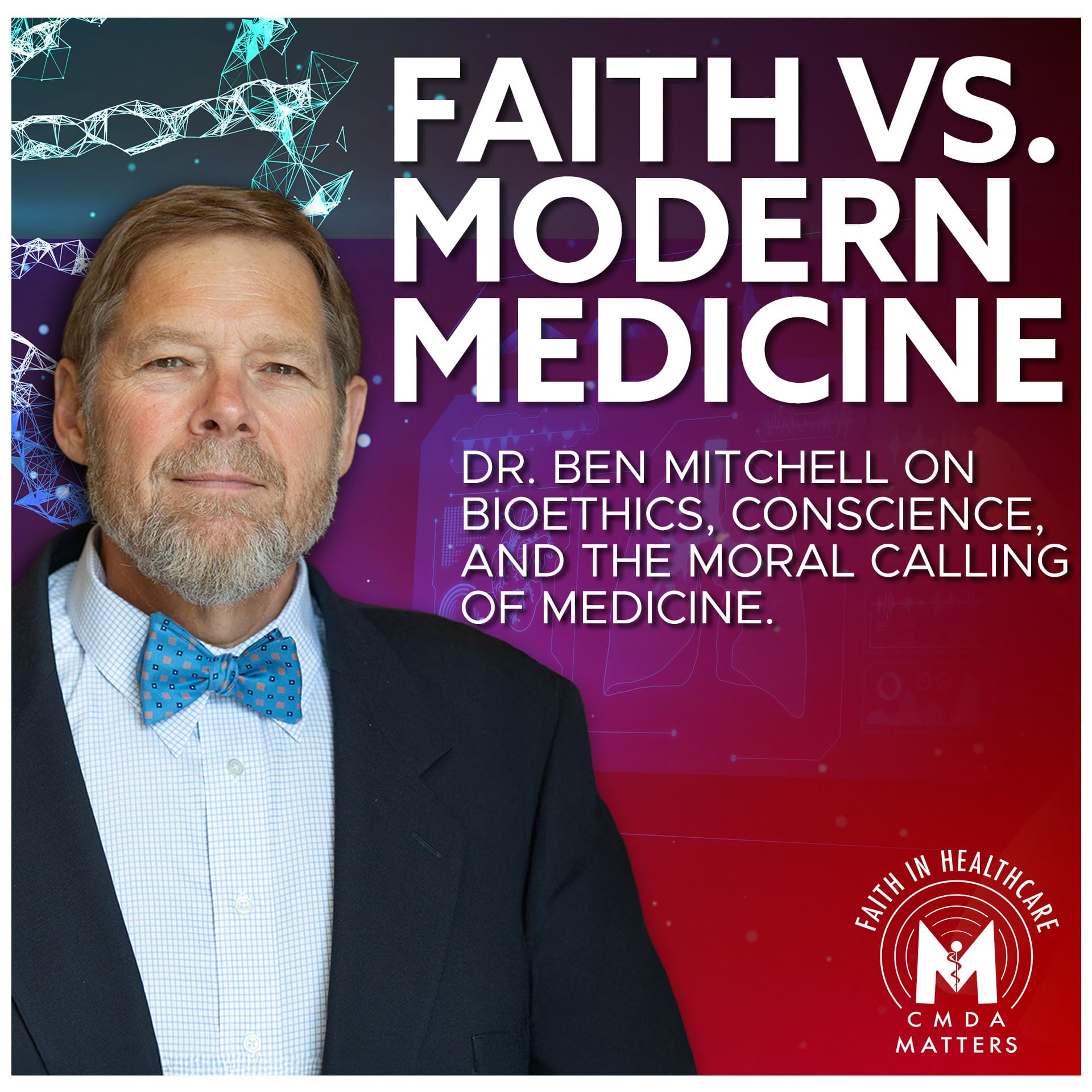
Well, next time Dr. Brick Lance and I will co host Dr. C Ben Mitchell. He's a leading bioethicist and moral philosopher for a conversation on his new handbook on bioethics and healthcare, which I frankly wish had been in my white coat pocket early on in my medical training.
Thank you for listening today to Faith in Health Care, where our mission is to bring the hope and healing of Christ to the world through committed Christ followers in healthcare.
We'll see you next time, Lord willing, on Faith in Healthcare.
[00:48:06] Speaker A: Thanks for listening to Faith in Healthcare, the CMDA Matters podcast.
If you would like to suggest a future guest or share a comment with us, please email cmdamattersmda.org and if you like the podcast, be sure to give us a five star rating and share it on your favorite social media platform.
This podcast has been a production of Christian Medical and Dental Associations.
The opinions expressed by guests on this podcast are not necessarily endorsed by Christian Medical and Dental Associations.
CMDA is a nonpartisan organization that does not endorse political parties or candidates for public office.
The views expressed on this podcast reflect judgments regarding principles and values held by CMDA and its members and are not intended to imply endorsement of any political party or candidate.