[00:00:08] Speaker A: You're listening to faith in healthcare, the cmda matters podcast. Here's your host, Dr. Mike chupp.
[00:00:20] Speaker B: Welcome, friends, to Faith in healthcare. I'm Dr. Mike Chupp, and I'm so glad that you're with us today.
If someone asked you why you're pro life, what would you say?
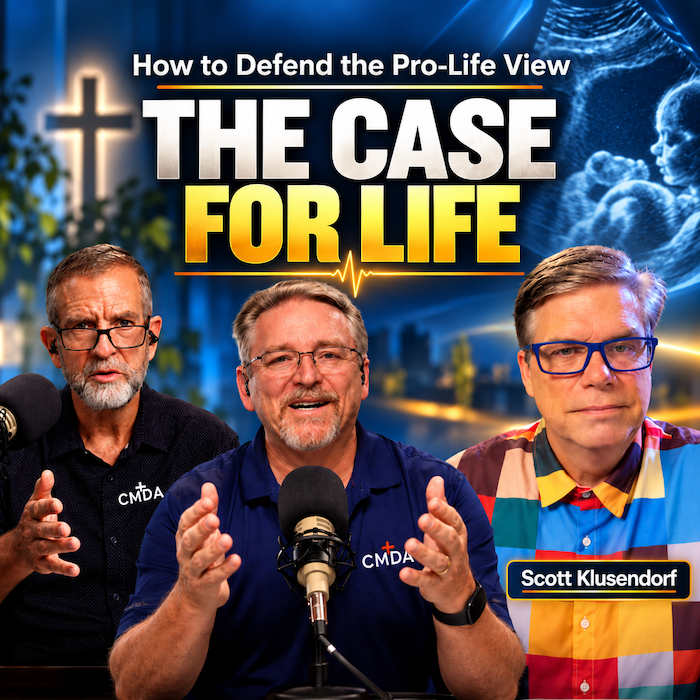
You may hold a deep conviction about the value of every human life, but explaining that conviction to someone who doesn't share your faith, well, that's another matter. Today, Dr. Brick Lance joins me for a conversation with Scott Klusendorf, who's the president of the Life Training Institute, and he's author of the book the Case for Life Equipping Christians to Engage the Culture.
For more than three decades, Scott has taught Christians to make a clear and reasoned case for the unborn and to ask better questions when a conversation gets tense. We're also going to talk about where healthcare professionals fit in and why. Your voice, it just might carry more weight than you think.
At the heart of it all is a question that touches every patient that we get to care for. Is their value inherent in being human, or does it depend on what they can do?
Here's our conversation. Let's listen in.
Well, today on faith and Healthcare, I've asked our vice president of advocacy and bioethics, Abe, who's been with me many times. Many of you will recognize his voice, Dr. Brick Lance, who commutes from time to time all the way from Eugene, Oregon. So welcome to the studio, Brick.
[00:01:54] Speaker C: Thank you, Mike. I love coming to visit you.
[00:01:57] Speaker B: Last year, you and I went up to Louisville for the Colson center annual meeting and both got to hear a very strong, incredibly powerful voice to protect the unborn. And why don't you introduce our guest who was speaking at that conference in Louisville?
[00:02:12] Speaker C: That'd be my pleasure. Thank you, Mike. Well, Scott Klusendorf, he is the president of Life Training Institute and the author of the Case for Life Equipping Christians to Engage the Culture. Scott has taught pro life apologetics at the graduate level at Biola University and Trinity Law School and lectured at more than 80 colleges and universities, including Stanford, Berkeley, UCLA, USC, John Hopkins, MIT, and the US Air Force Academy. Those are just to name a few of them.
At the practical level, Scott helps pregnancy centers. He helps them raise money, assist women facing unplanned pregnancies. The money raised helps women with shelter, baby clothes, parenting classes, medical care. Scott is a graduate of UCLA and holds a master's degree in Christian Apologetics from Biola University. Scott, welcome to the podcast.
[00:03:00] Speaker D: Dr. Mike Dr. Brick, good to be with you both.
[00:03:03] Speaker B: Thank you, Scott.
[00:03:04] Speaker C: Thank you, Scott. Hey, listen, Scott, we are big here at CMDA on mentoring. We would love our medical students, our residents and newbie physicians and such to be mentored. And we love providing mentors for them.
So you've had some remarkable mentorship in your career, and your career has been over many, many decades, including Greg Cunningham.
So I want to know how he shaped your thinking and other ones that you want to mention. In fact, you mentioned in your book the Cocyl Filter. We want to know what the COCO filter is.
[00:03:33] Speaker D: Yeah. Well, let me start with the mentors first and we'll get to the Kokol filter in a minute.
The two biggest voices into my life were Greg Cunningham and Greg Koukl. And they remain voices that I listen to. You know, one of the things I tell young guys that are coming up, the way you stay humble is to have a mentor because they'll call you out on stuff. And the way you stay effective is to have a mentor because they will always challenge you to be better than you are. They won't let you rest on your laurels. Well, Greg Cunningham is the guy that got me into this work. Greg is a former member of the Pennsylvania House of Representatives. He wrote legislation there that was litigated at the Supreme Court in the Thornburg decision. He wrote abortion control legislation that limited the evil of abortion. He is a guy that knows the political side of this, the legal side of it and the moral side of it. And I went to an event where he was speaking in November of 1990. At the time, I was an associate pastor at a church in South California. I always thought abortion was wrong, gentlemen, always. But I didn't lift a finger to stop it. I thought, okay, it's one of those issues, yeah, we should care about. But I didn't see a need to make it a priority. Well, that morning I went to that pastor's gathering expecting a couple of hundred other pastors there because it was a breakfast and pastors always show up when there's food, right? Well, when the topic was abortion, it was me, four other guys and their wives, and that was it. But here's the beauty of that morning. Greg Cunningham did not let the sparse attendance stop him from delivering the message he needed to deliver. And I was sitting in that audience and I heard a guy make a very compelling case for the pro life view. But then he did something that changed my life forever. He showed an eight minute video depicting abortion. I had never seen abortion. I sat there and wept. And I thought, I am no different than the priest and the Levite in the parable of the Good Samaritan. I passed by on the other side of the road. I may say I care about this issue, but I don't act like I care about it. And everything changed that day. I went home from that breakfast and I showed my wife the VHS tape he showed. By the way, VHS tapes were these rectangular things we used to show videos on. For anybody wondering what that is, our
[00:05:53] Speaker C: young people won't know that, but, yes,
[00:05:55] Speaker D: they don't have a clue.
Well, I showed her that video and I said, honey, I think my whole trajectory has changed. And six months later, with the blessing of my church, I resigned my associate pastor's role to pursue training Christians to make a case for the pro life view. So that's what I've been doing for the last 37 years.
[00:06:14] Speaker C: Wow. Wow. And tell us about the Kokel filter.
[00:06:16] Speaker D: The Kokel filter comes from my second mentor, Greg Koukl. Greg Cunningham taught me to be courageous. Greg Koukl taught me to be artful in my apologetics approach.
And Greg has a very good way of engaging people that isn't incendiary, isn't nasty. He's just very diplomatic and good at it. And he asks very good questions. And he has developed this line of questioning called the Colombo tactic. You may remember Columbo from the TV series.
Well, Columbo, this detective, just asks questions, and he gets to the bottom of these crimes. So rather than getting defensive when you're on the hot seat, you ask questions like, well, what do you mean by that when they call you an extremist, for an example? Oh, you're just a religious, political extremist. Tell me what you mean by extremist. Well, someone who thinks they're right. Well, help me understand here. Are you saying I'm mistaken? Yeah, I am. I'm right, you're wrong. Oh, you see the problem here? Then the next question that's so important is, how did you arrive at that conclusion? You know, people love to make all kinds of assertions that they just state without any evidence. And so by gently saying, tell me how you arrived at that conclusion, for example, that the fetus is just a ball of cells, tell me how you got there. In other words, what's the evidence for that? And then the third question is, have you considered the implications of your view? And what that does is help the person understand that they're going to pay a very high price for holding the position they hold. For example, I remember at the University of Maryland, an exchange student from Indonesia stood up at the end of one of my talks and said, I like you. You're very scientific, you're very philosophic. And I like you because you're not religious in the way you presented your case for the pro life view. Salute for that. But he said, I don't understand how you can claim that a fetus or an embryo that is not even self aware has a right to life. Now, most pro lifers at that point would start talking fetal development. They'd say something like, well, hey, by week six, we can measure heartbeat. By week 12, we can measure brain waves on an electroencephalogram. Wrong answer. You just conceded the premise that brainwave and cognitive function matter. So I pushed back. I said, tell me, why is self awareness value giving in the first place?
And how self aware do I have to be not to be killed? And I let the questions just hang there. And he stood there like a deer in the headlights. And then he got a smile on his face and he said, touche. No one had ever challenged his assertion. So the Coke filter has to do with those three questions. What do you mean by that? How did you arrive at that conclusion? And have you considered the implications of your view? It's a way of getting yourself out of the defensive position in the hot seat and putting the burden of proof back on the critic who was the one making the claims.
[00:09:14] Speaker B: Yeah, a mentor of mine. Scott, you say the best defense is a really good offense and putting it back on the others.
Well, you use a word that I've never used in a sentence in my life. So this is going to be a first for me. Your pro life case rests on a simple syllogism, and maybe I even pronounced that wrong.
[00:09:31] Speaker C: Brad. No, that was correct.
[00:09:31] Speaker B: Okay, very good.
[00:09:32] Speaker D: First time you got it.
[00:09:33] Speaker B: And here's the syllogism. It is wrong to intentionally kill an innocent human being. Premise two, abortion intentionally kills an innocent human being. Therefore, conclusion, abortion is morally wrong.
But I want to ask you this question. Speaking of asking questions, how often are you finding that simple argument, basic truth, working in today where we have clashing worldviews? Are you able to get through and how often?
[00:10:00] Speaker D: Well, the most important thing about the syllogism is, is two things. Number one, it shows that pro lifers actually have a formal argument for their position. We're not just asserting something, we're making an argument. Could our argument be mistaken? Of course. But they'd have to show it's mistaken. It's not enough to just assert that we're mistaken. But secondly, and most importantly, it cuts down on distractions. The minute you bring abortion up, people want to change the topic. They want to talk about choice, privacy, trusting women, not forcing your morality, yada yada, yada. Things they would never bring up if we were talking about killing five year olds, for example. Why do they do that? Because they want to dodge the central question in this debate, what is the unborn? And by stating my case as a formal syllogism, I keep the main thing. The main thing. And we can have a discussion on the merits of my case rather than all these distractions. By the way, all your listeners know that what I'm saying is true. Any of them that have been married more than 10 years know that if you're having an argument with your spouse and you're losing, every rational mind in the universe knows you're losing. The Lord Jesus knows you're losing. You're going to change the subject, right? I mean, it's human nature. So by having a formal case, we keep it focused on what really matters in this debate, which is the pro life argument, not all these side issues. You did mention worldviews, and you're right, those matter. And I wouldn't say it's a matter of either addressing the worldview or addressing the formal syllogism. Rather we now need to do both. For example, if your worldview is philosophical naturalism, your basic premise is the universe came from nothing and was caused by nothing. How does anything have right to life or, or dignity in that kind of universe? Well, it doesn't, because everything's a cosmic accident, right? So if pro lifers weighed into a conversation with someone who holds to philosophical naturalism and you start talking about how human life is sacred, the sanctity of life, the dignity of the individual, the person who's a philosophical naturalist is going to look at you like you stepped off Mars. Why? Because their worldview doesn't see any dignity in anything.
So it's important to be able to address that worldview, show where its shortcomings are, and challenge them to rethink that worldview. If they're a postmodernist, they think all reality is something we construct. We can't know objective reality as it really is because we're trapped behind our own sense perceptions. All we have according to that worldview is our own biases. That may be culturally conditioned or psychologically conditioned, but whatever, we can't get it truth and know it as it really is. Well, in that Case, a postmodernist is going to think of the child in the womb as a construction of the mother. If she thinks it has value, it has value. If she doesn't think it has value, it doesn't. So we get two pregnant women, let's say both of them at 30 weeks gestation.
One thinks of her child as an excited gift she's anxious to receive. The other thinks of the child as an intruder.
[00:13:09] Speaker C: And.
[00:13:10] Speaker D: And on postmodernism you can't adjudicate between the two. Neither one has really value other than what the mother gives the child. And then you come to the newcomer, the woke worldview. And that says that all knowledge is strictly from the perspective of the oppressed person. Objective truth is not only not known, it's oppressive. Because the only thing that counts as truth with a capital T is is what we call standpoint, epistemology, or lived experience.
Therefore, if you're trying to talk somebody into the pro life view and you're correcting their logic, if they're an oppressed person, they don't ask are your arguments good? They ask, do you have standpoint to even make a claim in the first place? And when pro lifers fail to recognize these worldviews that are in play, it can lead to talking right past the person you're trying to converse with.
[00:14:02] Speaker C: Hey, Scott, so I am going to ask you a worldview question then. And obviously you're great at apologetics because you're very logical and consistent, which are both important. But you know, reading your book, you're a philosopher, you're a theologian, you're a bioethicist. At least I certainly get that impression reading your book. You're very well read, you're very well educated, and you teach well. But here's my question, and let me give the premise. I think you'll find this interesting.
So I often get to speak to health care students, both nursing students, medical students, and I have a question that I ask them. And the question is whether human beings have intrinsic worth or if their value depends on their ability to contribute to society. When I ask that question after discussion, in the United States, almost universally though, they'll come to an agreement as a group that every human being has intrinsic worth. When I lecture in Eastern Europe, which I do frequently, and it's amongst all kinds of different faiths, you can imagine Hindu, Buddha, Islam, atheist, etc. Different countries from all over the world, I get a mixed response. They cannot come to an agreement whether human beings have intrinsic worth. In other words, you have to be Contributing something to have worth. So my question is, is America, is the United States losing this conviction that every human being is a mago dei, if you will, or has worth or has value because you've been in this business now for decades?
Is the culture changing?
[00:15:26] Speaker D: You know, at the academic level? Yes. And that should disturb us because academia filters down to popular culture at some point. So you get people like Peter Singer, Michael Tooley and others who argue that human beings are nothing special. All that matters is our immediately exercisable capacities, like valuing our existence over time, seeing ourselves exist through connected memories and whatever other arbitrary trait they pick out. Yes, those people are certainly less and less affirming of intrinsic human value or dignity. But your average man on the street isn't so quick to let go of that belief. For example, think about the debate about our borders. Right now there are people in the US Congress who say that the only human rights that exist are are those created by positive law through legislation of a legislative body like Congress or a state House. Senator Tim Kaine is an example of this. A year ago he argued that natural rights, those rights you have outside of government that are pre political, are actually a fiction and that they're oppressive and non existent. Well, that same Senator went on to argue that the immigrant coming through our border has a right to come into our country in virtue of his humanity, regardless of what our federal law states at the time. So on one hand he wants to deny natural rights that come to us in virtue of our humanity. On the other hand, he wants to affirm them when it comes to illegal aliens coming across our border. So this is the kind of sloppy conflict we get in the culture. And this is where pro lifers can make a very good point that our natural rights, those rights we have in virtue of being human, are pre political. For example, guys, I don't have a right to vote in the next UK election, though I'd very much like to. I love the uk. I love to visit there, but I don't have a right to vote there. Why? Because I'm not a citizen of that nation. But I do have a right not to be gunned down in the middle of Trafalgar Square every time I, I visit London. That second right, not to be gunned down is a natural right that the British Parliament didn't give me. The American Congress or President didn't give it to me. It's a right I have in virtue of my human nature. All humans have a right not to be gunned down in the middle of Trafalgar Square. Right. So that's a right that's pre political and government's job is to recognize and protect that right. And what our culture does today is it wants to say we're going to get rid of natural rights. Because obviously they're grounded in a transcendent source, some religious source, which I agree with. But what they end up doing is they kick away natural rights and then they go chase them back down again. It's like kicking a football down the field that you're punting and then running after it and trying to catch it when it's convenient. And it's convenient for them to talk about natural rights when it's illegal immigrants coming across our border, for example. Why those people have a natural right, a fundamental right to be here because they're human. I mean, humans have no borders, right? I mean, we've all heard these arguments, but when it comes to the child in the womb, and you argue that they also have a natural right to certain things, like a right to life, well, now they want to deny natural rights.
[00:18:47] Speaker B: You know, Scott, in your writings and your speaking, I think there are four key objectives that you have for the pro life movement. And I mean, a couple of them are pretty broad. So maybe it covers a lot of issues, but law and culture, pregnancy centers and post abortion healing. So why do you focus on those four? How do they work together?
[00:19:07] Speaker D: Well, let's take that first category, law. We need laws to win this fight. You know what is victory for the pro life movement? It's this. When each and every human being from conception forward is protected in law, meaning they have a right to life and they cannot be intentionally killed just because someone wants them killed.
So law matters because law reinforces the protection. Law also teaches valuable lessons, or I should say good laws do. They teach lessons that then get borne out in the moral culture that we live in. For example, think about anti smoking laws. Thirty years ago, you'd get on an airplane and there was a smoking section on the airplane.
[00:19:50] Speaker C: It was terrible.
[00:19:51] Speaker D: There was a smoking section in restaurants.
I mean, you know, nobody thought anything of it. Well, now if you light up a cigarette indoors somewhere, you're probably going to get shot. Why? Because the culture has changed so dramatically through the influence of law. Law is important. Good laws inform our morals. This is something that we see in Robert Bella's work, Habits of the Heart. It's an Aristotelian principle that we can date back to the classical times.
Clearly, our laws help shape culture. But we also have to have Culture, because you can't just pass laws that won't be enforced and won't be made permanent by the culture. You can't force something on the culture that it won't accept.
So some pro lifers make the mistake of saying, look, we just need to change hearts. We're not going to be about changing laws. Well, that's a big mistake.
Others say, you know what, we don't need to worry about the culture. We're just going to pass the pro life law we want and we're going to ram it through. And you know what? Who cares what the consequences are? Well, the problem is you can pass a pro life statute that will die standing up if the legal bench won't enforce it. You need juries to enforce it, you need judges to enforce it. You need DAs willing to bring prosecutions.
Without that middle game, your statute goes nowhere. So law and culture relate in that there's a reinforcement between the two of them. Now this gets then to what we talk about next, pregnancy centers. Pregnancy centers are the human touch to the culture. And the pregnancy center says to that woman, you don't have to kill your child. We're here for you, we will help you. And that's what pregnancy centers do. Which by the way, they outnumber abortion clinics now something like three to one, if not more than that.
[00:21:45] Speaker B: That's great.
[00:21:45] Speaker D: And these pregnancy centers operate totally on private funding. They don't get federal money the way Planned Parenthood does, the way abortion clinics do. And these centers help that woman bring that pregnancy to term and give her a strategy and help for dealing with the child after it's born.
Now, post abortion healing, the fourth thing I talk about is important because a third of all abortions annually in this country are repeat abortions. Why? Because the first abortion didn't get healed. And the healing that comes through the Christian gospel is the only thing that will bring about the resolution of that guilt and shame from that abortion. And that's why we need our churches who are preaching a cross centered gospel, who are preaching that man can get right with God because Jesus stood in their place condemned. And now they can be declared righteous in virtue of Christ's sacrifice on their behalf. So all these things reinforce each other. It's not pick one of the four. They all are important and the concerned pro lifer will treat them all as being important.
[00:22:51] Speaker B: Scott, you have described the mushy middle as a primary target in focus for apologetics.
So tell us who these folks are. What percentage of folks in our culture do they represent and why do you focus primarily on them for your apologetics?
[00:23:11] Speaker D: Well, I'll tell you why. Because like it or not, we need their votes to enact pro life legislation to protect children. You know, a lot of pro lifers think, who cares what the mushy middle thinks? We don't care what marginal pro life voting blocs look like or what they do. But the bottom line is you're not going to pass legislation without capturing people in the middle. And our ability to build coalitions with like minded people who maybe aren't with us on every aspect of our position, but they have enough pro life sentiment to go along with, you know, limiting the evil done to at least a certain point. We got to build coalitions with those people. You can't ignore them. And one of the things that concerns me right now is there are pro lifers pushing bills known as equal protection bills that basically say, look, we're gonna prosecute women for murder if they have abortions. The public is nowhere near ready to accept that less than 8% of the electorate thinks we should punish women who have abortions. And even if you grant that women know what they're doing, and I'll go ahead and grant that for the sake of argument, even if you think that as a North Star our law should treat all homicides the same, including unjust abortions, I'm fine with that. But the question now becomes, is it prudent right now to lead with legislation that prosecutes women for murder when we can't even get states to, you know, defeat pro abortion ballot initiatives that write abortion rights into the state constitutions? And oh, by the way, this is happening in red states, including states we thought were pro life, like Montana, Ohio, Missouri, Kentucky. And I think we're going to be in trouble in Idaho coming up in November. And then in Florida, we would have lost there except that there was a 60% threshold. And you could argue that even a state like South Dakota, the most pro life state in the country, arguably is at risk of having one of those amendments passed there.
In fact, I talked to a member of the state House there yesterday and he told me if that bill comes or that ballot initiative comes back in the next couple of years, he doesn't see how they're going to beat it. And he talked about one of the problems is pro lifers pushing legislation that the public and the culture is unwilling to accept right now. And what's happening is some of these pro lifers are letting their idealism outrun their prudence.
I'm all for abolition. I want permanent abolition. I don't want unsustainable abolition. That will be premature. And the problem is if you ignore the mushy middle, you're not going to be able to sustain your pro life legal strategy. It's going to get undermined by the courts, undermined by DAs that won't bring prosecutions, and undermined by juries that won't convict. Unenforceable laws are bad laws that teach bad lessons.
[00:26:16] Speaker A: Before we continue with this week's episode, here's a special announcement for you.
CMDA has a special October offer for you.
For a gift of any amount, CMDA will send a free copy of Scott Klusendorf's book the Case for Life Equipping Christians to Engage the Culture.
To take advantage of this special offer, visit CMDA.org October and we will send this book out to you as soon as possible.
Ladies, reconnect with your husband at the Women Physicians and Dentists in Christ marriage enrichment weekend, January 8th through 10th near Monterey, California.
Learn ways to strengthen your your marriage while enjoying time set aside just for the two of you.
Reserve your spot
[email protected] events.
Keep growing professionally and spiritually with the CMDA Learning center.
From CMDA event recordings to the Faith Prescription series and other continuing education opportunities. You can explore it all from any device and CMDA members earn CE credits at no cost.
Visit CMDA.org learningcenter to get started.
Let's jump right back into this week's episode.
[00:27:51] Speaker C: Well, Scott, I want to then come back addressing the church, which you commented on just briefly a minute ago.
And yes, since Dobbs, you know, a few years ago, four years ago, we've had multiple states again pass bills, you know, making a right to abortion. Again states that we would not have considered doing so, but consistently has happened. But part of the problem is we have churchgoers, for lack of better words, and I would say Christians in general that are voting for some of these amendments in these states.
So my question is how can the church do a better job of discipling believers in the biblical sanctity of human life?
In other words, are we teaching catechizing this well enough?
And how can we in health care, that's Mike and I. How can we in healthcare and our listeners come alongside the church? What can we do better to change the opinion within the church?
[00:28:47] Speaker D: Oh, that's a great question. Let me give you the marks of a pro life church and then tell you how medical staff intersect with that.
The marks of a pro life church are primarily Four marks. Here they are. Number one, a pro life church preaches and teaches a biblical view of human value. Humans are not valuable for what they do functionally. They're valuable for what they are, intrinsically creatures who bear the image of their maker. Then secondly, a pro life church preaches and teaches that abortion is the intentional taking of human life, what the Bible calls the shedding of innocent blood, and thus that is forbidden. Thirdly, a pro life church ministers to post abortion, men and women, directing them to the gospel of Christ as the only remedy for the resolution of that sin. And then fourthly, a pro life church equips its members to engage the culture. And here's where medical staff come in. Our opponents are spreading all kinds of lies right now. Primarily this one. Pro lifers want women to die, want them locked up, and want to deny them access to the medical treatment they need for ectopic pregnancy, for miscarriage and the like. All right, well, what happens is, like it or not, those lies resonate with marginal pro life voting blocs that aren't studying the pro life issue, who are just kind of those who feel a certain pro life sentiment, but they're not actually committed to our cause because they've researched it, studied it and made themselves experts on it. Those sentimental pro life voting blocs are easily swayed by rhetoric that says, oh, is it pro life for you to want women to die because they're going to be prosecuted because they won't get the medical care they need if they have a miscarriage? Do you really want that? And the marginal pro life voter hears that and thinks, well, that doesn't sound good to women. That's cruel. I don't want that. So they vote against any kind of pro life legislation or they vote in favor of an amendment that would write abortion into the state constitution. The great thing about docs and nurses, you guys like nobody else, have the ability to puncture these misconceptions. You know, it's funny, I saw a study, I think it was about six years ago, where it asked the public who speaks with the most authority in the culture? Well, as you can imagine, pastors were near the bottom, but so were lawyers. Lawyers were near the bottom. Guess who was near the top?
Doctors, Medical staff. They spoke with more authority than anyone. So when you see medical staff committed to the pro life view, who can step up? People like Dr. Christina Francis and others who stand up and say, these are all lies, you can get the medical treatment you need. Don't listen to these people. And docs step up and say we're going to fix these lies. We're going to correct them. It makes a difference. And imagine in a local church if a pastor on a pro Life Sunday had a doctor briefly share what the misconceptions are in the culture and educate the flock on this. It would make a difference at the ballot box.
[00:32:00] Speaker C: Yeah, Mike, I want to pause here a second and I'm going to resonate with what Scott just told us there. I would encourage our listeners to write down those four points and go to your church leadership and say, I want to help be a part of this church in teaching the imago dei and then pray about it. So gather with your small group and pray about it. I think this is so important that Scott has alluded to here.
[00:32:22] Speaker D: Yeah.
[00:32:22] Speaker B: You know, Scott, I was a guest on the Applog podcast Observations, and I told her I have a unique experience among physicians in America because I spent 20 years in a country where abortion generally was illegal and at a mission hospital, very busy OB service.
We were pro life. We were a pro life staff through and through. We never neglected women in distress. I mean, it would have been appalling to us to ignore a woman with an ectopic or any. And yes, there was a great deal of angst and frustration when a baby's life was lost. But you're right, we have the ability to say, this is nonsense. And I wonder, have either of you ever walked into a room in a debate? Because you've been in a lot, Scott, and and said, before we get started, let's just start with the things that we disagree on. Let's not spend time with a smokescreen on things that we really don't disagree on, like women needing health care who have an ectopic pregnancy and that mom's life matters. And then let's now talk about what we disagree on instead of confusing the issue.
[00:33:26] Speaker D: Yeah, well, do keep in mind our opponents intentionally are distorting the truth. They know that none of these pro life laws that have been passed deny a woman emergency health care. They all know that. In fact, many of the laws specifically define abortion as the intentional killing of the human life. And they go on to argue that things like treatment for ectopic pregnancy do not involve the intentional killing of the human life and therefore are not abortion, and therefore the statute does not apply to those cases. Our opponents know this, but of course they can get a lot of mileage out of it. And then when you combine that with pro lifers prematurely pressing legislation that says, hey, let's lock women up and prosecute them for murder. The public is going to be confused. And this is where doctors can step up and say, this is not the case. You can always get the medical treatment you need and you do not have to worry that if you're ever in an emergency situation, you're going to be denied life saving care.
[00:34:30] Speaker B: So Brigitte is a good role for our listeners, a great role.
[00:34:32] Speaker C: And not only that, Mike. So not everybody's Christina Francis, not everybody's Dr. Susan Bain, where they have a national platform. You don't need a national platform. You have your local community. And I think that's what Scott is saying.
[00:34:44] Speaker B: And that's where the trust is. That's where the trust is primarily. Yes.
[00:34:48] Speaker C: So Scott, let's switch gears a little bit from the church to higher education.
Our dear friend Dr. Bill Lyle, he leads a national organization, but what he does is goes into medical schools and shows them in utero surgery. So surgery on the patient in the womb, Fantastic. Clearly demonstrating that that is a patient because they're actually curing physical ailments of that patient. And you already alluded to with Greg Cunningham of seeing this video of an abortion taking place, which is gruesome, including my state that allows abortion up until the time of birth, which is really gruesome. I mean, they're all gruesome, but that's really gruesome. Right. So how do we then influence higher education? Are both acceptable again, this technique by Bill Lyle, just showing surgery of the patient in the womb and showing abortion, how do we convince higher education about educating that that is a life?
[00:35:38] Speaker D: The same way we influence everyone else. I don't think it's a choice between the prenatal pictures and the abortion photos. I say use both, especially in the age of chemical abortions now, where roughly 80% of all abortions are now chemical abortions being sent through the mail. Early imagery of the child in the womb changes the narrative from people thinking of these children as blobs to thinking of them as human beings. There's a wonderful site I love to use called ERF Science where they do work showing you very early embryos using a technology called Photoscopy. It's not ultrasound, it's actual video imagery. And you see hearts beating on these kids at four to five weeks in utero. It's amazing stuff. And when I've taken people to ERF Science and shown them some of this imagery, it's changed their starting point. The abortion pictures change how people feel about abortion as a necessary predicate to changing how they think and ultimately behave. Facts and arguments change how people think. The images, both prenatal and abortion, change how people feel. And in a postmodern culture like ours, we can't ignore the feeling aspect of this. So I commend Dr. Lyle on what he's doing. I think that's fantastic. Show these med students what's going on. You know, on that same point, in a recent debate with a pro abortionist, his argument was that child has no rights as a person until it's born. And so I asked the question, how does a change of location change the ontological status of the being in question?
And I cited for him an article in the New York Times, of all places, headlined Babies who Are Born Twice. And what the article was featuring is, is surgeries done in the womb to repair things like herniated diaphragms, where they remove the child from the WOMB at roughly 30 to 32 weeks, repair the herniated diaphragm, then put the kid back in the womb to be born normally at 40 weeks. And so the question I put to my opponent is, does that child go from being a non person before the surgery to briefly being one during the surgery while he's out of the womb, and then go back to being a non person again when he's tucked back in to be born normally several weeks later? I mean, this is the absurdity of the episodic problem the other side has.
[00:38:07] Speaker C: Yeah. And, Scott, just for your interest, that baby in the womb has a completely separate anesthesiologist and surgeon from the mother.
[00:38:15] Speaker D: Yes. There you go. There you go.
[00:38:18] Speaker B: So, Scott, I have many people close to me and around me. I won't say with a family or friends, but I have many who would identify as abolitionists.
And I've been told in no uncertain terms to my face, I'm not pro life enough as a pro lifer because I should be an abolitionist. There's infighting in the pro life camp to protect the preborn. So how can we do a better job working together?
You've talked about equal protection laws and so forth, but what's the way forward? How do I respond to those in my circle of influence who don't think that I'm pro life enough?
[00:38:53] Speaker D: Well, first of all, all pro lifers are abolitionist in principle. If there were a magic button we could push on your desk right now that would end abortion now and protect all unborn children, you would push it? I would push it. So does every pro lifer I know. The debate is about what do we do when we don't have the political power to protect all children? Do we protect as many as we can and thus limit the evil done? Or do we say, you know what, as a matter of principle, we're not going to protect any of them until we can save all of them because we don't want to teach bad lessons that some kids have value and others don't. Well, obviously, I think the duty of the Christian is to limit evil and promote the good insofar as possible.
Lincoln was absolutely an abolitionist on slavery. In fact, I've read several biographies about him, the best being Richard Striner's excellent book on Father Abraham. And Striner makes the point that there's no doubt Lincoln was committed to abolition in principle, but politically, he was willing to compromise and kind of jig and jag to get to the point where we could protect African American slaves. And the problem Lincoln had was even in the north, he didn't have support for total abolitionist slavery. He had the copperheads who wanted to reunify the country but leave slavery intact.
He had people that wanted to keep owning their own slaves. He did not have a popular mandate to just wave a magic wand and abolish slavery. He had to work incrementally to get it done. So he waited until 1862, for example, to issue his initial Emancipation proclamation. If Lincoln weren't committed to abolition, why did he refuse to sign the Crittenden compromise, which would have reunified the nation immediately but left slavery intact? And the answer is because Lincoln wanted abolition, but he knew he had to proceed prudently to get there. Wilberforce recognized that although he was committed in principle to abolishing slavery, he didn't have the votes in Parliament. And after 11 years of banging his head against the wall and going nowhere, he shifted tactics. He started working to outlaw the slave trade, which itself was an incremental step rather than full abolition. And then around that same time, between 1800 and 1805, he pulled back his general abolition bills because culturally, it was not a good time to introduce them. The British public was convinced that abolitionists were in cohertz with the French during the Napoleonic wars. And somehow, if the abolitionists were able to get their way, the public thought the French might win this war. So Wilberforce, recognizing the playing field he was in, pulled back his general abolition bills. Was that compromise or prudence? It was prudence. And instead, what Wilberforce did, he signed on to some regulatory bills. For example, bills that said how many slaves could be on a ship? What ports could these ships Dock at things like that, that some would say, well, he's just regulating the evil. No, Wilberforce was doing what could be done given the political hand facing him at the time. That's not compromise. The that's prudence that moves the ball forward. And people say, well, we should just push laws and don't worry about what the public thinks. Here's the problem. Merely getting a law out there does not mean you've done the work you need to sustain it. For example, a law that loses teaches a lesson as well. If your candidates and your bills keep losing, you're teaching the public that your cause is a loser. That's not good. What Wilberforce did is he got victories, real victories that underwrote future victories, and he was prudent in how he did it. So I would say here's how abolitionists and pro lifers can work together.
I'll give you three ways we can do this. Number one, right now, we should all be working to stop these state amendments that want to write abortion into our state constitutions. And here's why. An equal protection bill is dead on arrival and as is every other pro life bill in a state where abortion rights are written into the state constitution. Parental consent bill, debt on arrival. Equal protection bill, debt on arrival. If you want to get your bills going, you got to play the defense right now. That's required. So we should be working together on that. We should be working together to see to it that chemical abortion pills end up being a controlled substance. Being labeled as a controlled substance, requiring a doctor's visit and requiring proof of non pregnancy before they're dispensed, that would radically cut the abortion right. If we got rates, rather if we got that done. And then thirdly, we need to be working for free speech. We know what happened under the Biden administration. We know what happens when Democrats get power. They curtail pro life free speech. Under Biden's administration and in the state of California, for example, in other blue states, pro life pregnancy centers were told they must use their speech to refer for abortion or they'd be forced out of business with heavy fines. Well, we've got to stop that from happening. These are things we can do right now. And we shouldn't put those achievable objectives in peril by pushing legislation that has no chance of passing and is going to turn the public against us.
[00:44:24] Speaker C: Yeah. And then, Mike, just so the listeners know, our advocacy department is working very diligently on number two to get mifepristone under control. Stop the shield laws which allow it to cross state lines, et cetera, et cetera. So we're working diligently on that. And then let's not forget to mention one of Mike and our heroes is Benjamin Russ. Dr. Benjamin Russ from the 1700s who was abolitionist. He had a period in time where he owned a slave. And so people ignore his. But we all make mistakes.
We all make mistakes. None of us are perfect. But he was one that stood up and he signed, you know, he signed our Declaration of Independence. The one doctor signed it. Yeah. Yeah. So let's switch gears. Here's an opinion piece, opinion question for you, Scott. And we now know with this gender dysphoria, and I asked this reluctantly, by the way, because I'm a doctor, but medical malpractice lawsuits are working. It is actually turning the tide of these teenagers that are having their bodies distorted and they're winning large victories.
Is that a strategy within this pro life movement of suing the medical profession that are killing human beings?
[00:45:33] Speaker D: You know, it would take a grander legal mind than my own to answer that. I'll tell you what concerns me a little bit about it. Not that it can't be used strategically in certain contexts, but my concern is this.
Abortion is not wrong because it unjustly harms women. It's wrong because it unjustly takes the life of an innocent human being. The fact that women are harmed is a secondary result of the abortion. The primary evil is the child's life is taken unjustly and it's taken intentionally. So I want to keep the focus on the main thing. The other thing that, that I think I'm a little concerned about is the fastest rejoinder to a woman holding a sign that reads, I regret my abortion is five other women holding signs that say, we don't regret ours. You've made the issue subjective at that point, and I like to keep it objectively focused on the status of the unborn. Is it okay to intentionally take the life of an innocent human being? That's where I want to keep the debate focused. Could there be legal avenues to take where women sue abortion providers? Perhaps so I just am not sure how that would play out in the legal realm.
[00:46:46] Speaker C: So, Scott, we're going to end with a couple of questions here. And you have this famous acronym called sled, S L E D. If you could just briefly again define it for our listeners, and why every healthcare professional, not just the mushy middle public, but the healthcare professional, needs to know this acronym.
[00:47:03] Speaker D: Yeah. Just so everybody is clear. The SLED acronym was first put forward by Dr. Stephen Schwartz, a philosopher at the University of Rhode Island.
I have used it widely, popularized it, but he's the source of that. And what Dr. Schwartz pointed out is if you look at the differences between the child in the womb and you, the adult, or anybody else outside the womb, there are indeed differences. But that's really the wrong question. The question is not are there differences between you, the fetus and you, the adult? The question is, do the differences matter such that we could say you could be killed then, but not now? And he says, if you look at the four differences, you'll see a difference of size, a difference of level of development, a difference of environment, meaning where you're located, and a difference of degree of dependency.
And he says this, and I agree, none of those differences justify killing you at that earlier stage. For example, think body size. Yeah, it's true when you were an embryo, you were the size of a dot at the end of a sentence. But as a matter of principle, since when does body size determine value?
Shaquille o', Neal, the former basketball star with the LA Lakers, is a foot taller than all of us. But is he more human and valuable simply because he's bigger? Body size doesn't entail value. What about your level of development? Sure, the child in the womb is less developed than the adult he will one day become.
But since when does a level of development determine whether you live or die? And by the way, I want to pause here. Your listeners need to get this.
We need to put our opponents on the defensive when they make these assertions. When they say things like, oh, the fetus isn't developed enough yet. Instead of arguing fetal development at that point, look them in the eye and say, how developed do I have to be not to be killed and why that level of development and not something else? In other words, expose the arbitrary nature of this whole scheme.
So, you know, think about it this way. A two year old girl is less developed than a 21 year old young woman. The two year old girl does not have a fully developed reproductive system. Yet is she less human and valuable than the 21 year old who does? By the way, this is exactly what Abraham Lincoln would do when he would argue against slavery. Lincoln's critics like Stephen Douglas would say, oh, Mr. Lincoln, that black man is different than us. And Lincoln would say, yes, he is different than us, but is he different from us in ways that justify enslaving him? And then, to quote Lincoln almost word for word, Lincoln said the following oh, you say man A is white, man B is dark. The fair skinned man having the right to enslave the dark skinned man. Take care, by that rule you're a slave to the first person you meet with skin fairer than your own. Oh, you say it's not skin color, it's a matter of intellect. The white man you allege has superior intellect to the dark man.
Well, take care again, by that rule, you're a slave to the first person you meet with an intellect superior to your own. I think you can see what Lincoln was doing here. The very traits people were arbitrarily putting forward as decisive between black and white worked equally well to disqualify a lot of whites. And in the same way, these traits that people put forward to disqualify the unborn disqualify a lot of people outside the womb. For example, if you're going to argue that self awareness is what gives us value in a right to life, those who have more of it have a greater right to life than those with less. And human equality is out the window, put it on the ash heap of history. If you're going to argue it's the ability to feel pain, well, those who have a lesser capacity for that would be less of persons and less equal to all of us. And they too could be thrown on the ash heap of history. So I think you can see how these arbitrary traits that people pick out don't do the work they need them to do. And then E in that SLED acronym stands for environment. And that is the question where you are. Does it really have any bearing on what you are? When you gentlemen walk from your cars into the studio, you change location. I'm going to guess you journeyed at least 50 yards. Perhaps, but you didn't stop being who you were or what you are. How does a change of location from inside the womb to outside the womb change the essential nature of the unborn? That's what our critics need to argue for. And of course, they never do. And finally, degree of dependency. Yeah, you depended on your mother for survival when you were younger, but since when does dependency on another human being mean you can be intentionally killed? Now, correct me, guys, you may know this case better than I do, but I'm thinking of the case of the Henschel twins. These are two girls. They're now actually young women in their 30s, mid-30s, but the press has followed them from birth and here's why. They are conjoined.
And you look at a picture of these two women, you See, one set of legs, and then from the waist up, two body trunks, two shoulders, two heads. They share vital organs, they share a circulatory system. And it's been determined you cannot surgically separate them without killing both of them.
So if you don't have a right to life until you can live independent of anyone or anything, neither one of those girls has a right to life and both can be killed. Size, level of development, environment, degree of dependency. None of those are good reasons for saying, we could kill you then in the womb, but not now.
[00:52:35] Speaker C: Well, Scott, and that's going to lead to my last question. And there's just the recent case of maid in Canada. And I don't like the term maid. It's actually physician assistant killing, but where they actually killed an elderly woman who was dependent on others because they frowned on her dependency without the approval of the family. So we are living in a spiritual battle. So is this not the sanctity of human life in the womb? Is this not a spiritual battle? And how do we engage the spiritual battle?
[00:53:02] Speaker D: It is both spiritual, moral and cultural. Yeah, it's all those things spiritually. I think it's vitally important we come back to the role of the church. A culture will never be more holy than its churches are. And if our churches are silent on this issue, they are not going to be teaching the kind of cultural lessons that need to be absorbed by the neighbors that we live and work with day in and day out. So our pulpits need to be committed to being pro life churches. And that means preaching a biblical view of human value, preaching and teaching that abortion constitutes the shedding of innocent blood, which Scripture strictly condemns. It means ministering to post abortion men and women and helping them find resolution. It also means equipping our people to engage the culture with a persuasive pro life apologetic. That's where spiritual warfare is fought. You know, a lot of times we think of spiritual warfare as all things like praise and worship. You know, we get together, we sing, we praise the Lord, the roof rattles and we think, boy, we did spiritual warfare. It's funny though, how I see the Apostle Paul alluding to it in Second Corinthians, chapter 10. He alludes to it more as the taking captive ideas or arguments that exalt themselves against the knowledge of God, that that's really what spiritual warfare looks like. So when we equip Christians to make a case for life, which is what I tried to do when I wrote this book, the Case for Life, what I'm trying to do is equip rank and file Christians to do spiritual warfare by engaging ideas that are hostile to the true good and beautiful that God would intend. That's why we do spiritual warfare, to take those ideas captive.
[00:54:45] Speaker C: Yeah. Thanks, Scott.
[00:54:46] Speaker B: Well, Scott Klusendorf, we've run out of time, but I wanted to conclude by mentioning that in our show notes today we will have information about your life training institute. When did you launch that institute?
[00:54:58] Speaker D: We started in October of 2023.
[00:55:02] Speaker B: We will have a link to your institute and all the information resources available there. And I just want to say I've waited 14 months for this interview after hearing this.
[00:55:12] Speaker D: You did.
[00:55:14] Speaker B: And it's been worth the wait.
[00:55:15] Speaker C: It has been worth the wait. I could talk for another three hours with you, Scott.
[00:55:19] Speaker B: Yes, I guarantee you that's possible with Brick.
God bless you, Scott Klusendorf, and your ongoing work to educate, to do apologetics and the sled acrostic. Maybe we'll have our videographer Jared put up a nice little acrostic there. So many of us are visual. It'll be good to have that on
[00:55:39] Speaker C: and the syllogism as well.
[00:55:40] Speaker B: Yeah, how to spell syllogism maybe.
[00:55:42] Speaker D: And you know what else I'll do? I'll email to you a one minute defense of the pro life view that your people can commit to memory when they're asked why they're pro life. I gave that at the Colson Center. In fact, they have a video of me doing that. If you want to go secure that
[00:55:57] Speaker B: in the show notes for those of us who like to memorize things, that would be a fantastic thing to have. Thank you, Scott.
[00:56:03] Speaker D: Well, thank you guys for the work you do with your organization helping medical staff understand the issues biblically and morally. I appreciate both of you.
[00:56:12] Speaker C: Thank you, Scott.
[00:56:12] Speaker B: Thank you, Scott.
Many thanks to Scott Klusendorf for joining us today and to my co worker Dr. Brick Lance for helping us lead this conversation.
One point that I hope stays with you is that human dignity doesn't mistake diminish when someone becomes more dependent on our care.
As Christian healthcare professionals, we serve people at some of the most vulnerable moments of their lives.
Our belief that each person bears God's image, it should shape both the care that we provide and the way that we speak on their behalf.
I also want to return to Brick's encouragement.
Please talk with your church leadership about how you might help.
You don't need a national platform to make a difference.
Your clinical experience can help correct misconceptions in your very own congregation.
And as we speak about abortion, we must also make room for those carrying grief or guilt to hear the hope of forgiveness and the restoration they can find in Jesus Christ Christ.
You'll find links to Scott's Life Training Institute as well as his book, the Case for Equipping Christians to Engage the Culture in Today's show. Notes and don't forget, for a gift of any amount, we at CMDA will send you a free copy of Scott's book. You can take advantage of this special offer by visiting CMDA.org October and and we'll send it out as soon as we can.
If this conversation would help a colleague or someone in your church, I hope that you'll share it with them.
If you'd like to learn more about CMDA and connect with our community of Christian healthcare professionals, you can just visit our main
[email protected] Next week, Dr. Brick Glantz is going to join me again for another Q and A session as we respond to questions from our CMDA members and other listeners about the challenges of following Christ in healthcare. Today we're going to discuss difficult clinical decisions and questions of conscience considering how our faith shapes our response each day. I hope that you'll join us.
Thank you for listening to Faith and Healthcare, where our priority promise to you as a listener or better yet, a regular subscriber to this podcast.
And that's whether you're a healthcare professional or a patient who loves Jesus Christ. Our promise is this.
We will do everything that we can to keep your faith and healthcare connected. We'll see you next time, Lord willing.
[00:59:15] Speaker A: Thanks for listening to Faith in Healthcare, the CMDA Matters Podcast. If you would like to suggest a future guest or share a comment with us, please email cmdamatters cmda.org and if you like the podcast, be sure to give us a five star rating and share it on your favorite social media platform.
This podcast has been a production of creative Christian medical and dental Associations.
The opinions expressed by guests on this podcast are not necessarily endorsed by Christian medical and dental associations.
CMDA is a nonpartisan organization that does not endorse political parties or candidates for public office.
The views expressed on this podcast reflect judgments regarding principles and values held by CMDA and its members and are not intended to imply endorsement of any political party or candidate.