[00:00:08] Speaker A: You're listening to faith in healthcare, the cmda matters podcast. Here's your host, Dr. Mike chubb.
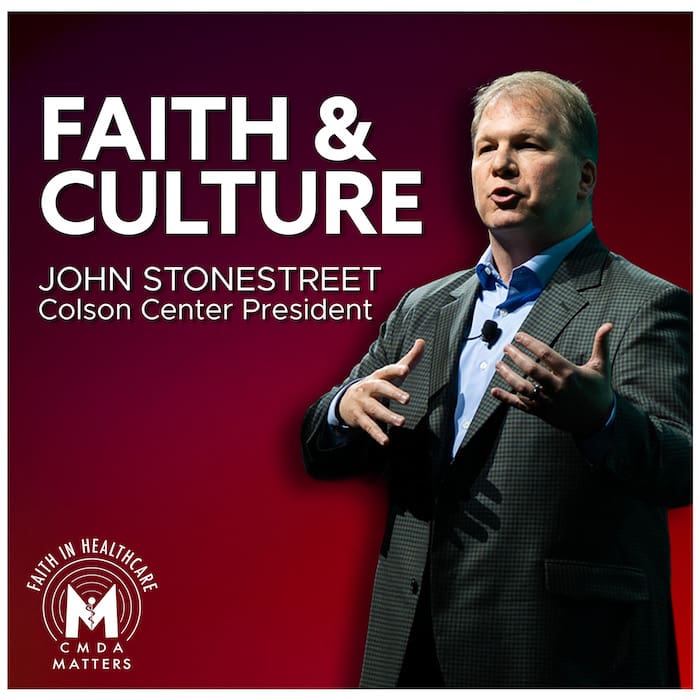
[00:00:19] Speaker B: Welcome, friends, to Faith in Healthcare. In our episode today, we are resharing a very special plenary message from 2019 by Mr. John Stonestreet, who is the president of the Colson Center. He's author and the daily voice of Breakpoint podcast.
It is an incredible talk. I remember being there on that evening and was so inspired. John invites us to ask a question that reaches far beyond politics or any headlines.
Not only what we are saved from and what we're saved to, but what we are actually saved.
If this conversation resonates with you. Well, John Stonestreet will be also speaking at this year's CMDA National Convention in April in Loveland, Colorado. He's one of many thoughtful voices that will be joining us, and we hope that you will consider being there also.
So let's dive in.
[00:01:27] Speaker C: I'm the president of the Colson center for Christian Worldview. Does that name Chuck Colson ring a bell? Of course. Chuck Colson was known for having what we often say is three lives. His first life was as Nixon's hatchet man, right? And that was a catalytic event. In his 30s, Chuck was such a gifted guy that he found himself with an office right down from the over office, the most powerful office in the planet. And Chuck was caught up in the Nixon White House and was what he would often describe as the arrogance and the power hungriness of that particular White House. And it ended up sending him to prison. But before he went to prison, in fact, before he knew he was going to prison, after he left the White House and had re engineered Nixon's second election by really engineering one of the greatest landslides in American political history, Chuck Colson found himself lost. And he went to see a former law client of his and this former law client of his. As he walked into the office, the other colleagues of Tom Phillips said, Tom doesn't want to talk about business, he wants to talk about Jesus. Because Tom had gone to a Billy Graham crusade and had trusted Christ and shared Christ with Chuck Colson. Specifically, in his home, in his living room, read a passage out of a book called Mere Christianity, a passage on pride. And. And that's when Chuck came to Christ. And that would start kind of his second life as a follower of Jesus, which immediately took him into prison.
And not only into prison, but back to prison when he was released.
As he was in prison, in fact, this is how the story goes. The night before he was gonna be released for his Watergate related conviction.
One of his cellmates said, chuck, you're a big shot. And big shots like you forget little people like us. And Chuck said, no, I won't. And the guy said, yes, you will. And Chuck said, no, I won't. And the guy said, yes, you will. And we're all pretty sure the reason Chuck Colson started the largest prison ministry in the world is that someone told him he wouldn't. And if you knew Chuck, that's kind of how he rolled, right? But something happened with Chuck as he was building Prison Fellowship ministries. How many of you guys have been involved in Prison Fellowship? Angel Tree or something like that? Remarkable ministry dealing with those who are in prison and their families. But as he was doing this and building this and as it was spreading, something else was happening in the cultural context. And this is really a punchline for tonight. And it would be hard enough to follow Jesus if all we had to deal with was our own wrong thinking and our own sin nature and all of that. But there's this whole other factor to the equation, isn't there? It's the factor of our cultural moment and this moment that puts so much pressure on the outside.
There's an old Chinese proverb that says, if you want to know what water is, don't ask the fish.
Now, why wouldn't you ask the fish? I asked a group of students that a couple years ago. They're like, I don't know. Because fish can't talk? No, because fish don't even know they're wet. And what water is to fish culture is to humans. And this is what Chuck was realizing as he was trying to build this prison ministry. And I remember having the privilege of traveling and speaking with Chuck the last several years of his life. One of those times was when I had the opportunity to meet David in Dallas, and Chuck would often, you know, say. He said, I just couldn't figure out why California could build and fill prisons faster than I could start a Bible study in one. And this was the time I remember he would throw out these numbers that when he was incarcerated, there were about 250,000Americans that were in prison. And today, and this would have been 2010, 2011, he would say, today there are 2.2 million.
So what happened and what Chuck Colson realized, and this is what we often call his third life, is when Chuck Colson went upstream from the prisons and asked the question, what was broken in culture that was leading to broken lives, that was leading to filling the prisons?
And that's what we have to think when we think about law and we think about politics and we think about any challenge that we face on a day to day basis.
Nine times out of ten, these challenges are coming to us downstream from a cultural source, upstream to us downstream.
And so what I want to wrestle with tonight is that relationship between Christians and culture. I want to wrestle with this idea of what if we're Christian fish swimming in this water? What does that look like for us? And I'll give you another punchline. I, I think Christians often do a lousy job understanding the culture in which they live. And especially I think in the American context and the American context, especially in our time and place, the culture does often a lousy job understanding us. Is that fair enough? Like we don't, we're not doing well right now in our communication with the culture. I'll tell you an example of this. I live, as David said, in Colorado Springs, Colorado. And when I had first moved there, it was 2007. I was driving around on a Sunday morning with my family and I was looking for a church that we were going to visit. We were in our minivan, had the radio on. Suddenly there was a breaking news bulletin that came across the radio. There's been a shooting at New Life Church. Now, New Life Church is the largest church in Colorado Springs. It's the closest thing that we have to a megachurch in the sense that there are like 13, 14,000 people on a Sunday morning. It's a very well known church. And there was a shooting on a Sunday morning in October, in 2007. You may have heard about this. There was a 20 something young man who had had all kinds of mental issues and so on. He had been kicked out of a YWAM base. So he drove up to a YWAM base outside of Denver, Colorado, shot two people in the middle of the night when they answered the door. And then he drove to this large church that was associated somewhat with ywam and he was armed to kill a couple hundred people. And he would have, he killed two people in the, in the parking lot, killed two more people in the doorway of the church until a security guard who said that she'd heard that morning from God that she was going to have to see some action, shot him and took him down right there in the doorway of the church.
Now, I was driving around that morning and suddenly there's a breaking news bulletin. There's been a shooting at New Life Church, right? Turn it up and want to know what's going on.
And of course there was chaos. There was misinformation. They didn't know if the shooting was over, if there were one shooter or two shooters. And suddenly as I'm listening to the news reporter trying to tell this story, she says there's someone on the line that was there. And I don't know exactly the chronology of this, but apparently there was a guy who was in the parking lot. He saw the first two people get shot. He panicked, ran down the hill, flagged down a car. And whether he called the police station first or the radio station first, I don't know. I just know that I'm listening to this conversation happen live. And the news reporter asked him a question. Here's what she asked. She said, was mass still going on when the shooting took place?
And he replied, huh. And she said, was mass still going on when the shooting took place? And he said, huh. And she said, was mass still going on when the shooting took place? And he said, huh. And she said, was mas. I promise. This went back and forth eight times.
Now listen. This woman is a news reporter in Colorado Springs. Have you heard about our town like we're known for all the evangelical organizations that are in town? Last time I saw this in the paper, there are 3,501 C3 nonprofit religious organizations, everything from Focus on the Family and Compassion International to the Christian Cowboy Association. There's three. Did you know there are three Christian Cowboy associations?
Man, that split must have been ugly. You know what I'm saying?
This woman is a news reporter in this town.
In the town. We joke about our town like we are the Mecca of evangelicalism. You're not an evangelical until you take a pilgrimage to our town once in your life and go down the wits end slide at Focus on the Family.
This woman is a news reporter in our town.
She doesn't know that the largest, most well known evangelical mega church in town doesn't have mass.
This guy doesn't know enough about Christianity, even know what mass is.
And it was just this kind of strange conversation. And I think this is one of the things we've got to stop and back up and say, what should our posture, what should our thinking, what is our responsibility to culture in the first place? Now I'm going to tell you. I think sometimes the root of this we can talk about how the culture misunderstands us, but that's only partially helpful. Let's talk about how we miss it as Christians. I think one of the ways that we miss it as Christians is that we often think about culture and we start with the wrong first question.
When I was growing up, we. We understood culture to be just the stuff that's out there. You know, the clothes and the movies and the colleges and the politicians and our job was to look at all this world of stuff and draw a line through it. I call it the line question. Where do I draw the line? Right. And we divide the world up between this part of the world and that part of the world. Everything on this side of the line is good, and everything on this side of the line is bad. And everything on this side of the line is Christian. And. And everything on this side of the line is worldly. Everything over here is sacred. Everything over here is secular. So when I was growing up, Christian music good, rock music bad. And then someone came up with Christian rock music. We didn't know what to do. That was confusing.
And I grew up in an environment where you weren't supposed to go to movies. It wasn't just some movies. You just don't go to the movie theater because bad movies are made, and they are.
But then Billy Graham started to make movies, right?
But we figured that one out. If Kirk Cameron is in the movie, it's good.
Of course, there's no question that we all have to say no to things in our culture. Our culture, particularly American Western culture, provides us with unbelievable choice and autonomy. And the illusion is that any choice is good just because we have the right to make a choice. Right? This is a whole new definition of what it means to be human. You'll hear this tomorrow morning.
I'm thinking from Nancy Pearcey that really, human dignity in our culture has been redefined as the ability to choose whatever we want, especially sexually.
So don't get me wrong, we've got to make some choices in our culture, and we're going to have to say no to certain things.
But I just think there's a better first question.
And I owe the framing of this question to my friends up at the Acton Institute. But I love the way that they put it in their little quirky film series that they put out called for the Life of the World. Here's the question. What is our salvation for?
Let me say that again. What is our salvation for?
By the way, I usually have a set of slides that go along with this talk.
And I wasn't able to get the slides going for various reasons. But if you would like a copy of those slides. Would you like a copy of those? I would be happy to send them to you. I know some of you, I talk fast. Did you notice that?
And so if you would like a copy of those slides, our booth is right there. You can just go right there to the Colson center booth and sign your name and we'll email you that. Okay. Just don't do it right now. Do it after the thing.
What is our salvation for? You know, as Christians, we talk a lot about what our salvation is from.
We're saved from sin, saved from the wrath of God. We're saved from the judgment of God. Amen. And let me just be really clear. If that's all there was to salvation is what we're saved from, you still should take that deal and tell everyone you know about that deal, because that's a great deal.
We might talk about what we're saved to. We're saved to heaven. We're saved to eternal life. We're saved to an eternal union with God in Jesus Christ by the power of the Holy Spirit. Amen, man. If that's all there was to salvation, is what we're saved from and what we're saved to, man, that would be great.
But here's the other preposition, the third preposition, not just from and to, but what are we saved for?
Do you ever wonder this? When I grew up, I grew up in a Christian home, went to a Christian school, and oftentimes when I thought about and heard about salvation, it was about what we're saved from and what we're saved to. Saved from hell, saved to heaven. That's an easy choice. And so I often wondered, well, if that's the point, to not go to hell, but to go to heaven, why does God keep us around after we're saved?
Anybody else wonder this growing up? Right. Why doesn't God just take me immediately to heaven? Because then I wouldn't sin, and then I wouldn't have to worry about that person that keeps making me sin.
Right?
That's the question. That's what I mean by what is our salvation for? Another way to say it is, why are we still here?
One story that's really helped capture my imagination on this question, what is our salvation for? Is the story of a student group that stood up courageously against the Third Reich and Adolf Hitler during World War II. They were at the University of Munich. If you go to the Holocaust museum in Washington, D.C. and you go through the main exhibit, right before you come to the end of that main exhibit, there's a wall that celebrates all the Gentiles that stood up for the Jews.
And on there, there's thousands of people. These are Amazing stories. One of them is a group called the White Rose. They were led by a brother and sister, Hans and Sophie Scholl.
There's a phenomenal movie about this with German that's in German but with English subtitles, called the Sophie the Final Days.
See, Hans and Sophie Scholl, they grew up in a typical German Christian home. And what I mean by that is the sort of typical German Christian home that was more German than Christian, and it was kind of more cultural than real. And so they would have just kind of gone along with most Christian families, which is either staying quiet or walking lockstep, literally and figuratively, without Hitler. But something happened to Hans and Sophie Scholl. They went to college, and while they were in college, they were mentored by some professors. And this mentoring relationship led them to beyond a cultural faith to a personal relationship with Jesus Christ.
And as their personal faith grew, they realized that their personal faith was putting them in conflict with the culture around them. And they became increasingly disgusted, especially Hanschul, by what they saw happening from the Third Reich. And so what they did is they gathered a small group of students, and over a period of two years, they published six different pamphlets. And they distributed them around the university campus and even around nearby neighborhoods, documenting the atrocities of the Third Reich, from human rights abuses to the execution of the Jews to terrible military strategies and everything else.
They did it six times.
During their sixth distribution, the students were tucked away in an assembly, and so they were trying to scatter them across these pamphlets across the campus. And they were just about to run out of time. The students were just about to be released. And so Sophie Scholl saw the last stack of pamphlets that they had, and she took it to the top of the university tower, and she pushed it over, and the paper scattered across the ground. And a janitor spotted her, turned her in for littering.
But within four days, her, her brother, and one of the other students had been brought in for questioning, accused of treason, put on trial, convicted of treason, and executed by guillotine in four days.
If you go to that campus today, there's a memorial to these students, and it's bronzed papers on the ground.
Hanschul had a motto. As Steve Garber tells this story in his book, the Fabric of Faithfulness. He talks about this, and he talks about Hanschul's motto. I love this motto. Here's what it is. He said, I'm Christian and I'm German, therefore I'm responsible for Germany.
I'm Christian and I'm German, therefore I'm responsible for Germany.
Now, that's a strange question. What is he trying to say? What he's trying to say is that for Hanschel, the fact that he's a Christian and the fact that he's a German seem incidental to one another, but they're actually not. They're. Actually.
There's a responsibility, a calling that's implied by that.
In other words, it's not an accident that he's a Christian and it's not an accident that he's German. So he's got to put the two together. The place to go really to see this unlocked is Acts, chapter 17. When the apostle Paul gets a chance to talk to the Epicurean and Stoic philosophers on Mars Hill. He says an awful lot of interesting things about God, but he's engaging a group of thinkers that don't have any sort of biblical framework whatsoever. You remember, because he goes to Thessalonica first, and then. Then he goes to Berea first, then Thessalonica, right?
And then he talks to the Athenians and he tells them about Jesus. They don't even know who that is. And they say, what is this babbler trying? They have no context whatsoever. So Paul's talking to the Epicureans and Stoics, and he says so many really interesting things. But here's one of the things that he says. Ready? That the God who created everything determines the exact times that people live and the boundaries of their dwelling place. Place.
Did you realize that?
Do you realize that it's not an accident that we find ourself in this cultural moment and not in another cultural moment that God wanted us here and not in another place that God. Now listen, I have a hard time with this. I have a hard time with this, especially as a dad.
I have three daughters.
And you know what those three daughters did for six years?
They prayed that God would give them a little brother.
And they won. So now we have four kids, three daughters and a son. But I tell you what, if you have kids or grandkids here, do you ever think these thoughts, like, why do they have to be alive?
Why? Couldn't have been a little bit different? Why this world?
I don't know about you, but I struggle with this.
Why can't my kids live in the good old days? I don't know when they were, but I've read about them. They sound awesome.
And the answer is, it's God's fault. God determined the exact times that people live and the boundaries of their dwelling place. This is what Hanschel was getting at the fact that he's Christian and the fact that he's not only German, but German in that cultural moment was ordained by God. And somehow when you put the two things together, you get calling, you get what we're saved for.
How would you write that out? I'm Christian and I'm. Think about the details of your life that you didn't choose. I'm Christian and I'm American. I'm Christian and I'm North Carolinian. I'm Christian and I'm male, or I'm Christian and I'm female. I'm Christian and I'm a sister or a brother. All these details. You didn't choose. This is really easy, by the way, when you do this in Texas. I'm Christian and I'm Texan, therefore I'm responsible for the universe. You know how Texans are so, so obnoxious.
So what are we safe for? Let me tell you two things that I think we're not safe for. And we need to be really clear about this, particularly in the face of the challenges of this cultural moment. Ready? Here's the first thing that we're not saved for. We are not saved for escape.
There are escapist religions. What I mean by that, there are religions where the point of those religions or worldviews or philosophies is to help you escape from this trouble around you. Buddhism is an escapist religion. The whole point of Buddhism is to enter a place of mental escape where you don't want anything. You rid yourself of desire, which means you rid yourself of suffering, and you can enter a place of mental contentment.
Hinduism is an escapist religion. You don't escape through your mind. You escape through the cycle of births and rebirths called reincarnation until you finally get it right. And the goal of getting it right is not to live again. It's to. To stop living, to be absolved in the oneness of the universe.
Oprah ism is an escapist religion. That's just my name for kind of the American way of thinking about religion a lot of times, right? Which, you know, religion is something to make me happy. And so I basically, I escape from the bad thoughts. I stop thinking about the negative, and I only focus on the positive. And that'll make good things happen in my life.
So there are escapist religions.
Christianity is not an escapist religion. We are not saved for escape. And I think it's for two reasons. Number one is you can try to escape the larger culture around us, we can try to escape the brokenness. We can hide from it. We can kind of try to find our path to safety, but it doesn't really work.
I found this out with my own kids about five or six years ago. I was flipping pancakes on a Saturday morning and my wife put on a praise CD, and the CD that she put on was 10,000 reasons. Right. You know that song, right? Bless the Lord. Oh, my soul. You remember that song? And my middle daughter, out of nowhere just pipes up. She's like 6 at the time. She's like, hey, Daddy, is that Justin Bieber?
I was like, what?
I don't even know how she heard Justin Bieber's name, because we have never had a Justin Bieber song in our house ever.
So we spanked her. And I'm just getting ready to do that. But you can do your best to try to keep culture out, but that's not the way that culture works. It's like the water that we swim in. But here's the deeper point. Christianity is not escapist, because at the center of Christianity is Jesus Christ.
And Jesus Christ is revealed to us in the scriptures in so many different ways. One of the most beautiful places, of course, is in John chapter one. As. As one theologian said, john chapter one is like a pool in which a child can wade and an elephant can swim.
Because John 1 goes deep fast, doesn't it? In the beginning was the Word, and the Word was with God, and the Word was God. And it goes on to talk about how the Word made all things. Then we get up to verse 14, and what does it say? And the Word became flesh and dwelt among us. That's more than just a proof text. John is revealing that Jesus himself embodies the trajectory of God as he has interacted with the world all the way through creation. Let me say that again. In John, chapter 1, verse 14, John is describing the trajectory of God to his world.
If you think about it, the Word became flesh, the Word became flesh. The trajectory is not God trying to escape, escape his people out of here. It's actually God just systemically. In fact, you can see this all the way through the creation, all the way through the biblical story, from Genesis, all the way to the maps. What you see is that time after time after time after time, God comes and walks with his people. He comes and deals with Adam and Eve. He comes and actually deals with Cain. He comes and walks with Enoch in the cool of the day. He comes and works with Noah. He comes and calls Abram out of all of these nations and makes of him a great nation. And when he pulls him out of Egypt, he walks with him embodying a pillar of fire and a pillar of cloud. He comes and indwells the tabernacle, the words of the prophet. He fully comes in Jesus Christ. Amen. The fullness of the Godhead and bodily form. Paul says. But Jesus himself said, it's good that I go away, because if I go away, God, I'm gonna send you what the Holy Spirit. So God comes down again even when Jesus goes away. In fact, from the beginning of the biblical story to the end, the only time God stops coming down and being with us in this world is in the new heavens and new earth.
And that's because it says, not that God pulls us out of here, but because God moves.
God says, behold, I make my dwelling among men a tabernacle among men.
So the center of Christianity is Jesus Christ, which gives us a trajectory that God isn't about escape, that God reveals Himself fully in Jesus Christ and the center of our understanding of who we are as Christians is God walking with us through this world. Ultimately, in Jesus Christ, Christianity is not escapist.
[00:26:03] Speaker A: Before we continue with this week's episode, here's a special announcement for you faith and healthcare listeners. We want to invite you to the 2026 Remedy East Mission Conference, happening March 6 and 7 at Liberty University in Lynchburg, Virginia.
Remedy exists to equip and encourage healthcare students, trainees and professionals to live missionally, serving Christ through their vocation, wherever God has placed them.
This year's theme, Beautiful Feet, drawn from Romans 10:15, reminds us that God uses ordinary faithfulness to accomplish extraordinary things.
Whether you're an undergrad in professional school or residency or actively practicing in healthcare, you'll find plenary sessions and breakouts designed to challenge, encourage and strengthen your calling.
All healthcare related students and professionals are welcome and we'd love to see you there and mark your calendar for the 2026 CMDA National Convention, April 23 through 26 in Loveland, Colorado, a time to renew your spirit, recharge your faith and connect with fellow believers in healthcare.
We're thrilled to welcome John Stonestreet, President of the Colson center and co host of breakpoint Radio, a nationally recognized voice on faith, culture, theology and Christian worldview.
Convenient lodging is available at Spring Hill Suites by Marriott, with special CMDA room rates reserved for attendees.
Learn more or register for either
[email protected] events let's jump right back into this week's episode.
[00:27:56] Speaker C: And I've gotta say, I think that one of the idols of the church in this generation, when we stand before God and he could, you know, idolatry pops up in all kinds of different forms. I think one of the idols of this generation is safety, the idol of safety.
And it's an idol that we got from the world. Do you remember about. I think it was six or seven years ago, the COVID of Time magazine had the bubble wrapped kid, right? The kid who we try to keep safe from everything. And a lot of us talk about how, you know, we used to go on road trips and ride in the back window, you know, and we don't do those things. And, you know, we used to have, like, welding sets for little boys.
You know, it's probably a good idea that we don't anymore.
But there is something about our culture that just kind of wants safety. We'll sacrifice our national freedoms on the altar of safety. Safety.
Safety is an idol, and it's an idol in the church as well. But we're not safe for escape quickly. Let me tell you the second thing we're not saved for. We're not saved for accommodation.
And by accommodation, I just mean just like we're not saved to escape the culture. We're not saved to sell our souls on the culture's altars either.
And this is a real challenge. Every generation of Christians faces that challenge. How do we live in this culture where without losing those things that are essential to our identity as Christians? And we're facing that right now. There's an awful lot of cultural pressure out there. Isn't there anybody else here a little dizzy by how quickly things went from being unthinkable to unquestionable, especially for our kids.
Anybody else struggle with that?
And so we're tempted. We're told, you've got to change your mind on some of these things. And of course, we. We know that so many of these things that we're told we have to change our minds on have to do with sexuality.
And we're told that you have to change your mind because if you don't change your mind, you'll be on the wrong side of history.
You'll be swept up into the dustbin of history.
The culture has moved on, and we're told that in all kinds of different forms. And so the temptation is to accommodate. A lot of times, the temptation to accommodate is much more subtle. I think the greatest way that Christians have accommodated a secular culture is not just by changing our minds on sexual issues at an alarmingly high rate or even our behavior when it comes to marriage or when it comes to pornography or all the other things we could point to. One of the most effective ways that we have accommodated ourselves to the culture is by believing that Christianity is a personal, private faith, not public truth about life in the world.
See, this is secularism's greatest influence. Secularism's greatest influence is not in making people atheists.
It's in making people what one theologian called practical atheists. Atheists say that there is no God. Well, okay, there's some people who say that practical atheism is living as if God is largely irrelevant to most of life.
And that's where secularism has its influence on far too many Christians, isn't it?
Is that we privatize our faith.
But where we're at now in our culture is a really interesting place. You know, this year, 2019, is the 10th anniversary of a document that Chuck Colson co authored with Robbie George and Timothy George called the Manhattan Declaration. You guys remember that? The Manhattan Declaration. The Manhattan Declaration was signed by half a million Americans. It was a statement of Christian conviction on life, marriage, and religious liberty. And I think the most prophetic and the most powerful statement in that entire document was the very last line of the document. Here's what they wrote. As Christians, we will ungrudgingly render to Caesar what belongs to Caesar, but we can never render to Caesar what belongs to God.
And it's a powerful life. And I've been thinking a lot about that in light of the 10th anniversary of the Manhattan Declaration. One of the things I've been thinking about is if you go back 10 years and you say, what was Caesar claiming that belonged to God in life? Marriage. If you look at life, marriage and religious liberty, Caesar was claiming life through Roe v. Wade, and in Oregon was claiming life at the end of life because of doctor assisted suicide.
But marriage and religious liberty, at that point, they weren't claiming those things.
Now, you fast forward 10 years, and whereas the government, the state, Caesar was claiming just one of those three areas. Today, 10 years later, Caesar has got its grasp on all three of those areas.
And so the question is going to be, where do we stand?
Are we going to allow deeply our deeply Christian convictions? Because I get it. I get it. It's hard. It's hard.
Are we gonna allow these deeply Christian convictions to be changed by the cultural moment? Because Caesar brings along an awful big lever, doesn't he?
Caesar can be quite compelling.
And this is where we stand right now is where are we going? Are we gonna have the courage in all three of these areas to say, you know what? Life, marriage, and our conscience, they don't belong to Caesar, they belong only to God.
That's it.
So if we're not saved for escape and we're not saved for accommodation, what are we saved for?
I'll give you the phrase that, that I like. That kind of sums this up.
I don't think we're safe for escape. I don't think we're saved for accommodation. Christians are saved for hopeful engagement.
Hopeful engagement.
Hopeful engagement.
Let's dig deep into that for just a second. Let's start with that word hope.
The temptation that we have to try to escape and the temptation that we have to try to accommodate is a temptation that all generations of Christ Christians in every cultural context face. And the only thing that will keep us from those dual errors of escape and accommodation is that we have to keep something straight. And this thing that we keep straight is the source of our hope. Here's what I mean.
We have to keep straight the story and the moment.
The story and the moment. We live in a cultural moment. We live in a cultural moment where a lot in our culture is up for grabs. I mean, in other words, there's a lot of things that really matter that are being kicked off around being rejected and denied, being replaced and so on. It's a serious cultural moment. But never make the mistake to think that the moment is the story.
Praise God. What he's given us in His Word is the story, the grand story, not just a story of the world, not just a story of the disciples or the Israelites or the Christians. Actually, what God gives us in His Word is the story of all of reality. It starts in Genesis and the beginning, and it takes us to revelation, which is the.
No, not the end, the new beginning.
Right? And so what we have here is a story. And the temptation is to stand in our moment and to think, I don't know how to. I've got to rethink the story. Here's the truth. Ready? You can never, ever understand the story from a moment. You can only understand a moment, really, from. From the story.
And there's a fundamental truth of the story.
And that fundamental truth means that the Christian's posture and the Christian's attitude and the Christian's deepest conviction has to be one of hope.
We just celebrated it just a couple weeks ago. Hey, by the way, did you know there's a book about joy? There's a book in the New Testament that's all about joy. Does anybody Know what it is?
Right? Philippians. Who wrote it?
Where was he when Paul wrote it?
Prison. The Book of Joy is written from a prison. Did you know there's a book of hope? It's all about hope. It's all about what hope is. It's all about what hope is grounded in. Anybody know who wrote that one?
Peter. It's Peter's first letter.
Hope is all the way through there. It's where we get that one verse. Always be ready to give an answer to anyone who asks you for the hope that you have.
And it's interesting because Peter talks about hope not as if it's wishful thinking. In other words, hope for Peter is not based on circumstances changing.
And this is really important because the context of the Book of Joy is a prison. Anybody know what the context of the Book of Hope is?
Who said that? Say it again.
Amen. Persecution. Peter starts by talking to a group of Christians. He's writing that letter to. To a group of Christians who are facing persecution, but it's about to get a whole lot worse.
To a group of Christians who are facing Nero.
He talks about them as if they're the Old Testament diaspora. They're the scattered ones. They're in exile. He uses all this Old Testament persecution language and applies it to them.
And in the middle of it, he says, christians are people of hope.
Not that Christians should feel hope, because hope's not a feeling. Hope is a reality for Christians. It's not based on a circumstance that will change. It's not based on persecution that will lighten up. It's not based on things getting easier. The single thing that hope biblically is based on is something that has happened and that has become the most insignificant event in the whole history of the world. And just a few weeks ago on a Sunday morning, we looked at each other and we joined with Christianity all throughout history. And we said to each other those words that we say on every Easter Sunday morning, which is, christ is risen. He is risen, indeed.
See, when the early Christians said that, they weren't saying, I believe Jesus rose from the dead. They were saying it to a group of people that could prove them wrong in a heartbeat.
They were standing up in the city where everyone saw Jesus died. And they weren't saying that I believe Jesus is risen, but they were saying, no, no, no. Jesus is risen from the dead.
You know what that means? It means that no matter what happens in the history of the world, Christ is risen.
Right? The next election goes the way we want it or doesn't go the way we want it. Christ is risen.
Our brothers and sisters in some of the ancient Christian communities on the planet continue to face death and persecution, real persecution, at a level that we don't know yet here, because of their faith, what's still true for them. Christ is risen. Miley Cyrus keeps putting out albums. Christ is risen.
See, that's the central truth in the history of the world. This is what Chuck Holston. This is how Chuck Holston used to put it. He said, christians have not reason. Sorry, let me say it again. Christians have not right to despair because despair is a sin. And Christians have not reason to despair because Christ is risen.
So however we look at the challenges of our cultural moment, we need to do it with hope.
The second part of that is that engagement. What does engagement look like if you're taking notes or if you want to go and get the notes later by signing up at the table. I want to point your attention to this passage of Scripture. Ready? A second cross. Corinthians, chapter 5.
Most of us know, I think 2 Corinthians 5, 17.
If anyone is in Christ, he is a new creation. This tells us what salvation is.
But what's unbelievable in that passage is right after Paul tells us what salvation is, in verse 17, he directly answers the question, what is salvation for? In verse 18 and 19, he says, God was in Christ reconciling the world to himself and has given to us the ministry of reconciliation. That is that God was in Christ reconciling the world to himself and has given to us the ministry of verse 19 repeats verse 18.
So what are we saved for? Let me ask it a little bit differently. What are we reconciled to God for the ministry of reconciliation?
This is what's brilliant. God has enacted in Christ Jesus a cosmic story of salvation, a cosmic story of redemption and reclamation. Now, I know there's different views on how the end times are going to fold out, but here's what we can all agree on. Because John quotes Jesus in his book of Revelation, here's what he says. Jesus says, behold, I make all things what new. And what Paul tells us is as God in Christ is making things new, he invites us to be part of that whole process.
That's why we're still here.
That's what we're saved for. Reconciled ones are called to be reconcilers.
One of the last things Chuck Colson did, he was challenged about this. He was challenged about his legacy.
And he was challenged that his legacy shouldn't just be an organization and it shouldn't just be some Books and some great teaching. Although that was great. He was challenged that his legacy should also be repeated in the lives of others. And so he was challenged to start a one year deep dive program called the Centurion's Program. We call it the Colson Fellows Program now.
And basically the idea was exactly that, that if you are reconciled, you are called to be reconciled. Style errs knowing why you believe what you believe, being able to engage the cultural moment around you with the hope and meaning of Christ. If you want more information on that, by the way, you can check with Bill there at the table and he'll tell you about it.
But let me tell you a story, because whenever I think about what it means to be a minister of reconciliation, I think about a story in my own life. One of the cool things that's been part of my story is getting being able to meet some really neat people like David Stevens, like Joni Eareckson, Todd I like Chuck Colson. But if you were to ask me who are the most important people in your life? One of the ones that I would name and she'd make the top three. And basically right behind my parents was someone that I met when I was in the ninth grade.
I went to a. I grew up in a Christian home, went to a church that was connected to a school. And it was a really small little school.
In fact, our pastor was our assistant principal and the principal was the assistant pastor and the youth direct. Hold on, I know. And the youth director was the basketball coach and athletic director and assistant principal.
It was one of those places. Anybody know what I'm talking about?
Our school was so small. In fact, when I was in the 9th grade, they took the 9th through 12th grade boys and put them all together in the same Bible class.
And we showed up after half a semester, we showed up or half a year, we showed up right before Christmas break. It was the day right before Christmas break. And of course, when you show up to school the half day of school before Christmas break, you're not expecting to do much academically, right? You're expecting to have a Christmas party. But our principal, who was also our assistant pastor and also our Bible teacher, had a different idea.
He said, now what we're gonna do today is we're Gonna take a 9th grader and a 10th grader who can't drive, partner you with an 11th and 12th grader who can drive, and we're gonna send you out two by two to go visit the shut ins from our church.
You can imagine how excited we were about this.
We were furious. I remember I got partnered with my friend Brian, who was in the 11th grade. I was like, brian, what the heck? I don't wanna go see these old people. Why we gotta go see these old people? He goes, me neither. I said, well, what are you gonna do? He said, here's what we're going to do.
He said, we've got two names to go see. We'll take one of the names, throw them in the garbage, and then we'll just tell our principal we couldn't find her house and we'll just go see the first name. Then we'll be done early, we can go to the mall and meet some girls.
I thought this was a great plan.
So that's what we did. We took one of the names, threw it away, and we went to see the only name we had. Her name was Ms. Buckner. We knocked on the door. Ms. Buckner invited us in. There was a 9th grader, an 11th grader and an 89 year old woman.
It was awkward.
We didn't have a lot to talk about.
And then she said this. She said, I know, let's sing Christmas carols together.
We sang Silent Night and then we were done. She didn't want to sing anymore. I have no idea why she got done. And we said, well, Ms. Buckner, we've got to go because we've got to go visit this other lady before we go back to school. Which was a complete lie because we were going to the mall.
And she said, well, before you go, let's pray. So I prayed and Brian prayed. That took 30 seconds total.
And then Ms. Buckner prayed. I've been in church my whole life. I had never heard anything like this before.
In that moment, I remember I looked up because I thought Jesus was sitting beside her and they were talking. It blew me away.
We left the house and I remember Brian and I saying, yeah, she was a cool lady. And then didn't think a whole lot more about her.
I can't explain the next part of the story, except for the Holy Spirit. But two years later, it was right around Christmas and I woke up and it wasn't because I was walking with the Lord or sensitive to it. I was your typical deacon's kid. Knucklehead, bad kid.
And I woke up one morning and I could not shake. Go see Miss Buckner. Go see Miss Buckner. Go see Miss Buckner. So I told my girlfriend that we needed to go see Ms. Buckner. I told her because I couldn't drive and she could drive and she thought it was a terrible idea. She's like, what are you talking about? This is stupid. I'm like, no, I need to go see Ms. Buckner. She said, I don't want to go see this person. I don't know who this person is. I was like, just drive me there. So she drove me, but she thought it was such a dumb idea. She didn't even get out of the car.
I went up to the door, I knocked on the door. Ms. Buckner came to the door and I said, Ms. Buckner, you don't remember me. I was here two years ago with a friend named Brian. And she said, john, I prayed for you this morning.
That woman prayed for me every day for the last eight years of her life.
About a year later, God got ahold of my heart and things began to change. And I would go back to see Ms. Buckner all the time. I went off to college, and in the summers I would go back and work at my church. And I would take the people that I was working with and friends to go see Ms. Buckner.
All of them would leave her house going, man, that woman's awesome.
I took two 9th grade boys once to go see her. And on the way out, one of them literally looked at the other one and said, when I grow up, I want to marry someone just like her.
She was 93, I think, at the time.
Look, to this day, I don't know what she has prayed me into and out of.
I mean, this woman just prayed for me. There were so many times I would go see her and she said, well, how's that thing going? I'm like, what are you talking about? She said, you asked me to pray about this. I said, I did. I. I wouldn't even remember.
And she would.
I graduated from college, went up to work at a church in Michigan over the summer, and they offered me a full time position to stay. And they were going to send me to the seminary. And then I had this other opportunity to work with a short term mission group and to go to Jamaica for a year and host mission teams. And I was really didn't know what to do. And I don't think God always speaks this way, but in this case it was really clear that he wanted me to go to Jamaica. So I told Ms. Buckner I had her prayer about it, and when I told her that, her eyes just lit up. And she said, I just knew that's what God wanted you to do.
So I'm definitely going there now. Right? Get out of it.
But that day was the last time we saw each other.
She was 97. She'd had a tough year. Physically, her mind was still unbelievably sharp.
But we kind of knew, you know what I mean?
We didn't say goodbye. I knew that I wouldn't be back in the country in time to see her again before she passed away. And I didn't. So that day we didn't say goodbye. We said, I'll see you in heaven.
I was only in Jamaica for a month. My mom left me a voicemail and said, hey, Ms. Buckner went to be with Jesus.
I walked into that woman's house, snotty nosed, hypocritical, jerky little Christian kid who didn't like her, didn't care about her.
I lied to her.
She changed my life.
I never once knew her when she could leave the little extension apartment that her grandson built for her on the end of her house.
She lived in a 20 by 20 apartment. The only time I ever saw her in eight years when she wasn't in that little room was when she was in the hospital after her surgery. And she changed my life.
I was invited to speak back at the graduation for that school a couple years ago. It was probably about six or seven years ago now. And I told this story about six or seven hundred people there from this community. And I told the story and all I said was Ms. Buckner. I just said her name and I looked across the audience and heads were nodding and eyes lit up and tears were running down people's. I hadn't even told the story yet.
And I realized that this woman who faithfully lived out her identity as a reconciled child of God changed a culture, changed a community, influenced dozens and dozens and dozens of people.
And I always think about that and think, man, I'm not stuck in a little apartment.
I'm not stuck here.
So the question is, what are we saved for?
We're saved to use the place that God has put us, the salvation that God has given us and the gifts and talents and the opportunities to bring restoration and reconciliation wherever God has placed us. Amen.
Amen. Let me pray. Father, we're grateful to be together tonight for all these lives, so many of them we've heard about, even tonight, that have faithfully over decades, just stayed at their post, done what you have called them to do.
Please, Father, don't let us grow weary and well doing.
Please, Father, make us so enamored with what you have done in our lives and in the story of history that it dominates our lives and whether that's with a big national platform, whether, whether that's with just a little extension apartment on the end of our homes, that we can just meet with people wherever that is. God, thank you for allowing us to be a part of your kingdom, to be the sort of restorer that you've called us to be. Give us new vision, give us a deep sense of that purpose.
And we pray, as you taught us us to pray, that your kingdom would come here on earth as it is in heaven. We pray this in Christ's name. Amen.
[00:51:14] Speaker B: What a powerful reminder that John Stonestreet has given us that we're not saved for escape or for accommodation, but for hopeful faith engagement right where God has placed us. Friends, whether our calling feels visible or unseen, the invitation remains the same.
If this message encouraged you, we invite you to share it with a friend or a colleague and to subscribe to Faith and Healthcare. And if you're able, we'd love to see you at our national convention this April 23rd through the 26th where John and many others will help us through, think well and live faithfully as followers of Christ in health care.
Well, next time on the podcast we're going to be joined by another one of our national convention speakers. This will be part one of a two part episode conversation on in vitro fertilization.
Dr. Kristen Collier, medicine Faculty from the University of Michigan. She's going to join us and explore the pain of infertility alongside the moral, theological and cultural questions that are raised by assisted reproductive technologies.
I want to thank you for listening to Faith and Healthcare today where our mission is to bring the hope and healing of Jesus Christ to the world through committed Christ followers in health care.
So we'll see you next week, Lord willing.
[00:52:45] Speaker A: Thanks for listening to Faith in Healthcare, the CMDA Matters podcast. If you would like to suggest a future guest or share a comment with us, please email cmdamatterscmda.org and if you like the podcast, be sure to give us a five star rating and share it on your favorite social media platform.
This podcast has been a production of Christian Medical and Dental Associations.
The opinions expressed by guests on this podcast are not necessarily endorsed by Christian Medical and Dental Associations.
CMDA is a non partisan organization that does not endorse political parties or candidates for public office.
The views expressed on this podcast reflect judgments regarding principles and values held by CMDA and its members and are not intended to imply endorsement of any political party or candidate.
[00:53:38] Speaker C: SA.