Episode Transcript
[00:00:08] Speaker A: You're listening to faith in healthcare, the cmda matters podcast. Here's your host, Dr. Mike chubb.
[00:00:19] Speaker B: Welcome, friends, to Faith in Healthcare.
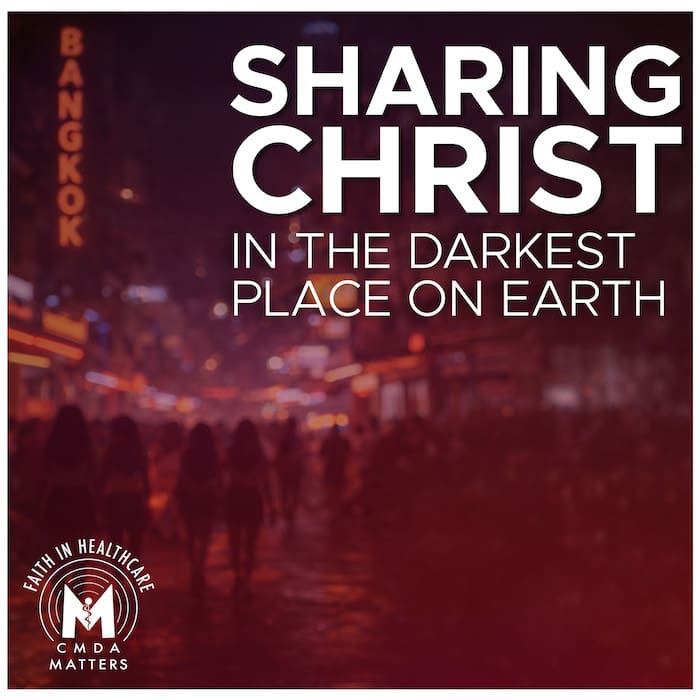
You know, there are places in this world where darkness and evil feel more palpable than others.
Bangkok's red light district is one of them. Tragically, it's a major hub for human trafficking in Thailand, where a quick Internet search estimates that over a half million people are living in modern slavery.
And yet it's exactly there that a group of Christian health care volunteers chose to go to serve women who are trapped in in that darkness.
In this episode, I'm joined by ER nurse Lori Price and dentist Dr. Valerie Preston, who co led a global health outreach, or GHO, mission team to Bangkok in late 2025 after several years of serving together in places like Tanzania and Ecuador. With gho, we're gonna talk about trauma, informed care, spiritual warfare, what it really means to plant seeds that you may never see grow, and how medical and dental care became a doorway to share the love of Christ with nearly 300 women during their trip. Let's dive in.
Well, welcome to Faith and Healthcare, where we explore every week what it looks like to follow Jesus Christ in the sacred space between suffering and healing. And our episode today brings us into a place, well, frankly, involving profound darkness. And yet in the darkness, light.
I have two women with us on the program today. Lori Price, who's a nurse, and Dr. Valerie Preston, who's a dentist. And they were leaders and team members of a volunteer healthcare team who served in Bangkok, Thailand at the end of 2025, serving for women who are exploited in human trafficking. These were not just medical and dental encounters. You're going to hear there were some holy moments involved and dignity was restored out of God's grace, trust was built and the love of Christ was made visible through skilled hands and compassionate hearts. So, Laurie and Valerie, thank you for taking time out today to join me on Faith and Healthcare.
[00:02:47] Speaker C: Absolutely. A pleasure.
[00:02:49] Speaker B: Well, before we got going, Laurie had a chance to tell me, Valerie, that you guys have been kind of team leading in several places that several years ago you had an experience on a short term team and you got along pretty well. So you said, hey, let's keep doing this. How many short term teams, Valerie, have you been a part of and or led?
[00:03:08] Speaker D: Oh, let's see. So I was turned on to DHO through a fellow dentist by the name of John Pefferly. The back in 2017. 2018. Is that when it was, Lori?
[00:03:18] Speaker C: Yeah, 2017.
[00:03:20] Speaker D: And he invited me on an all dental team going to Tanzania.
So that was where I met Lori. She had been on a few other teams. I had been busy raising young kids up until then.
We met on that team. We became fast friends. I don't think I've been on a GHO mission team without Lori since then. And I want to say we've been back to Tanzania, Bethlehem, Ecuador, multiple locations. So Lori and I just clicked. And when Trish asked who's gonna lead a team, I said, I can't do it by myself, so Lori's gotta do it with me. And I now follow her. She's really the true leader.
[00:03:57] Speaker C: Not so.
[00:03:57] Speaker B: Not so well, let me just say just a couple of lines of your bios and then direct listeners to our show notes where they can get a whole lot more on both of you. But Dr. Valerie Preston, graduate of University of Maryland School of Dentistry, she got her Doctorate of Dental surgery degrees with OC in 94 and before that a Bachelor of Science from the Ohio State University in 1989. And Lori was telling me, emergency room nurse who loves patient care and saving lives.
So welcome again. Welcome both of you. Laurie, let's just get started off. What's your favorite place that you've been a part of leading a GHO team to? What's your favorite country and ministry that you were part of?
[00:04:40] Speaker C: I don't know that there's a favorite. They're also unique. So I love Ecuador. We go there in the summertime and it's beautiful. But then you feel so useful in a place like Thailand because the needs are so great. So I don't know if you can call one a favorite.
[00:04:58] Speaker B: Okay. How about you, Valerie?
[00:04:59] Speaker D: You know, I like the dangerous places. I'm just weird like that.
Anybody that knows me knows this. So Lori actually took one of the first teams with Trish to Thailand and the second day she was there, I told her, lori, I'm going with you next year. We're doing this together next year. So I knew immediately that's where I needed to be. I love all the trips as well.
We really spend more time feeding into the team on some of the safer trips, but we really get to immerse ourselves with the population we're treating in some of these more dangerous places.
[00:05:29] Speaker B: And you mentioned Trish for our listeners benefit. Dr. Trish Burgess, who is our director of Global Health Outreach for about eight years now. So you talk about dangerous trips, risky trips, and I guess thinking about you mentioned human trafficking being very dark and to some degree risky. Can either one of you take us back to the moment that God first stirred your heart for this particular work in Thailand, when Trish shared with you or posted the opportunity to go take care of those who are caught enslaved in a human trafficking situation.
[00:06:05] Speaker C: I think in retrospect, I have been on multiple human trafficking trips to Central America with GHO in past years.
So when Trish offered the opportunity to co lead with her on a trip in 2024, I knew immediately that I was drawn that direction. Having a special place in my heart for women who have been abused and seeing what I've seen throughout my work career and the extent to which women are exploited, it's just a pure pull on my heart that I desire to help those women and they are so needy. And when you, when you are able to reach out and connect with them, you just feel that love of Jesus going out into their lives and to see the response that they give is just, you know, God's working in a very, very particular, very special way there.
[00:07:13] Speaker B: Dr. Preston, how about you?
[00:07:14] Speaker D: You know, some of that is same for me. I actually had a patient who started a Salvation army clinic here in town in Raleigh, North Carolina and he would share with me back in the early 2000s about the human trafficking that was happening locally.
So I became very interested at that time. You know, their mission through the Salvation army actually is to, you know, find local women and shelter them and help them come, you know, walk side along them. But you know, when Lori first told me about this trip, I was too busy to go the first year. I'm still running my own private practice, but as soon as I heard what was happening over there, like I said, I just told Lori, I'm with you. I feel like the pull to go and help.
[00:07:58] Speaker B: So two American healthcare professionals going cross culturally, you've done it many times in this particular situation in Bangkok where just a brief Internet search for me, the whole country estimated right now half a million people being trafficked. And Bangkok of course is prime destination. So there've got to be many, many, many there.
So you're doing cross cultural ministry, working through translators, I'm assuming in most cases.
How do you deal with the sensitivity of cross cultural barriers and communicating the love of Christ as ardent Christ followers and respecting those women and the various cultures they come from because I assume that many of them are being internationally trafficked, right?
[00:08:45] Speaker D: That's right.
[00:08:46] Speaker C: That's right. I think that it's key to recognize that we don't go alone. We partner with a non government organization. They are Nightlife International and Nightlight has a coffee shop in that red light district.
And they are living out their faith. They are being the light of Jesus in their neighborhood all year long. And so we come alongside them only to offer some services that they need. They need health care, they need dental care. And by doing that, we open up a connection and a space to share.
And we allow them to be heard, we allow them to express their needs, we ask them for prayer. How can we pray for you?
And it allows them a safe place to open up by partnering with someone who lives there. They know the culture, they know that honor, shame, boundary that we're not quite as familiar with, that we don't work with in a daily basis. And they know what the people around them in their own neighborhood are experiencing. And so by offering services, we're really just opening up a track to invite relationship for the staff, the outreach of nightlife. They can come in and talk. They're the translators, they're the ones who are actually communicating.
And we're just the draw that brings them in.
[00:10:20] Speaker D: We always reference ourselves as sort of being the flypaper, you know, we draw the people there and then we sort of let our local ministry take over the hard work, you know, and following up with those women and really trying to just develop relationships with them.
[00:10:35] Speaker B: I can't imagine the environment you described in a short testimony that I've had a chance to read about the stench and the incredible nightlife. And you know, I'm sure both of you remember Frank Peretti and his this Present Darkness books, but were there times when you're just skin crawled because of the evil and the wickedness that surrounded you? I mean, describe it for our listeners what you faced each and every evening that you were there.
[00:11:02] Speaker D: So because of the sensitive nature of what we were doing and when we needed to be there, this clinic ran a little different than your standard everyday clinic would run, where you would get up in the morning and, you know, work until the afternoon and then go back. We did it in reverse because we knew that these girls start their day late in the day and they're asleep during the day. So, you know, we started our clinic at 4 o' clock in the afternoon after praise and worship time with their organization.
We worked until about midnight. So when we left that clinic, sometimes as late as 1:00 clock in the morning, we walked out into a world that we have never seen before. It was just pure evil, pure darkness. We've never felt like that. I mean, we were just praying the whole way back to our hotel. You know, it was just something we have not experienced here. And I don't even know how to put that in words. What would you say, Laurie? How would you. It's wall to wall people.
[00:11:54] Speaker C: You cannot walk on a sidewalk without touching people on either side of you. That's how dense the population is in this area. And women are lined up along every inch of the sidewalk trying to get business.
So any male especially that walks by them, they'll grab out and try and solicit time with that individual. So every single male member of our team was pulled on multiple times trying to somebody trying to get business. They're desperate. The competition is thick. There's so many people and there's music going and lights flashing, and it feels almost like you're walking the strip In Vegas times 10, like Vegas on steroids. But it feels dark. You feel that evilness.
And so you're just drawn to pray. You are the light of Christ to them. And so not judging them, not shaming them, but being considerate to them and giving them eye contact, acknowledging who they are, but praying the whole way as you're walking among them, because it is very, very overwhelming to see that much blatant sin right in front of you everywhere.
[00:13:21] Speaker B: Well, from reading some of your prayer updates to those who are praying for you back at home and for some of us at cmda, it was clear that you were taking care of women who were across the spectrum in terms of brand new to the situation versus those who had been in that situation for a while and they had obviously experienced profound trauma. So what did you learn about providing trauma, informed medical and dental care that everyone listening, every Christian clinician should understand in that situation, women who feel trapped that they are truly in slavery.
[00:13:59] Speaker C: I think the biggest thing that I realized is they want to look pretty.
And so by us giving them services, we're affirming their worth, which makes them feel whole. And so there's an aspect of, yes, they want to look pretty so they can attract business, but helping them to understand their worth comes from who they are.
So it's a long process, I think, in a culture like that to help someone transition into becoming an individual of faith. But the first step is building trust. And you do that by talking to them, by letting them be heard, letting them share their pain, and letting them then have affirmation that you care about who they are. You want to pray for their needs, you want to pray for their health, you want to hear who they are and affirming their worth.
[00:14:59] Speaker B: And you prayed. You pray with every one of these patients, correct yes.
[00:15:03] Speaker D: And we always ask their permission and we always ask them, what specifically? What can we pray for you for?
You know, what are your needs? What. And, you know, they're very open and receptive, but they are skeptical. You know, at first they're very skeptical. Why are you here? Why are you doing this? Everything in their world, you're getting something out of it. Somebody's getting something out of it. So why are you here? What are you getting out of it? And so we really try to relate. We're only here because Jesus loves you and that we want you to know. And because of that, we love you.
[00:15:34] Speaker B: I did read one story of a woman that was, you know, been sort of tricked into going to Bangkok because.
From Africa and was just so embarrassed and scared and, you know, that you were able to pray with her. So you did know details. I mean, you were given some details about where these women were in their journey.
[00:15:53] Speaker D: Okay. It depended on who it was, how much they would share.
[00:15:57] Speaker B: You described very extensively that daily prayer and worship as a team. I think you had a team of 17 people was quite essential.
So how did you see spiritual warfare play out on this trip and, you know, the unity as a team? How did that come to play in terms of helping you through this, that present darkness?
[00:16:20] Speaker C: Our team of 17 was only part of the puzzle. There was also a group of interpreters from the local church there that came alongside and the people from Nightlife themselves and their outreach team that organized all this. So we were just a small cog in the wheel that was going on there. But we met each day at three o' clock and we prayed for a solid hour beforehand, putting on that armor of Christ, praising God, acknowledging that this is a spiritual battle that's fought in the heavenlies. This is a time that we're calling on God to equip us, to give us the words, to give us that breastplate of righteousness, the belt of truth, and all the things that it says in Ephesians to prayerfully ask the Lord to prepare us for the battle that we're going to see and that hearts would be opened as they see the light of Jesus. And what we're doing, we're trying to love on them, we're trying to give them something special in order to help them trust that outreach team at Nightlife that's communicating with them and telling them about Jesus. So it's preparation of praising God for an hour, praying to him, praying together as people who've never met each other. But it's so incredibly powerful. The Worship time was beyond any worship that I've encountered anywhere else. It was so incredibly powerful. And then we would go from there, from that worship time into our clinic time.
[00:18:01] Speaker B: Valerie.
[00:18:02] Speaker D: And pretty quickly, when we were there, during their praise and worship time, we realized that this is part of their world. Every day, this organization, they pray against spiritual warfare. They know what's going on. They're praying for that protection every day to protect the walls of this place, place, keep it sacred, keep out demons. I mean, it's real, and you feel it.
And their prayers are so powerful that we felt so safe.
[00:18:28] Speaker B: And these are Thai Christians that are part of this ministry, I guess.
[00:18:31] Speaker D: Thai some Americans who have relocated.
[00:18:34] Speaker B: Okay. And they know the streets of Bangkok very well.
[00:18:37] Speaker D: They do.
[00:18:38] Speaker B: Valerie, from a dental perspective, what surprised you most about the physical and emotional needs that you encountered? And how did just routine dental care, or maybe not so routine dental care become a doorway for dignity, trust, and opening up any gospel conversations?
[00:18:54] Speaker D: So I've sort of found my little niche with dentistry. I realized that most people are the same as they are here. They don't care one way or another if they have a cavity and you have them filled. But if there's something cosmetic that. That bothers them, and I can fix that for them. It opens up everything, you know, it just starts conversations. It builds trust. When they see that I have done something to make their appearance a little bit better, and this goes with all the countries, they feel so grateful that that's been taken care of and acknowledged and kind of surprised by it, honestly, that that really seems to open a doorway of trust.
[00:19:32] Speaker B: I got to see some before and after pictures as part of those reports I was privy to, and some pretty impressive after pictures in terms of the smile, the beauty of the appearance of the teeth.
[00:19:43] Speaker D: Well, it's all about that. And then, you know, at the end of the day, once, you know, they open up and they realize what we've done for them, they will start communicating their needs. They'll start talking a little bit more. You can just feel them relax, which is really powerful.
[00:19:56] Speaker B: Laurie, before we got going, you were sharing with me that while I think you saw maybe close to 300 patients during your time there.
[00:20:05] Speaker C: That's right.
[00:20:05] Speaker B: That while there were no overt confessions of wanting to follow Christ by any of these women, you did have those that ask for rescue that you were able to bring out of that. Just. Can you tell us any one of those stories of women that you brought out of the trafficking environment?
[00:20:23] Speaker C: Sure. There were two young women, very young, who had Arrived five days previously from Uganda. And they came in to have their teeth cleaned. And in the process of waiting, they talked to a lady that's on staff, the director there for Night Light. And she actually got their story because she can speak in their language and got their story that they had actually come thinking they were going to be retail clerks in a store and come to find out that wasn't what really happened. They were now attached to a local bar and they had quotas. They had to meet so many tricks they had to turn a month, so many drinks that they had to buy like 90 drinks a month from this bar in order to satisfy the debt from their visa and from their travel from their country. And the one had been a pastor's daughter. And she was so devastated and distraught how ashamed she felt and how she didn't feel like she could do this and she didn't know what to do. They were both very overwhelmed to find the situation that they'd been tricked into and deceived into. And Annie offered to give them safe rescue. And she took them away to a place of, of safety and began that process then of repatriation in order to repatriate back to your own country, because your documents are not yours anymore. Somebody's confiscated them. Sometimes it can take up to a year. And you have to go through a process of 11 different government agencies. So it's a very lengthy process. But they are able to have a residential facility where they can house a certain amount of women and help them through that process. And in that process, they get to see the light of Jesus more and more, and they get to experience the love of Jesus coming from staff there. And they get somebody to hold their hand, walk them through that process.
And then they get trained in some sort of skill that they can use to earn a living in a dignified way wherever they're going back home to. So those two women that night began their journey back to their country and back to where they are able to earn a living in a way that will help their families back home. Because really, it's all about money. Most of these women get trapped in this industry because they need money.
And in these honor shame cultures, if you're able to work as a woman, you need to work to provide money for your family. You're not just doing this because you think it's fun. You are doing it out of a pressure that's put on you from your family to give money and to help feed and support the rest of the family, whether it's Aged parents or grandparents or young children. Most of these women are just trapped, trapped by the need for finances. And so they get in that cycle and they don't know how to get out. But by building those relationships, they're able to recognize some hope in Jesus and hope to find a way out of their situation.
[00:23:43] Speaker B: Valerie, you think dad to that?
[00:23:44] Speaker D: Well, and a lot of these girls that we met that were not Thai girls are actually just like Lori said, tricked into thinking they're getting, you know, respectable work and then finding out once they get in country that their visa and their passports have been stripped and now they have no return ticket home and they find themselves in a place that they don't feel like they can get out of. And the government also, correct me if I'm wrong, Lori, they will try to go get a visa and they will up the amount of money needed for that every single time they go. So the. The bar keeps changing and.
[00:24:17] Speaker B: And I have to believe that there's a strong level of opposition to the whole idea of bringing women out of this. I mean, as I understand.
So it's not as if you waltz into here and everyone, you know, okay, these nice Americans expats. We'll just let them do that because they're nice people. I assume that there would be, you know, just like Paul had lots of opposition in Ephesus from Great is Artemis of the Ephesians. Great is this human trafficking industry. For us, that they would be opposition. Any manifestation of that opposition that you sensed during your time in Bangkok.
[00:24:55] Speaker D: We didn't necessarily sense it ourselves, but we definitely heard about it. And we know for a fact that these girls, when they make that commitment, it's risky because if their employers find out about it, they go after them. And this organization has been targeted many times.
[00:25:10] Speaker B: That does not surprise me.
[00:25:12] Speaker C: Me.
[00:25:15] Speaker A: Before we continue with this week's episode, here's a special announcement for you.
The CMDA Learning center is continuing to grow, and it's an incredible resource for Christian healthcare professionals.
You'll find content from recent national conventions, the Faith Prescription series, continuing education opportunities, and a wide range of courses designed to support both your professional work and your spiritual growth.
And here's the best part. As a CMDA member, you can earn continuing education credits at no cost.
To start exploring the full library, visit CMDA.org learn.
We're incredibly grateful for our sponsors supporting CMDA's 2026 National Convention.
Our premier sponsors include Liberty University, College of Osteopathic Medicine and Samaritan's Purse.
Our diamond sponsors are Helping Hands for Hospitals International, DLP Capital, the Euthanasia Prevention Coalition USA Honey Lake Clinic, the Theology, Medicine and Culture Initiative at Duke Divinity School, the Colson Center, Chinmed and Blue by Thrivewell.
Our gold sponsors include Beacon Wealth Consultants, America's Health, Share and Capstone Wellness.
And our silver sponsors are GFA World, the American association of Pro Life Obstetricians and Gynecologists, and the Southern Baptist Theological Seminary.
All of these organizations will have booths at the convention, so be sure to stop by, learn more about their work and connect with their teams.
This year's national convention begins today in Loveland, Colorado.
Stay tuned for more information about how to access the plenaries and breakout sessions from this year's convention in the CMDA Learning Center.
Let's jump right back into this week's episode.
[00:27:36] Speaker B: So we often in healthcare and with donor organizations and foundations, we want to say this is how you know these are outcomes. And we if you give this much, we will rescue this many women. And sometimes it's just not that simple.
How did God reshape your understanding of what faithfulness and fruit really look like after this incredible experience inside darkness?
And I'll just say parenthetically, I just love the statement that you made in your testimony that it's not as if God showed up because you showed up. God's been there all along and you were looking for how to join him. So talk to us about dealing with the fact that you don't necessarily get the outcomes that you're hoping for to get all these women to accept Christ and come out.
[00:28:22] Speaker D: We're there to plant seeds, and we know that's what we're there for, you know, and it's not our place to do the work. We're just there to help get the girls, you know, plant the seeds so that maybe somebody else comes along in the future or maybe they get in with this organization and they remember what they've seen in the past.
So, you know, we try not to put that pressure on ourselves. You know, we know that's not our job. That's God's job.
[00:28:45] Speaker B: Yeah. And you reported. You reported. Laurie, I'm going to give you a chance to answer that, too, here in a second. But one thing I appreciate about your testimony, that one woman shared her testimony of how God had used the team from last year to lead her to help, and now she's a believer in working for City Light Coffee Shop and no longer in the sex industry. So it's a demonstration of what seeds were planted a year before. Obviously, Laurie, anything to add to that and what are kingdom outcomes?
[00:29:12] Speaker C: I think that it's really interesting because we are just planting seeds, we're building bridges. I think in order to really find Christ, they have to be able to trust an individual to hear the gospel. And so we're just trying to open doors to build trust with a ministry that's there all year round. We're coming in and offering some services to bring people in, but when you go back and you read online about this particular ministry in Thailand, they're there all year round. They're doing Valentine projects, they're doing Easter projects, they're doing sponsoring nail nights where people can get their nails done. They're doing haircuts, they're, you know, they're doing all kinds of outreaches all year long and we're just one of them. But it's all about building relationship to gain trust and have the privilege of showing the light of Jesus along the way and letting the light of Jesus do the work because he's the draw. He's. He's the one that's going to bring them into a relationship of light. And so as you are just there being the light of Jesus, he is doing the work and he's opening doors and opening hearts. And it was such an encouragement to hear the woman who was now employed in the coffee shop to give her testimony to us and say that the beginning of that was the previous year in 2024, when we had been there and she had come and to the clinic and then she had, during that year her life had changed and she had met Jesus.
And so that's really, we're trying to be the light, just open a door, build trust with that relationship as being our primary goal and letting God use the relationship to bring himself as the
[00:31:03] Speaker B: light of the world for either one of you. One of the benefits of these, even though it's only a week or 10 days of these that I think many people don't realize who may not have done this before, is yes, you do tremendous ministry, you grow in your faith. It's an incredible team building experience.
But when you come back, there are folks on this side of the pond who are impacted and want to know, including if you're working in a secular place like I think you are, Laurie, and certainly probably Valerie, you are too, with staff and peers, Community Church. What have been some doors that have opened for you? It may not just be even this time to Bangkok, but other times doors that have opened for you to share your faith because people want to know it's not just something cool. Why do you do this? And opportunities for folks to ask you for the reason, for the hope that you have and doing it with gentleness and respect when you get back.
[00:31:58] Speaker D: Well, you know, a lot of my friends and my patients sometimes think I'm crazy to do it, I bet. But you know, I just, when, when they realize I just don't have that fear. I feel like I'm in the will of God when I'm going to do these things. You know, again, planting seeds, no matter where you are, even here, you know, just to hear about it. We try to talk about it a lot in our practice. You know, everyone in my practice is involved with getting me prepared and ready to go. I don't know if, you know, but dental is a big deal to take all that equipment along. It's a big process before we even get out the door.
[00:32:32] Speaker B: Yes, of course.
[00:32:33] Speaker D: So we try to involve our patients, we try to involve our community, our churches, so that they can understand what's going on. And then again, we're not just blessing the people over there, we're also planting seeds and trying to bless people here as well.
[00:32:45] Speaker C: Yeah, Lori and I think over the years as we've done this, we've continued to amass a following, people who read our emails because we're trying to relay to people back home a bird's eye view of what's going on. So we're sending out an email every day about what happened the previous clinic. And it allows people to feel like they're getting a hands on kind of view so that they're participating with you, they're praying with you over the situations and they're seeing exactly what's going on. It's drawing them in from your local church, from your local workplace. I have people on that email list from many different trips that I've been on and it probably goes out to a couple hundred people every night that this is what happened during clinic that day. And so you're able to expose them to the work that's being done. And it does ignite some people that they want to be a part of it. Recently, my workplace does not actually give me any kind of goods, but they partner with a ministry called Medical Teams International and through them I'm able to get some of the equipment that we take with us. And so this week they wanted a blurb to put out to their staff about what happened, what went on, and so I was able to give that out. Well, then I saw it in the newsletter for our Hospital, which, you know, there's 300 staff in the ER, but it went to the entire hospital. So you never know what God can do with that information that went out. Everybody who's on staff read that or could have had opportunity to read it. So you never know what God's going to do. He's going to use all those little seeds in his own way, in his own time to bring about his purposes. Yeah.
[00:34:45] Speaker B: His providence. That's fantastic. Thank you for sharing all those things, both of you. Well, we've got many, many Christian healthcare professionals and friends and family that listen in, not just here in the US but around the world.
For those who are listening, who have been thinking about or just now, because hearing your testimony, thinking about this kind of an experience and what they might do next, what is one faithful next step they can take, whether it's globally or right, where they practice, to take the next step, to investigate, to think about maybe doing something for the kingdom of God in obedience to the Holy Spirit.
[00:35:23] Speaker D: I mean, just praying about it, getting involved in their local church. A lot of churches do mission work, you know, maybe starting somewhere in your own community.
You know, I also do a lot of work locally with the local refugees. You know, that's kind of a good way to get started just to, you know, kind of wet your feet. You know, GHO offers a lot of different mission trips. Some of them are, you know, safer and in a more relaxed environment, more family friendly, you know, so there's all kinds of places that can happen. And, you know, we. We don't need just people to go. We also need people to pray. We need people to, you know, financially support these causes. So, you know, not everybody is called to go, but everybody's called to help.
[00:36:05] Speaker C: I think that's key. Everybody has some responsibility as a believer to input into the kingdom of God. He tells us to. And so you might be somebody who's just reading an email and, and seeing what's going on, but feeling and then responding to that pull of Jesus. I can pray and I can participate financially. I had one lady last year that gave me $50. Just hand it to me and she says, you'll know when the time's right, somebody will need this. And sure enough, we gave it towards hotel housing for the people who wanted to get a safe housing rescue. And so there's different ways, but being perceptive, when people inquire about what you've done, finding out, you know, how interested are they, and if they want to participate, I can help them and facilitate that going to Thailand might not be for everybody, but it's such a incredible opportunity to shine the light of Christ in a dark place. And it's such a sensitive place. Those people have a place in the heart of Jesus where he just loves them and we're the vehicle that he can use to love them. And so if people are interested, there's always opportunities to serve. And it may not be actually going, but there's always opportunities to help.
[00:37:30] Speaker B: Well, Dr. Burgess, I know Trish Burgess would really want me to share that if they go to cmda.org GHO they can look at the trip schedule. And I noticed that this coming October, there's another trip coming, at least. Laurie, I saw your name there. Valerie, are you also going back?
[00:37:47] Speaker D: I am.
[00:37:48] Speaker B: Okay, so what are the individuals? What would the Dream Team look like for you in October so our listeners can hear? These are the kinds of professional volunteers we could really use.
[00:37:58] Speaker C: I think for us, the most valued, I think, is that ob GYN type of provider, the person who is able to give reassurance to someone in that area. But also then. I don't know if I mentioned, but every single person that comes into the clinic wants an HIV test because they are required to have them every three months. And if they go to a state hospital, it costs $100.
But if they come and have it at our clinic, it's free. And so we get a lot of people that just come for HIV tests. But being able to be a contact point, you know, whether you're a nurse, whether you're. We had a dietitian, a nutritionist doing HIV testing. I mean, being there to just prick somebody's finger and put blood in a tube and give them an HIV test result, I mean, that's easy. Most people can do that.
There's a lot of opportunities. We want couples. We had a couple of dentists and a wife that came.
It's important for these women especially to see a man in a role that's healthy, in a healthy marital role, and to realize that there are men that don't abuse you, there are men who can treat you with respect. Those are important things for us to demonstrate a different way of life just by coming and serving.
[00:39:24] Speaker B: And Valerie, any additions to this Dream Team that you would to what Lori has just shared?
[00:39:29] Speaker D: Well, we always need hygienists.
Most of the girls, these girls don't have a lot of severe dental needs because of their age, but they do need their teeth cleaned. And we found that out. We had took a wonderful hygienist Last year, she was probably the busiest person on that entire team.
[00:39:47] Speaker B: Wow.
[00:39:48] Speaker D: So we never can get enough hygienists. We believe we already have one coming this year, but we're always open to another one.
[00:39:53] Speaker B: Well, I want to thank you ladies for joining me today. I do want to close in a prayer, but before I do that, any other final thoughts, anything burning that you really wanted to share with our listeners today?
[00:40:04] Speaker C: I think there's nothing more satisfying in life than being the hands and feet of Jesus in a world of darkness, in a world where people are just overwhelmed with sin. It's an incredible opportunity for us to be there and meet these people where they are without judgment and love on them and give them worth and give them value by hearing them and talking to them and helping them with their
[00:40:33] Speaker D: needs and just to see the light of God shine in a place of such darkness.
[00:40:38] Speaker B: Yeah. That theme is woven all throughout your prayer Updates and requests. John 1:5. The light shines in the darkness and the darkness has not overcome it. Ladies, I'd like to pray for you and for those who are back in Bangkok.
Oh, Heavenly Father, we thank you that the light shines in the darkness and the darkness cannot and does not overcome it. Thank you for going before this team last year and for upcoming teams that are going around the world, including back to Bangkok. Sustain them, Father, and continue to work with them through their obedience in ways that only eternity will fully reveal. We lift up the women who were seen, touched, and cared for not as objects, but as image bearers of yours, and I pray that the seeds planted by Lori and Valerie and the other 15 members will take deep root. May healing continue in their bodies, mind and souls. Draw them to yourself, Heavenly Father, because you are the true source of freedom. If the sun sets them free, Father, we know they'll be free indeed. We also pray for every healthcare professional listening right now. Where there's weariness, would you bring renewal? Where there's fear, Father, bring courage. And where there's confusion, bring clarity. Remind us, Lord, always, every day at CMDA and beyond, that faithfulness matters, even when we don't get to see the outcomes that we're hoping for. Lord, teach us to serve not for recognition, but for your glory. Use our hands, our minds, and our presence as instruments of your mercy. We offer all of this to you, Father, in the name of Jesus, the great physician, the redeemer of the broken, and the King that we serve. Amen.
[00:42:23] Speaker C: Amen.
[00:42:34] Speaker B: As Laurie and Valerie reminded us today, faithfulness doesn't always look like the outcomes that we hope and envision.
Sometimes it looks simpler, like cleaning someone's teeth and asking permission to pray, trusting God to do what only he can do with the seeds that are planted.
One of those seeds, planted during a 2024 trip, took root over the following year.
By the time this team arrived in 2025, that same woman was a believer in Jesus Christ, employed at the coffee shop, and no longer in the sex industry. Praise God.
As believers, we're called to be the hands and feet of Christ, to serve faithfully, and to share the gospel of Christ. And testimonies like this remind us that even in the darkest places, like that place in Bangkok, his light overcomes the darkness.
If today's conversation stirred something in you, whether that's a call to serve, as Lori and Valerie did, to pray or to give, I want to encourage you to take one faithful next step.
You can explore GHO mission opportunities, including an upcoming trip to Bangkok this October. You can just go to CMDA.org GHO to check it out.
You know, not everyone is called to go, but as Laurie and Valerie said, everyone is called to serve in God's kingdom, whether it's through GHO or some other ministry friends. If this episode encouraged you, I want to challenge you to share it with a colleague. And be sure to subscribe so that you don't miss future episodes of Faith in Healthcare. And if you'd like to connect with other believers in healthcare, you can visit us by going to cmda.
Well, next week we are sharing a very special conversation that I had the privilege of doing as co host with Dr. Brick Lance on his Voice of Advocacy podcast. We sat down with Dr. Bill Lyle. He's an OB GYN and founder of the organization Pro Life Doc to discuss maternal fetal medicine, scientific truth and and the sanctity of life.
I want to thank you for listening today to Faith and Healthcare where I promise to you as a listener or better yet, as a subscriber to this podcast, whether a healthcare professional or even a patient who loves Jesus Christ is this we will do everything that we can at CMDA to keep your faith and healthcare connected.
We'll see you next time, Lord willing.
[00:45:26] Speaker A: Thanks for listening to Faith in Healthcare, the CMDA Matters Podcast.
If you would like to suggest a future guest or share a comment with us, please email cmdamatterscmda.org and if you like the podcast, be sure to give us a five star rating and share it on your favorite social media platform.
This podcast has been a production of Christian medical and dental associations.
The opinions expressed by guests on this podcast are not necessarily endorsed by Christian medical and Dental associations.
CMDA is a non partisan organization that does not endorse political parties or candidates for public office.
The views expressed on this podcast reflect judgments regarding principles and values held by CMDA and its members and are not intended to imply endorsement of any political party or candidate.
[00:46:20] Speaker B: It.