[00:00:08] Speaker A: You're listening to faith in healthcare, the cmda matters podcast. Here's your host, Dr. Mike chubb.
[00:00:20] Speaker B: Welcome, friends, to Faith in Healthcare. You know, public trust in science and medicine has really taken a hit in recent years, not always because the science failed, but because the culture around it did.
We've seen institutions buckle under political pressure as well as fear.
Honest questions were silenced, debate was discouraged, and many healthcare professionals found themselves, frankly, unable to speak freely without consequences.
So what does it look like to pursue truth with integrity in that kind of environment?
And how does faith sustain that pursuit when the pressure to conform is so strong?
Well, few voices in modern medicine have been more tested by those questions than our guest today.
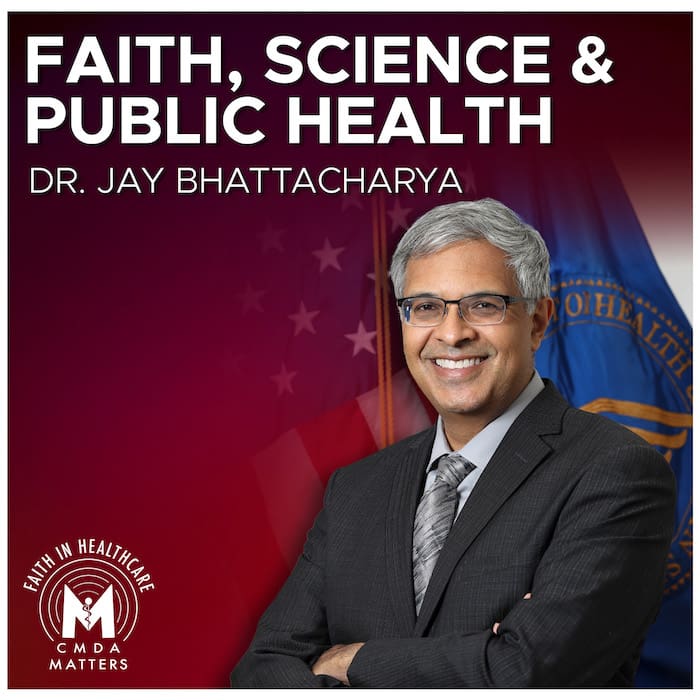
Dr. J. Bhattacharya is director of the National Institute of Health and acting director of the cdc. But beyond his credentials, he's a follower of Christ who's very open about how his faith shapes his commitment to serving vulnerable people, as well as his willingness to stand firm when science and consensus part ways.
In this episode today, we talk about NIH funding priorities, the COVID reckoning, so to speak, vaccine, science, gender, medicine, and what it looks like to lead with an audience, one answering ultimately to God alone.
So let's dive in.
Well, I have the amazing privilege today on Faith and Healthcare to welcome if he's not the most famous doctor in America today, he's at least the most famous doctor in Washington, D.C. and that's Dr. Jay Bhattacharya. He's an academic, physician and researcher and economist and public health leader who is now serving in the prominent roles as both the director of the NIH and acting director of the CDC. And I believe, Dr. Bhattachary, you're the first person in history who's ever had both of those roles simultaneously.
[00:02:33] Speaker C: I can see why, because I think you probably shouldn't have both these hats on for very long.
Well, in those roles, I'll try my best, though.
[00:02:40] Speaker B: In those roles, Dr. J, you are shaping some of the most important conversations in modern medicine beyond your professional accomplishments. You've been very open about the role of faith in your life, how a Christian worldview can inform not only personal conviction, but also the pursuit of truth and compassion and integrity in healthcare. So thanks for your willingness to join us and share your expertise. We've got a lot of questions for you, and I can say in the history of this podcast of seven years, you have been the most requested guest ever for this program.
[00:03:13] Speaker C: Oh, my goodness. Okay, I'll try to live up to this.
[00:03:16] Speaker B: Now, for our listeners who listen Most of the time you'll know I have a co host. And it turns out, And I told Dr. J at the beginning, that we wanted to feel welcome. And so we have a Stanford alumnus, Dr. Brick Lance, as my co host today. Welcome, Brick. All the way from seven time zones away in Kenya.
[00:03:35] Speaker D: Yeah. Thank you, Mike. It's a pleasure to be here and pleasure to talk to a fellow Stanford alumnus. We do bleed cardinal red, so I'm
[00:03:42] Speaker B: surprised you didn't wear cardinal red today, Brick. But let's get going. Dr. Bhattacharya, how does the Bible and your faith influence your thinking on public health and research?
[00:03:55] Speaker C: I'm a Christian. I accepted Christ when I was 18.
That changes you. What my purpose in life is is to serve others.
It's the basis of that commitment that comes from faith, from my commitment to Christ is that I'm not living for myself. I'm living for the betterment of other people, especially vulnerable people. And that informs everything I think about if I resisted. You're talking about how I have the two hats and no one else's hat, because it doesn't matter, right? If I don't do the job in a way that improves the health and well being of everybody, if I don't make these are hard decisions, these are hard jobs. But if I don't make those decisions in a way that are consistent with the calling that I have, that I believe comes really from my commitment to Christ to do things for the betterment of others rather than for myself, then I'll have failed.
[00:04:48] Speaker D: Jay so let's talk about the nih, the National Institute of Health, and you've only been at the home now about a year, and you've made some significant changes. And so I want to talk about one specific change, and that's research with fetal tissue. And so you've stopped that. And so but my two questions is, what's your reasoning behind that? And was that an easier, difficult change to make? And then what are the other future changes that you want to see in the nih?
[00:05:16] Speaker C: Sure. So the hemophital tissue wasn't actually all that hard a choice, in part, because there's two sets of arguments that I think were very persuasive to me. First, a scientific argument.
We were tracking at the NIH the use of fetal tissue in research over time. And what we've seen is a pretty sharp collapse in our support for fetal tissue because people, scientists, weren't asking to use it anymore or at the same levels that they were, say, 10, 15, 20 years ago. And the reason is that there are better alternatives available.
Induced pluripotent stem cells, a whole host of organoid technologies, and so on. And so in that sense, the scientific importance of them, to the extent they are always scientifically important, has been supplanted by new technologies.
That's one argument. The second argument that's persuasive to me is a public health argument.
I'll just use an example. From the pandemic. There were Covid vaccines that were produced using embryonic stem cells. I think the Johnson Johnson vaccine, I think, was, as a production matter, using. Now, I had the privilege of being on a bunch of Catholic radio shows during the pandemic routinely. When I was on those shows, I would get questions, is the JJ vaccine produced using embryonic stem cells or human fetal tissue?
Then for the MRNA vaccines, were human fetal tissue involved at all in the research? The answer is yes for many people, not everybody, and certainly not every Christian, because every Christian, I think, is a matter of discernment and something where Christians can legitimately disagree. But for many Christians, they felt it was unethical to use it, use these products.
If you have a public health intervention where you are expecting basically almost everybody to want to use it or to take advantage of it, you want products that are as ethically unconflicted as possible. So a broad range of people use it as possible.
I think from a public health point of view, it really, it's a good idea for research to use ethically, as ethically unconfected as possible. And that's not always possible.
Right. There may be situations where some people disagree about the ethics of certain things. That's just the nature of our society. But we should seek in research to make investments in research products, research streams that are ethically conflicted for as broad a range of society as possible.
[00:07:48] Speaker D: Well, thank you for that. We really appreciate that.
[00:07:50] Speaker B: Dr. Jay, it's been close to a month now that you've been acting CDC director, and I'm sure you didn't see that coming. And now that you've been there, how do those roles intersect, if at all? I'm sure there's been political posturing over the years somewhat between these two positions. And so how are you going to capitalize on that? And for how long does this last, do you think?
[00:08:11] Speaker C: Let me start with the second one.
I can't wait until the President nominates a permanent director and the Senate confirms that's how long it'll last, however long that takes. I have to say, though, it's been an Amazing time. The last three weeks I've spent a lot of time down here in Atlanta meeting with the folks in the cdc. They're two different organizations, two very distinct missions. The NIH has primarily a research mission. The research is aimed at improving the health and longevity of the American people and the world. You know, biomedical research. Whereas the CDC has a public health mission, both communication and on the ground activities, a host of policies and guidance to people for how to live better, healthier lives.
Right. Two distinct missions. Now the CDC's mission has to be grounded in science for it to be really tenable.
And that's where I think, you know, I've been trying to use the time at the CDC because of the sort of unique relationship I have with the nih, to better integrate the CDC and NIH activities together than they might otherwise be when two busy people are trying to lead two big organizations and so made a little bit of progress. So one of the things I'm super excited about, I don't know if you Remember, back in 2019, the President issued a challenge to the country to end the HIV pandemic by 2030.
I remember sitting at Stanford then thinking to myself, there's no way. We don't have the technology.
There's no way to do this. It's impossible. Aspirational goal, great, but how do we do this in 2024? There was a big advance in part based on NIH funded research on a drug that if you get an injection for up to a year, I think six months to a year, you're not going to get hiv, even if you're exposed, like you can be needle stuck or whatever and you're not going to get hiv.
It's called Lancapavir. There's other products now that are coming out that provide similar protection to people who don't have HIV for an extended period of time. It's not a vaccine, it's a different kind of product that provides really broad protection against HIV for, again, for people who are uninfected. And of course there's all these products that already in use by people with hiv. If you take them first, you are going to live a long life. You're not going to die from AIDS like people did in the 80s and 90s before these products were available.
And also the viral load becomes so low as to be undetectable.
So even if you have hiv, you won't necessarily spread. If you're on these drugs, you take those two things together.
A way to stop HIV from spreading from people who already have HIV and a way to prevent you from getting HIV if you don't have hiv. And if you deploy those two things in the right way, you can actually achieve the President's objective. What I've done at the NIH is I've directed research to devise strategies of outreach to communities, to figure out which communities are most at risk, and so on and so forth. A research mission, the CDC's Public Health Mission can help accomplish the actual on the ground sort of interventions. We need to do this. We can reduce the HIV pandemic to nothing by 2030 with these two technologies. We don't need to wait for a new vaccine. I've waited 40 years for a vaccine that's never come. It's just a huge, huge opportunity and being able to wear both hats, I can motivate both organizations to take this on as a challenge.
[00:11:31] Speaker D: Well, let's talk about the money and the funding of research and get your opinions on where the money money should be spent. I do want to. I have a bias here, Jay. My bias is I was part of a study that was funded by NIH and I'm a private practice orthopedic surgeon. But this is a multicenter study, 82 surgeons, 50 sites, with a 10 year follow up on revision anterior cruciate ligament injuries. Anyway, we got over 20 publications in all funded by NH. It was a wonderful paper, won several awards with the research, all funded by nih. So very, very grateful if I can say so.
But my question is funding private versus public research, is there a balance? How do you achieve that balance? And other than orthopedics, if you will, and other than hiv, what are your some visions for or what are the needs in research in our country today?
[00:12:18] Speaker C: So can I just clarify, when you say private versus public, do you mean like private funders or public funders or private or public?
[00:12:25] Speaker D: So funding either, yeah, getting private funds to help with NIH funds. Because NIH can be public funds. And are you funding academic centers? Is there a bias towards academic centers versus a private practice, that type of situation?
[00:12:38] Speaker C: There certainly is a bias toward academic centers right now. So just broadly, why should the NIH exist? Right? So the argument really is that there are research streams that no private entity would ever have any interest in funding, but that are publicly beneficial. Right? So a lot of basic science work that can't be patented, for instance, the discovery of the double helix, for instance, you couldn't have patented that discovery. And yet it's fundamental to so much of biology. Right? Fundamental biology is research that Publicly, if you just relied on private funding, you would have less of it than it was the right amount. Right. And so the NIH exists partly to fill that hole, but the NIH also exists to bring those discoveries to help usher them to the bedside, the so called valley of death, where you have a great idea, a biological idea, you have maybe a product you want to try out, but it's very hard to get people excited about it in the private sector until you have some evidence that's going to work.
And so I think the NIH also has a role in that.
So all the way across the research continuum, from basic science to trying new ideas out in clinical, in human populations, early stage up to almost everything, including potentially phase three studies for drugs, the NIH has some role. Now the private sector has a tremendous role also to play. Right. So most of the funding for testing drugs at scale happens by private sector investments, but they rely on NIH funded innovations in order to get to that stage. Let me get back to your other point about which kind of institutions should be fund do we fund here? I think we actually have a problem. So the NIH traditionally funds academic institutions.
I think about a third of our portfolio goes to about 20 institutions in this country. All the big name universities, including Stanford. And we also fund through small business grants. We fund some private companies and things and some, some labs, independent labs. But primarily it's the big bulk of our extramural portfolio goes to a few top universities.
I think that's a problem. And the reason why I think it's a problem is not that I think those top universities shouldn't be supported. I fundamentally do. Obviously I worked at one of them for a long time. It's. But I think if you go across the country and you talk to people, I've been now to like University of Alabama, University of Oklahoma, University of Iowa, Arizona State, I've been to Medical College of Wisconsin. I've been around the country and what I've seen is that there is tremendous scientific talent with people with amazing biological ideas that have the potential to really transform how we treat a whole host of diseases. And they just have a lot of trouble getting NIH funding.
And it's because of the way that we direct funding. Facility support. Right. Because the NIH doesn't just fund projects, it also funds the facilities themselves.
Almost 10 billion, 8 to 10 billion dollars of funding goes for facility support. So the way we fund the facility support, we decide that is you have to have great scientists at your institution that can win the awards and then Piggybacked. On top of that, you get facility support.
But you can see the problem, because how do you get great scientists at your institution unless you have great facilities?
It's just like catch 22. That guarantees that our funding is going to be concentrated. You get scientific group think, you get great ideas that don't have a chance. Because of this, I'm thinking of ways to, like, really open that up so the funding can go to places that doesn't traditionally go where all the great ideas are. Fund the great ideas rather than just the institutions themselves.
[00:16:00] Speaker D: Okay, let me just piggyback on that, Jay. So what are some of the criteria you look in the applications for funding from nih? There's got to be certain criteria that your staff look for for specific research. And are there some themes along with those criteria?
[00:16:14] Speaker C: Yeah, so we have. We have 27 different institutes, and they're all focused on particular disease areas or particular sort of biological areas. Right? So for instance, we have a National Institute of Child Health and Development. Right. So for focus on research on helping kids, there's a National Institute of Aging. Right. So there's a National Institute of Heart, Lung and Blood. There's a Dental Institute, for instance. Right. So 27 different institutes. Each institute has its own strategic priorities for the area.
Right. So, for instance, one of the priorities for the National Institute of Allergy Infectious Disease is solving the HIV crisis. Okay, Right. That's a major focus. Right. Each institute then is led by scientists who look through this whole sort of opportunity space and say, well, here are great ideas, great places for scientists to come.
Then what we do is we put out requests for essentially for proposals from scientists across the country.
Last year, I think we received 100,000 proposals.
We can't fund maybe 8 to 10,000 of those, so only a small fraction. So how do you choose 8 to 10,000? What's science first? Right. So each proposal, each of the 100,000 proposals goes to a scientific review committee. It's read by three scientists, three different scientists who are scientists drawn from across the country, not NIH employees.
They give the score for the proposals based on three criteria.
One is how important and innovative is the work, proposed work. Two, are the methods somewhat reasonable? Do they have a chance of succeeding for the aims for the proposal? And then three, how good is the scientists in the institution? A lot of that. Third thing was, when I came to the NIH, it was graded on a 1 to 9 scale. It was like all this detailed information.
Ultimately, it doesn't really matter if the institution is great or the investigator is so fantastic. What matters is does the institution and the investigator have the capacity to do the work? So we turned it from a 1 to 9 thing to a 01. So if you're sitting at institution outside of the top 20 and you have a great idea, you have a pretty good background and you are capable of doing the work you're proposing, you should be able to get funding. You'll get a one on that for the other two scores. The innovation we have now made the institutions, the institutes, able to fund really highly innovative ideas. Because often you have a highly innovative idea, sounds like you had one, but then that means the methods are going to be uncertain. You don't know if it's going to work.
Too often in the past we've been too conservative, if you will, in not funding ideas that are. That might not work, but if they did work, oh my gosh, you could cure type 2 diabetes or something, right? And so I've turned the institution and the culture of the institution toward being willing to take those kinds of intellectual risks, even on projects. So now you may see portfolios of projects where a lot of the projects don't work, but the ones that do transform science or transform medicine or cure disease. In fact, if you have a portfolio of 50 projects and all 50, all they do is produce papers that sit on a shelf.
What have you done? I mean, it doesn't help anybody, right?
In fact, that's evidence of a failed portfolio.
Instead, we're going to fund a portfolio of projects. Some of them will fail. It's fine. We don't know in advance if they're constructive failures. That's actually a good thing for science. And then some of them will succeed spectacularly because they're taking big intellectual risks.
[00:19:34] Speaker B: Well, Dr. J, I had the chance to listen to you being interviewed just a few days ago. And just for the record for our listeners, in terms of the amount of funding coming out of the nih, I heard you talk about fake news and that it is not accurate to say that NIH is backing off on funding. Can you just verify that for our listeners?
[00:19:53] Speaker C: I mean, it's shocking, all these stories. I don't know where they get their information.
So last year, Congress funded and the President signed a budget for the NIH for $48 billion. And we spent all that money on science.
This year, again, the Congress funded and the President signed a budget to give us a little bit over $48 billion.
And we're going to spend all that money on excellent science. I don't know what to tell you. It's like people want the NIH to fail from a political point of view. They just want people to think that the NIH is failing. It's just like the numbers just don't support it. I think we fund right now 55,000 projects again, 8 to 10,000 new ones every year, many of them multi year projects. And so I don't know what they're looking at.
There were disruptions at the beginning of last year.
When the new administration comes in, there's often disruptions. But we got back on track and we put out 55,000 projects of our funding.
I just don't understand.
I mean, part of it is maybe is that we've changed our funding decision making so that it favors newer investigators, favors new intellectually risky ideas. And so that means people who are getting the old, they're just used to getting funding on ideas that are just marginal or incremental. They're not getting funding and they're complaining.
[00:21:14] Speaker B: Probably the most popular request that I've received in a conversation with Dr. J from the NIH has to do with vaccines. Now you walk into a room filled with healthcare professionals, I don't care whether they have faith or not, the temperature goes up in the room when the conversation turns to vaccines. So of the funding from nih, what space is there? What are the priorities in terms of doing research on vaccines? What are your personal priorities regarding vaccine safety, schedules, comparative effectiveness and so forth? What's ahead?
[00:21:45] Speaker C: Do you think it's funny? Because when you talk about vaccines as a group, I mean, of course generally there have been many vaccines have been tremendously useful and successful in prevent. The smallpox is eradicated in part because we have had a great vaccine for it. Right. But you shouldn't be talking about vaccines as a group. You should be talking vaccine by vaccine by vaccine. You should apply. Because each vaccine has its own story.
[00:22:07] Speaker D: Right?
[00:22:07] Speaker C: Right. And you need to apply good science to that, to that, to the story of each vaccine. Right. So some vaccines work very, very well to prevent disease. Like the measles vaccine. If you get the measles shot, you're not, you know, the MMR shot. You're not going to get measles, most likely. I mean, very, very small fraction of people who get that, and that provides lifetime protection for measles. The COVID shots didn't provide protection against getting Covid very famously. Right. So they're both called vaccines, but they have very different properties regarding the disease they're supposed to prevent. They have different side effect profiles. Right. So the chickenpox vaccine, the old ones, Zostavax. I remember getting the Zostavax vaccine and I didn't even feel it. It was like nothing. The new one, the Shingrix vaccine, but that Zostavax vaccine didn't do well against actually protecting you from zoster. You could still get Zoster with this. The new one, Shingrix seems to be much better at protecting you against Zoster. But you're going to get a sore arm for several days. You might even get a fever. All that'll happen to you, right? Each vaccine has its own story, and at the nih, we are investigating that story in scientific ways.
It shouldn't be a religion. It should be a matter of science for deciding what properties each vaccine has. And you direct money to places where you have diseases that are really harming people. And if you can develop a vaccine for those diseases, then that would be. I mean, this is why the United Nation spent 40 years trying to develop a HIV vaccines harmed so many people for so many years. Right? It's a very difficult virus to develop a vaccine for. Haven't been successful at it. It's a scientifically challenging question. There have been many candidates that have failed. Failing means it doesn't actually protect you from getting, getting hiv.
So it's not. I just want to take it out of this realm of almost quasi religious awe that public health people and doctors sometimes give to it and just make it in the space of scientific discovery and scientific questioning.
[00:24:01] Speaker B: Thank you.
[00:24:05] Speaker A: Before we continue with this week's episode, here's a special announcement for you.
The CMDA Learning center is continuing to grow and it's an incredible resource for Christian healthcare professionals.
You'll find content from recent national conventions, the Faith Prescription series, continuing education opportunities, and a wide range of courses designed to support both your professional work and your spiritual growth.
And here's the best part. As a CMDA member, you can earn continuing education credits at no cost.
To start exploring the full library, visit CMDA.org learn.
We're incredibly grateful for our sponsors supporting CMDA's 2026 National Convention.
Our premier sponsors include Liberty University, College of Osteopathic Medicine and Samaritan's Purse.
Our diamond sponsors are Helping Hands for Hospitals International, DLP Capital, the Euthanasia Prevention Coalition usa, Honey Lake Clinic, the Theology, Medicine and Culture Initiative at Duke Divinity School, the Colson Center, Chinmed and Blue by thrivewell.
Our gold sponsors include Beacon Wealth Consultants, America's Health Share and Capstone Wellness.
And our silver sponsors are GFA World, the American association of Pro Life Obstetricians and Gynecologists, and the Southern Baptist Theological Seminary.
All of these organizations will have booths at the convention, so be sure to stop by, learn more about their work and connect with their teams.
This year's national Convention is just one week away, April 23 through 26 in Loveland, Colorado.
If you haven't registered yet, there's still time.
Visit nacon.cmda.org to secure your spot.
Let's jump right back into this week's episode.
[00:26:26] Speaker D: So, Jay, I'm going to put you on the spot a little bit. I have two questions on vaccines. One, maybe just a personal opinion, and I don't know if all of our audience knows, but the aap, the American Academy of Pediatrics, certainly has some difference of opinions with your advisory committee, the acip, the Advisory Committee on Immunization Practices.
And I know you hope that there will be dialogue between the two because you want people to dialogue. But here's my question, and I don't know if they'll settle all their differences or not, but do you have a personal opinion on immunization regimen for children?
[00:27:00] Speaker C: Well, I signed off on the on the I signed as recommended to the former acting CDC director on the revised schedule.
And it's different than the American schedule was. It's much closer in spirit to the Scandinavian schedule. I mean, the reason I signed off on it is not for any specific vaccine.
When I look at what happens in Scandinavia or the UK Or a bunch of other European countries, they don't have vaccine coercion. Very few of those countries actually have vaccine mandates, and yet they have very high rates of uptake of some of the most essential vaccines, like the MMR vaccine vaccine. And the reason they have that is because the public health officials trust the public to make the right decision and give them good information, try to make those decisions and consequence. Reciprocally, the public trusts public health.
Reciprocal trust is the basis for their success in vaccinations for the most essential vaccines.
In the United States, we've taken a different approach, and you can see this during the COVID pandemic, essentially, public health often, too often took the approach of demonizing people who chose differently than what the public health recommendation said. There were polls that absolutely shocked me during the pandemic where large groups of people, often politically divided, would say if you don't vaccinate your children for Covid, then your children should be taken away from you, essentially with this idea that there's a clean and unclean class and the unclean class chooses not to get vaccinated and the clean class does. That is the death of public trust.
And it is guarantees that you're never going to get the high levels of vaccine uptake for the most essential vaccines that you need.
I would love to restore a situation where people trust public health and public health is trust people. And that's the philosophy I have taken toward my public health engagement. The last, you know, throughout my career.
[00:28:49] Speaker D: Is the NIH funding any MRNA research currently?
[00:28:53] Speaker C: Yes. Yeah. So for instance, I think it's a very promising technology for cancer vaccines.
Now, the risk benefit profile is very different in cancer. You have a supposedly patient with late stage cancer. The fact that the MRNA product might have some other side effects is less important relative to the potential to cure that cancer.
Right. Because that's such a big deal and you're giving it to targeted populations with a vaccine, you need a very different risk benefit profile. First, it has to be very, very effective at scale. And second, it has to have even low rates of severe consequences.
If you're giving 100 million people a vaccine and you have a 0.01 rate of some severe consequence, lots and lots of people can get that severe consequence.
You have to have a higher standard in the concept text of vaccines for safety than you do for a product that's in oncology, for instance.
I think it's tremendously promising. The MRNA technology for cancer is tremendously promising. So we're definitely investing in it. And also even for other respiratory diseases, I mean, research. Yeah, absolutely. If you have a. I don't want, I want an all of the above approach for this. Do I think the MRNA platform has problems that need to be solved? Yeah, that's why we're doing research in it. Right. I'm not trying to like force people to take it. I want to do research on any promising direction that actually potentially could help human life.
[00:30:16] Speaker B: Well, Dr. J, I wanted to ask a question about COVID but, you know, I realize that by asking these two general questions, you know, you could spend an hour answering these. I know that, but your name for flashed on the marquee, all of our marquee, not only within healthcare, but in the public square because of the Great Barrington declaration and other things that you stood up and said, wait a second. And then you were criticized for it. And I do want to publicly thank you, especially as a fellow follower of Christ, that you have been gracious in the time that has passed, including in your current role toward your predecessor, who by the way, was on the program just a few weeks ago. And though Dr. Brick and I understand that you've communicated with him and that you maintain a good relationship. So thank you. And now I'm going to ask the questions because I think we can really learn from what you're going to say. What did we do well during COVID And what did we not do well during COVID And we don't have an hour, so you'll have to give us a summary.
[00:31:15] Speaker C: Yeah, I mean, it's hard because I was a critic. So let me start with what we didn't do well, and let me try with what we did well. Actually, why don't I start with what we did well, just because I don't want to be all negative.
I think that the scientists of the country and the world came together in a unique way to address a real problem, and we saw some real advances in knowledge very, very quickly. So the development of dexamethasone as a treatment for patients, inpatients with COVID very early on, I think a UK innovation that probably saved millions of lives.
People in hospital with COVID that's just one. I can name a dozen, dozens of other sort of innovations that we made that saved lives during COVID as a result of scientists taking. Picking up whatever they're doing and instead turning it to this major problem. And again, I was a big critic of public health during COVID You probably already heard a little bit of that. But let me just say again, in praise of public health, it's hard when you're communicating with the public about complicated scientific topics that you have to reach everybody at.
And the spirit of public health was to try to help, even though, again, as I said, I was very much a critic. And then for the public, you know, we made tremendous sacrifices in order to save vulnerable people.
Right. People were asked to do things, many of which didn't turn out to be great in retrospect. But people made sacrifices. They wore masks when they were asked to. Again, I have questions about whether they actually worked, but when we asked people to make sacrifices for the greater good, you saw the public do that. And I think that those were all. I mean, I learned as. As a society, we. We have goodwill in many ways.
Okay, can I go to the negatives?
[00:32:59] Speaker B: Sure.
[00:33:00] Speaker D: And I'll just comment. I would say the medical profession as well, Jay, that there. I. I knew numerous healthcare professionals, nurses, staff, doctors that made significant sacrifices.
[00:33:10] Speaker C: Absolutely, Brooke. Absolutely. 100%. That's absolutely true. Right. So I think there was goodwill. I think where we went wrong Deeply, deeply wrong.
It's actually a spiritual thing that went wrong. We were so scared as a society that we decided that the act of treating one another as a mere biohazard was a great good.
It was an act of love.
The idea that we should treat one another as our neighbors and as mere biohazards became essentially a dogma and you couldn't question it. Downstream from that is so many of the pathologies, right? The fact that we couldn't talk to each other and try to learn from each other. The science around Covid is complicated. No one got everything right. Normally in science, that kind of disagreement alongside empirical testing results in better knowledge. That was essentially set aside during COVID like I was a professor at Stanford with a full professor at Stanford. And when I spoke up, I almost lost my job as a Stanford tenured Stanford professor. There was censorship at scale. A lot of people self censored because they, you know, like they. I was looking at the randomized evidence on masks and it was very clear. The randomized evidence on masks suggested that masking populations broadly didn't actually have big, such a big effect on disease spread. And yet people were like acting as if it was like settled science. And a lot of people who knew about the randomized evidence on masks stayed silent because they were afraid of the mob.
I think that root problem that we thought it was a great good to treat one another as mere biohazards and if you disagree, you're some kind of heretic. That is the root problem downstream from that was the censorship, the sort of suppression of discussion. And I think a lot of that is, I think, you know, I think every day about what led to that and how we can build our society in a more resilient way so that we never do such a thing again. But it's something I think will take a generation really to absorb because it is a deep spiritual thing. Actually at the root of what happened
[00:35:12] Speaker B: when I hear self censoring. The topic that I think of right now that is just so dramatic in medical academia is the issue of the whole thing of gender and gender science and what people proclaim as science. But we have so many members, Dr. J across this country in big places who said, Mike, I brought it up to my chair, but he said we will not have this discussion. So how can you, in this incredibly important position, how can you influence these academic institutions across the country, fine institutions that have done such great things for us healthcare wise, that actually psychiatry sections and pediatric sections, especially adolescent, that they actually don't have to self censor because they know just like you came close to losing your job, they will lose their jobs if they say, wait a second. The evidence worldwide is not in favor here. We need to change directions.
[00:36:05] Speaker C: The NIH has tremendous capacity to allow debate on the specific issue of like, gender transitions. I think the spell is starting to be broken. Mike. I don't know if you, I mean, I don't know about what you're seeing, but it started actually with a very brave report issued by Hilary Cass in the UK looking at the science of gender transitions. The key question, the key scientific question that I think drove the hysteria was if you have a child who's confused about their sex, and if you don't allow gender transition to happen, will that child be more likely to commit suicide?
That's the scientific question. That's not an ethical question. That's not a, that's.
[00:36:46] Speaker D: It's just hypothesis.
[00:36:47] Speaker C: Yes, yes, a pure hypothesis. And it turns out that there is not good evidence that the answer is yes.
Right. In fact, there's very little evidence that supports the hypothesis that if you don't allow the child to go through hormone blocking or surgical alteration, that that child is going to be. If you allow a child to do that, they're going to be less likely to commit suicide. That's not what's found in the literature.
So that report by Hilary Kass in the uk, combined with a whole bunch of similar kind of efforts in Scandinavia, started to change the conversation in Europe.
Here in the us, in hhs, we issued a report last year which covered a lot of that evidence and more and found the same conclusion. And this was written by a group of people who were all the way across the political spectrum with a whole range of scientific expertise. What I've learned from this is that leadership, like places like the nih, places like the cdc, we can create environments where this kind of intellectual suppression happens by saying, oh, this question's settled, you're not allowed to ask it. Right. Or we can create open environments where people are allowed to debate and discuss. Because, you know, as a hypothesis, I mean, I was skeptical hypothesis when I first heard it, but I knew people that like fully believed it. And fine, let's have a discussion about what the evidence actually shows.
[00:38:11] Speaker B: Right?
[00:38:11] Speaker C: I think that discussion, opening that discussion is healthy because then reality comes out of it, at least in principle. If you have, from the top, you have this WPATH or whoever says the science is settled, if you disagree, you're some sort of Neanderthal, then you can't have the Honest conversations about the evidence that lead to the truth. So I think there's real responsibility for organizations like the nih, organizations like the cdc, to set a culture of openness in scientific discussion. I mean, no one has a monopoly of truth in science. It's just too complicated, too widely varied a set of things. The truth comes out of disputation, discussion, honest engagement with data and it takes time.
[00:38:52] Speaker B: Yeah, thank you for that answer. Thank you.
[00:38:54] Speaker D: And Jay, I would even make the comment that that can also, without having discussion, it leads to bad ideas coming to fruition. And when bad ideas confusion, you have victims. And what we're seeing in our healthcare profession is those that want to de transition back, they're coming to Christ because they've seen the desecration they've done to his own, to their body, to God's creation, which I find remarkable.
So I have a personal question for you.
I don't think Mike knows going to say this, but you know, Mike's my boss. He's the CEO of the largest Christian healthcare network in the world. And so he does get criticisms, but he got a lot of blessings and a lot of joys with his job. So same question to you.
You don't mind being in the mix and you get criticized, you get called names. So my question is what are the trials that you're facing, but what are the great joys you're facing in this
[00:39:46] Speaker C: new leadership role as Christians that we, I think we were told by our Lord that we should expect to be criticized. We're not to live our life just to seek the plaudits of others, other humans. Right.
We kind of have an audience of one. Amen. And so I don't think the criticisms per se matter. What does matter is like if I'm doing something wrong, I do want to know, right? If I'm thinking about something incorrectly, I want to know. So I want to leave.
So I try. I mean I'm not going to read the comment sections of every everything but because that's too much. But I do want to leave open engagement with people who think differently than me in good faith. And in fact, to me that's one of the most fun things about these jobs has been to be able to interact with people who really I don't agree with, at least up front when I get into the conversation. And then after the end of the conversation I learn, oh yeah, they have great evidence and I change my mind.
It's really quite fun, especially on top scientific topics where I've formed some scientific opinion based on Very little. And I meet somebody who knows a lot more than me, and I can, like, learn the evidence for it. It's just. It's really fun. I think that's probably the only real joy of this job. I miss being a professor. Honestly. Like, it's. That was my. That's what I thought I was going to be for my life. That's why that God had called me. I love talking to students. I love teaching. And so I do miss that. I don't love the crazy environment that D.C. is very much.
I miss being at Stanford. But on the other hand, the capacity to do a lot of good potentially for the world is. You know, I feel like God plucked me out of where I was comfortable and put me here. I got to do my best.
[00:41:19] Speaker D: So if you can give a word of encouragement to our listeners. So we have healthcare professionals, all specialties, the range, all specialties, all occupations, and some have no interest whatsoever in research. Some are actively, deeply involved in research. We have some great academicians within our midst.
What encouragement can you give to them about research to encourage them, encourage those that really don't participate, but to support it? And is that part, this, this idea that you're bringing to NIH and now the cdc, is that part of rebuilding trust in healthcare? Because we've lost some trust in healthcare?
[00:41:54] Speaker C: Yeah, I mean, I think There was a JAMA article a couple years back that said that only 40% of patients trusted doctors, slightly higher for their own doctor. So there's at least there's some consolation for doctors who are listening. You know, you're doing the work of actually bringing health to people, and you're doing it by being partners with people in sometimes in the most difficult times. There's great honor in that the basis for which we all in medicine make our decisions is science, and that science often is unclear. And so that makes you all that are listening or doctors in the room in a very difficult position because you have to be able to tell somebody, well, this is what I think is right for you, based on your knowledge of the patient as well as your knowledge of the scientific literature. And if the scientific literature is ambiguous, well, then that makes the job much harder, doesn't it? The genius of medicine is that we navigate that uncertainty, walk beside patients in their most difficult trials and help them.
Not because we are omniscient creatures that can heal at a touch, but because we are people who care deeply about the scientific evidence, but also care deeply about people. And we essentially give our lives over to using our knowledge for the benefit of others. And so doctors that do that, and I know that's most doctors I know, I am so grateful for the work that you do.
[00:43:15] Speaker D: Okay, so I have another question, very personal opinion, and that's on mifepristone, the chemical abortion. So there are quite a few states that have sued the federal government, if you will, because mifepristone is crossing state lines. And now with Dobbs, you're supposed to be able to regulate your own state. And I know Louisiana has filed a lawsuit against the federal government and the DOJ has just blocked that lawsuit. Who knows what's going to happen in court? So I'm not asking for a legal opinion.
And then we had the EPPC report last May discussing the harms from chemical abortion.
So do you have a personal opinion of what role the federal government should take in regulating mifepristone?
[00:43:55] Speaker C: I mean, unfortunately, I'm not also heading the fda, so I don't have to make the decision about whether it should or shouldn't. And I probably don't. I don't want to step in the prerogatives that my good friend Marty Makary, who leads the fda, has. I'll just say broadly my observations about this issue is that the entire public conversation just seems fundamentally dishonest in a way.
Right. Because, okay, the public conversation and the scientific conversation focuses on does taking mifepristone for a chemical abortion increase the likelihood of a mom dying if she takes it. Right.
That's what the EPPC report was about. That's what the big fight at the FDA is happening.
I'm not going to step into that because again, I want to leave that open, let Marty have a full role without my stepping into it. But that's not really why we care about this issue, is it? I mean, obviously we care about moms dying. That's true. But let's say the science comes out says moms don't die as a result of it, mifepristone, that there is no elevated risk of maternal mortality.
Many Christians would still oppose mifepristone, wouldn't we?
Right, because it's not really about that issue.
So I don't know. I don't know that we as a society are in a position to have an honest, real engagement without causing. On this issue of life, we pick things that are outside peripheral fights. You know, was Roe v. Wade drafted correctly? You know, I don't know. Peripheral fights rather than the central fight, should it be decided by the states of the federal government? All these are important Fights. I don't want to denigrate them or demote them in importance. They're all very important fights. Should you be required to see an ultrasound before you make a decision about it? I mean. I mean, all these, like, these are peripheral fights. The real fight is what does it mean to be human? Right, Right.
[00:45:46] Speaker D: It is that. You're absolutely right.
[00:45:47] Speaker C: And what dignity we owe to every human being. Are we all made in the image of God? That's really what the central fight is about.
[00:45:53] Speaker B: Wow.
[00:45:53] Speaker C: Yeah.
[00:45:54] Speaker D: And if we denigrate that image, then it leads to cultural problems, but.
[00:45:57] Speaker C: Yes, but those are secondary. Like the cult. The central fight is. Is what? Who is made in the image of God.
[00:46:04] Speaker B: Yeah.
[00:46:04] Speaker D: Yeah.
[00:46:04] Speaker B: And we want to remain engaged in that fight. Dr. J. We're running out of time. So we have a listening audience that believes in the power of prayer, the need to pray, including, as the New Testament tells us, that we should pray for those in authority over us, those who have been given significant positions of responsibility, as you have. So I'm going to close this in a minute in a brief word of prayer. My favorite prayer for any Christian doctor out there. But could you give us two or three ways that our listeners who are prayer warriors could pray for you right now?
[00:46:35] Speaker C: For me, I would love prayers for wisdom, prayers for how to unify people on these very, very deficit questions in ways that people see for good faith, interactions with people that fundamentally disagree so that we can come to some level of peace.
A lot of fighting over public health, let's say six, seven years. And we need to come together as a country and focus on the most important things that we can do together. Address the chronic disease crisis, the problems of Alzheimer's, population aging, keeping our kids healthy, wisdom for all of those.
[00:47:13] Speaker B: And I suppose you would add to that, Dr. J, a record time frame of an appointment from what you told us at the beginning of a new CDC director.
[00:47:24] Speaker C: I mean, it's a little selfish of a prayer for energy would be helpful, too.
[00:47:30] Speaker B: Well, let me finish this up in prayer. We've been talking with Dr. Jay Bhattacharya. It's been a tremendous honor. But this is my favorite prayer from 2 Thessalonians, chapter 1, verses 11 and 12. So we keep on praying, Dr. Bhattacharya, asking our God to enable you to live a life worthy of his call. May he give you the power to accomplish all the good things your faith prompts you to do. And then the name of our Lord Jesus, your savior, will be honored because of the way you live.
And you will be honored along with Him. This is all made possible because of the grace of our God and Lord Jesus Christ and it is his name. I pray for you. Jay. Amen.
[00:48:05] Speaker C: Amen. Thank you Mike.
[00:48:07] Speaker B: You're welcome.
[00:48:07] Speaker D: And thank you for being honest and open with us. This is going to be a real encouragement to our listeners.
[00:48:12] Speaker B: Amen big time.
[00:48:13] Speaker C: Thank you Greg.
[00:48:14] Speaker B: God bless.
[00:48:14] Speaker C: So good to talk to both of you.
[00:48:15] Speaker B: Bye bye.
[00:48:15] Speaker C: God bless you both.
[00:48:26] Speaker B: Doctor Bhattacharya, or Dr. J as he likes to be known, always thought that he'd spend his life as a professor at Stanford. And by his own admission, he greatly misses it. Well, friends, I can identify with Dr. J as I thought that God would have me serving him in Kenya at Tenwic Mission Hospital until I retired or until he called me to my eternal home.
But God had another assignment for me here at CMDA.
So I was really inspired when Dr. Bhattacharya told us that when God places you somewhere unexpected, you must do your best.
And the place that God has placed him in is truly remarkable as he's leading both the NIH and the CDC simultaneously, a combination that no one has held before. And he's at one of the most consequential moments in modern public health.
What he's teaching us from that position is that the practice of medicine is not just a technical enterprise. It is a deeply human and for us as believers, a deeply spiritual one.
When we treat one another as mere biohackers, when we silence honest inquiry, when we fight peripheral battles while ignoring the central question of what it means to be human as well as made in the image of God, we lose something essential.
And it takes Christians willing to speak up, regardless of the cost to help us build something better going forward for God's glory.
Well, if this conversation encouraged you, and thank you to many of you who have written to tell us that you listen every week, Please share it with a colleague and be sure to subscribe so that you don't miss future episodes of Faith in Healthcare. And if you'd like to connect with other believers in healthcare who are wrestling with these same questions or ethical issues, just Visit
[email protected] Next week I'm going to be joined by nurse Lori Price and dentist Dr. Valerie Preston to share about their Global Health Outreach Mission team, which served women trapped in human trafficking in Bangkok's red light district and where medical and dental care became a doorway to dignity and the light of Christ. You don't want to miss it.
Thank you for listening to Faith in Healthcare where our promise to you as a listener or better yet, a subscriber to this podcast, whether a healthcare professional or you're a patient who loves Jesus Christ, is this.
We will do everything that we can to keep your faith and your health care connected.
We'll see you next time, Lord willing.
[00:51:25] Speaker A: Thanks for listening to Faith in Healthcare, the CMDA Matters Podcast.
If you would like to suggest a future guest or share a comment with us, please email cmdamatterscmda.org and if you like the podcast, be sure to give us a five star rating and share it on your favorite social media platform.
This podcast has been a production of Christian Medical and Dental Associations.
The opinions expressed by guests on this podcast are not necessarily endorsed by by Christian Medical and Dental Associations.
CMDA is a nonpartisan organization that does not endorse political parties or candidates for public office.
The views expressed on this podcast reflect judgments regarding principles and values held by CMDA and its members and are not intended to imply endorsement of any political party or candidate.
[00:52:21] Speaker C: Sam.