[00:00:08] Speaker A: You're listening to faith in healthcare, the cmda matters podcast. Here's your host, Dr. Mike chubb.
[00:00:20] Speaker B: Welcome friends, to Faith in Healthcare.
Before we get into today's episode, I want to just take a moment to share a heartfelt thank you. Thank you with you, our CMBA family.
We just finished our fiscal year giving campaign and I have to tell you that God, as always, has been faithful and so were you.
Back in late April, we launched a $250,000 matching gift challenge as part of our $1.1 million fiscal year end goal. And honestly, what happened next reminded me why I'm so grateful to serve alongside this community.
So many of you. Stepp and your generosity was extraordinary.
Every dollar you gave will help fulfill our promise. Your faith and health care connected through the CMDA Case C A S E which stands for community Advocacy, Service and equipping. Your support is bringing a Christian witness to healthcare across the country and around the world.
So on behalf of our entire team, thank you. Thank you for praying for us, thank you for giving and thank you for being the reason the mission of your CMDA continues to move forward.
One of the many ways your generosity helps advance Christ centered healthcare around the world is through ministries like the one you're going to hear about today.
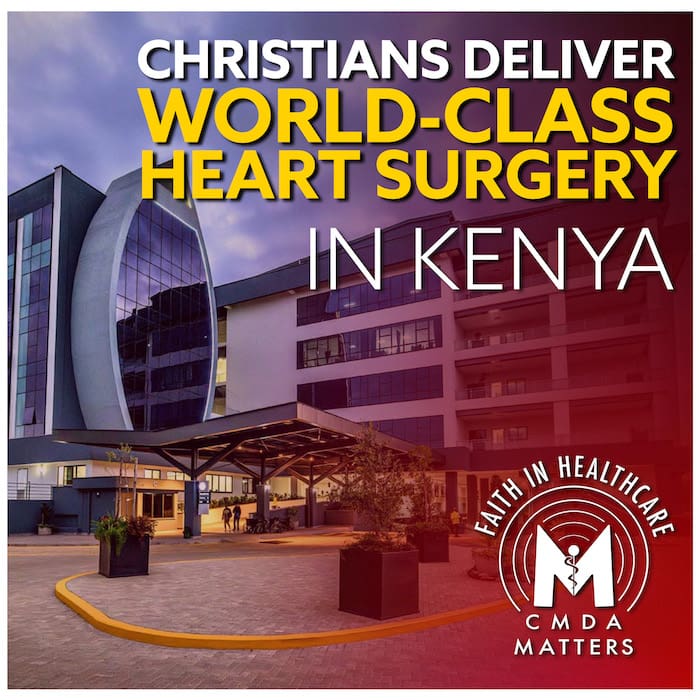
For many years, God has been doing remarkable work through Tenwic Hospital in Kenya, bringing compassionate, Christ centered care to patients from all across East Africa.
The hospital has grown to include a new cardiothoracic surgery center now offering life saving heart care to people who might otherwise never receive it.
I'm joined by two longtime friends and medical missionaries, Dr. Russ White and Dr. Carol Spears. And we're going to talk about God faithfulness over many decades of ministry, the tremendous growth of Timwick's heart program, and why caring for a patient's physical heart is always an opportunity to point them to the great physician. So let's get into it.
Well, today on Faith and Healthcare, it is a tremendous privilege. I've been waiting for this interview for a number of weeks and excited to welcome to the program, Dr. Russ White and Dr. Carol Spears. And I would say, Russ and Carol, that there haven't been guests on this program over the last seven years whom I know better than the two of you. So this is going to be, well, like a surgery department meeting maybe of the past at Tenwek Hospital. So welcome today. Thanks for joining us all the way from Kenya.
[00:03:18] Speaker C: Thank you.
[00:03:19] Speaker D: Thanks very much.
[00:03:20] Speaker B: Well, briefly before we get started with this conversation, Dr. Russ White, we joke that he's an African American because he was born in Belgium, Congo, to medical missionary parents and University of Michigan grad. So he's pretty happy with the NCAA basketball results here. Not long ago, also a grad, got his public health training from Harvard and general surgery at Brown University there in Rhode island. And a fellowship, an advanced fellowship, which has a lot to do with our conversation today, a cardiothoracic surgery fellowship in Bristol, England. He's director of a new cardiothoracic surgery center there at Tenwick Hospital in southwest Kenya. Russ has been at Tenwic for almost 30 years, Clinical professor, also part time when you come back to the States at Brown University and has lots of kids and lots of grandkids. So we'll have your full CV in the show notes today. And Carol Spears has also been serving for I think 20 years. How many years has it been that you started?
[00:04:26] Speaker C: 2008. I came well, 2007 and then yeah, started a training program in 2008. So been a while.
[00:04:33] Speaker B: So Carol's been following God wherever he leads. And this is a second career as a doctor and a surgeon. I think you worked for Ma Bell, didn't you? Once upon a time back in the day.
Got her training in surgery at the University of Kentucky and has served at tenwic in Kenya as well as meeting the needs of Muslim women in the Middle east for nearly five years and not quite two years ago returned to her second homeland of Kenya to help Russ and the staff here at tenwic run the new cardiothoracic surgery center. So again, it's a delight to see both of you. Neither one of you have changed a lick since I left 10 years ago.
[00:05:17] Speaker C: Must be the lighting here.
[00:05:20] Speaker D: Sure.
[00:05:21] Speaker B: Well, you've both been living and serving cross culturally, as we said, for a number of years. And what new truths. Let's start with you, Russ. What new truths or lessons has God been showing you recently in your work for his kingdom there at Tenwick?
[00:05:36] Speaker D: Thanks, Mike. It's a real pleasure to join you and be part of your podcast today.
Before I answer that, I have to say this is like the three musketeers reunion here. Yeah, yeah, yeah. I mean this was the triumvirate here at Tenwick Hospital. The, the three of us got the general surgery residency going and I, I remember us making a 10 year pact together to stick with it and get it up and running and we all kept our, our pact and that program is still running vigorously today. So it's sort of exciting to have three of us together. Yeah, yeah.
I think what I've learned most recently a couple of things.
Number one, God's grace is much bigger than any of us can imagine.
I've been impressed with that.
You know, we talk about it, we preach it, we teach it, but it's really come to hit me at my heart that this whole concept, this Christian concept, which is unique among religions in the world, that we can't do anything to win our salvation and we can't do anything to take us beyond the realm of God's grace that he wants to redeem us.
And I've seen it in my own life. I've seen it in employees lives that I'm working with and counseling with. And as the director of this place, I get involved in some of the HR issues and some of the difficult problems.
And God's grace is just bigger than we can imagine.
[00:07:21] Speaker B: Praise him.
[00:07:22] Speaker D: I think another thing I've been really learning a lot about is that God continues to use broken vessels. You know, we're.
Yeah, I've been here almost 30 years.
There have been ups and downs in that time. There have been days or times that I thought, boy, I'm tired out. It's time to be done.
But God continues to use imperfect vessels to bring about his glory. And for that I'm grateful.
[00:07:55] Speaker B: Aren't we all? Russ, Carol, how about you?
[00:07:59] Speaker C: Yeah. Also from my perspective, Mike, it is just so great to be a part of this today. Thank you for this privilege. And as I came to Tenlich and joined the two of you, you guys were heroes to me. And even though I'm a tiny bit older than you guys, you were my mentors in so, so, so many ways. How to adapt to living on the field as a missionary, how to be a surgeon, how to get out of situations that you never thought you would be in. And you probably are not trained for that we saw. So I'm just really thankful for the two of you and the impact that you've had on my life. And I think for me, as I reflect back on the, you know, almost two years that I've been back here, it's God's incredible faithfulness.
And you know, you can look at any given moment in time and he's faithful in whatever situation that we are in. But when you look over time and we do take a moment to think back to when I joined in 2007 and we were just barely moving into the new, brand new building down there with five ors, filled them up immediately, how now we have this whole huge new building and it's rapidly growing and expanding God's just continued to be faithful, and he has led all of us in our various visions and dreams and, and paths, career paths and, and missionary paths.
But he's. He's had purpose in that sometimes things that we don't understand.
And right now we're going through, you know, some things here that we think, oh, gosh, this is so challenging. But you can just stop and realize God's going to be faithful and he's going to see us through.
[00:09:49] Speaker B: Amen. Well, for our listeners, these two guests for my kids were Uncle Russ and Aunt Carol.
And Aunt Carol. I often describe you to other people here around CMDA Realm as being often the representative of the voice of the Holy Spirit in my life, because often coming to me and saying, you know, I think what you shared yesterday at Morning Report might have offended so and so or, you know, may not have been received the way you want it to be received. And my favorite of all time, surgery department, meaning I've told a number of people about this, was there was a day that just, you know, like this happened once in my whole career when I lost my temper and kind of lost it and got really frustrated and then had to come back later and apologize to you guys and your teams for having misunderstood a scheduling problem.
And you called, I think, a relatively urgent surgery department meeting in Russ office and you had cut out from construction paper little skin lesions and warts and stuff. And you had them tape those things to our foreheads, each one of us in the room.
And the point was we all have warts and we all stumble. You know, as Russ, you were saying, we're broken and God. So I really, that just is a fun memory with a piece of construction paper taped to my forehead having a conversation. So, yeah, thank you for all the wonderful ways that you've impacted both of you, my life.
Well, we're here today to talk about this incredible facility, which I tell people. And for our listening, I really recommend that you go to YouTube and see this interview because we're going to have some images for you today as well as some links to some videos. But I tell people if this was picked up and transported to downtown Manhattan, it would be amazing even if it was in Manhattan in New York City.
And Russ, you'll remember that I was there, I think, in 2022 in your guest room and for this podcast had a conversation about what you envisioned in this cardiothoracic center where surgery and cardiologists being done and endoscopy. Has it turned out the way you envisioned four Years ago.
[00:12:00] Speaker D: Yeah. You know, I mean, if I back up more than four years ago, this was not on my radar for a long time. Even when I first came to Kenya, as you mentioned, I did cardiothoracic training, but I never honestly thought we would do cardiac surgery here.
I did that training primarily for the thoracic part that I knew would be helpful.
And I just came at it from a western philosophy that, you know, people around here don't eat Big Macs and French fries very often and we don't have a lot of heart disease. And cardiac surgery is quite expensive. It requires a lot of equipment, a lot of gear, a lot of highly trained staff. And I just thought, honestly, it wasn't probably worth the expense. And it took some time. It took years of God kind of picking at my heart and using other people to say, maybe we should consider this. And I kept poo pooing it and saying, I don't think we should do that. We're busy enough.
And I eventually came to see the massive need for cardiac surgery that is pretty much unmet in sub Saharan Africa.
We estimate in Kenya, which is more advanced than a lot of the other countries in the area, that out of the patients in our population who need cardiac surgery, only 5% of them actually get it, meaning the rest will die of their disease.
So four years ago we had this plan which started as a small drawing on a napkin on my dining room table and then kind of grew from there as we dreamed. And I always believe in dreaming big. You might as well dream big and not limit God.
And we came up with rather audacious drawings eventually.
I don't think it really struck me, as you look at something on a diagram, the size of this place.
This is a 400,000 square foot facility, seven floors on one side, six floors on the other side. And it really is a state of the art facility.
We're doing things here that nobody else in East Africa is doing. And I'm amazed, I really am amazed as I stand here and see our young surgeons who we've trained here who are all better than me. They're all excellent surgeons and I'm, you know, proud of them in that sense. But I'm just amazed at what God has done. And that out here in the middle of rural Kenya is this big, beautiful, state of the art cardiothoracic center where we're doing the vast majority of all the open heart surgery in the country of Kenya.
[00:15:03] Speaker B: Well, all three of us have a mutual friend who shared with me a saying that I'd Never forgotten. This is John Wright, Russ, who said hard is easy, soft is hard.
So as incredible as it is, the point of John's statement is that building structures infrastructure is a whole lot easier than the software of the hr. And so, Carol, soft is hard. What have been any. You're directing the medical staff there, clinical services, if you will. I'm guessing there's a little of HR that happens. I know both of you are doing that, but what have been the challenges in terms of hr, having a medical staff come and go as that happens? Tell us a little bit about, give us some insight those challenges.
[00:15:48] Speaker C: Yeah, I can definitely relate to John Wright's saying and agree with it. But I would say that soft part is what's so critically important.
And I think that the thing that has been the most enjoyable and good about what we've done is that we got to start start new and we got to interview and hire a team that is 75% of our team is under 35 years old. And so we have a very young team, a highly skilled team.
And we just started from the very beginning having any discussions as we onboarded people or we have these town hall meetings now where we talk about the importance of integrity and joy in your work and serving and showing compassion and love and treating each other with respect and all of the values that we wanted to have that are so important in culture, how to handle conflict, how to go to your brother when there's some disagreement and to work that out according to scripture. And so we've had bumps along the way, but I, I think that we've enjoyed benefit of really being able to sit down around a table and work through to where we could find solutions or reconciliation. We've not had a lot of divisiveness in our team. We have also the advantage, I think, of having a really amazing leadership team. And so we were really blessed that God sent talented people to be our manager of HR and every person around the team, marketing and operations and strategy and projects and our spiritual ministries, finance. All of these guys have just really engaged and been so good at what they do and had good ideas and suggestions and we've been able to work it well together when we, when we face those challenges.
[00:17:58] Speaker B: So let's back up a little bit, I think for our listeners or viewers benefit. Tell us about when you launched, when you opened the facility and then what sort of services and volume Russ, are you having there at the center?
[00:18:10] Speaker D: So we officially opened in January of 2025.
We opened first with our outpatient department we continued our inpatient surgical service at the main campus and that moved up here in about mid February.
We have three clinical floors and we've only opened one of them so far, plus the outpatient area.
Our volumes have tripled since last year.
We were basically trying to meet the needs of a huge population out of a single operating room four days a week.
You'll remember, Mike, when you and I worked together on developing that new surgical center at Tenwick and we, we felt like we were pretty much in heaven when we moved from two operating rooms.
And we thought we'll never, I mean, we can always have space, but those rapidly filled with all of the specialties that we now have.
And we were really struggling to care for this huge backlog of patients.
So suddenly we moved into a place that has six operating theaters.
We've only opened, we say, two and a half at this point and already tripled our volumes this year. We expect to probably hit 500 open heart cases in the year, which is way beyond any other facility in the country of Kenya. And that's just open heart cases. We do thoracic cases as well, as you're aware of.
Our volume and endoscopy has gone up significantly because we have a beautiful new endoscopy suite with four different units. And our ERCPs and interventional procedures have gone up significantly in a separate recovery room for that whole unit.
And then we keep busy as well with the esophageal work. We still see a lot of esophageal cancer, pulmonary work with tuberculosis and other infections. So yeah, our volume has really increased and we're, we're trying to adjust ourselves and move smoothly. You got to keep up with it with the human resources.
We can do so many cases, but we got to have the staff in the ICU to care for those patients. And Carol's very involved with interviewing and bringing those on board. It's an exciting time here.
[00:20:49] Speaker B: How many critical care beds you have functional right now?
[00:20:53] Speaker D: That's a difficult question to answer because the floor that we opened is intended eventually to be completely critical care. It's 38 beds and we'll have 38 ICU beds, but we've subdivided that into a very critical care, immediate post op and then a critical care and then a step down and then award for the time being. Eventually we'll have 38 ICU beds and 170 total beds in the facility.
[00:21:25] Speaker C: We flex beds based on the need. So when we have surgical camps and a lot of additional surgery and patients need ICU care or step down care for longer then ward beds are also ICU beds in that particular floor of the hospital so we can flex as needed. But I think we, I think we say right now we have 45 total beds open because we've got some private rooms and we have a some space in what's called the preoperative holding area that we're just using for the patients that are either pre op or about ready to go home.
So out of those 45 beds, 16 to 20 to 24 would be ICU at any given time.
[00:22:10] Speaker B: Before we got going, I shared with you, I was guest in the home just a couple of weeks ago with one of your many, I think, short term pediatric cardiologists who come and Dr. Mike Liske in Knoxville, Tennessee. And he was just describing to me the kinds of procedures that are done in the US and some in Kenya. So talk to us about your cath lab and also the mix between congenital heart surgery cases and rheumatic heart disease sorts of cases.
[00:22:39] Speaker D: Yeah, I'll share with you a little bit about the surgical side and maybe Carol can fill us in on the cath lab side as she's directly supervising that.
The mix in the operating room is it's about 50% adult, 50% children.
50% of what we do is related to rheumatic heart disease.
And I would say about a third of what we do is congenital heart disease.
And then the remaining mix is a mix of coronary artery surgery, a lot of aortic surgery with many, many aneurysms and dissections.
We've kind of become the referral center for those.
We get quite a few referrals from Nairobi. And you know, that's the other place where there's five different hospitals doing cardiac surgery. So I always know when we get a referral from Nairobi, it's one of two things. It's either a very complicated dissection that nobody wants to take care of, or it's a patient with no money at all. And again, nobody wants to take care of them. So that's who we, we get here and then there's a group of people thrown in there as well. I just finished operating today on an esophageal patient. So we still continue to see those patients as well. And perhaps Carol can speak to the cath lab.
[00:24:05] Speaker C: The cath lab has been just a tremendous blessing. When I first came here and was really trying to learn a little bit about cath lab because I didn't have experience in that as a general surgeon that's not something I'd ever been around a whole lot.
I heard numbers kind of like, oh, you could expect maybe one or two every few months or something, you know, acute MIS coming in that might need an urgent intervention.
Oh my goodness. Our numbers are far more than that for both urgent and diagnostic procedures. We're doing somewhere between 40 and 50 and we hope that that will grow, but that's with a single interventional cardiologist who's doing primarily adult interventions. But I'm so proud of our team because they really are able to mobilize quickly. And so when a patient comes, usually to the main campus emergency department with an MI needs an intervention and perhaps stenting or something to intervene, they're able to do it. They're able to come in from home. We put drivers in place to go pick up the team around Tenwick and bring them here. And so I think we're one of the few centers who's able to try and respond within that recommended interval of being able to save as much heart muscle as possible. So we're really thankful.
[00:25:27] Speaker B: Wow. Really come a long way, Russ, since those days of those open cases with the ancient mitral valve dilator with blood everywhere. What an incredible transformation.
[00:25:43] Speaker A: Before we continue with this week's episode, here's a special announcement for you.
If you've ever wanted to become a more effective mentor or help others grow with greater purpose, join us September 25th and 26th for mentoring with a coach approach.
This two day intensive course will equip you with practical coaching tools, resilience building strategies and a coaching mindset to strengthen mentoring relationships plus foster both personal and professional growth.
Led by experienced coach and emergency physician Dr. Darrilyn Fulk and a physician life Development coach Ken Jones, this CE eligible course is designed for healthcare professionals who want to invest in the next generation with wisdom and lasting impact.
To learn more or register, visit CMDA.org events and if you if mentoring is something God has placed on your heart, be sure to also explore CMDA's mentoring and discipleship Commission.
The Commission exists to equip Christian healthcare professionals to invest in the next generation through Christ centered mentoring and discipleship.
By providing practical resources, training mentors, fostering meaningful relationships between experienced clinicians and trainees, and advocating for spiritual formation in healthcare education, the Commission is helping shape healthcare professionals who are grounded in both clinical excellence and biblical truth.
Learn
[email protected] mentoring something exciting is happening at CMDA Healthcare professionals across the country are stepping up and becoming lifetime members of CMDA at record pace and we want to invite you to join them.
This is more than a membership. It is a declaration that your faith and your calling are permanently connected, that you are committed to the mission to help bring the hope and healing of Christ to the world while being a champion to the next generation of believers.
To learn more and join a community committed to transforming healthcare For Christ, visit CMDA.org Lifetime to go even deeper with CMDA.
At CMDA, we want to help Christian health care professionals live out their faith with both conviction and compassion.
One way we do that is through Standing Strong, a three tiered curriculum designed for students, residents and practicing clinicians.
Standing Strong equips Christians in healthcare to remain grounded in biblical truth while navigating increasing cultural pressures with wisdom and Christlike care.
You can learn
[email protected] standing-strong let's jump right back into this week's episode.
[00:28:55] Speaker B: Let's switch gears a little bit and you mentioned earlier about the pacs, the Pan African Academy of Christian Surgeons program that started in 2008 and what a blessing. Still have the pictures of the very first collage I think that you put together, Russ, of graduates that still pray for Those it's been 18 years now. How many grads from not only general surgery, but talk to us about Update there at 10. The different programs that are present, including the cardiovascular fellowship and just some stories, a few stories maybe of grads who've left Tenwick.
[00:29:34] Speaker D: I'll let Carol answer your question about numbers because she's right up to date on that.
[00:29:37] Speaker C: Yeah, we recently compiled some of that for the Ministry of Health.
The cabinet secretary was coming and Tenwick has graduated 48 surgeons and physicians, consultant physicians. That does include family medicine. But in general surgery, orthopedic surgery, neurosurgery, OB gyn, family medicine and cardiothoracic surgery as a fellowship. So we are so proud of that and so thankful for that. And those those graduates have been serving on the continent of Africa. That may change shortly. But until now that has been all of everybody stays around this region and praise God for that. There's about 46 or seven continuing residents and fellows continuing each year.
So God has just really been at work in these less than 20 years that that was not possible with man's effort. So that was God's hand. And I think that that has contributed to 10 weeks growth, to its recognition as a referral center for all of these surgical disciplines as well as cardiac and to the excellence that I think has been pursued in 10 week.
[00:30:58] Speaker D: If you add to that the interns we have now 30 interns every year. So we've got 75 doctors in training at any given time. Between the two campuses here, it's really a major, major training center.
[00:31:13] Speaker C: Not to mention all the nurses that are in the nursing school, they have nursing training and so many other programs there as well, and chaplaincy training. So it's a big academic institution.
[00:31:23] Speaker D: So you'll remember Mike, of course, our first two graduates in general surgery were Agneta Odera and Araga Fakadu. And both of them went on to be two of our first trainees in cardiothoracic surgery.
And they've been doing some amazing, amazing things. Araga has been pushing the envelope with minimally invasive surgery here at Tenwick. I think we're the only place in the country doing minimally invasive mitral valve replacements.
He just always amazes me at the cases that he takes on and does remarkably well and transferring that knowledge to our trainees. And honestly, they come out exceptionally well trained. I've. I've always said I'm not going to sign somebody's diploma unless I'd be willing to let them operate on me.
And I can say that's the truth. Our cardiac graduates, seven of them, I'd let any of them operate on me if, if I needed it. So we're really blessed in that respect.
[00:32:31] Speaker B: So you've had seven grads. How many have stayed at Timwuk and how many have gone elsewhere?
[00:32:35] Speaker D: We've had two go elsewhere. One we knew we were sending back to Zimbabwe because that was the plan. He was sponsored by the Zimbabwean government.
We have another who's working currently in Nairobi. We still stay very much in touch.
He's heading up the new, brand new Kenya association of Thoracic Surgeons. There's never been an organization, so that's cats, and we're a vital part of cats, and the remainder have stayed with us. Dr. Arag has been with us right since he finished. It turns out he'll be leaving us actually quite shortly and taking up a position at Loma Linda University in the United States.
They've been eager to get him for many years and it's their great blessing to have him come and are a bit of a loss, but we've still got a great team to take care of patients.
[00:33:35] Speaker B: Well, we've not talked about the main thing yet, and I do want to get to the main thing, which is so well captured by Timmwick's model. We treat, Jesus heals. I've always called it a battle cry.
And so talk to us a little bit about the spiritual ministry.
Someday I really hope to get there and sit in that incredible chapel with the fish window and just multiple levels from the various patient floors and talk to us about spiritual ministry, about ministering to broken stony hearts, if you will. As Ezekiel told us.
[00:34:15] Speaker D: Well, you know, cardiac surgery lends itself to speaking about spirituality and our spiritual hearts. It's just natural. I talk to patients every day and, and say, yeah, you've got a. Essentially a broken heart that needs to be fixed. And with God's grace, we think we can fix it. We're. We're getting pretty good at that. And I think we can offer you a excellent operation and God willing, no complications, and you'll come through this well, but you've got another heart we need to talk about as well.
And, you know, patients will frequently, you know, I'll ask them, tell me about your own faith. And many times people will say, well, I'm. I'm a Christian.
And, you know, in this culture, nobody's a nothing.
As you're well aware, atheism is an invention of the West. In post modernism, in this part of the world, everybody understands there's more to life than we see.
So when somebody says, yeah, I'm a Christian, it might mean they truly are. It also might mean, I'm just. I'm not a Muslim or a Hindu, so I guess I'm a Christian.
But I'll frequently ask them, so is Jesus living in your heart?
And when they shy away a little bit and don't quite understand that, I say, because tomorrow morning I'm going to be inside your heart.
Am I going to meet Jesus there?
And that really opens a door for, well, what do you mean by that? Well, let me tell you what I mean. Jesus is more than just a name. We say on Sunday mornings, he's a living, breathing person and God Almighty, and he wants to live in your heart.
And while you're here at Tenwick, if that's not the case, it can become the case.
Let us show you how that can. Can happen. And that continues to be our ethos.
In every patient, we see that sort
[00:36:32] Speaker B: of approach to patient care. And I know that there are fellows, residents, maybe sometimes interns listening in or observing this sort of dual ministry.
Coming back to the states now 10 years, I describe it as the disturbing disconnect. I'll confess to you that even a couple times when I've shared with the PACS Commission and, you know, 50 or 70 surgeons in the room, I plead with them, if you don't know how to do spiritual ministry with patients. Please don't go to Africa and corrupt those residents, because I don't want you to corrupt them. To somehow separate the physical healing and surgeons from the spiritual ministry.
Briefly, one or both of you talk about ministry to the trainees and how you bring them up and mentor and disciple them in the faith to be doing that sort of dual ministry that you just described. Russ?
[00:37:25] Speaker C: Yeah, I think that it's not only trainees now, it's probably also our whole entire staff. But from the trainees perspective, thankfully with PACs, they require a spiritual curriculum.
Just like you have your, your clinical curriculum that's necessary for you to graduate, then going through a spiritual curriculum is just as important.
And our team here works through that spiritual curriculum, and they meet weekly for Bible study together. And I think that we've been very blessed that some of the graduates of our program kind of came here with a heart of ministry and, and like Dr. Legal M comes to mind, who, who probably has led more people to Jesus, you know, than many in this facility because he just has such a burden and a passion and an anointing even to, to show that love of Jesus to patients and to be so concerned about their spiritual growth.
I think the thing that has also become extremely important to us now that we're in these leadership positions is that these 330 staff members, that so many of them are so young, so many of them also need to be discipled in, in their walk with Christ. And we have a, a wonderful, passionate head of our spiritual ministries, Reverend Fanson. And he and his team really have a heart for that. The, the avenue that, that has given us an opening to really be able to share even more deeply with our team is when we go through the hard times, when we lose a patient or we have something devastating happen, just the impact on the caregivers, the healthcare providers is also real.
We got to be there for the family, we got to be there for the patient, assuming that they're still with us after whatever we encounter. But I think that really trying to take seriously talking about grief, talking about the, the secondary trauma that comes to healthcare providers, talking about how we process the impact that these things have on us, and making it okay doing debriefings, you know, pointing ourselves back to scripture, all that has really been done and is vitally important in what we do.
[00:40:03] Speaker B: Russ, anything to add to that?
[00:40:04] Speaker D: Oh, I'm amazed at some of our young trainees, I have to say.
You know, over the years, I've. I've Grown and adapted. And I think earlier on I was, I was more focused on being sure we got the academically brightest trainees.
That was probably more important to me. Now I can say we still get academically incredibly bright trainees. She mentions Dr. Lijelan. He just graduated in December and is one of our young consultants or attending surgeons here now. He won the award in December as the top performer of all specialties in the board exams. And his heart is so tender for the Lord. I mean, he just spends hours and hours sitting and talking with patients and families and sharing his faith and feels a deep burden that that's what he's here for.
And he's an excellent surgeon, technically gifted, humble guy. And I just thank the Lord that he sent us these people and we have the privilege of mentoring them and working with them and living alongside of them.
[00:41:24] Speaker B: Wow, what an incredible legacy. And I still remember sitting in one of our former general meeting rooms where we had the morning report and doctor story coming in and sitting there and he just started weeping just to see that group of trainees, you know, maybe 20 or 25 and now just further expansion.
The staff there must be close to 2,000 if you take the entire ministry community.
And so Carol, I think you wanted to share a story about ministry to. I mean, people get sick.
You have that many staff, there are people that you go through loss with. And I remember some accidents and some tragedies that we had together, including the loss of the principal at that time of the nursing school. Tammy King, tell us a story that you wanted to share about losing one of your medical officers.
[00:42:18] Speaker C: Yeah, we just very recently had just a tragic situation where a young medical officer had been on call the night before and happened to mention to her colleagues that she didn't feel very good and was starting to have some chest pain and a really bad headache. And she went to the accident emergency there at the main campus and just collapsed with a heart attack.
Just in her 20s, I guess without trying to share too many medical details, she required an urgent cath lab intervention. She later required follow up intervention and surgery.
And it really impacted the entire physician team, particularly all of our trainees and medical officers and staff.
Because it's one of your own and it's such an unusual situation in your 20s to experience this.
As we walked through that, we all walked through it together as a team, talked about it, prayed about it, met with her family, met with her close colleagues and friends and really tried to help them to understand all of the complex things that were happening around them in A very highly technical environment with complex surgical things going on.
And ultimately she didn't make it. And we. We trust God. We know that he is the great physician and that he is the one in control of the outcomes. But even as the entire team processed her death and as her family processed her death, I think they recognized, wow, the care she got was what she would have received had she been in, you know, downtown Manhattan or downtown Boston. And so we're just so thankful that everything possible that could be done was done.
We trust God with this outcome. And then we've tried to walk through that grieving process as a community and have had a variety of discussions and debriefs. And they had a very special ceremony that only the trainees and colleagues down there at the main campus attended. But we saw pictures from that. And so I think it's been a time for God to really help all of us take stock of our relationship with him and how we trust him when we go through things that are so challenging and difficult.
[00:45:10] Speaker D: Wow.
[00:45:11] Speaker B: Thanks for sharing that difficult story with us.
You know, we're running out of time, both of you. I wish we could go on for another half an hour. But you mentioned earlier, I think, Carol, that there are still pretty significant needs in terms of specialists. And I do run into cardiologists and cardiac surgeons all the time who say, hey, Mike, what could I do? And I'm like, well, I do have a place you could check out. But right now, what are your most acute needs in terms of whether short term or long term help?
[00:45:38] Speaker D: Yeah, Mike, I'm asking you to grab those cardiologists and put them on a plane.
I hear a lot of the same people say, what can I do? And you know how that goes. Sometimes something happens. A lot of times nothing happens.
Our interventional cardiologist is working on his own. He's on call 24 7.
That is not survivable. Right. And we really could use some help in that area.
We're looking to hire another one. They're hard to find.
And when you talk to these cardiologists who are just retiring, why don't you suggest a second career to them?
Give up the golf in Florida and come here and work with our team. And I think you will find great joy in doing that.
[00:46:32] Speaker C: Absolutely. Adult or pediatric cardiology.
If we had other missionary cardiac surgeons that wanted to come and be alongside our team, we would welcome that pediatric or adult cardiac intensive care. We are desperately in need of more help there.
[00:46:52] Speaker B: Sorry to interrupt you, but it hadn't occurred to me before. But surely there have got to be cardiology groups. I mean dozens and dozens of them across the US where they could take rotations and it would be a great way to recruit new cardiologists to the group and it would be a great way to promote their services that they would do a month at a time because a lot of these cardiology groups, as you know, are massive. So if you're out there listening or viewing this program and you have some colleagues or you are a cardiologist, maybe talk to your group about this opportunity and you've heard it straight from Russ and Carol's mouths that the needs are great. And just imagine being that interventional cardiologist 24 7. That's painful even just to hear, guys.
So well, any final comments? How can we, our listeners, our viewers be praying for you guys over the coming months?
[00:47:45] Speaker D: Pray for our human resources. As we began this discussion, the those are our most precious resources. And we're really Carol mentioned we. We started fresh with this new facility and we're trying to focus on that. That our team is critical and keeping that spirit of teamwork and encouragement and building each other up that the Lord would bless that would prevent the devil getting a foot in there and creating division.
We're really actually very pleased with where we're going and I pray the Lord will continue that.
We have some more big projects coming up that we're excited about and I'm trusting the Lord's going to supply them. I don't know where it's going to come from, but we need more housing here at 10. We've run out again and I've got the plans drawn. We've got the land ready.
I just need $4 million so that's ready to roll. We bought some new land for a school.
We found as your you would know, Mike, that one of the major issues that keeps people from staying at 10 Wick keeps both national and missionaries is the lack of a school to the quality that they want right near here.
So if there's a champion out there that wants to come and develop a school with us, come on along. We'd love to have you here and join us. So be praying that the Lord will meet some of those needs. Carol, you may have others.
[00:49:25] Speaker C: No, I just feel like I should also say for the main campus, they have so many needs as well and all of these very surgery disciplines we mentioned and medicine and pediatrics and so pretty much any buddies help would be welcome. But we're so grateful for CMDA and for you, you know, advocating on behalf of the Christian doctors and dentists in, in America. And one thing that anyone can do is pray, you know, to continue to pray for God's work around the world and if you, you know, feel led to pray for the work specifically here at 10 Wick and at the 10 week CTC Cardiothoracic center and just that God will continue to see us through, you know, to provide what we need. Just in time.
[00:50:13] Speaker B: Well, we'll have a bunch of links for our listeners and viewers. We'll have a bunch of links including a video about the CTC and some other programs. We didn't even have time. I was just talking to a mutual friend of ours the other day about the Mustard Seed House program, which is like a Ronald McDonald house that you have there, providing for families that don't have resources. Which that story in itself to me and how God brought it about was just so remarkable to hear as an alumnus of Tenwick. So thanks, Russ White and Carol Spears for joining us today. And I can't wait for this program to come out and for our faith and healthcare listeners to hear it and for our prayer warriors to get going to pray on your behalf. And we'll keep following both of your prayer letters very closely and praying for you. So can't wait to see one or both of you at our national convention or otherwise in the near future.
[00:51:05] Speaker D: All right, thank you so much, Mike. It's been a pleasure to spend some time with you.
[00:51:09] Speaker B: God bless.
What an incredible reminder that healthcare is about so much more than just treating disease. As Russ and Carol shared today, every surgery, every patient encounter and trainee that they mentor is another opportunity to demonstrate the compassion of Christ and share the hope of the gospel of Jesus Christ. Their work at Timock Hospital is also a reminder that God, he continues to accomplish extraordinary things through ordinary people who faithfully answer his call.
And by investing in the next generation of healthcare leaders who are going to carry on that mission forward.
Whether God's leading you across the world or into your own community, every act of faithful service can become a testimony to God's grace.
If you'd like to learn more about Tenwick Hospital's cardiothoracic center, opportunities to serve, or ways that you can be praying for this ministry, we're going to include links and resources in today's show notes.
And if you found this conversation encouraging, would you please share it with a fellow healthcare professional who needs to hear it and subscribe so that you don't miss future episodes of Faith in healthcare next week? Dr. Bill Griffin and I are joined by Dr. Alwyn Rapoz and Dr. Marjorie Rapoze and they're gonna share with us how the Saline Process Witness training has transformed the way that they care for patients.
Together with sharing the hope of Christ, their stories offer practical encouragement for any of you Christian healthcare professionals who want to confidently integrate faith into your everyday practice.
Thank you for listening to Faith in Healthcare, where our promise to you as a listener or better yet, a subscriber to this podcast is we're gonna do everything that we can to keep your faith and health care connected.
We'll see you next time, Lord willing.
[00:53:27] Speaker A: Thanks for listening to Faith in Healthcare. The CMDA Matters Podcast if you would like to suggest a future guest or share a comment with us, please email cmdamatterscmda.org and if you like the podcast, be sure to give us a five star rating and share it on your favorite social media platforms.
This podcast has been a production of Christian Medical and Dental Associations.
The opinions expressed by guests on this podcast are not necessarily endorsed by Christian Medical and Dental Associations.
CMDA is a nonpartisan organization that does not endorse political parties or candidates for public office.
The views expressed on this podcast reflect judgments regarding principles and values held by CMDA and its members and are not intended to imply endorsement of any political party or candidate.