Episode Transcript
[00:00:08] Speaker A: You're listening to faith in healthcare, the cmda matters podcast. Here's your host, Dr. Mike chubb.
[00:00:19] Speaker B: Welcome, friends, to Faith in Healthcare.
You know, I have an important question I want to ask you.
What does every Christian physician, dentist, physician, associate, nurse practitioner, healthcare executive, pt, ot, optometrist. Okay. Basically every member of the healthcare team and all of their trainees have in common?
Well, each one needs to know that they are not alone in the exam room. That their faith and their healthcare practice, they're meant to be intimately connected.
And that's exactly what CMDA exists to do.
Each year, through CMDA Campus and Community Ministries, we walk alongside more than 14,000 healthcare trainees and professionals, equipping them to bring the hope and healing of Jesus Christ to every patient they serve.
This work simply wouldn't be possible without our dedicated volunteers and the generosity of faithful donors like you.
Last month, I shared an exciting opportunity, a $250,000 matching challenge. And today, I'm incredibly grateful to tell you that together we met that full match.
Thank you and praise God.
But we're not finished yet. As we approach the close of our fiscal year on June 30, we still have a gap to close to reach our $1.1 million goal.
And these final days, friends, are critical.
So today I want to personally invite you. If you've been considering a special year end gift to support your cmda, now is that moment when you give. You're not just giving to another ministry. You're standing with your Christian medical and dental associations as we seek to equip and encourage healthcare professionals on on the front lines of faith and medicine.
To make your gift, just visit cmda.orggive or you can call our stewardship team at 888-230-2637.
I want to thank you for being a vital part of this mission and for helping your CMDA finish the year strong.
Well, now on to this week's episode.
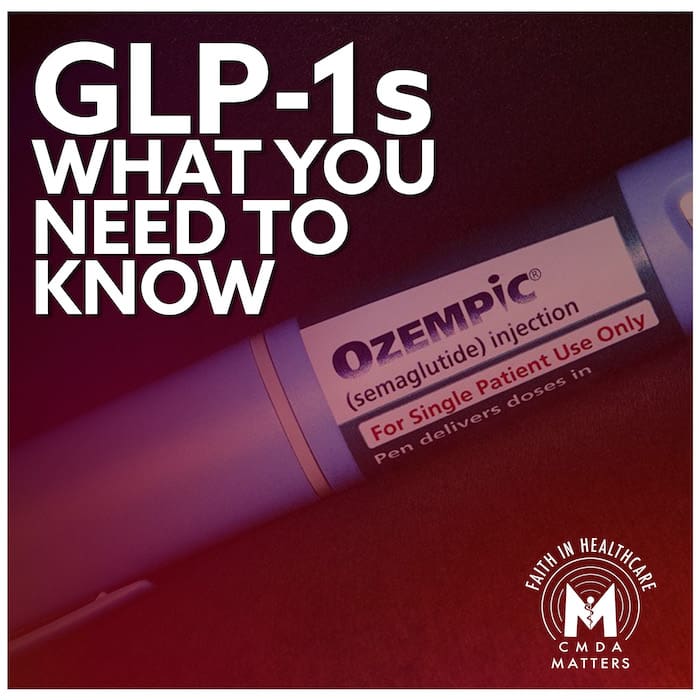
There are few drug classes that have generated as much conversation in medicine as quickly as GLP1 receptor agonists. And it's a conversation happening in primary care offices all across the country every single day.
This is the first of two episodes that explore GLP1s from very different angles.
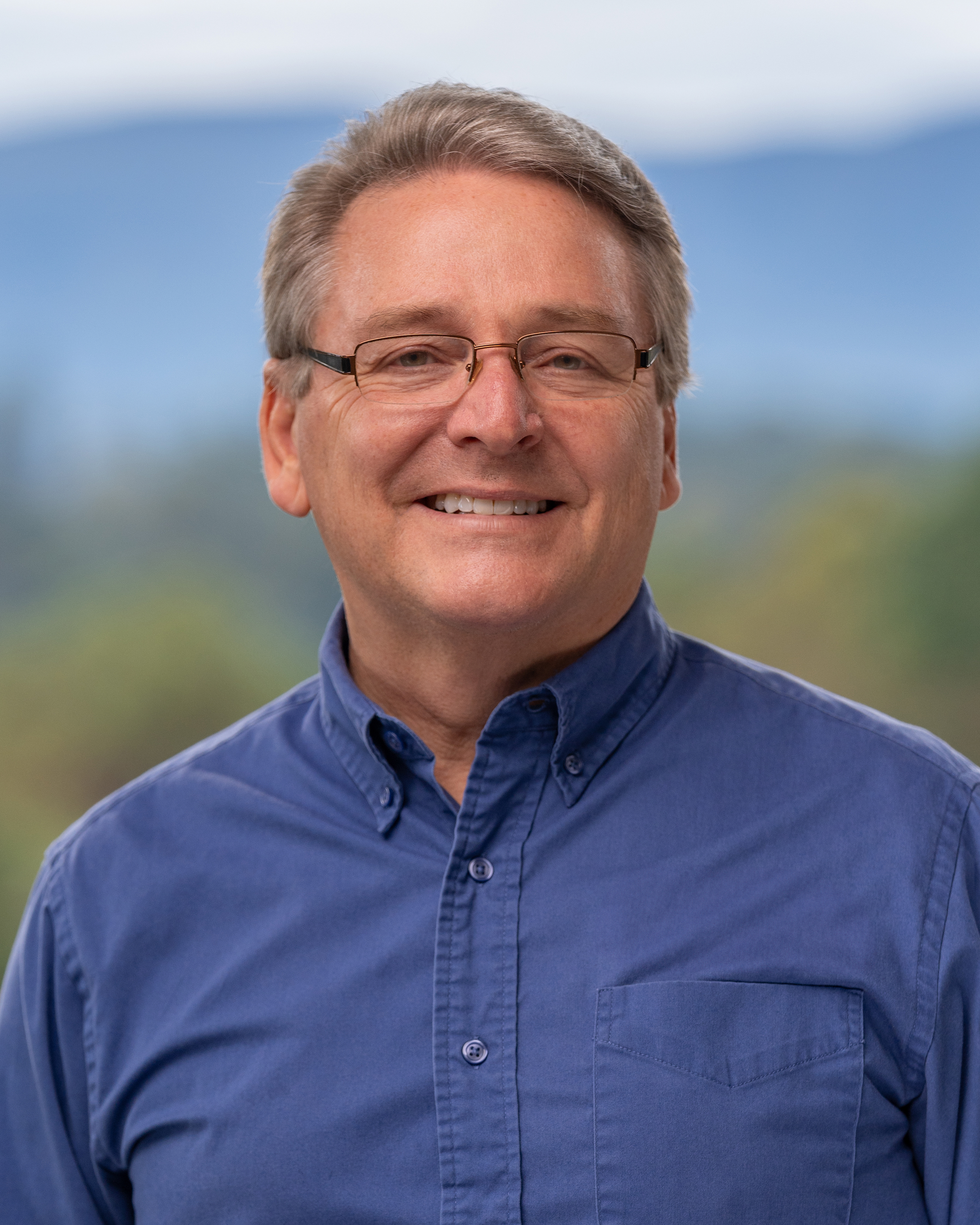
In this episode, Dr. Amy Givler joins us with with the clinical perspective. She's a family physician who has served patients in Northeast Louisiana for decades.
Dr. Givler is going to bring us both clinical depth and candor to a topic that is transforming how we think about treating diabetes, obesity and beyond.
We're going to talk about how these medications work, who they're for, what the side effects look like, what happens when patients stop taking them, and the honest questions we still can't fully answer.
And then next week, we're going to look at GLP1s from more of a theological, anthropological and ethical lens. But first, let's dive in on the clinical side.
Well, today on faith and healthcare, I have a guest whom I have known for many years, and she and her husband, both physicians. And my wife and I have spent a fair amount of time together, whether being on vacation at her place in Rhode island or traveling across Europe on a reformation tour last year. Dr. Amy Givler and her husband Don, both physicians. Amy's a family physician who sees outpatients and Monroe, Louisiana, and she and her husband Don, one of their favorite things to do is to go with medical students from their local medical school to Kenya, from lsu, Shreveport, for a global health rotation. So she's been there to Timok Hospital where I served for a while. She's the mother of three, including one of those is a family physician. So she's surrounded by doctors and grandmother of four.
She's been on our board, I think now, six years. Amy, is that right?
[00:05:05] Speaker C: I think so. Yep. Maybe a little more. Maybe seven.
[00:05:08] Speaker B: And she loves to. She loves to. This is not her first rodeo. She loves to appear on various podcasts, including one of my favorite, the World and Everything in it, and has been there a number of times, maybe even Dr. Gibler talking about the topic that we're going to discuss today, but topics like chronic pain vaccines, the doctor patient relationship, and healthy eating, which relates to what we're going to talk about today. So, Dr. Gibler, thanks for agreeing to come back because you've been on the program a couple times, once as my co host. Thank you.
[00:05:38] Speaker C: Yes, that's right. Last summer. Yeah. Thank you so much for having me, Mike.
[00:05:42] Speaker B: Well, Amy, just a couple of background comments before we jump into a topic. We've been discussing GLP1s glucagon, like peptides, for a number of months. And just a few weeks ago, I was the guest with my wife in the home of two family physicians whom I won't name, but whom, you know, who are very busy docs. And I had the chance, knowing that this conversation was coming, to ask them, how much of a role do you play in the lives for your patients? Very busy doctors in terms of prescribing and managing GLP1s. And they both said about a third of our patients, a third of our patients. And I would say they probably have a normal distribution of the kinds of patients, ages, diseases and so forth. So I was a little bit blown away by that, Amy. A third of patients. And I also have a very bright engineering, chemical engineering nephew who's in Indiana who took me by the plant that he's helping Eli lilly build a $5 billion facility to make Manjaro and someday an oral tablet. So I was pretty impressed by that.
But on top of all that, in my own family and working environment, I've now counted up to nine people who are someplace in their journey on being treated and helped by GLP1. So this is drug class that's really present. And so when did you first start using these agents, Dr. Givler? And for what purpose?
[00:07:13] Speaker C: So for most of my career, actually pretty much my whole career, I've been working with indigenous patients in northeast Louisiana, in Monroe.
And so my patients don't have a whole lot of money, so they have to get their medications covered by Medicaid or Medicare or the vast majority of my patients and a little bit of private insurance and very little self pay.
So my diabetic patients with diabetes type 2 have been using, I've been using GLP1s with them. Not nearly as effective as the ones we're talking about, the semaglutide and the tirzepatide.
For 10, 15 years they've been on the market and very effective for diabetic care. They are injections. So they're patients who don't want to take injections and they haven't been taking them, but they're very effective.
And then when these two came out, the semaglutide and then Tirzepatide, which is Ozempic and Mongero, I jumped pretty much right on board with treating diabetes with these medicines because I already was comfortable with the class of drug in that they were very safe and those side effects can be tolerated, you know, with, with tweaking.
And that's not usual for me. So usually I am not a jump on the bandwagon. Even, you know, glitzy new drugs. I am a wait, you know, a year, two years, wait till my patients are really asking about it, which is a year or two years because they don't watch, you know, a lot advertisements for medications or whatever. But I jumped right on because they were so clearly helping people not only lose weight, but it was really controlling diabetes.
So I've been using them now for years and the public payers, you know, Medicaid and Medicare are covering them if people have diabetes, but not for the purpose of even pre diabetes or obesity.
[00:09:22] Speaker B: So are there signs that that is going to change just because even though diabetics, obviously the long haul prevention of complications is obvious. But even for others, is that going to change?
[00:09:35] Speaker C: Yeah, it is.
That has already.
Apparently there's going to be something they call a bridge program for Medicare patients that's going to start this summer. And it is to provide these medications if you have to have some like pre diabete, perhaps morbid obesity, I'm not quite sure about that, but cardiovascular indications or whatever. So that is gonna get covered by, for Medicare patients and we'll see. Medicaid is a tough environment though.
[00:10:07] Speaker B: Dr. Gabriel, we're gonna have some listeners today who are not familiar at all with these medications or how they work. And I know you've prepared for us maybe a diagram that we'll put up on the screen at some point. But can you just explain basically how they work?
[00:10:21] Speaker C: GLP1 is a peptide. It's actually a hormone that our bodies make. But our natural GLP1 exists very briefly in the body because it's metabolized very rapidly.
So you think, well, what are. Anytime you have a hormone, it has to have a receptor where it's utilized somewhere distant. So these GLP1 is made in the distant small intestine and it travels to wherever there are GLP1 receptors.
And you would think, and this is all the place they looked in the beginning, you'd think, oh, they're in the stomach.
Because when I tell you how they work, they're in the stomach, they're in the pancreas parts of the GI system. But actually you find GLP1 receptors all over the body and most importantly is in the brain, in the hypothalamus. And those GLP1s activate. So the. So when natural GLP1s have been mimicked by these medications. So these medications, GLP1 agonists, are medication other molecules that act on receptors that are somewhere in the body. So the receptors that are in the brain have to do with satiety, like feeling full.
[00:11:49] Speaker B: Yes.
[00:11:50] Speaker C: And it's all about hormones, you know. So that is what we're talking about. We're talking about a hormonal system for regulating how much we eat, that God brilliantly did in our bodies.
The ones in the, in the stomach.
Delay emptying of the stomach, delayed gastric emptying. That's where the, the GLP1s work in the stomach and the ones in the pancreas. There's like two. There's different cells. So there's alpha cells and beta cells. And the alpha cells put out glucagon. And glucagon tells the liver to put out more glucose.
And so these tampen that down so there's less glucagon that gets. That gets released. And the beta cells, as most people listening will know, are what produce insulin. And insulin is the only cell it also a hormone. Well, glucose, glucagon is a hormone too. All these are hormones. The insulin is the only cell that we have that piggybacks glucose molecules and takes it out of the bloodstream and puts it into the tissue that, you know, the muscle, the organs, the tissue that we. That needs, you know, that's starving. That's saying, here, give me glucose, give me energy.
And so the only a cell for that is insulin. That's why we die if we don't have insulin. So the GLP1s ask those cells to make more insulin.
[00:13:25] Speaker B: So talk about the side effect profile. The general surgeon in me is thinking about gastric receptors and about slowing motility, that there's gotta be maybe for those already having gastric reflux, that that must increase.
[00:13:39] Speaker C: Not really reflux as much. I mean, it can. But I recommend. So these weak shots, we're basically. I know there's pills out there, but maybe we'll touch on that briefly. But basically we're talking about the shots. And the shots I recommend to my patients to take it on an empty stomach. So there's nothing, not much in the stomach that is now going to be sluggishly emptying. Right. And to not eat a gigantic meal right after taking the shot. And that decreases the incidence of nausea and vomiting.
And so side effects tend to stick with the GI tract. Right. So a lot of people have constipation, ironically, a lot of other people have diarrhea.
[00:14:26] Speaker B: I've heard that both from both of those extremes, from the people that I
[00:14:29] Speaker C: know, and then just feeling bloated. But again, that can be mitigated by not having a lot in your stomach. And so because it decreases, because taking it, your appetite is suppressed because your body's sort of thinks that you've already eaten.
So then when you eat, especially if it's somebody who like obese people, a lot of time talk about just food noise. I don't know if you've ever heard that expression, but just that, oh, I'm always thinking about food. I wish. Gosh, I'm hungry right now. And fighting it minute by minute all day long.
And that is a lot of people. And so it dampens that down. And people who have started taking these medicines, if that has been the primary reason for their eating more calories than they need, they're like, ah, freedom. Finally, I don't feel like I have to eat. I can do other things without putting so much of my brain and energy on telling myself, no, don't get up and go to the refrigerator. So they've been a real boon.
[00:15:41] Speaker B: So when patients come to your office, let's talk a little bit about the non diabetic because there's no question that the explosion in the last few years has been for obesity. And a JAMA article that I was reading from just about two years ago stated even at that time, maybe on the basis of BMI, but that over 40% of Americans would qualify clinically to take a GLP1 on the basis of just BMI alone.
[00:16:09] Speaker C: Right.
[00:16:10] Speaker B: So how many patients now would you say? I talked about others who had a third. But what percentage of your patients with diabetes or not are you treating? And how many are wanting, how many are coming to your office and saying, Dr. Givler, I want to try this. And it's one of the things that I thought probably you as primary care doctors, much more than those of us who had patients who were referred to to us, me as a surgeon, that probably this comes up more commonly in your practice than it would for mine, that, hey, I saw this on TV and what do you think about this for my problem?
[00:16:41] Speaker C: Yeah, so so many people, you know, obesity is exploding in our world, although it's starting to level out, at least in America because of these medications, actually, because I've taken care of people for, you know, I've been a doctor for a long, long, long time, since 89.
And we've never had a medication with obesity that is safe.
I mean I've, I've been very fads,
[00:17:10] Speaker B: many fads, but they've come and gone, many fads.
[00:17:13] Speaker C: But medications that actually turn out to be dangerous. And I've seen it come and go and pretty much hasn't been my patients because again, I'm kind of reluctant a follower on bandwagons. Right? But when you talk about adding a medication for obesity, you have to think, well, let's talk about not only the side effects of the medication, but let's talk about the side effects of obesity. Because obesity is a dangerous condition and it way increases your risk of many cancers and cardiovascular disease and kidney disease.
So your earlier Alzheimer's, these are just statistical of people who are obese are at higher risk for these things. So by treating obesity.
So now we're talking about non diabetics at this moment, but thinking about the obese portion of those people. Right.
And you think, well, what are the consequences of staying obese or in our current food environment, increasing in weight over the time? Because that's what we tend to see. And we could talk a little bit about our food environment on a different podcast.
[00:18:27] Speaker B: Probably.
[00:18:27] Speaker C: Maybe so, yeah.
But for obese people, I would say I really wish they were covered because they are effective and they are safe. And I'm. I'm a cautious person when it comes to medication. And I'm all about. I have had. I've had people say, no, I just, you know, I can never stop being nauseous, even on the little tiniest dose, and even taking it every other week instead of every week. And I'm like, okay, you're just super sensitive to it. And that's, you know, we won't keep you on this med. You know, I'm not going to force you to take anything. But I'm like, okay, this is not a medicine you tolerate. But a lot of times you can get somebody on the medicine if you start really low and increase very slowly, you know, over months.
[00:19:16] Speaker B: And doctors have told me that it's just a matter of titrating the dose, you know, the nausea and the other GI complaints that if you just taper off, then still the satiety is taken care of, but the GI complaints are lessened. It's amazing because I have known a number of people on those, and of course I'm thinking about it because we've been talking about it for months, and in my family, lots in my extended family, many people have been on them. I've never heard a story of failure. It's amazing. But you taking care of lots of patients, have you had patients that have failed on a GLP1?
[00:19:48] Speaker C: Well, you have to think so. Basically, my patient population who are taking them are diabetics. So in terms of the success of having their hemoglobin A1C, you know, the marker of their diabetes being better.
[00:20:04] Speaker B: Yes.
[00:20:04] Speaker C: They don't fail. They. I have not. I agree with you. I have. My patients, I have not seen that fail. I have seen patients not lose weight.
Now. A lot of times their. Their trajectory was gaining, you know, five, ten pounds every year, their whole life, you know, every year, their whole life.
So plateauing is success in that sense.
[00:20:27] Speaker B: Yeah. No delta.
[00:20:28] Speaker C: Right.
So I wish that we could prescribe them for non diabetics in my patient population, but I think there is definitely medical reason to do so.
[00:20:41] Speaker B: Yeah.
[00:20:46] Speaker A: Before we continue with this week's episode, here's a special announcement for you.
The 18th ICMDA World Congress is right around the corner from June 30 through July 5, 2026, on Jeju Island, South Korea.
ICMDA has been bringing together Christian physicians and dentists from around the world since 1963, and this gathering is one of the most meaningful ways that this work comes to life.
It's a chance to be strengthened in your faith, connected to a global community of believers in medicine, and part of something much larger than your own practice or place in the world.
If you've ever wanted to experience what it looks like when the Holy spirit moves across 14 world regions through the hands and hearts of Christian healthcare professionals, this is it.
We'd love to see you there.
Visit CMDA.orgevents to learn more and register. Today, The CMDA Learning center is continuing to grow and it's an incredible resource for Christian healthcare professionals.
You'll find content from recent national conventions, the Faith Prescription series, continuing education opportunities, and a wide range of courses designed to support both your professional work and your spiritual growth.
And here's the best part. As a CMDA member, you can earn continuing education credits at no cost.
To start exploring the full library, visit CMDA.org learn let's jump right back into this week's episode.
[00:22:40] Speaker B: So I think what you're getting into a little bit, and I'm very interested in your take on this, because clearly these are not cheap drugs and that's why you're bringing up Medicaid, Medicare, because of some sort of coverage for your patient base. And so maybe one of the ethical arguments that's just upon us and will continue to, you know, become bigger and bigger is obese patients who don't have insurance and are going to have health problems, these markers for disease that obesity represents. So are there programs, I mean, have you been able to link people up just for obesity with programs from some of these companies that are making, we already know, billions and billions of dollars, Right? Have you been able to link them up with a program so that they
[00:23:20] Speaker C: can afford it only if they have insurance?
So there's bad insurance out there in that it doesn't cover much. But if you have any kind of commercial insurance, you can sign up with the company.
I think Manjaro is $25 a month, you know, is what you end up paying.
But you have to write, I've, I've looked at those applications and you have to say you absolutely do not have any public insurance, meaning Medicare and Medicaid, that is you. And, and I'm not going to ever encourage my patient to lie on those. Right. And so there are some times that brand name drugs have programs, but they don't specifically ask, you know, a lot of time, you know, if about public insurance. But, but for this they are. So I don't know why I really, if somebody, you know, if a reader, a listener knows why they're not allowing Medicare Medicaid patients to access, you know, because these programs are like you pay for Bonjouro, it's 25, as I said. But for Ozempic, I think it's 499amonth. You know, they're paying $499 for basically, you know, self pay, but you have either self pay or they have insurance. So.
[00:24:46] Speaker B: Well, the review that I read in JAMA from a couple of years ago talked about basically traditional discipline exercise, decrease intake and what the percentage of body on average of weight loss is versus now GLP1s versus bariatric surgery, with or without GLP1s. And certainly it's a gradation. It's moving up in percentage with some of the more recent GLP1s, one of which I think is from Eli Lilly, that's pending approval with somewhere between 18 and 21% weight loss within the space of I think 18 months. So pretty dramatic. So that's success. What happens after that success? What does maintenance look like for these patients? Because the recidivism must be high. It has to be high.
[00:25:33] Speaker C: Yeah. So if you just stop a medicine, stop One of these GLP1 agonists, receptor agonists, that's what the whole name is. But if you just stop them suddenly, then it's.
The studies show that 70 to 90% weight regain.
Now 90% is not 100%. So there was like, we're talking it's definitely weight regain, but there's something happened in the body that was at a lower weight for a time.
And I kind of, I know this is controversial in the obesity literature, but about the set point that if you are at a certain weight, your body thinks that's the weight. It's got to be. So if you starve yourself like a diet and you just stop eating, then your body is going to be, oh, let's slow this lady's metabolism way down because she's starving and we need to have her weight go back to where it was the set point. Right. And so there is some of that. That happens. But now some recent studies, if somebody wants to get off them, the recommendation is to wean slowly. To slowly do it. Not just like, go from a high dose to zero, but to go slowly down.
And then there's a lot of talk in this world of this literature about just the very lowest dose. And every other week, so you're just giving a little teeny bit of it. You know, every once in a while you're getting it, and it just cuts and it just allows somebody to continue to make healthy food choices. I was thinking that helpful would be to talk about our food environment just a little bit right here.
[00:27:19] Speaker B: Go for it.
[00:27:20] Speaker C: Yeah. Because, you know, why is obesity exploding in America? You know, I mean, if you look at the percentage of people obese, and yes, people are more sedentary. They're looking at screens and not running around.
But we also have so much processed food available to us at every corner.
And fast food, which is very processed. And by processed, I mean it's basically been exploded, the nutrient. You do have protein there, you have carbs, but they've sort of exploded it so that they can make the nuggets all look identical because they re put them back together first they explode them, then they put them back together again.
That means that even though, yes, it was a chicken at one point, it is now easily distributed in your body and so and absorbed as very small molecules. You know, it doesn't take much to get it to sort of. It sort of gives you a, you know, a burst of insulin, you know, to get rid of, to. To manage that.
Yeah. So we are, I think, you know, people talk about a toxic food environment. You know, I just call it a difficult food environment because people come in. How do we celebrate? We celebrate with food. We celebrate with sugar, fat.
And I don't have a problem with a lot of fat. But if you add simple carbohydrates to fat and salt, you know, they call that the sweet spot, I think, you know, in food lingo, where they're trying to get you to buy more of these, you know, junk food chips or whatever. And so they're just making it taste so that you. We're talking about addiction. We're talking about people who sell food who are trying to get us addicted to that brand, that type of food. Whereas I much prefer that my patients eat real food.
Food that grows in the ground or that was an animal and that has not been processed by companies and has an ingredients label. I'd rather they ate Actual food.
[00:29:46] Speaker B: Right. So I'm guessing then that you take some patience during this fast food holiday that these GLP ones potentially would take them through, that you counseling, give them lots of education to help them so that in two, three, four years, whatever, when they've had the weight loss that you want them to have and that they want that now they've had a chance to recalibrate their eating habits. Is that generally your habit with your patients?
[00:30:16] Speaker C: Yeah, that's the hope. You want to get them physiologically and metabolically. You want to get people below the obesity threshold, which is a BMI of 30.
But even overweight, you know, which is a BMI of 25 to 30 is a higher risk environment. But these might be lifelong medications. You know, it might be that somebody, in order to dampen down that food noise, needs to take them forever. Now, with a caveat in that I was going to say this when you asked about are they always successful with losing weight? And I have patients, if they don't lose weight, their diabetes may get better. But if they're not losing weight, we start talking even more about why are they eating. And a lot of times people are eating from stress reasons and their dog died and they have a stressful job or whatever. And if you're eating for stress reasons, they don't help that. Right. If you're feeding some kind of. Oh, I just, I feel better when I eat because, you know, it kind of is filling up a knee, an empty spot in my heart. Well, GLP1s don't help with that. They help with hunger.
Hunger kind of eating. So I do try to talk to people before I ever, you know, we have quite a discussion before I put somebody on a GLP1.
[00:31:52] Speaker B: I'm sure, Amy, that you've talked to lots of your peers and you probably have a daughter that you have conversations with.
[00:31:58] Speaker C: That's right.
[00:31:59] Speaker B: Because she's younger and maybe has a different patient mix. I don't know. But compare and contrast your approach to the use of GLP1s with maybe others that you're aware of that you've had discussions with. And I've had several with family docs about this, but not that many yet. So I'm just curious for our listeners to hear how do different primary care doctors approach the use of these drugs?
[00:32:22] Speaker C: So that's helpful because I've already decided. I mean, even though I am sort of an enthusiast for these drugs, because I think they're really safe, I think amongst my peers, like people here in Louisiana, you know, who I go to church with or whatever and we talk about it. A lot of people are already thin, okay, they're already normal weight, but they're like at the high end of normal weight and they want to be at the low end of normal weight.
There is no advantage to going from the high end of normal weight to the low end of normal weight. And so I discourage people from doing it. But, you know, our culture is rewards.
[00:33:05] Speaker B: It values thinness.
[00:33:06] Speaker C: Yes, it values thinness. Yeah.
So that is something that I think we need to watch out for. You know, that's sort of more in the vanity camp. And so we have to be careful with that. You know, this needs to be a health tool, I think.
[00:33:23] Speaker B: So clearly what's happening in some populations, I don't know that it's in yours, that people aren't eating at all and not getting enough protein. So I've been reading about muscle wasting and I just had a staff since my chapel that I shared yesterday. One of the staff came and said, oh, Dr. Chupp, I would love to lose 25 or 30 pounds, but my doctor says, no way. I have osteoporosis and I've had this problem, this problem, and she won't let me take a GLP one. So how would you respond to that?
[00:33:51] Speaker C: When you talk about protein, I really want to emphasize the need for protein because actually, when I have a patient on a GLP1, I talk about protein. Every visit, I talk about protein and I talk about strength training. Because if anyone, anyone, if you lost weight because you just stopped eating or, you know, really cut your calories, you would lose probably 30 ish percent of the weight loss you you lost would be if you just ate the same diet, you know, you would lose muscle mass.
That's not good. We don't want to lose any of our muscle mass. We want to enter old age with vigorous muscles. And so we all know frail older people who with sarcopenia, which means their muscles have wasted away. And so we do not want that to happen to our patients. So what I say to people is if you don't have much of an appetite and you don't feel like eating much, you need to eat something, but it's protein. You need to have healthy protein, meaning actual meat, beans, you know, avocados. You've got to have, you know, food that is rich in protein. These yogurts nowadays, you know, they've got massive amount of protein in them. It's like great, you know, just you, you need the first thing you eat if you're Only going to eat a little bit. It needs to be protein and then bind that together with strength training, you know, weights, doing weight exercising to keep those muscles so they don't waste away.
[00:35:26] Speaker B: What monitoring? I mean a lot of therapies require all kinds, you know, all kinds of lab tests. But other than weight, which is an obvious one, what other monitoring are you doing? Anthropomorphic measurements or what do you do in your practice?
[00:35:40] Speaker C: I think some people are, but I, I'm not, I'm just looking at their A1C going down, down, down. I just love it, you know.
But yeah, they don't seem to affect electrolytes or whatever. I mean I'm monitoring those but I'm monitoring protein intake, you know, and I'm having, when I, you know, when I see them three times a year, whatever, I'm asking them about protein to make sure that they're eating enough because that is where they're going to lose their muscle and I don't want that to happen.
[00:36:12] Speaker B: As we start wrapping this up, I do want to ask you, how would you respond to colleagues. I was with five up and coming second year medical students just a few evenings ago and who've heard you talk about non opioid pain management and appreciated your lecture because that's another area where you like to share with audiences.
And when I talked about this whole arena of GLP1 Management, one of the students, actually the One of the five that I know the best, just said, Dr. Trump, this just doesn't seem right. It doesn't seem right that something would be so easy and would not require any discipline and it just works. And aren't we about teaching our patients and training our patients how to show discipline and to do more exercise and it just doesn't seem like this is rewarding good things in our patients. So how would you respond to that end of first year medical student who's getting ready to take his first year finals?
[00:37:07] Speaker C: Well, I suspect he's thin.
[00:37:09] Speaker B: He's very thin and very muscular.
[00:37:11] Speaker C: Yeah, there we go. And he's young.
So I used to be 70 pounds heavier and I started eating low carbohydrate about 10 years ago and I lost the weight. So that's the way I eat because it worked for me and I actually really like the diet. So I, even though I am normal weight right now, right sort of in the middle of normal, I'm very sensitive and sympathetic and empathetic and all those words with my obese patients because that's me, you know, if I was not Eating the way I'm eating, I would be obese. I know it. And probably a lot of more health problems than I have right now, which are pretty small.
So I think there are people who are thin who are like, oh, gosh, just don't eat. I mean, it's easy for me. So it must be easy for you, too, because, you know, that's. It's just easy to not eat. But I talked about that food noise.
It is really hard to constantly fight a voice in your head that's saying, gosh, you are hungry right now. You are really hungry. No, I'm not hungry because I just ate an hour and a half ago and it was a good meal. No, no, you're hungry. And look, I think there's some cookies. I think there's some cookies. You can go get them. You know, this is what the word. The things that are going on in people's heads all the time. And to have that, just to be able to dampen that down, that's a mercy, I think. Yeah. And we also help people who want to stop smoking with medications. Right. Because we know it's addictive. I think there's a lot of foods that are addictive. My personal belief is that sugar is addictive. It certainly was for me.
[00:38:53] Speaker B: It's a dopamine hit.
[00:38:55] Speaker C: Yeah. And so we want to help people get over addictions. And there are alcoholics who take medication to help them get off alcohol. And before I pass, they've already done the big study, came out a few months ago about alcohol with GLP1s, and they help alcoholics get off alcohol.
There's several big studies ongoing about tobacco. It's not out yet, so I can't say it, but it makes sense. There are also studies on gambling, because that's another thing that people do compulsively, you know, and it seems to help with that. This is all anecdotal at this point, because the studies aren't done. But just that craving, unless somebody has lived with that, I don't know that they're going to understand what their patients are going through.
[00:39:49] Speaker B: Well, though Amy knows the word of God very, very well, together with her husband, Don. You know, I've thought about asking you some biblical questions, even some theological. But we have a special guest next week coming onto the program, Dr. Kimberly Cook from Dallas Theological Seminary. And I've saved most of those theological anthropology questions for Dr. Cook. And we will get into enhancement and human flourishing topics as well. But I wanted to have one of America's doctors who's been on numerous podcast platforms. Dr. Amy Givler to give us the basics clinically about the GLP1s. I think it says a great deal that you, like a lot of our CMDA members who are primary care doctors, are cautious, conservative and not necessarily cutting edge. So it's going to say a lot to you in the listening audience that Dr. Amy Givler is very positive about these medications. You've heard her talk about them today. So Amy, I want to thank you for joining us today on Faith and Healthcare and I'm going to figure out another topic that we can have you back for one of these fine days and one of the things that you like to talk about. So thank you. Our love from CMDA to you and
[00:40:58] Speaker C: your husband Don and I can't wait for next week. Looking forward to Dr. Cook.
[00:41:03] Speaker B: Thank you. God bless you, Amy.
[00:41:05] Speaker C: Thanks.
[00:41:14] Speaker B: Well friends, one thing's for sure, GLP1s are not going away anytime soon. Soon. Whether you came to this conversation as a clinician or a patient, or simply someone who was trying to make sense of what you keep hearing about these medications, I hope that this episode gave you a clearer picture of what the science says as well as what responsible prescribing looks like and what we still don't know. Frankly, at the heart of this conversation is something that Dr. Givler models so well, bringing wisdom and humility and a genuine care for patients to a topic that culture has been quick to ramp up and sensationalize.
You know, that's what faithful healthcare looks like. So thank you, Dr. Amy Gibler.
If this conversation encouraged you or equipped you today, please consider sharing it with a fellow clinician or a friend who needs to hear it and subscribe so that you don't miss future episodes of Faith in healthcare next week. Dr. Professor Kimberly Cook from Dallas Theological Seminary joins us to continue the conversation on GLP1s.
This time from the perspective of theological anthropology, a big mouthful, and biblically sound ethics. We're going to explore human flourishing, creaturely limitation, and what it looks like to pursue transformation while remaining faithful to who God made us to be. You don't want to miss it.
Thanks for listening today to Faith in Healthcare, where our promise to you as a listener, or better yet, a subscriber to this podcast, whether you're a healthcare professional or a patient who loves Jesus Christ, is We will do everything we can, friends, to keep your faith and your healthcare connected.
We'll see you next time, Lord willing.
[00:43:16] Speaker A: Thanks for listening to Faith in Healthcare, the CMDA Matters Podcast. If you would like to suggest a future guest or share a comment with us, please email cmdamatterscmda.org and if you like the podcast, be sure to give us a five star rating and share it on your favorite social media platform.
This podcast has been a production of Christian Medical and Dental Associations.
The opinions expressed by guests on this podcast are not necessarily endorsed by Christian Medical and Dental Associations.
CMDA is a nonpartisan organization that does not endorse political parties or candidates for public office.
The views expressed on this podcast reflect judgments regarding principles and values held by CMDA and its members and are not intended to imply endorsement of any political party or candidate.