[00:00:08] Speaker A: You're listening to faith in healthcare, the cmda matters podcast. Here's your host, Dr. Mike chubb.
[00:00:19] Speaker B: Welcome friends, to Faith in Healthcare. I'm thrilled to share that just a few weeks ago we had an incredible national convention in in beautiful Loveland, Colorado, bringing together over 1150 of our CMDA community from across the USA for an incredible, unforgettable experience.
We gathered to be equipped, encouraged and reminded of the unique opportunities that we have as Christian healthcare professionals to share the hope and healing of Christ not only in our local communities, but but also as part of regional, national and global communities.
The energy was so incredible, especially with more than 225 students and residents joining us.
It was a tremendous blessing for everyone.
During the convention I had the joy of sharing my own personal CEO challenge to the assembly, the unveiling of our new CMDA Brand Promise, which is your Faith and health Care Connected Five simple words, but so powerful.
Those faith and health care connections include engaging in biblically informed bioethical debates on the critical issues of our day transforming lives through five CMDA Ministries which focus on proclaiming the Gospel on a daily basis through healthcare missions efforts in the States and around the world through reaching the next generation of healthcare professionals with significant growth in undergraduate and graduate campus ministries. You know we're approaching 400 campus groups across the U.S.
well, on Saturday I also had the privilege of announcing our fiscal year end giving campaign.
Our goal this year, friends, is $1.1 million by June 30.
It's definitely a stretch goal, I'm sure you'll agree, but no surprise, the Lord has already been working to help us meet this goal.
A group of CMDA donors have stepped up to inspire all of us to consider our support by offering to match the first $245,000 that's given.
So I want to thank you for prayerfully considering your best gift of the year to help meet this goal by June 30th. It will keep your CMDA strong and ready to serve locally, nationally and globally through these many ministries to and through healthcare professionals. If you want to give your gift Today, just visit CMDA.org give or just call our stewardship team at 888-230-2637.
Many thanks for prayerfully considering your gift today.
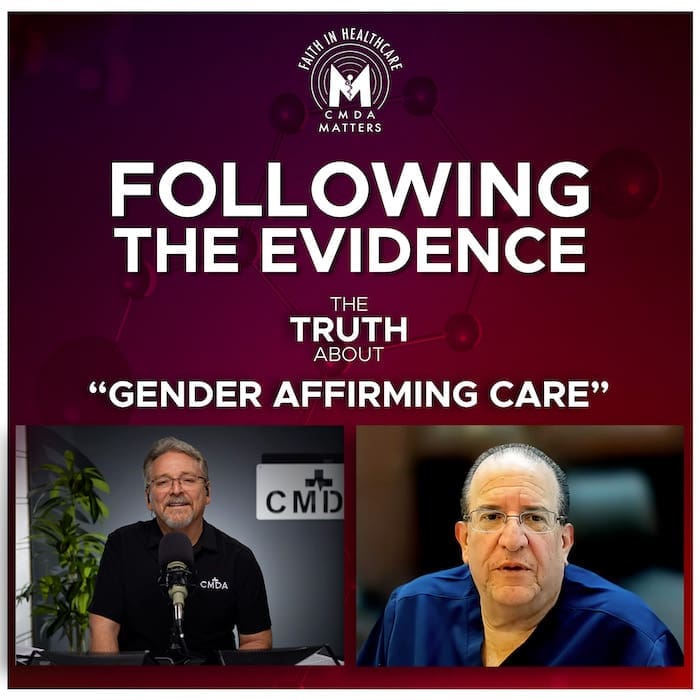
You know that commitment to engaging the critical bioethical issues of our day is exactly what today's episode is all about.
The conversation around hormones and surgery for children and adolescents who are struggling with gender confusion has been one of the most controversial and ideologically driven in Modern day medicine.
In this episode, Dr. Brick, Lance and I are joined by Dr. Scott Glasberg, who's a world renowned plastic surgeon and past president of the American Society of Plastic surgeons, known as ASPs.
In February of this year, Dr. Glasberg led the ASPs to issue a landmark position statement urging our medical community to stop performing gender affirming surgery on children and adolescents, those who are under the age of 19.
This was a courageous evidence based stand that sent ripples all across American health care.
Well, join us right now as we explore what it means to follow the evidence when the culture is pressuring us not to in order to protect vulnerable patients and to do no harm above all else.
Well, today on Faith in healthcare, we've got Dr. Scott Bradley Glasberg. He's a world renowned plastic surgeon with a private practice in New York City, long history of consulting in the biotech industry and has a special interest in regenerative medicine and evidence based surgery. And that's going to play a big role in our conversation today is Scott Glassberg's attentiveness to evidence.
He has served as president of the American Society of Plastic Surgeons, the Plastic Surgery foundation, the New York Regional Society of Plastic Surgeons, the New York State Society. I could go on and on. Dr. Glasberg, you've got more leadership positions than I have fingers and toes.
So welcome to Faith and Healthcare and our listeners will be able to get all of your CV on our show notes today.
[00:05:29] Speaker C: Thank you for having me.
[00:05:31] Speaker B: And today with us listeners, you're accustomed to Hearing his voice, Dr. Brick Lance, our vice president of advocacy and bioethics, fresh off the boat or the plane from Oregon.
[00:05:41] Speaker D: Yeah. Well, thank you, Mike. It's a pleasure to be here with both you and Dr. Glasberg.
[00:05:44] Speaker B: Well, Dr. Glasberg, I was made aware of your position and past statements from the American Society of Plastic Surgeons by a mutual friend, Dr. David Larson out of Milwaukee, who's emeritus professor there from Medical College of Wisconsin. So thank you for accepting our invitation, coming at such a critical time as this when we have this discussion about what has been historically in the last decade called gender affirmation surgery. So thank you.
[00:06:16] Speaker C: Thank you for having me. And yes, Dave Larson is a close friend and longtime mentor. Interestingly enough, I met Dave as a resident when I was training in plastic surgery and he was in a prominent position with the, I think it was the American Board of Plastic Surgery. And just from there on took, took off. And he was a longtime mentor and
[00:06:36] Speaker B: friend, if I might add. When was your term as the president of the American Society of Plastic Surgeons.
[00:06:41] Speaker C: Sure. I was president of the American Society of plastic surgeons from 2014 to 2015 and then subsequently made my way up the other side, the Plastic Surgery foundation side. And it was president there from 2020 to 2024.
And I was fortunate, I say, and honored, because only a few people have ascended both realm of both societies. And in addition, as it'll play out in our conversation here, I'm one of the few, if not only two private practice plastic surgeons who have served as the president of the Plastic Surgery Foundation. And I mentioned that because I realized that when I started to ascend that side of the society, that being the research and charitable arm of our society, I took it upon myself.
Patient safety has always been in my realm and something I've lectured on. But evidence, while it was important to me, I really wanted to become an expert in an evidence review and science and data from that standpoint. So I took it upon myself during that ascension to really study and become intimately involved with the evidence surrounding many of the procedures that we do in plastic surgery. And I'm sure in our conversation now that will come up as a key part of what we're going to talk about.
[00:08:01] Speaker B: So Dr. Glasberg, for our listeners benefit who may not be aware of the guidelines both from 2024 as well as just in the last couple of months that have come out of the ASPs, just tell our listeners what the guidelines were like in 2024 and then what your recent update was.
[00:08:17] Speaker C: Sure. So we began an iterative process at ASPs of reviewing the data, science and evidence in the real gender affirming surgery. We were looking at the whole thing, gender affirming care as well, which includes endocrine and hormonal therapies probably over the last three to five years, particularly the transition point in about end of 2022, early 2023, when we started to look at the data and realize that it seemed to be of low evidence and low certainty. And I'll explain a bit what that means in a minute. But with that half in 2024, right after about the Cass report came out, that was the large government funded study out of England look at looking at gender affirming care and where Hillary Cass, who I've spoken to, you know, realized that the evidence in the entire field in this realm was of low, low, low certainty, low quality.
We then realized that we needed to come out with a statement as well, since we were it was just confirming what we already saw. And so In August of 2024, we released a statement, I did many interviews with the media basically telling our members that the evidence in this realm, gender affirming surgery for adolescents and children, is of low quality uncertainty and for that reason they should take caution.
Well, over the ensuing about year and a half, till February 3, 2026, to which you're referring, that review of the evidence continued on and finally Asps took the position on February 3rd of this year to state that it felt that a gender affirming surgery for children and adolescents should be postponed until the age of 19.
We took that position on surgery because that's our expertise, you know the rest. While it also showed low certainty, low quality evidence, it's just not the realm which we, which we work in. What that meant is a position change for the society a bit, or I would say an evolution of the, of the statement and the policy. And now, you know, the way it's been viewed by others. And again, I don't mean to speak for other societies, but it is a change in the realm of the medical field as to a position which is different than other societies have taken. That's probably why, and you know, we were the first probably why we got so much attention in the media and from a variety of sources.
[00:10:43] Speaker D: Dr. Glasberg. And I appreciate that. I would even state back In August of 2024, when you had what most people would call a neutral statement, that was also unusual for medical society to do that. So you were even off the scale then and then now evoluting to this time of February of this year with your statement essentially against gender surgery for children and adolescents. So here's my question of the pressures within your society and if you can take us through the internal workings of your society and the discussions there is the scientific evidence which you have followed. But this is a divisive issue within our culture. So were there other pressures, medical, legal would be one, public opinion, policymakers, you know, ethical consideration, because there's an ethical concern as well. What were the other pressures in formulating your new statement of February this year?
[00:11:33] Speaker C: Loaded question, many two hours here.
So the general statement about our society, I really believe that patient safety and evidence review is a core basis of what we do at ASPs.
And so let's say politics, politics never plays into that decision. You really want to do what's in the interest and well being of our patients. Okay, so with that as the background, I think you're correct. 2024, we were called out as well for being the first one to take even that position. You said it as neutral. It was probably a little bit over neutral. And then, you know, we've sort of evolved now to where we are. I think all of those things are considered. You're absolutely right. This is a very controversial issue.
And I think it was Ronald Reagan who probably said that if I'm making everyone happy, I'm probably not doing a good job. And so we realized that and we've interacted with those who disagree with the position statement. You've probably heard there's been a petition that was signed by about 300 plus surgeons.
The vast majority of the responses that we got to the statement have been incredibly positive. You know, we have 9,000 members in the United States, 11,000 plus worldwide, and it's been, you know, pretty consensus based, positive for what we've done. Tons of ethical, considerate, ethical considerations, which I know is your expertise. Yeah, that's a huge part of what we're doing here. Adolescents and children are, as you know, a vulnerable population cannot generally consent to procedures on their own. And so we have to take all of that into account.
But most compelling, I think, is the fact that from a clinical standpoint, from a standpoint of doing what's best for our patients, it is impossible, based on the current data, to, to make a positive risk benefit ratio for these procedures for patients. And that's the essence of what we do as physicians, surgeons, plastic surgeons. Every single day I assess for a patient what is the risk, does the benefit outweigh the risks? And here we can come up with a positive equation for that. And given the fact that that's simply the basis of everything we do, that's an important consideration, to say the least. The one last thing I will note is these surgeries are irreversible, basically. Irreversible. That has to be a huge ethical and clinical consideration when considering doing these surgeries on patients.
[00:14:08] Speaker B: Dr. Glasberg, we are part of a team. You point that out in the position statement. We are part of a multi specialty team with these children and adolescents who are suffering with gender dysphoria or incongruence.
And outcomes are meant.
So clearly our mental health specialties professionals who are working our teams are so vital in this process before, during and after.
And there have been a lot of studies that have come out over the last decade in terms of these mental health outcomes and whether it's hormonal or surgery interventions for those suffering with gender dysphoria. What do you think about the recent study that just came out from Finland? 23 years. Cause you're watching the. And it's just. If I can just briefly read their conclusion. Regardless of gender, adolescents suffering from gender dysphoria present with excessive psychiatric morbidity. Subsequent to medical gender reassignment, Psychiatric treatment needs appear to increase.
It should be noted that in some individuals, medical gender reassignment appears to be linked to deterioration in mental health.
So a massive study, 2,000 patients compared to 16,000 matched age controls.
So I assume that supports your cause a little bit.
[00:15:25] Speaker C: Absolutely. I saw that paper the day it came out and of course, leave it to the finish to be ahead of us, because that whole block of Europe is clearly ahead of us. They were 10 years ahead of us in terms of treating these patients. I think they learned from their ways. I believe we should learn from their ways to your point.
And they're ahead of us in terms of, you know, culling through the data and making changes to the way they treat this group of patients. So kudos to them. It was a great paper. You know, I think one of the things when we look at evidence is sort of looking at, you know, what's a good study, you know, with a good question at the beginning and a good set of data to answer that question.
And I think they've done a really good job with that article in assessing things. But you're right, it does affirm, no pun intended, what we're talking about in terms of limiting the surgeries to people under the age of 19, you note,
[00:16:25] Speaker B: and maybe we'll get to it later, you have six different areas where you just say we come up with this position paper because of these six general areas. But clearly one of those is desistance of the gender dysphoria over time.
And it's really difficult to know in whom that's going to happen. But studies have shown, and it's been since. I don't remember his last name, Paul from Johns Hopkins, but 75 to 95% desistance rate. We've known that for 50 years. And so these irreversible procedures, it just, it seems like it's a. Do we have anything else in all of surgery or medicine in which a problem, a disorder, a psychiatric problem that is going to resolve generally on its own, that we go ahead and intervene anyway? Can you think of another area like this?
[00:17:12] Speaker C: Not really. And it's such a great question because some of those who have opposed our statement have sort of tried to turn that question on us and ask the question, you know, why are you holding these surgeries out to such scrutiny? You don't hold any other surgery after this type of scrutiny. And my response to that is that's just not true. And let me break it down for you. Some of the procedures they use, for example, we do breast reductions in people and women under 18, age of 16.
But there's tons of good evidence and data to support both the physical benefits, leaving back pain and neck pain and even psychosocial benefits as well. There's tons of data.
The other one they refer to often is rhinoplasty. We don't hold rhinoplasty up, but the key there is we don't make the same claims. I never told a rhinoplasty patient that I was going to save their life by doing a rhinoplasty. I was. I never told the patient that your mental health is going to get better by doing a rhinoplasty on you. But unfortunately, those are the claims that are being made with these surgeries. And that's where the evidence is lacking, that's where the data is lacking, is the mental health benefits. You pointed it out. Not only do patients not just stay the same from the mental health, but they actually deteriorate quite frequently. I do want to address the mental health, you know, the psychiatric psychologist. Involvement in that multidisciplinary team. Crucial for the point. You say, right, we know that there's desistance and depending on what you read, what number the vast majority of patients with gender dysphoria that will generally evolve and go away over time if we leave them. I think what's also important from that psychiatric realm is that psychotherapy is really the.
That these patients should be treated first and foremost before anything else happens. So unfortunately, what we're seeing is a jump from a very quick psychotherapy session into hormonal therapy and then eventually into surgery. And that's really not doing the patients any justice. So I know that those that oppose what I'm saying will say, well, no, that's conversion therapy. You're taking someone who's truly gender dysphoric and convincing them somehow that, that, that is, you know, what they want to be. My father was a psychiatrist and rest in peace, he was a great psychiatrist and I used to watch him treat patients and he will tell you that, you know, that's not what's ever done in psychotherapy. Good psychotherapy treats patients for these psychiatric issues that we have that they have. And, you know, we know that many of these patients, when they start out, carry DSM 3 criteria or whatever. DSM, we're up to criteria with regards to Psychiatric disorders. And so it's important to treat them first from a psychiatric standpoint before we end up. To your point, there's no other surgery where I rely on the evaluation of a psychiatrist or psychologist before. Do you sometimes get them involved? Sure.
There are things like body dysmorphic disorder that I've never treated and I sometimes send a patient for evaluation for that. But neither does it guide my care. Usually it stops my care.
[00:20:31] Speaker D: Dr. Glasberg, that's going to lead to my next question. I want to take our listeners back in a journey in time, if I can. You and I have been in practice for many, many decades and I want to talk about the evolving care here. So in medical practice, in your specialty, my specialty, we talk about the standard of care or community standard of care. And so this has evolved over time. So I want to know your own personal journey as well as your plastic surgery society's journey. Back when we started doing these procedures and these surgeries and you hear all kinds of words, gender, affirmation care. My state uses gender confirmation care. But then others would say it's gender distortion, others would say it's sex rejecting procedures. So the language is all over the map.
And this was started, these procedures were started without any scientific evidence.
And what I let me give my analogy if you will. You know, frontal lobotomies were started back in the 40s and 50s based on a Nobel prize winning scientist who developed this procedure for a real disorder, a real diagnosis, practiced for three decades. And you and I were alive back then and they didn't stop until the 1970s doing frontal lobotomies. In fact, I was still taking initial practice. I was taking care of a young person who had one for a seizure disorder. But how did we get started on this path of the procedures we're doing without scientific evidence? I guess that's my question. What was your personal journey and what was your society's journey?
[00:21:58] Speaker C: Let me give you some personal perspective. And then I could talk about ASPs.
I can tell you that what I noted is that in the mid teens, like the 201617 realm, while gender affirming surgeries have been around for quite a while, the numbers took off exponentially.
And one could easily attribute that to the growth of social media and the increased ways that we communicate. And we see that in our field, not just with these surgeries, with many surgeries. Cosmetic surgery took a big turn in the early 2000s because of things like social media, greater acceptance and things like that. So no one should minimize the power of that voice. And that movement to increase.
And so to your point, though, when it comes to guidelines, when it comes to standard of care, standard of cares are based on just that, guidelines. And we at ASPS sincerely wanted to come up with guidelines in this area. We knew that our member surgeons were doing these surgeries.
It's the basis of what we do all the time. We routinely come up with guidelines documents for a variety of procedures that we do.
But the problem is, when we looked into the data, there's just simply not enough data there.
I don't want to get too much into the weeds, but there are a variety of frameworks that are used to create guidelines documents.
Part of that is what's called systematic reviews, where there's usually a question, the question gets answered, and the evidence leads you to that answer. And if it's good, then you can come up with the guidelines. And guidelines consist of a lot of recommendations, and each recommendation is tiered at a certain level. How good is the evidence? Well, if we were to write a guidelines document here, all of them would be of the lowest possible recommendation because the evidence is just not there.
And where this has planned, unfortunately, really in a difficult manner, is with wpath.
WPATH is held out there as the quote, unquote, standard of care. That's what they call themselves, and they call themselves a guidelines document.
And people, patients and surgeons put their trust in wpath. And what, unfortunately, we've come to learn about the process by which these guidelines, these standard of care were brought about just doesn't meet the quality that we need in evaluation of data. And, and, you know, as you know, a lawsuit in Alabama discovery recently showed there was a lot of influence of pressure politically to put those guidelines forward. And it's unfortunate because, again, patients and surgeons are relying on these things. And so it's a variety of causes as to why these surgeries, why these hormonal therapies started to take effect without, or start to be used without evidence. But it's a whole host of things. It's a litany, it's almost a perfect storm, say, of not following what we, you know, really should be doing, which is following the evidence and following the data.
And, you know, I don't want to sound trite, but we, we say it in our Hippocratic oath, do no harm. It sounds kind of trite because everybody is that statement. It probably applies really well here, right? Our primary goal with children and adolescents should be to do no harm, don't put them at risk, do what's safest first, and then if you have the evidence, if you have the data, if you can prove positive outcomes, then you can go on to do surgery.
[00:25:32] Speaker D: Okay, so which then leads my next question. In the future. So you look back. Let's look to the future. And I don't mean to make you a prophet or anything, but the consequences that are going to come down the line, particularly for practicing surgeons and physicians in this gender dysphoria for adolescents and children.
Now, we had a lawsuit in your state, a couple million dollars for someone, a teenager, that had their breasts removed. And I don't know if there's going to be more of this or not. And I do want to pause here and say thank you. And I am speaking on behalf of my boss, our CEO, Mike Chubb. The statement that you now have published this year is profound and I think
[00:26:13] Speaker B: it has a significant ripple effect.
[00:26:15] Speaker D: I think it's going to have a significant ripple effect on the.
[00:26:17] Speaker B: Maybe on the ama. I don't know if the AMA made their subsequent statement as a result, Scott, of your society's statement or not, but certainly that was about the same time.
[00:26:26] Speaker D: Yeah. And I hope other organizations, medical societies, follow suit that you follow the evidence and produce the statement.
I will note in your statement you have a disclaimer on every page, and that's because you know there is a medical legal consequences to doing procedures.
So I don't know what you predict for the consequences. I can just tell you in my state of Oregon, there's zero desire to stop doing these procedures, absolutely none within both the medical community and the legislative community. And so that also influences public opinion. But what do you foresee in the future? Can you predict?
[00:26:59] Speaker C: Well, let me take it from the standpoint of going back a bit. Right. And you're right, Argonne has, you know, there was just a legal decision there that shows exactly what you're saying.
There are tons of these lawsuits out there. The one in Westchester was a little bit different.
I think the misdiagnosis there was probably, what I know of the case was probably a patient. I mentioned early body dysmorphic disorder.
And I had said that that's a red line forever operating on anyone. So I think that's what got entrenched there. And it was very interesting who the plaintiff expert was in that case. It was actually a gender surgeon. So that case is not a great one. But there are other ones out there. And the future is going to see over the next little bit, a lot of these cases get adjudicated. And I think we're going to be dealing with things of lack of true informed consent and whatnot. But let me make a point that we make in the position statement is this is not a retroactive condemnation of surgeons. I'm going to put on my hat. Maybe it's too idealistic to believe that the surgeons that are doing these procedures are doing them because they truly believe and believed that this was the right thing to do. So in no way should there somehow be retroactive, you know, retribution against those surgeons. But it's a forward looking statement to your point. And so, you know, we've now reached the point where we know that the evidence is of low quality and low certainty for children and adolescents. So the hope is that this will stop these surgeries. We're realists, we know that it probably won't stop all of them, but at least we can be on record as a specialty organization, medical organization, of trying to do and recommend what is correct for these patients. If you're asking me what the future holds in terms of data, what I've seen is that we will continue to assess the data as we've done in other areas. If that data changes, if there's more that's shown, we consider changing our position statement.
But right now there's no indication of that. And part of the problem is that doing studies in this area is just so difficult. Because of what we talked about earlier, it's very difficult to typically do a study here. So randomized controlled trials is just not a realistic approach.
One thing that I've talked about in many different forums is that if these surgeries are going to be done at all, they should be done in a clinical trial. Meaning that if you're going to do the surgery, every bit of evidence that you're able to generate should be part of a trial that then can be reviewed. And you know, unfortunately right now, given what we know about the data, you know, I don't think these surgeries should be done at all. But if they are for some exceptional reason, then those should be done in a major medical center where there's an IRB and there's an ability to review that data on a constant basis. But I don't see it changing.
It's been going on enough. We have enough evidence or lack of evidence to show that it doesn't appear that it's going to change. Moving into the future.
[00:30:08] Speaker A: Before we continue with this week's episode, here's a special announcement for you.
If CMDA has encouraged you or helped shape who you are as a Christian healthcare professional, we want to invite you to consider becoming a lifetime member.
Lifetime membership is a way to make a lasting investment in this ministry.
You will be part of bringing along the next generation of believers in healthcare while helping bring the hope and healing of Christ to the world.
It's about staying connected to something that truly endures and gives back.
To learn more, visit CMDA.org Lifetime the Savior the CMDA Learning center is continuing to grow and it's an incredible resource for Christian healthcare professionals.
You'll find content from recent national conventions, the Faith Prescription series, continuing education opportunities, and a wide range of courses designed to support both your professional work and your spiritual growth.
And here's the best part. As a CMDA member, you can earn continuing education credits at no cost.
To start exploring the full library, visit CMDA.org learn let's jump right back into this week's episode.
[00:31:35] Speaker B: Our Faith and healthcare listeners are used to hearing me say the following statement.
The House of Medicine and Surgery is broken in this arena and I say that because of private conversations. Dr. Glasberg I've had with so many doctors, so many surgeons, psychiatrists, pediatricians in academic settings where they have to self censor because they bring it to a department chair and want to have a discussion and they're shut down. And I just, I haven't practiced as long as you, both of you gentlemen have. But I have never ever heard of anything like this in which discussions among academicians, people who care deeply about evidence based, cannot have these discussions. And these are at big places. We're not talking about small institutions, huge places. So my first question is, has there ever been anything in medicine quite like this?
And it's as I shared with you before we got on this program and I kind of fell into this in 2016 and it was a wake up call moving from Africa to America, all of this that was going on.
Have we ever had this before? And the second address for us, this whole issue which you have in the position paper about informed consent in minors and how in the world you are recommending to your colleagues who want to continue or feel they should continue offering this, maybe in Oregon or elsewhere. How in the world do you get appropriate informed consent in a 12 or 14 year old girl or boy?
[00:33:04] Speaker C: Guys, questions are loaded the first part and say that very unequivocally there should never be anything in medicine that we're unwilling to speak about.
In addition to trying to make myself an expert in evidence, I've also, and this has been my entire 25 year career, is to say that we should always want to get to the table in another arena, maybe a conversation for another time.
I am the co founder of what's called the Breast Surgery Collaborative community.
Breast implants have been a highly contested area.
So what did we do? Me and a colleague from Texas brought together a group of stakeholders, experts, patients, manufacturers, to get in a room and talk about issues where there was controversy so that maybe we can come to consensus. And we have, we have. In terms of ASPs, we may get to this or not.
I was pretty instrumental in starting a gender surgery task force at ASPs. It came about because the president panel that I wanted to run at our annual meeting in October 2024 was forced by petition to be postponed.
And out of that we formed this group to try to build consensus amongst the stakeholders, knowing full well that it might be difficult. And so I'm a believer that we should always be talking, no matter whether we disagree or agree, and trying to build consensus. This is one where it is just very difficult, admittedly to build consensus. But let me speak to the other organizations without revealing names or specific organizations. Since I put myself out there on this topic, I have been reached out to by numerous board members of some of these other organizations asking me, how did you do it? How did you convince your society to do it?
And I've spoken to them at length and I've tried to, you know, say to them time and time again is no convincing, follow the evidence.
The evidence, you know, will speak to the facts.
And if everybody keeps an open mind as to the evidence, then you should land in the same place where we landed without having to convince anyone.
And I've said this publicly in another interview that I am calling on every board member or president or vice president of any of these other societies to try to dig deep and take an honest look at the evidence and data that's out there.
And hopefully you will come to the same conclusion that we did at ASPs regards to the low quality and low certainty. Unfortunately, as you know, there is, you know, other fact confounding factors that play into this and that's what's made it a difficulty. So your answer is, you're right in terms of broken. We need to get back to a time in medicine where we were truly doing things based on the evidence, based on the data, and based on what was truly beneficial for patients. I'll be honest, I forgot.
[00:36:07] Speaker B: Your second question is informed consent. You said that was another loaded question.
[00:36:11] Speaker C: Sure. One thing that Asps has done for the last, I believe it's about 15, 20 years, is we offer to our members the ability to use legally clinically reviewed consent documents and in a time frame where we developed those for gender affirming surgery in general, not just for minors. We have disclaimers there as well, saying that, you know, there's no evidence to show that there's mental health benefits from doing these procedures. And please be careful to, you know, to tell your patients that.
So we're very mindful of the informed consent issues and now changing back to adolescents and children.
We're very mindful of the fact that these patients can consent on their own.
I've dealt with a lot of their parents. They're confused, they are deferring to medical experts to tell them what to do.
It's really one of the most disheartening things that I've heard in this journey of speaking about this.
And it's. But I've heard it repeatedly and there's actually some voice recordings of it. His parents being told, would you rather have a live daughter or a dead son?
That is just, you know, that's just heartbreaking because that tears to the essence of what being a parent is. Of course we want to do what's best for our children, but we're looking to you to tell us what's evidence based, not to use some line to convince us there's that word again, what we should be doing with our children. And you know, that's come up in a variety of forums and it's just not where we should be as physicians, as surgeons.
[00:37:52] Speaker B: And at some point, I mean, you're talking about not looking back, looking forward. At some point in medicine, surgery, something becomes malpractice to do or to say, does it not? I mean, at some point in time we have to say that statement, which we've heard all over the place, is just not true. It's not true anymore. It's just not accurate.
[00:38:11] Speaker C: It's a violation of the standard of care that, you know, transgresses that line that you're putting out there.
And that should be a line that we're never willing to cross.
You know, when we talk about risks with patients and you know, every patient gets risk, alternative and benefits, one of the alternatives is to do nothing.
And that's true of every surgery we do. Right. Even if you've got a tumor. And this may lead to, I think, a topic I hope we'll talk about, which is this concept of patient autonomy. But yeah, I think it's real important in terms of informed consent to do a true informed consent to really, I Lay out for my patients all of the alternatives of benefits and risks and allow them to make a determination whether or not to go ahead with a procedure.
[00:38:58] Speaker D: So Dr. Glasberg, I want to keep on this idea of informed consent. I want to take our listening audience into your office, okay, into your examining room. And I will tell you, in my examining room, I'll have that 11 and 12 and 13 year old come in with their parent, one of the parents, and say, hey, this is the next professional athlete in this sport. You must do this doctor. And so the patient's family puts undue influence on me, the surgeon, and then vice versa. I can put undue influence on the patient and the family, particularly we're talking about adolescence. And again, I can quote the dead son, live daughter if I'm in that gender field, which I'm not.
But I guess my two questions, one, do we realize the power that we have as healthcare professionals of the influence we have on the patient and the family? And do we realize that they can actually influence our decision by what they demand of us too? This idea of my autonomy, my body, you must do what I want. Doctor, how does that look in your office and other plastic surgeons office when this comes up?
[00:39:59] Speaker C: Probably very similar to yours, right? I sit with a patient and depending upon their age, I'm not just speaking to the parent, I'm talking to the patient as well. Because you know, once you get into that 11, 12, 13 year old, at least you have some understanding. I don't think by any notion you, you're ready to make that this type of life altering decision, but you know enough to, you know, inform them as well. And it's a long conversations with them depending upon seizure, you know, these are long conversations and you can operate on a patient unless it's an emergency without seeing them twice.
Very often patients, not children, come without anyone with them. And I offer to see them a second time for that informed consent decision so that somebody else can hear what's being said.
In addition to your point, anybody who tells you that we don't have the ability to influence is just not being realistic. I don't want to call them liars, but they're just not being truthful. And we can, we know we can as surgeons, I know that I can convince a patient to generally do whatever I want. And that's a powerful tool, the powerful responsibility that we accept.
And I would just never do that.
If a patient, even if they ask me what do you think I should do, My response is A, B and C.
And these Are the risks and benefits of each. Ultimately though, it's your choice.
But let me address another one because this is a real elephant in the room, this concept of patient autonomy. Because people have come at us with this argument that there's no question that decision making about a surgical procedure or any treatment should be a shared responsibility, decision making process between the patient and the physician and the surgeon.
But the concept of patient autonomy came about to deny care, not to dictate care. And what I mean by that is you've got a tumor, you've got a disease process, and you know, you're free to make a decision. It's free will. I just don't want that treatment. It's chemotherapy, it's going to be too painful and it's going to be no, I'm going to try to convince you that really you may not be making the right choice. Ultimately that's your decision.
But it's not about patient autonomy is dictating care. And why?
Because you and I as physicians and surgeons have trained to know, you know, the data behind what can and cannot be done and what's medically necessary. I give an article an example recently, an article I wrote that, you know, patient came to me one time and asked me to shave off their fingerprints.
I didn't ask why they wanted it. You know, could I do it and could I do it safely?
Absolutely. Would I do it? I told them absolutely not. Why? Because there's just no medical indication for me to do something like that.
[00:42:54] Speaker D: Yeah, that's a good example.
[00:42:56] Speaker B: Yeah. And set yourself up as a professional, not a provider. That's one of the things that I'm seeing more and more in the literature we've been talking about at CMDA for a long time, that we should not settle for being a provider.
My next question, Scott, would be in terms of conscience. And Ezekiel Emanuel during the Obama years wrote an article for JAMA about that we are not conscripts as doctors.
We chose our fields and therefore conscientious objection really doesn't have the same place. And that if our societies, if these guidelines that come from WPATH or wherever, say we should be doing abcd, well then we just need to get in line and that there's not a place for conscious objection even if we put forward evidence. So I'd be interested in your thoughts because we talk a lot around CMDA about conscience and what informs our conscience.
[00:43:49] Speaker C: Well, this sort of speaks to a little bit of what I was already suggesting is everybody is entitled to that ability to think for themselves. And make a decision for themselves that could be a patient or it can be a surgeon as well.
But for us as medical professionals, as physicians and surgeons, you know, we have to rely upon the evidence and data.
So just because somebody comes out with a quote unquote guidelines document, and it may not be in this field, maybe any procedure, the whole point of what we do as physicians, you know, is to move the ball forward and critically evaluate that document. It's what we, it's the basis of our, you know, medical education process. It's the foundation of my surgical training.
I had a great chairman in general surgery. He said two things to me. He said, one is what you don't know fills textbooks. And he also said to me, scott, the day that you stop learning and critically evaluating, that's the day you retire.
And that had lived with me, what was it, 25, 27, 28 years ago. But he said that to me as live with me and is an essence of the way I practice. I think we should all be practicing.
[00:45:00] Speaker D: So I going to ask your advice here. I'm going to ask advice for all our listeners and for myself, where we proceed from here. So you have a very solid statement, just came out in February of this year. The pressures on us practicing medicine, practicing surgery, are enormous. We have our medical societies, our community profession. We have public pressure, we have legislative pressure, we have legal pressure, we have the whole culture.
So what advice would you give to not only plastic surgeons, but general surgeons, the family practice doctor, anybody that's going to care for a young person with gender dysphoria? Any lasting advice you want to give?
[00:45:43] Speaker C: Well, let's start with the empathy part, right? No one is disputing that gender dysphoria exists. And there are patients, young patients, who have this diagnosis.
But the key is, is to putting them on a path to success, putting them on a path to an outcome that is favorable.
And, you know, it starts with psychotherapy and things like that, not to give to political pressures. I started, when we started this conversation, I it was very clear. ASPS is, is in a clinical arena and does not partake in political discourse when it comes to their guidelines or their statements or their policies.
Physicians have that same obligation as well, is to stick to what's clinically beneficial for the patient and sounds right, do the right thing. Based on our training, based on our knowledge, based on our review of literature, based on our review of evidence. I think if you hold to that mantra and core, then whatever we're talking about, conscience or general feelings or opinions should Follow suit. I mean, that should be the foundational basis. Basis. I'm sorry. Of everything that we do and say and how we treat patients. We need to treat them with empathy and treat them with respect and guide them the way that, you know, we, you know, have learned to guide them.
[00:47:08] Speaker D: Yeah, thank you. That's good. Good advice.
[00:47:10] Speaker B: Well, I wouldn't consider myself a prophet, but again, when I. When I moved to the U.S. in my mind, Brick, I had a feeling it was going to be plastic surgeons. If anyone was going to turn the tide, it was likely to be plasma or maybe gyneurologist. I don't know one of the two. Because in contrast to other issues that we engage in quite actively, Brick, especially Brick, is medical director of a pregnancy resource center. And we engage heavily on issues of beginning of life.
But those who. The bad outcomes here are alive and able to share their bad outcomes with the world.
And it was clear to me that it would be plastic surgeons who would say, we're at the tip of the spear here. If we don't follow best evidence and this doesn't turn out well, we are going to be the most vulnerable. So, as we said earlier on, Dr. Glasberg, thank you for the way that you approach this, because it is very winsome and it's very much at the heart, as you've said a couple, three times. It's a heart of our profession, really. We want to see the best outcomes and human flourishing.
And we are indebted to you here at CMDA for the position that you have developed. And I just. I hope for, and I'll pray for a ripple effect to the other societies, especially those like the American Academy of Pediatrics, especially American Psychiatric association, those that have continued to thumb their nose, I'll just say it. Thumb their noses at Europe and the uk, The CASS report, and say, no, no, no. We have our own evidence. We're not paying attention.
Any final comments, Brick?
[00:48:42] Speaker D: We're gonna wrap up here. I agree. Again, just express my appreciation to your plastic surgeon society. And I, too, hope that the other societies will take note. And I will say, unfortunately for our medical profession, as Mike, you already alluded to, there's a broken house. And I hope that they can see not only the brokenness and the harm, but the need to change. And I hope doctors will repent. Yeah, I hope doctors will.
[00:49:08] Speaker B: Yeah. We've been talking between us, Scott, about a concept that I don't know that I've heard necessarily in medical history, but an actual reconciliation with the public over how we've not dealt with this very well. And we should have. Not going back to try to throw anybody in jail or put anybody in front of a judge or anything, but just to say we didn't do this well and we need to reconcile with our patients and the public. I don't know your final comments on that. Before we close.
[00:49:40] Speaker C: I would echo exactly what you both have said. You said it very eloquently. I agree with you. And to my statement earlier, I hope that other societies will look at this evidence and data and come along in terms of doing a true evaluation and doing what's best in the best interest and well being of our patients. I'll leave you with one final thought. We didn't have time for it here, but we must not forget those that are detransitioning, those who experience regret and detransition because they are going through a very difficult time. I can tell you firsthand, before about two years ago, I had never treated a detransitioner before.
But because I've put myself out there and I actually helped another journalist get care for patients, which she said she was not able to get in other parts of the country, they've now come to my door. And much like we say here that multidisciplinary teams are being formed to treat gender patients with gender dysphoria, I'm now being forced to put together a multidisciplinary team to treat detransitioners. It's a difficult, painful process for the patient and me as a surgeon as well, because it's just not that much I can offer them because of the irreversibility of these procedures. I do my best to treat them the best I can.
I involve my colleagues in other specialties, be it urologist or psychiatrist, endocrinologists or whatnot, to help me.
But we can't forget about that population as well. And that is the core of what we're talking about here.
[00:51:14] Speaker D: Dr. Glasberger, I want to echo that, too. We work closely with an organization called Resilience Health Network, and it's trying to create a network of all specialties that includes orthopedics. I have patients in my practice that have gone through this care and trying to attempt to change their sex or their gender. So it comes in all specialties. And so we need to create a network of physicians that care that have the empathy that you so mentioned to care for these, that want to transition back to their biological sex.
[00:51:44] Speaker B: Yeah. And in fact, Rick might as well just say coming in just a couple, three weeks we're going to have a livestream webinar with some detransitioners.
[00:51:54] Speaker D: That's correct, yeah.
[00:51:55] Speaker B: Yeah. Dr. Scott Glasberg, this has been a delight and accomplished all the things I'd hoped this conversation would accomplish.
So receive our best regards and may many people who hear this rally to this cause of recognizing. I mean, these detransitioners are dealing with regret and already have this mental health issue that the Finnish have so carefully documented. So wish you the best. I hope we get to cross paths in the near future.
[00:52:23] Speaker C: Absolutely. I hope so as well. And thank you for having me on your show.
[00:52:26] Speaker B: Yeah, you're welcome.
[00:52:27] Speaker D: Thank you, Dr. Lassberg.
[00:52:38] Speaker B: Friends, though the house of medicine may be broken, our ultimate hope is never just from medicine alone.
It is in our God who calls us to this profession.
And conversations like this one are a reminder that he is still at work. He's raising up clinicians from diverse religious and professional backgrounds who are willing to follow the evidence as well as speak the truth and put patients first.
The ASPs position statement is a milestone, but as Dr. Glasberg made clear today, the work, it is far from over.
There are surgeons still performing these procedures, detransitioners who need care and compassion, and a healthcare community that we're a part of that must be willing to look honestly at the data.
You can find a link to the actual ASPs position statement and additional resources in our show Notes today.
Friends, if this conversation encouraged you, please please share it with a colleague and subscribe so that you don't miss future episodes of Faith in Healthcare and to connect with a community of believers in healthcare who are living out their faith and calling every day. Just Visit
[email protected] I want to thank you for listening to Faith in Healthcare where our promise to you as a listener or better yet, a subscriber to this podcast, whether you are a healthcare professional or a patient who loves Jesus Christ, is this.
We will do everything that we can to keep your faith and health care connected. We'll see you next time, Lord willing.
[00:54:29] Speaker A: Thanks for listening to Faith in Healthcare, the CMDA Matters Podcast. If you would like to suggest a future guest or share a comment with us, please email cmdamattersmda.org and if you like the podcast, be sure to give us a five star rating and share it on your favorite social media platform.
This podcast has been a production of Christian medical and dental associations.
The opinions expressed by guests on this podcast are not necessarily endorsed by Christian medical and dental associations.
CMDA is a non partisan organization that does not endorse political parties or candidates for public office.
The views expressed on this podcast reflect judgments regarding principles and values held by CMDA and its members and are not intended to imply endorsement of any political party or candidate.
[00:55:28] Speaker C: Sam.