[00:00:08] Speaker A: You're listening to faith in healthcare, the cmda matters podcast. Here's your host, Dr. Mike chubb.
[00:00:20] Speaker B: Welcome, friends, to Faith in Healthcare.
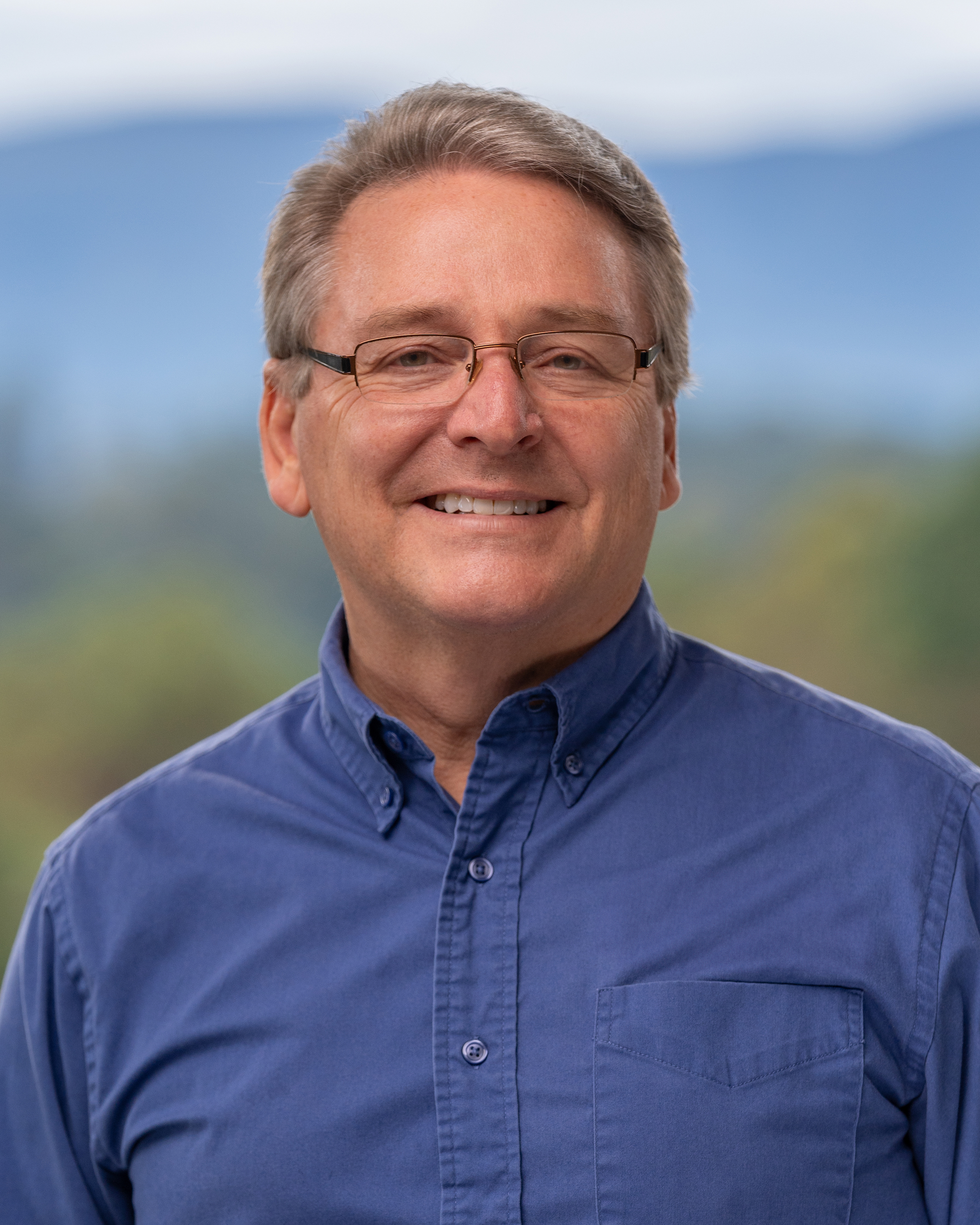
Dr. Bill Griffin joins me today as we sit down with a dear friend and an absolute standout in the world of dentistry, Dr. Andre Mickle. He's a tenured professor and residency director at Case Western Reserve University.
But even more, he's a man who sees every single patient, every student, and every moment in his clinic as an opportunity to share the love of Jesus Christ.
From praying with anxious patients to mentoring residents from around the world, his story will challenge and encourage you. So let's dive in.
Well, today on Faith and Healthcare, I have invited our senior vice president, Dr. Bill Griffin, or Griff, as we lovingly call you around here at cmda, to the program because we have a very special superstar in the dental world as our guest today. Griff, don't we?
[00:01:26] Speaker C: Yes, we do. And it's a friend, and I'm glad to be a part of this.
[00:01:29] Speaker B: And we have roped Dr. Andre Mickle into ministry at CMDA over these last couple of years, such that he got involved in a couple of weekends this September, involved in your Dental Missions conference group, as well as our September Board of trustees meeting. And Dr. Mickle, I think a highlight for 2025 for me, one of them was walking in St. Charles with you and your wife esto Marys and hearing about the passion of your life for reaching your residents and postdoc fellows for Christ who've never heard the gospel before. That was such a delightful memory for me.
[00:02:06] Speaker D: Yeah. Thank you for that. That's just so powerful and important to me, just to really share the gospel with everyone who I meet. And the Lord really put on my heart a long time ago that, you know, students and doctors are coming from all around the world, oftentimes in places that are closed to the gospel. And what a great opportunity just to share the gospel of Jesus Christ with them.
[00:02:24] Speaker B: Yeah. Well, let me just briefly tell our listeners Dr. Andre Mickle is a tenured professor, chair of the Department of Endodontics, and the director of the Postdoctoral Endodontic Residency Program at Case Western Reserve University School of Dental Medicine, and where he has served as teacher, researcher, clinician, mentor, advisor, and friend to countless students and doctors from five continents for nearly 30 years. And we'll have the full bio and CV in our show notes today. But there are a lot of letters, Griff, after Andre's name.
[00:02:59] Speaker C: There certainly are.
[00:03:01] Speaker B: And so I wanted to ask, as we get launched here, Dr. Mickle how did you come to trust and follow Jesus Christ? When did that happen?
[00:03:09] Speaker D: Thanks for asking that. I just feel really led just to say one thing first, and that is, you know, I really consider myself to be a Christ follower first who just happens to be a doctor and a university professor, as opposed to a doctor who just happens to be a Christian. So that's why I see myself first and foremost. I was fortunate that, you know, I think back to a small church in Alaska in Kenai. It's called Kenai Baptist Church. And my father was in the Air Force and we were stationed up in Alaska. And there was a small church that invited my older brothers and my mother to church, and they, they went. And I was really young at the time, but that was where my mother first accepted Christ. And my brothers, my father didn't come to accept Christ until much later in his. In his years.
But that's where I had my first memory verse. I think before I could even talk anything rationally or knew what I was saying. My first memory verse was John 14:6. You know, he's the way and the truth and the life. No one comes to the Father except through him.
And as we were in the Air Force, we traveled to many different places. Eventually went to Keesler Air Force Base, which is in Biloxi, Mississippi, the Tactical Air Command training base. And it was There, I was 10 years old in our services that we had for junior church and my pastor, his name was Pastor Christian. How about that? What a great name, Pastor Christian. I'll never forget him. A true Christian, just a great mentor and teacher and really shared Christ more and more. Of course, we had devotionals and things at home, but that's where I really came to really know Christ and accept Christ as my personal savior. Was baptized there, 10 years old, and I still remember just a great time of really hearing God's voice, hearing him speak to me. And I would talk to him as I'm walking down the street. So even then I was walking and talking with him, you know, at a young age. So that's where it all really began. But my mother and I laugh about that little church in Kenai, Alaska, on the Kenai Peninsula, that if it wasn't for that church and. And Pastor Perry, who was his name, where would I be today?
[00:05:04] Speaker C: God had it all worked out for you.
[00:05:05] Speaker D: Yes.
[00:05:06] Speaker C: Now, Andre, your clinical work is in the field of endodontics, which means you are a root canal specialist.
Now, the term root canal carries with it. How do I say?
It's some of it. Of A pretty uncomfortable connotation.
Is this treatment as scary as some would claim?
[00:05:26] Speaker D: First of all, let me just say that Obama in the White House used to always say, that's worse than a root canal. It was so bad that I felt like I had to call the White House and say, stop saying that. Right. So obviously, people think of root canals as being, you know, like, the worst torture in the world. And it could be, if not anesthetized, but really it's not. And for me, it's been a matter of just making sure patients are profoundly anesthetized. And what a great opportunity just to pause and ask them because they come in being fearful. I'm just asking them if we can. If I can pray for you right now. Right. And many times at this point in my career, I don't. I don't usually ask people. I just kind of break into prayer with them. But just a great opportunity to show some faith. And for those who are believers, we know that we put our trust in Jesus Christ. And I let them know. I'm sure you prayed this morning, and just know that my hands are in Jesus hands as well. So that really helps people to feel much better about this dreaded procedure that's really not so dreadful as they see.
[00:06:19] Speaker C: And when patients are anxious like that, it gives us an opportunity to share with them. I think about that passage in Second Corinthians 1 where it says, blessed be the God and Father of our Lord Jesus Christ who comforts us in our afflictions so that we can offer that comfort to others. And root canals give us an opportunity to be faithful in that regard.
[00:06:35] Speaker B: Still, don't sign me up, Griff. I'm not signing up for a root canal.
[00:06:39] Speaker D: Yeah, that's a great scripture. And I think about that scripture often because it says that that comfort and peace that God has given us, that now we have an opportunity to turn around and use that for other people. Not just obviously in dentistry, but in any area of our life where we have gone through some hurt or trial or tribulation. What a great opportunity to turn that around. And now with the same comfort that he gave us, we can now give to others. I love that passage.
[00:07:03] Speaker B: Well, Dr. Mickle, since I know your story, the answer to this next question may take you a while to unpack a little bit, but it's very important. And that is, how has your Christian faith impacted the way over these 30 years that you approach mentoring and training of students to integrate your faith and influence them with your faith?
[00:07:22] Speaker D: Well, I think, first of All I think of something Tony Dungy said years ago, and essentially he said that it's not about me. It's about everything that God can do through me for others.
And so I have to remember in all of that, you know, I'm the chairman, I'm the program director, and I have all these accolades and, you know, four degrees, but really, it's not about me. It's about everything God can do through me for others. So really just showing a servant leadership and really caring compassion for all of my residents and students, knowing that Jesus first loved me and, you know, while I was yet a sinner, now I can turn around and use that same love for others as they come here from all over the world. I'm thinking about Mike. One day I'm in the clinic, and I have a map of the world up in the clinic. And on this map, I have a little pin where all of my residents have come from over the years.
And this was probably, I don't know, 20 years ago. And I'm. One morning, I'm in the clinic, I'm looking at this map, and I'm looking at, wow, five continents. People have come from five continents to come here to Cleveland, Ohio, to train in my residency program, right? And I'm thinking, that's amazing. And then God kind of whispers in my ear, he says, from the ends of the earth. And I thought about that. Acts 1:8, right? You should be my witnesses in Jerusalem and in Judea. In Judea and Samaria and to the ends of the world. And God was kind of saying, the ends of the world are coming to you right here in Cleveland. And what a great opportunity to make sure that no one leaves this residency without having heard a really cogent gospel message in word. And indeed, that they see my life and how I live. And I actually proclaim the gospel at some point as well. So God just put it in my heart to ensure that no one leaves without having had that.
[00:09:05] Speaker A: And.
[00:09:06] Speaker D: And he made it clear to me that, you know, I don't even have to go to the ends of the world like Mike Chubb in Africa to do this. I'm right here where I am. I have no excuse.
[00:09:14] Speaker B: They're coming to your doorstep.
[00:09:15] Speaker D: Yep, exactly. And then it was interesting because, you know, some of the residents. This was a number of years back. It was kind of humorous to me. And I'm walking down the hall, and I tend to speak to everyone. I say, hello, how are you doing? And one of the residents from another, not even in my specialty, it's another specialty. And she came up to me, says Dr. Mikkel, and she's from Saudi Arabia. Just. I can't explain it. We don't know what's going on, but for some reason, we just all really like you.
And I got a thought. It's nothing but the Jesus in me. So, you know, again, that gives an opportunity for me to really deflect that. It's not me. I'm really in and of myself, you know, a wretched man, right? But for the grace of God and Jesus Christ and the blood, it's really about the Jesus that's in me, that helps me to be the person you know, I am.
[00:09:55] Speaker C: Amen. Now, in addition to your pursuit of clinical excellence, you've also spent a considerable amount of time pursuing theological studies to the point of recently receiving an M. Div. Degree.
So, first of all, how in the world did you fit that in? And then secondly, how does that affect your approach to patient care?
[00:10:15] Speaker D: So here's the situation.
I have always thought that I needed to know more, right? I need all the help I can get, right? And I always tell that I have a men's Bible study in my home every Thursday night. And what I tell them is that I need all the help I can get. That's why I'm here.
But essentially, Griff, I did get an M. Div. But I actually also got my doctorate ministry more recently, which is, you know, which was a bit more of a feat. But essentially what I did, what I was concerned with was I felt like I had gone as far as I could learning on my own.
You know, I did a lot of reading and training and listening. And I really felt like I needed, you know, more training and to really hear from some other scholars. And it would be nice to know a little Hebrew and a little Greek too, at the the same time as well, right? And so that was really my impetus for going back to seminary, really, was to become a better. To facilitate me becoming a better Bible study teacher. That was my only impetus, right? I teach men. I'm in the prayer ministry. I'm involved in my church. I just need to learn more and do more. And so that's why I went back to seminary. And then when I was finished with my M. Div, I felt like I wasn't quite done yet. I felt like there was something more that needed to be done. And that's where I did my demon project on Muslim evangelism. And the way I did it was, you know, every Saturday morning, I was up early in the Morning, typically, you know, most evenings I was working and studying. On Sundays, I'd wake up about six and I'd spend three hours before church and I'd run up and take a shower, then go to church. And we'd go to church and take my wife to dinner and come home and take a nap for 30 minutes and then study for three more hours. So it was really just a Holy Spirit. It was really a Holy Spirit exercise, if I can say that.
I really said, lord, if you want me here and I'm supposed to be here, then help me to really be faithful, to do the assignments, not so much to get an A or to get a degree, but so that I can help the people of God to become all that they can be and trust you more and more.
[00:12:03] Speaker C: Well, for our members who might not go back and get those advanced degrees, can you share anything with us that you learned that helped you with regard to patient care?
[00:12:14] Speaker D: Yeah, I think one of the main things was, and I'm not sure that I think it confirmed things for me. Right. I already felt like I was compassionate. But I think one of the things seminary does is it really helps you to be more introspective of yourself. Why do you believe what you believe?
Right. It really solidifies, you know, your belief in understanding, you know, who Jesus is to you personally. We have so many things that we've heard grandmother say or friends say or the pastor say, but we don't really know them experientially for ourselves. And I think it just really helped to solidify for me in my mind some of those questions. And knowing that we are only here to advance the gospel, that's really our only purpose for being here is to go and to advance the gospel of Jesus Christ. I mean, I think Stan Key, our speaker at the. At the dental convention and in the CMD convention, said it best. You know, Jesus is Lord and the five words or he came, you know, he died, he rose, he reigns, and he's coming again. It's really all about those things. So if Jesus has risen, nothing else matters. If Jesus has not risen, nothing else matters.
[00:13:18] Speaker B: You know, Andre, one of the powerful parts of who you are and the way that you live and serve is that you're not in private practice. You are in a prestigious university position, your faculty program director, and is so frequent for me to hear in 2025 that integrating faith and practice is fine for people in private practice and who aren't in academic centers, but for those of us in academic centers, it's too risky.
So how does your faith in that academic center there at the School of Dentistry and program director, chair, how does your faith. How do you live it out in front of patients as well as colleagues? And does anybody push back?
[00:14:05] Speaker D: I think the way I live it out is really to think how can I best share Christ wherever I am? And I'm always looking for opportunities to do that. Right. I believe that wherever we are, you know, our goals, I call it pda, Our goal is to extend the presence of Jesus. That's P. To declare the lordship of Jesus over every situation.
That's D. And then just simply ask people if you can pray for them. And it's amazing that when people are having issues or trouble, not only will they allow you to pray for them, but they actually will come to you to pray for them. For instance, I'm sitting in my office one day, and Guy comes in and he's kind of staring at me. And he says, well, my sister's having trouble, and she lives over in the Middle east, in Dubai and Iran. And he says that we don't know what to do. My family has done everything we can. They've gone to doctors, and, you know, we're not sure what's wrong with her. And. And I'm kind of just looking at him like, well, you know, what do you want me to do for you? Right? And the Lord just kind of whispers to me, just ask him if you can pray for him. And so finally, you know, I said, well. I said, well. I said, well, Muhammad, his name is Mo. I said, do you mind if I just. If I just pray for you? And he looked at me incredulously, and he says, well, yeah, that's why I came in here. That's why I came to you. Right? So he knew that I was a praying man because he knew there were others who had come for prayer over the years. And him knowing that already, he actually came seeing, seeking that. So I think just letting people know that you are available, and as things come up, letting them know, I just simply ask, do you mind if I submit that to the lordship of Christ? Do you mind if I submit that to prayer for the lordship of Christ? And most people, when they're having challenges, despite what religion they are, whether they're Hindu, which I have, whether they're Muslim, which I have, whether they're Mormons, most people are open to that. And it's just an opportunity then to advance that after I do that and talk more and more about it before.
[00:15:57] Speaker A: We continue with this week's episode here's a special announcement for you.
REMEDY is coming to Chicago, Illinois on January 10, 2026.
We're thrilled to add this new location to the growing movement of REMEDY Missional Healthcare conferences co hosted by CMDA and cchf.
REMEDY exists to equip and encourage healthcare students, trainees and professionals to live missionally, serving Christ in their vocation, wherever he places them.
This year's theme, based on John 14:12 14, is Ask, Receive, Glorify.
Whether you're an undergrad in medical or dental school, in residency, or practicing in healthcare, you'll find breakout sessions and plenary speakers designed to challenge, inspire, and help you grow.
All healthcare students and professionals are welcome.
Make plans to join us at REMEDY Chicago. We'd love to see you there.
To register, just go to remedy.cmda.org and mark your calendar for the 2026 CMDA National Convention, April 23 through 26 in Loveland, Colorado, at the base of the Rocky Mountains.
Our theme this year will be lift up your eyes.
This annual convention is a time to renew your spirit, recharge your faith, and connect with fellow believers in healthcare.
We're thrilled to welcome John Stonestreet, President of the Colson center and co host of the breakpoint Podcast, a nationally recognized voice on faith, culture, theology, and Christian worldview.
Convenient lodging is available at the Embassy Suites by Hilton Loveland Conference center and Spring Hill Suites by Marriott, with special CMDA room rates reserved for attendees.
Learn more or register for either
[email protected] events let's try right back into this week's episode.
[00:18:10] Speaker C: Now. Andrea, the Lord has called you to play a strong leadership role at Case Western Reserve.
You lead the Department of Endodontics and you also direct the postgraduate Endodontic program.
How does your walk with Christ affect your approach to leadership?
[00:18:28] Speaker D: Very simply, it's all about servant leadership, right? That we serve by example. My first lecture, when my residents start the first day, the first lecture, I say, these are the things that are important for me. And I said, now this is personal. Let me say this up front, this is personal. But would you like to know what it is? And of course they all want to know. And I said, this is what's important. It starts with God at the top, then family, and then endodontics.
God, family, endodontic, that's important. That's why you're here. You should do your work. But it's not the most important thing there is. There are things that are much more important than that. So if you have issue with your family and you need to Go somewhere or be somewhere with your family. You just let me know if you have concerns, if you have prayer needs or some issue you're having at home that you'd like to discuss with me. I'm always open and here for that. That's my number one goal. So I end most of my emails with the term number 10. We call it number 10. And now all of my residents over the past 30 years, when we say number 10, number 10 means I love you. So we'll sometimes just say, hey, number 10, that means I love you. So I think it's really leading with love and compassion. And when I've learned, Griff, that without love and compassion, there can really be no true commitment to sharing Christ. And quite frankly, no one wants to hear it without the love and compassion.
[00:19:44] Speaker C: And I know where that love and compassion comes from.
[00:19:48] Speaker B: You are our CMDA student chapter faculty sponsor there at Case One, so, you know, you've got tenure. You know, when I think of tenure professors like, okay, they're untouchable. But what is your advice for students who are Christ followers in terms of living out and being open about their faith and honoring Christ as their students, residents, and beyond?
[00:20:12] Speaker D: That's a great question. And this kind of leads me to one of the things I found in my DMIN project that really looked at Christian Medical, Dental association leaders on campus and how they share their faith. And what I found was that the predominant way they share their faith was to live a life of compassion and integrity for others to see around them. So it's important that they live that out because people are watching, right? And then to just be honest, when people say, how is it that you don't have as much anxiety or why is it that you are able to handle this? Just say it's. It's, you know, it's because Jesus in me. I think that when we talk about what Jesus has done for us personally, I mean, who can really have issue with that? This is what he's done for me. And so I just encourage them to share. What has he done for you? I mean, that's probably the best form of evangelism, of how, hey, I once was blind and now I see, you know, and this is when we see where I was before Christ and where I am now after Christ, I think that's the biggest example. And when. When people see them live it out, that compassion and integrity, they know that it's not just, you know, talk. We're walking the walk. And I think that's incredible for us to live that Out.
[00:21:19] Speaker C: I see the love and zeal you have for ministering to students. In fact, when we first met, it was at a conference, student conference in Lexington.
And you weren't just downloading information to those students, you were touching every student there with an illustration of what Christ has done in your life. And the rapport has so much to do with the opportunity for them to learn from you.
[00:21:41] Speaker D: And.
[00:21:41] Speaker C: And a similar event occurred just a couple months ago when we were together for the Great Commission Dental Conference in the Dallas Fort Worth area. And what a glorious time that was together. Yes, I very much enjoyed your breakout session, and a number of others provided great feedback on your session as well.
Andre, how was your experience at the conference, and how would you like to see this event influence Christ followers in years to come?
[00:22:08] Speaker D: Well, first of all, I think that this conference was an absolute joy. And I don't want to say it should be mandatory for all believers, but I would just say if you have not gone to that conference, that's something that you need to go and you have to. And you're in.
[00:22:24] Speaker B: And you're in dentistry, I assume, and you're in dentistry. I don't know. Is that true for us doctors, physicians, that we should also go?
[00:22:30] Speaker C: Well, there should be a medical equivalent someday? I think.
[00:22:34] Speaker D: We'Re equal opportunity employers. We'd love to have you there as well. But I think the key, though is really hearing how others are living out their faith, that I'm not alone.
And I will just say this. One of the curiosities that I had years ago was I said, I can't be the only one at a university that shares my faith with Christ. I wonder how others are doing it and what are some of the best practices? I think that for me is what I got out of that. Some of the best practices for sharing our faith with others, for having fellowship with new believers or those who aren't believers, and for doing outreach to people who are, you know, potential believers at some point. So it was really more best practices for me that I could just get some fresh new ideas. And quite frankly, it was just reinvigorated my own spirit to say, hey, I'm not alone. There are others who are fighting this battle. You know, we often have the Elijah complex. You know, I'm the only one, right?
And there are so many others who are out there and just, just so gratifying. So I'm really looking forward to next year already as well.
[00:23:32] Speaker C: I'll be there with you, Lord willing.
[00:23:34] Speaker D: Amen.
[00:23:34] Speaker B: Andre, you pursued a research project by Reaching out and surveying CMDA leaders across the schools. And we have 385 plus now across the country. And because of your desire to see how are people reaching out and are they being effective in reaching Muslims who are in our. And there are many, very many across the graduate world, whether in dentistry or in medicine. So what have you learned, either good or bad, so far?
[00:24:03] Speaker D: The number one thing, as I told you, that many, most leaders were able to evangelize by their compassion that they show day to day and by living a life of integrity. What I did not see as much of was the actual verbal proclamation of the gospel. I mean, at some point we have to get to that. And of course that's difficult in university settings. I get that oftentimes you feel that people have their own faith and they have a right to their own faith. But the reality is, is that in many countries where the gospel is growing exponentially, believers really believe that it's important for them to go and share the gospel with everyone that they meet. Right. And so that was one of the things I found, is that the verbal proclamation, we could do better at that. But many people, you know, it comes down to being fearful, right? Fearful of the university, fearful of what they will say, fearful of losing friends, fearful of offending, fearful of not knowing the answers when they ask questions. And I will say that, you know, in my early days I would. I was probably more argumentative with those of other faith, and that never went far. And so really, without the love and compassion, you know, there can really be no real proclamation of the gospel, whether it be in word or indeed. So I think that what I learned mostly is that we have to have the love and compassion and remember that God loves all of his children and many of them don't know him yet. And that's why we have been commissioned to work in commission with God to go and share the gospel with others.
[00:25:35] Speaker B: Let me ask a professional question of either Griff, you or you, Andre, and that is endodontics.
What percentage of graduates are going into endodontics as they come out of dental school? And in general surgery, we looked at the transplant surgeons as our rock stars. Maybe. So is Andre a rock star in the dental world? The guys who do endodontics?
[00:25:59] Speaker C: I can definitely say from personal experience, yes. The first several years in my private practice, general dentistry, I. I was doing root canals. And then I realized I did not have the success rate of my specialist, and I realized I needed to lean on him because he was in my patient's best interest. So Andre My hat is off to you and your colleagues.
[00:26:19] Speaker D: Well, my hat is off to you as well, Grip. Because you're in the trenches. I would just say that a big bulk of my practice is probably more surgical. And we're doing a lot of things through the surgical operating microscope. So I'm usually doing things at 10, 15, 20, 25 power through like a Zeiss 300 microscope or something like that. So we're really doing microsurgical procedures. And yeah, we probably are one of the smaller specialists. So, yeah, not that many people are, you know, go into. Into endodontics, relatively speaking.
I think we have 50 programs across the country.
Two of them are in Ohio. So there's not even that many. That many programs. And it's very, very selective to get into.
[00:26:58] Speaker C: One of the things I really appreciated about my specialists, and I'm sure you do this too, is sometimes I would do root canal treatment and it would not be successful. And I'd refer to the specialist. And with their microscope, they could identify perhaps a fracture or a reason for the failure. Other than my failure.
[00:27:16] Speaker D: Exactly. Oftentimes it's not your failure. And it's amazing because without the microscope, I mean, I really don't think I could practice without using a surgical operating microscope for everything that I do now. And so that's one of the things that we teach our residents here when they first come in. And many have been doctors for years. And we have to basically go back and use extracted teeth and typodonts to teach them how to use a surgical operating microscope. Because there is a pretty steep learning curve to be able to do that. But once you are able to do that, you can see so much better inside of the tooth. I remember one of my professors told me as a dental student that your eyes are an extension of your fingers. Right. And that just never sat well with me back then either. Right. Like, no, I'd rather see with my eyes, not just, you know, have my fingers be an extension. Now I can actually see that. So it does make it so.
[00:27:59] Speaker B: Especially when you're sticking those fingers into somebody's mouth.
[00:28:01] Speaker D: Yeah, that's right.
[00:28:03] Speaker B: Well, I'm so glad that you were open to and put your name up for service on our board of trustees last year and came on board. And so you have very fresh eyes. And as you've been learning about CMDA and now have been at two board meetings. And in a minute, I'm going to read from the end of a letter that you've submitted to us saying why I want to serve on the, the CMDA board of trustees. But what have you learned that has really surprised you?
What has stuck out to you about CMDA that you've learned about this 95 year old ministry?
[00:28:36] Speaker D: Well, the first thing I'd say about the board is I was really pleased to see how much everything that we do is bathed in prayer from, you know, people at the board members before they give their presentation of their particular subjects, how we pray for them, how the meetings start in prayer. I mean, just everything is bathed in prayer. And it just reminds me that, you know, we are to just be totally dependent upon, upon Jesus. Right? Not independent. You know, Satan wants us to be independent. You know, I can do this myself, I have this. But just how dependent we must be entrusting the Holy Spirit to lead the organization, to guide the organization and to know that we are the hands and feet of Jesus as we go around this world. So that was, you know, I will say that, you know, in my dissertation I did actually, you know, had some of the history of CMDA in there. So I'm pretty well, I was pretty well read on cmda including when you came from Tenwick. That's actually. You are actually in my dissertation, by the way. Mike.
[00:29:31] Speaker B: Oh, wow. I need a copy of this document, I think. I didn't know that.
[00:29:36] Speaker D: Yeah, so I just. And how you, when you came in, how you decided to make some new updates and changes and things just from the history of how it started in the dorm room of two students at Northwestern. So I felt like I had a pretty good grip on it and it just really, I really felt like it was right for me. I said, what better place for me to be? I'm a doctor and I also have a Doctor of Ministry degree. I mean, it's the perfect marriage for me. Right. So I could actually marry my Doctor of Ministry and my Doctor of Surgery together in one place and use that for the Lord's glory and the Lord's honor in the, in the number one healthcare organization in the world. And so I'm just honored to be a small part of it, to play my small piece and to really, my goal has really been the last few years, really to come and learn as much as I can. I think when I'm new somewhere, I think my job is to listen and learn and find out, you know, the culture that's there and how things have been moving and going forward. And I've been given great mentors, you know, like Van Heywood, let me just say Van. And also Blake and of course Griff. Has always been a mentor to me as well. So just that really wonderful mentorship there, I think that was also nice. The fellowship of the CMDA has been excellent. I think back to when we were in North Carolina two years ago, how my wife and I just really enjoy that. We were kind of captured on the, on the campus. You know, we weren't. She said, aren't we going to go off and go see the city? I was like, no, we're here to be. We're going to be stay right here.
[00:30:58] Speaker C: Right.
[00:30:59] Speaker D: And so it was just nice to be there with like minded believers who all understand that this body that God gave us, that we just do a small part of it, but it's really Jesus who is the ultimate healer and he's allowed us to be a small piece of that.
Yeah, that's so humbling.
[00:31:15] Speaker B: Well, your eight page letter, it ends by you writing a short prayer and then some comments. You say, risen and enthroned Jesus, I hear you whispering in my ear, be bold in your leadership, for I am with you always.
And you write, jesus has given me his command to go and make disciples. Jesus has orchestrated all nations coming to me. We've heard about that today.
Now I as a leader must respond. It is my job, Andre Mickle, to lead and teach my men's small group, the CMDA and all others who would follow me to pray for boldness, just as the church prayed in response to the threats of the Sanhedrin in the book of Acts. Then, like the apostles, I must lead in boldly continuing to share the gospel, even if it means being persecuted like Peter and John. And I can act boldly because Jesus has all the authority. I'm his representative carrying that authority. And finally, I do not need to fear anything because he is with me always, even to the end.
So I was like, this guy needs to be on our board, Dr. Gonzalez.
He's a winner. So thank you for being willing. And to your wonderful wife of how many years now have you guys been through?
[00:32:33] Speaker D: 11 years.
[00:32:33] Speaker B: 11 years.
[00:32:34] Speaker C: Well, Andre, anything at all that we forgot to ask about that you might want to add.
[00:32:38] Speaker D: Wow. Well, first of all, it was just great sitting and chatting with, first of all, just brothers in the faith and people who I consider friends and quite frankly, people who I consider superstars. So thank you both for just what you continue to do and for even allowing me to be a place, a small part in all of this. I think for me, it really comes down to wherever I am. As I said before, extending the presence of Jesus, declaring the lordship of Jesus and then just simply asking people, can I pray for you? And I just find that those simple things have helped to open so many doors to the Gospel and for Jesus to be Lord. So thank you so much for having me. It's just been a joy.
[00:33:17] Speaker B: Well, for our young people out there listening who are thinking about someday becoming a dentist and you dream of the day you get to do a root canal. Maybe they should. We should give them your contact. You can reach out.
[00:33:25] Speaker D: Absolutely, absolutely. We have people come and shallow us all the time. We'd love that.
[00:33:30] Speaker B: God bless you and thank you Dr. Mickle and greet your wonderful wife.
[00:33:33] Speaker D: Thank you kindly.
[00:33:43] Speaker B: Friends. I hope that Dr. Andre Mickle's story has encouraged you as much as it encouraged us here at cmda. His boldness and sensitivity to the Holy Spirit that remind us that every clinic, classroom and conversation can become a place where Christ is made known.
So whether you serve in private practice, academic, healthcare, administration, same culture, or cross culturally or anywhere in between, may his example spur you on to live out your faith with boldness and with love.
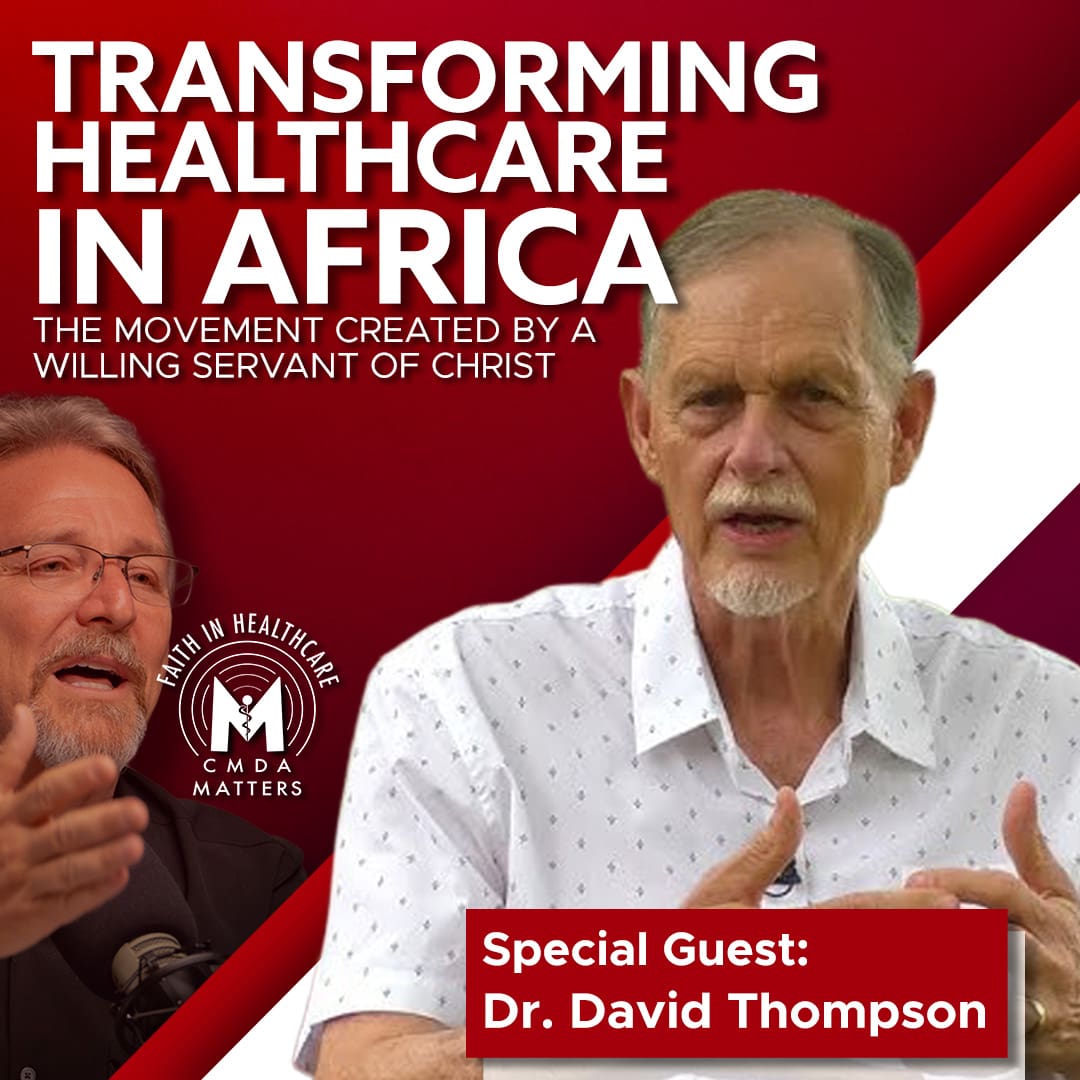
Next week I'm going to be joined by Dr. David Thompson. He's a man whose life's work has transformed medical missions, especially across the surgical specialties, and he has helped equip African surgeons who are serving their own communities in Christ's name. I want to thank you for joining us today. May you recognize this week that the Lord is with you and that he is for you to do his good work. We'll see you next time, Lord willing, on Faith in Health Care.
[00:34:53] Speaker A: Thanks for listening to Faith in Health Care, the CMDA Matters podcast.
If you would like to suggest a future guest or share a comment with us, please email cmdamatterscmda.org and if you like. If you like the podcast, be sure to give us a five star rating and share it on your favorite social media platform.
This podcast has been a production of Christian medical and dental associations.
The opinions expressed by guests on this podcast are not necessarily endorsed by Christian medical and dental Associations.
CMDA is a nonpartisan organization that does not endorse political parties or candidates for public office.
The views expressed on this podcast reflect judgments regarding principles and values held by CMDA and its members and are not intended to imply endorsement of any political party or candidate.