Episode Transcript
[00:00:08] Speaker A: You're listening to faith in healthcare, the cmda matters podcast. Here's your host, Dr. Mike chubb.
[00:00:20] Speaker B: Welcome friends, to Faith in Healthcare. You know, as we reflect on this past season of ministry at cmda, I want to begin by saying thank you.
Many of you have given so generously of your resources, your time and your prayers, and we're deeply grateful here at cmda. Your partnership is what sustains this ministry and allows us to serve Christian healthcare professionals across the country and really around the world. I also want to speak candidly with you because I believe that you'd want me to as we closed our fiscal year, our budgeted need was $1.1 million by June 30th. And while we claimed all of the generous $250,000 match offered by several donors, we fell short of our goal with a total, including the match of $659,000 given.
You know, this was very encouraging, but it was not enough to fully support the many ministry efforts of your cmda.
As a result, we're entering this new ministry year with a need to carefully evaluate our priorities and steward our God given resources with even greater intentionality. Frankly, unless we receive additional financial support, we are going to face difficult decisions about reducing the scope of our work.
While this is not a time for lingering in disappointment, it is a moment, however, of clarity.
The Lord continues to open doors for ministry, whether it's in advocacy or in student and resident outreach, and in leadership development in global health missions, as well as in equipping healthcare professionals to live out their faith with both excellence and courage.
The opportunity, friends, has never been greater in my opinion. But we must ensure that we what we pursue aligns with what we can faithfully sustain.
So I do want to ask you today two things. First, please, please pray for us for wisdom, for discernment, and for unity as we seek to focus on what is most essential to fulfilling the mission of your cmda. And second, if CMDA has been meaningful to you in your career, whether you're just getting started or you're down the road several decades, I would invite you to consider how you might part partner with us more deeply during this season.
Your support directly fuels this work and together, friends, we can continue to impact lives for Christ through health care.
I do want to thank you again for standing with us. It is a privilege to serve alongside you our commitment, our CMDA promise, is that we will do everything that we can with God's help to keep your faith and your health care connected well. Now let's turn to today's conversation.
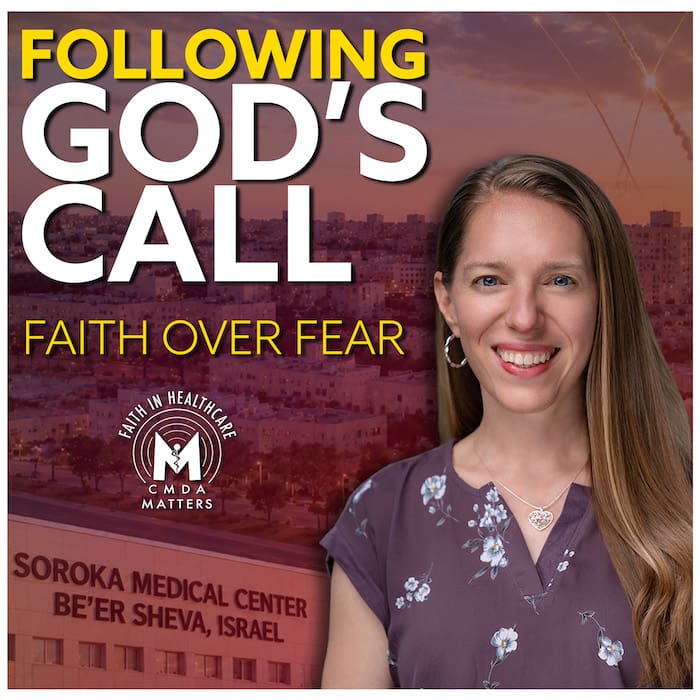
My guest today is Dr. Tiffany Schatz. She's a gifted general surgeon who had built an established life in the United States and then sensed God calling her family to leave it behind and serve patients in Israel. We talk about what she's learned while caring for people during seasons of uncertainty, following God's leading through unexpected circumstances and living with hope that's firmly planted in Jesus Christ.
So let's dive in.
Well, today on faith and healthcare, it's my privilege to welcome Dr. Tiffany Schatz all the way from from Beersheva, Israel. She's a general surgeon, a lifetime member of CMDA who I got to hear her voice the other day on Faith Radio talking about assisted suicide. So she's a woman of many talents, including general and thoracic surgery. She did her undergraduate degree at Messiah College and then actually went to medical school in Israel there where she's currently practicing, got a focus on cross cultural care and international and resource poor settings, general and thoracic surgery training and then not too long ago decided with her husband, with her family to move to Israel. So before we get any further into that, welcome today to faith and healthcare. Dr. Tiffany Schatz.
[00:05:01] Speaker C: Thank you. I'm so happy to be with you.
[00:05:02] Speaker B: Well, when our vice president for communications, Mandy Morin told me your story, I'm like, I want her on tomorrow to have a conversation.
Incredible story.
I just, I want to first, for our listeners and my benefit, what led to this transition from Messiah to Ben Gurion to go to medical school?
[00:05:22] Speaker C: I was planning originally to serve cross culturally from a young age.
And then in college when I had this sort of pull toward medical school, I initially thought I would go maybe to India to study medicine. But because I didn't know any doctors, I wasn't really exposed to medical education or what these kind of things meant. But I just knew I wanted to be cross cultural as soon as possible and to start my journey of service as soon as possible.
And so during that time that I was applying to medical school, my parents asked me to apply to some other American schools as well, just telling me that they didn't feel a piece about me going to India for medical school. And so during that time my dad actually passed away very suddenly and I had an email from Columbia University where I had applied and they said based on my interests, they think that my fit for this school, that they collaborated with Ben Gurion University and Beersheba, Israel, the medical school for International Health was a good fit for me and they asked me to consider applying to it.
I did, and it was a a great decision. I'm very thankful to have trained in Israel. The training was great, the population was quite diverse and I had a tremendous exposure to a lot of pathology, which I feel was very beneficial for my training.
[00:06:56] Speaker B: And then you came back to the US and did your general surgery training and then practice in the US for a period of time.
[00:07:04] Speaker C: That's right. So basically I went through my general surgery training and I did thoracic surgery training and at that point I had a baby with very significant special needs.
So we settled down in the States for that period of time and I ended up having my third child, also had significant special needs.
And during that period I had a lot of questions. What was happening with my life as I wanted always to serve and I always wanted to live cross culturally. And so having a different family structure than I expected, especially with such a high demand profession as surgery, it didn't all seem to fit together. And I didn't quite understand why that was happening. But over the subsequent few years that I started in practice and really continued to seek the Lord, I found that, you know, I became very content with just being faithful in the place that God had put me. And then it took several years to really let that grief go of that deep, deep desire to live sacrificially, to live cross culturally. But I came to a place of really deep satisfaction and the desire to use my life for God's purposes in the world basically, you know, to learn and to pursue being an intercessor in a serious fashion, to give out of my resources from my American income and to live sacrificially in the place that we were.
And I felt really a deep sense of contentment during that period that really was only within a few years of now, just a few years ago.
[00:09:02] Speaker B: So I'm fascinated because the conversation that we're going to get into here shortly, you're in a conflict zone. You're back in Israel.
What led a conversation with you and your husband? What does your husband do?
[00:09:14] Speaker C: My husband's a software programmer. He's a startup guy, so he develops software programs and is involved with new initiatives, new startups.
[00:09:27] Speaker B: So October 7th happened two or three years ago now, what's happening in conversations between you and your husband and you and the Lord about what's happening now in Israel in conflict and now of course, with Iran. So tell us about that transition, how God led you by the hand to go back to Beersheba, Right?
[00:09:48] Speaker C: Well, it was something so unexpected, you know, after you come to a place of contentment. You think, okay, now I'm where God wants me to be, and I am also content in that.
But it really was a fast switch, because October 7th happened, and most of those patients who were brought as victims of that horrible tragedy were brought to Soroka Medical center, where I did my training in medical school, where I was with the surgeons who were taking care of those trauma patients. I saw in my mind's eye those operating rooms and those wards and those surgeons. And I felt such a deep grief and anguish and the compassion of how difficult that caregiving situation is, as well as the patients and so forth. But the hospital itself received more than 800 trauma victims in less than 24 hours. Every 90 seconds, a new trauma victim was coming through the door, being brought by private cars and vans and ambulances and whoever could bring them. And sometimes people would bring cars full of people who had passed away because they just were trying to get people to the hospital.
And when I heard about that, my heart was just really moved. And I thought, I would love to volunteer.
I would love to come and help. What can I do?
So at that point, I signed up to be a volunteer. Just looking at, when could I come? And I was on a webinar call with the head of Soroka Medical Center a few weeks later, and he said, you know, we really appreciate everybody who wants to come and volunteer, but it's very disruptive. You know, people want to come and volunteer who don't know the language, who don't know the system, who want to come for two weeks. And it's a very large hospital. It's a very large hospital system. There are many hospitals who are involved at that point. And so to say I'm going to come for two weeks, it turns out to be very disruptive.
So what he said at that point was, what we really need is for people to come and stay.
And it was like an arrow to my heart. It hit me in that soft spot that I had been feeling all of that desire to help. It. It hit me, and for me, I felt moved. I didn't know if that was from the Lord at that moment, actually, I thought I was probably insane to think that. But, you know, it's my.
My desire. My desire is to go. Great. Well, I couldn't shake that thought and that desire.
And I didn't bring it up to my husband right away because I thought, he's going to think I'm completely nuts.
You know, we have this complicated family. We have two kids with wheelchairs. We've got. We just put an elevator into our home. We have a wheelchair van with a pneumatic lift. And we've finally gotten everything kind of settled. So we got things worked out, and now you want to uproot our family and move to Israel.
So I had that sense that he wouldn't think it made any sense.
And so I waited.
But after a month of having this persistent desire and burden, I finally brought it up to him. And I said, lord, it's in your hands, because how, you know, the heart of the king is. Is in the hands of the Lord. And so I. I just brought it up. And the first thing that he said was, well, if we're going to do that, we better talk to a lot of people and figure this out, you know.
And so it was really very smooth from there.
We started talking to friends that we have in Israel, and we took one step at a time.
[00:13:44] Speaker B: And this was. Now, about what time frame, what month and year was this?
[00:13:47] Speaker C: That was January 2024.
[00:13:51] Speaker B: And then what was the amount of time between then and your actual landing in Beersheva?
[00:13:58] Speaker C: Well, there were a few different things that happened. You know, we did the paperwork and it went very quickly. It was very smooth. And so my thought was, let's get our family there before the new school year so that all the kids can start school and get going a reasonable time.
But soon after our paperwork was completed and our immigration visa was approved, my husband's uncle died and his mother also was diagnosed with breast cancer.
So, you know, at that point, he said, you know, I don't think we're ready yet. I think we need to put the brakes on this.
And so I had actually already started closing down my practice and took in. Taken myself off of the call schedule, which I've never not been on the call schedule. And so I was planning to immigrate to Israel in August, and I was not on call in August. So I said, well, I'm suddenly free, so I think we should go to Israel and at least visit and then we'll just see what happens.
And the day before we went on this trip, just he and I, there was a threat from Iran to strike Israel. And I thought for sure he would say, you know, we can't go. But we came anyway. And there was a real sense of distress here because they hadn't had any strikes from Iran yet. And there was a real feeling that this could decimate Israel. This could be it. This could be the end of Israeli society as they know it. And there was a Real sense of heavy fear. And then a couple of days after we got there, my husband's mother fell and broke five ribs. Ended up in the icu.
And my husband said, you know, let's hold these plans. Let's not, let's hold for now.
And so I was actually pretty, pretty devastated because as I told you, I had already laid down all of this desire to do cross cultural service. And so I thought this new air that was blowing into my balloon was all from the Lord. Like, I did not conjure that up.
And all of the pathway that we had walked in to get all the paperwork done and all the doors that were open, that was all from the Lord. And so I just did not know what was happening. And also I'd closed my practice. I had taken myself off the call schedule. That's a big deal. It takes a few months to do that. And then to get back on to get a patients all scheduled, it also takes a few months. And so this was something that was a matter of faith. And I just had to again and again lay it down and believe that this was all from the Lord and that at the right time he would bring us. So a few months later, in January 2025, my husband said, what are we waiting for? Why are we waiting around here? Let's do this. What's the soonest we can.
We can go.
Of course, then I had turned the key of this practice back up, but I looked at the calendar, I looked at the immigration flights that were arriving to Israel, and I said, April. April's as soon as we can go.
I don't think I can do this all again, but April, I can do it. So then we flipped it into high gear and suddenly we were selling everything in our home.
We were making all the plans, once again, closed down my practice. And the amazing thing is that we had such a sense of urgency to do this thing.
And it was really something shocking to our friends and family who were like, what's the rush? Why are you in such a hurry and the kids are in school? Why not wait till the end of the school year?
And why do you have to. I mean, basically we just like gave away and sold everything we had. And it was, you know, bargain deals for all of our belongings. So it was, it was something. But I felt also that when I was filling out the paperwork the year before, but at that time I had this sense of urgency and it was as if we were given orders, as if we were in the army and we were given orders to get up and go Move quickly. And I couldn't. We were compelled. We had to do it. And so we did. We got here in April of 2025.
[00:18:46] Speaker B: Well, a lot has happened since April 2025. And I wouldn't say that necessarily. Shalom is a word I would think of in the midst of all that you've experienced, because now you're in a setting, you're in a war zone. And most of our listeners have only experienced war and conflict, Tiffany, through news headlines. So help us understand now what daily life looks like for those like you who are serving in a hospital in the midst of a regional conflict with attacks from Iran, and read an article and clearly, you know, people on your staff come in and their neighborhoods have had missile attacks. So just tell us what's happening today.
[00:19:29] Speaker C: Well, today, fortunately, we're not under lockdown, but when we have had these periods of attack from Iran and when we have rockets from the Houthis and Yemen and from Gaza at different times, it's very surreal to feel that, you know, every day looks like this. The beautiful sky, the weather is great. You know, we, we live in a very nice place. But also this sense that things could change very quickly. And, you know, there are multiple layers to this because we have a great defense system. The Iron Dome and David's Sling are air defense systems that catch most of the missiles and rockets that are sent.
So most of the time we go to the bomb shelter, to shelter during air raid sirens, but we expect that most of the time that they're going to be, they're going to be intercepted, but we know that they are not always. And we know that those ballistic missiles, if they hit, and if they hit us directly, they will kill us.
So there's that kind of two sides to that feeling, that being relatively secure, but at the same time, knowing that we're not truly fully secure in the hospital.
We're very fortunate to have a lot of patients that are able to be moved to bomb shelter environments for their time on the wards. And our operating rooms that survived the bomb in last June are also in a bomb shelter area.
So these are safe zones in the hospital.
And so that it's interesting because it's as if nothing's happening. We just continue serving patients, taking care of patients, discussing plans of care and doing the things that we normally do. Even when there is a siren on our ward, all of our iron closures are closed and we continue speaking with the patient in front of us, rounding.
And then on the corner of the nurse's desk is a computer with the news up to see what's happening, but otherwise everybody appears to be going through business as usual.
So people do serve in the hospital with all kinds of different home experiences, children who are off serving in the IDF or who are injured.
We have, like you said, a nurse came in after her entire apartment was blown out. She had to leave her family in the winter, no windows, and her husband and kids were at home and she came, she was still neatly dressed, she had her makeup on and she showed up and she took good care of patients as an integral part of the team. And I think that's the picture of how people function, you know, and maybe a little bit of separation, but there's a commitment to serving.
[00:22:42] Speaker A: Before we continue with this week's episode, here's a special announcement for you.
If today's conversation has you thinking about how to more intentionally integrate your faith into patient care, consider attending a Saline Process Witness Training.
This course equips healthcare professionals to confidently and respectfully address the spiritual needs of their patients through practical tools like taking a spiritual history, recognizing opportunities for faith conversations, and praying with patients when appropriate.
Used by more than 50,000 healthcare professionals in over 120 countries, the saline Process combines biblical principles with hands on learning you can apply in your practice right away.
Join us October 30th and 31st in Birmingham, Alabama or November 20th and 21st in Boston, Massachusetts.
To learn more or register, visit CMDA.org Saline.
If you've ever wanted to become a more effective mentor or help others grow with greater purpose.
Join us September 25th and 26th for mentoring with a coach approach.
This two day intensive course will equip you with practical coaching tools, resilience building strategies and a coaching mindset to strengthen mentoring relationships plus foster both personal and professional growth.
Led by experienced coach and emergency physician Dr. Darren Fulk and a physician life Development coach Ken Jones, this CE eligible course is designed for healthcare professionals who want to invest in the next generation with wisdom and lasting impact.
To learn more or register, visit CMDA.org events.
Let's jump right back into this week's episode.
[00:24:51] Speaker B: The article that I read about you also had a story about an Arab doctor who's part of the team and so it's I assume a multinational team that you serve with, right?
[00:25:01] Speaker C: Well, our hospital at Soroka, half of our patient population are Bedouin and they're Muslim. We have a sizable Ethiopian Jewish immigrant population, a sizable Russian Jewish population.
Half of the doctors and the staff in the hospital are also Arab Israeli. So we work together very, very Integrated as far as team care of patients. It's a really wonderful environment in that sense, very multicultural.
So it's actually very important to have all of these different members on the team because many of our patients don't speak Hebrew or English or they speak Hebrew with broken Hebrew. So we need our Arab doctors, our Russian speaking doctors and all the team members who come and help to translate for different patients.
[00:25:55] Speaker B: And then how often, Tiffany, do these sirens go off currently, like this month in June?
[00:26:00] Speaker C: Fortunately for us in Beersheba, we haven't had any sirens this month, thank God.
Most of the sirens are happening in the north by the border of Lebanon.
We have been fortunate so we're sort of living life as usual. Although we go to sleep at night some nights when they say that Iran is going to attack tonight, we're expecting a 3am Siren to let us know to take the glass windows out of our bomb shelters and close the iron enclosures or stay close to the bomb shelter.
But we haven't had, and we're thankful for that. In our community though one of our young men was our faith community. One of our young men was injured this week in an attack in Lebanon in a drone attack to his tank. And fortunately he survived. But it was, you know, it's very, it strikes close to home for sure.
[00:26:53] Speaker B: So I assume, of course, life carries on for Israelis. And so your surgical load, I assume is most of the time a normal sort of a variety of surgical cases, is that right?
[00:27:07] Speaker C: Right. Most of the time when we're on a lockdown time, they do decrease the number of elective procedures and everybody is, you know how it goes with the operating room. Everybody's trying to get their cases on and negotiating about because they don't keep the operating rooms running as much because they want to be ready for a mass casualty situation.
So we really have to haggle to get our cases and that kind of thing. But yeah, we're doing lung cancer, we're doing esophageal cancer, you know, all the basic stuff. One interesting thing that I did see is that because our beds decrease in that setting, we have to change the way we approach some diseases and processes that we might take a non operative approach on.
And the beds are needed, patients need to get out of the hospital. So we might proceed with a surgical option before waiting the few days or weeks to see if the medical options will work, which I thought was very interesting. I've also heard from my colleagues in the community that they found that we, not our department in particular, but the hospital itself is discharging patients in a more acute state because we just don't have the beds. And more patients keep coming to the er, as you know, so then we have to discharge them. And the community doctors are, are sort of having to pick up the pieces with patients who are a little bit more acute on their discharge than normal.
[00:28:41] Speaker B: I'm just wondering about the bigger story. Your family, your special needs kids.
And has that opened any doors in your community, where you live or at the hospital? Because people know that you've come with your family, that you have these extra stresses and challenges that you face.
Any God sightings in all of that, in the larger story?
[00:29:06] Speaker C: Yeah. Israelis are very thankful for support because they really do feel the global censure of their society, of their population, of defending themselves, and they feel a lot of support. When our family, or families like us choose to move here and say, we stand with Israel, we're going to, you know, continue to support, that's definitely a big deal.
As far as our kids, our kids are always making friends and reaching out and they are definitely a source of community, community building.
And my, my, my daughter, who's bigger as well, she's my social butterfly. And so we're very fortunate to have made many friends. And then I do see that I have a tremendous amount of favor at which I'm very thankful for.
I just, you know, as a surgeon, things can go, they can go any which way. And working in an environment with a new language and a different system, a different team structure, it could be a hostile situation for a surgeon. And I found just over and over a welcome, but also I think just favor with having my cases go really well, having things just really fall into place. And I do do see the providence of that, that my pathway has been laid to make us more secure here.
[00:30:40] Speaker B: What is the daily language for you in interacting with staff and patients?
[00:30:44] Speaker C: It's Hebrew.
So my first few months here I was studying Hebrew and I'm still studying on the job, but it's a challenge. But it's a great language. It's very mathematical. And so there's a lot of rules and a lot of connections that you can make. I'm hoping that I really can master that in the next few years.
[00:31:06] Speaker B: And is that helping you, Tiffany, with your Old Testament reading?
[00:31:10] Speaker C: I would like, so I would like to. Yeah, definitely. It goes both ways.
[00:31:17] Speaker B: I haven't had a chance to ask you, when did you first get involved with cmda? You've become a lifetime member, so that means you've been, you've made a commitment for a lifetime, so. But when did you get introduced to the Christian medical and dental associations?
[00:31:30] Speaker C: I think I had heard of it, but I didn't really.
I don't think I really registered because I went to school in Israel and we didn't have a chapter at our school. I never was connected.
It was probably just a few years ago I went to a regional conference meeting and then from there I heard about the media course and I was really, really blessed to be able to participate in that. And then. Yeah. And I think CMDA has a lot of great resources.
I'm really thankful to have the connection.
[00:32:06] Speaker B: Well, as a Christian physician, how has this experience, Tiffany, shaped your understanding of what it means to be a faithful witness for Christ in a setting that's just marked by fear, grief, and such tension?
[00:32:20] Speaker C: That's a great question, because I don't think it's unique to this environment.
You know, as a person who has dealt with a lot of different kinds of challenges and stressors throughout my life story, I think that we can count on and depend on and rest in the Lord and we have a hope that is not connected to our circumstances.
So where those who don't have hope will be, like you said, in fear and doubt and grief, we can live in joy and delight, really, even in the midst of this stressful situation. Basically. It doesn't mean that I don't feel anxiety or a rush of adrenaline when we hear, say we're in our bomb shelter and we hear a big boom where a rocket has fallen. But we know our security doesn't lie in the U.S. our security doesn't lie in Israel.
Our security lies in the Lord. And no matter what happens, we can trust in that.
I think even when I was here as a medical student back in 2009, and it was the first, the first rockets reached Beersheba from Gaza, and we didn't have the Iron Dome then. So there was a lot of anxiety, a lot of fear. It was definitely a terror situation where the whole population was frozen in place. And I remember that you would go to a bomb shelter in a store or out, and people would be crying in fear, you know, and I think there's still a sense of, of that, of that fear, but most everybody has to just keep going.
I really believe that, that our faith gives us a much deeper sense of security in the midst of all of these things. And I really don't think it's that much different than when I've had patients who aren't doing well or my Own kids who are in a severe health crisis. It all comes from the same place of distress.
[00:34:32] Speaker B: So it's been 14 months since April 2025.
Your family's come to terms with this new life for you guys? Or do you have parents, siblings, friends who just say get back here, you're crazy for staying there?
[00:34:46] Speaker C: Our families all are, have different perspectives.
A lot of people want us to come back. Obviously people miss us, but our family here is mainly happy and content. I do still feel that we are making an adjustment. It's still a big adjustment.
We're still all working to master the language, which I think is a big part of a cross cultural adjustment. I think once we get the language, then we'll will be much closer to feeling settled. But yeah, I think we're very happy. I think we have a great place to live.
To me, I'm as happy as I've ever been anywhere.
I'm very pleased with my surgical practice. I love meeting all the people I get to meet both in the hospital and outside the hospital.
I love to eat good food and there's lots of good food here.
Yeah, I think we're doing pretty well. Obviously every family has its ups and downs, but I have to say that our kids, when we decided to come to Israel, were some of the biggest support for the idea. And my daughter, who's now 15, she felt that this was definitely from the Lord and that was a big test. You know, if we're telling our 14 year old, we're going to move you across the world in the middle of high school, ready to go. We kind of thought she would have a hard time with it, but she was one of the most enthusiastic. She wanted to get going. What are we waiting for? Let's do this. And that's been a beautiful thing and something that has encouraged me along the way that we are on the right track.
[00:36:27] Speaker B: A remarkable teen. Wow, what a daughter.
You know, before we got going briefly, you mentioned a phrase that I came across in the article about you that I'd never heard before.
And it's the phrase made aliyah.
And I probably butchered the pronunciation of that Hebrew word. But you said it's from the songs or psalms of ascent. And that's fascinating. Our national convention, our psalm was Psalm 121. Our theme, you know, was look, lift up your eyes. And so tell our listeners just a little bit about this migration or immigration. And do you have any Jewish roots, any family roots that are, that are Jewish?
[00:37:12] Speaker C: To start, my husband's family is all Jewish and I'm. My family is not Jewish.
So to immigrate to Israel, you have to have Jewish roots. And so being married to my husband gives our family the right to immigrate. Okay. Essentially, it's coming up Laalot, or making aliyah is. Is to go up. To go up to the land that God has promised, to go up to Jerusalem, to ascend to the mountain of the Lord kind of a thing. And the idea is that you're going toward God and God's purposes. So they also talk about Jewish people who leave the land. They're going down, they're going down, away. And it's a biblical concept, but it's very interesting. And so that's what they call immigrating to Israel as a Jewish person is making aliyah, is going up to the land.
[00:38:08] Speaker B: Wow, what a great concept. How can our listeners, as we wrap up this conversation, how can our listeners pray for you specifically? And I'm also curious about any 1 Peter 3, 15 moments that come and, you know, you've been talking about hope and living differently and being a shining light and salt.
How can we pray for you? And for what moments should we be praying? What opportunities should we be praying for Tiffany and your family in terms of being that salt and light?
[00:38:42] Speaker C: Well, thank you for that question.
You can certainly pray for our family. The biggest challenge in any family is to continue in love and forgiveness and kindness to one another.
And so, you know, for, for our, our marriage and for our parenting to be filled with grace and, and love and reflect. What is Jeremiah say that the old pathway of righteousness. I also would ask that you would pray the same for the congregation and the communities here who, you know, the biggest challenge is a breakdown of relationships and breakdown of communication and splintering of leadership. And I think it's. It's one of the biggest challenges, and it's one of the things that keeps the community from being as effective as. As possible. So, yeah, obviously I would love to have many conversations and many, many opportunities to share, but really, you know, the Lord, he's working. He's doing the work, and we're ready for whatever he's going to do.
And I would just pray to be ready to be ready for that.
[00:39:57] Speaker B: Well, you've been an obedient woman of God. You and your husband have both been obedient. And praise God for that obedience, the amazing example of courage and obedience, the urgency that you described earlier when it's, we've got to go, God's calling us to go, and for going, and may the Lord bless you and make his face shine upon you and be your shade by your protective shade. The sun will not harm you by or the moon at night. You know that Psalm 121. So God bless. And for our listeners on a regular basis, Dr. Schatz is on Faith Radio talking about all kinds of bioethical issues. So you're a woman of many talents including surgery and Hebrew and the list goes on and on. So I hope we get to cross paths sometime and maybe we'll get you to speak someday at our national convention. Who knows?
[00:40:54] Speaker C: Well, that would be a tremendous honor. Can I tell you one thing that I didn't get a chance to mention, but it's really quite amazing as far as the resilience of the people here and the medical teams. One of the doctors from the intensive care actually had a gunshot wound to the head during these conflicts and was found and brought to the hospital and nobody recognized him initially. He was cared for for a while, ended up having a long term care tracheostomy, all the things and recovered and is now back working caring for patients in the icu.
It's really, you know, continuing persevering on through, through these days and it's remarkable.
I think that's the nature and the spirit of the, of the people.
[00:41:47] Speaker B: Thank you for sharing that story of one of your colleagues. God bless Tiffany. Thank you.
[00:41:51] Speaker A: Thank you.
[00:42:03] Speaker B: What an encouraging conversation with Dr. Tiffany Schatz. I was reminded, friends, that following God's call doesn't always lead us to places of comfort or certainty, but it always leads us to the place where he is at work.
Like Tiffany, may we each be faithful wherever God has placed us, trusting that our hope as well as our security are found not in our circumstances, but in Christ.
Please join me in praying for Tiffany, her family, her colleagues and the patients that she serves. And let's also pray that God would give each of us wisdom and hearts that faithfully reflect Christ to those he places in our daily care.
If today's conversation has impacted you, please share it with a fellow healthcare professional and subscribe on YouTube so you don't miss future episodes.
I invite you to join us next week as Dr. Brick Lance explores what it takes to rebuild trust in healthcare from a Christ centered perspective. It's a talk that he gave in early June in Knoxville, Tennessee at the annual Colson Center National Conference.
Thank you for listening to Faith in Healthcare, where our promise to you as a listener or better yet, a regular subscriber to this podcast is we will do everything we can at the CMDA to keep your faith and your healthcare connected.
We'll see you next time, Lord willing.
[00:43:43] Speaker A: Thanks for listening to Faith in Healthcare, the CMDA Matters Podcast. If you would like to suggest a future guest or share a comment with us, please email cmdamatterscmda.org and if you like the podcast, be sure to give us a five star rating and share it on your favorite social media platform.
This podcast has been a production of Christian Medical and Dental Associations.
The opinions expressed by guests on this podcast are not necessarily endorsed by Christian Medical and Dental Associations.
CMDA is a nonpartisan organization that does not endorse political parties or candidates for public office.
The views expressed on this podcast reflect judgments regarding principles and values held by CBDA and its members and are not intended to imply endorsement of any political party or candidate.