Episode Transcript
[00:00:00] Speaker A: Foreign.
[00:00:08] Speaker B: You're listening to faith in healthcare, the cmda matters podcast. Here's your host, Dr. Mike chubb.
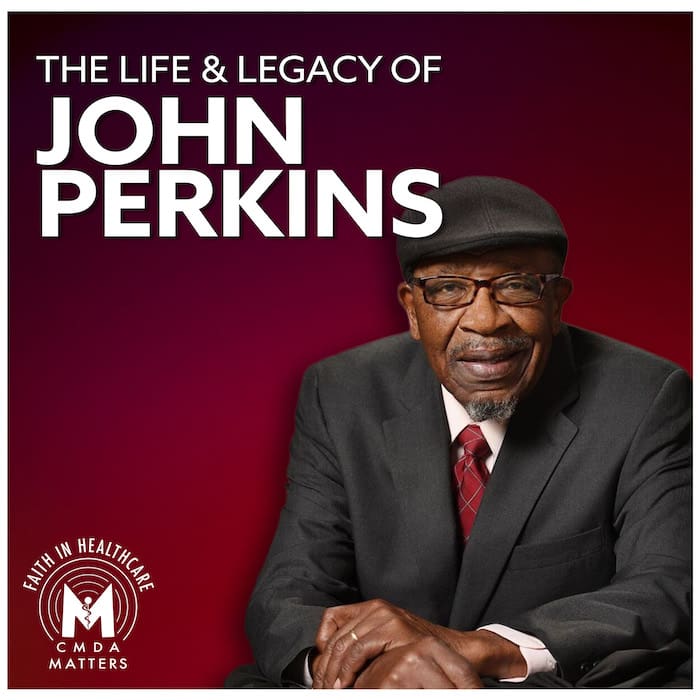
[00:00:19] Speaker C: Well, today on Faith and Healthcare, we're releasing actually a special episode because a very, very special man that we want to honor and help reflect on his life, a remarkable servant of Christ, Reverend John Perkins, has passed away. And for decades, he stood as a courageous voice for justice, reconciliation, and the dignity of every human life, shaped deeply by his own experiences of suffering and redemption in the segregated South.
So, from the front lines of the civil rights movement to his lifelong commitment to Christian Community Development, Rev. Perkins embodied a faith that was not only proclaimed, but it was lived out, often at great personal cost. His vision of racial reconciliation, grounded in the gospel, well, it continues to challenge and inspire the church today and certainly our constituents, members, and ministry partners. So we're going to have a conversation today and remember his legacy and consider what he has left for the next generation and reflect on how his life calls each of us to faithful witness in our own time. And so to do this, I am so delighted to welcome back to Faith and healthcare our CMDA president and board chair, Dr. Omari Hodge, who's a family physician and been involved in training for many years now, the next generation of family doctors. For over a decade, Omari has been involved in so many different ministries of cmd.
Omari, welcome back to the program.
[00:01:51] Speaker A: Thanks for having me, Mike. It's always a pleasure to talk with you. We do it so often anyway, so this is just an extension of who we are and what we do right now.
[00:02:02] Speaker C: Yeah, absolutely. So you're very easy to talk to. So it was comfortable for me to say, hey, let's add a program because of a man whose ministry that you and your fellow members of the Racism, Reconciliation, Equality and Diversity Committee of our board introduced to all of our membership by offering the Perkins Justice Pilgrimage. That's down in Mississippi. And we're going to get to that. But I just wanted to ask you from your place now, where you are there in Tampa, as you've thought about the late Reverend Doctor Reverend Perkins, what does he continue to teach us about faithful Christianity? What does it look like when the Gospel of Christ confronts suffering and injustice and, and division?
[00:02:46] Speaker A: You know, it's.
It's still so surreal to me that, one, he's gone, but then two, that we have the opportunity to spend time with him.
[00:02:54] Speaker C: Yeah.
[00:02:55] Speaker A: And what I saw was a man who was 90 some odd years old, but not a man who had lost any zeal for his passion to create connections. And when People hear for the gospel and not just from the standpoint of pointing them to Christ, but bridging the gap of culture, bridging the gaps of political divides, bridging anything that would stop us from walking lock and step as brothers under the banner of Christ.
And I think his legacy, especially when you consider some of the hurts and pains that he's endured. If you haven't read his book, please do because he goes in depth about that. It's just such a tremendous reminder and in some ways I feel like an indictment towards myself of how we can, how we need to really shoot for true unification and not just go through the motions.
Dare I say I'm enthralled with what he has been able to accomplish with his time here on earth. And I'm sure that he has been able to hear, well done my good and faithful servant.
[00:04:09] Speaker C: Oh wow. It was such a gift to me that the two of us, Amari, we were able to share that experience. Now you had been there before, so it wasn't your first time, but for me the first time just we weren't sure we would get to meet him, frankly when we were there. And lo and behold, he shows up at the restaurant with his daughters and he comes alive when he's talking about principles and, and truth that he's been talking about. I mean he was a modern day prophet in many respects. But I think I shared with you. I first met him here in Bristol, Tennessee because he came. King College has a visiting professorship, many speakers who come through in the month of February and it was Black History Month. And so he came at a local Baptist church. The church invited us all in the Community Inn. And so there we were filling the church, maybe one hundred and fifty people, half white people, half black. And when he came out and stood on the stage, age 93, 94, he looked out, he began to cry and he said, this is a blessed appearance to me. This is what I have been hoping for. As if it was the first time, obviously not as the first time that he saw. So that was number one. Omari Second is that he said, if you leave tonight and don't hear anything from John Perkins, I want you to remember that if you are going to lead, you've got to lead with passion and with zeal.
So those are two things I remember. He was so happy to see us there that night. And it was about you lead with passion. And I'll never forget that.
[00:05:45] Speaker A: OMARI yeah, he had a way of speaking that really captured your focus. And his words tend to Just ring in your ear long after you've had the conversation.
[00:05:59] Speaker C: So what struck you most about seeing those on that Perkins justice pilgrimage? What struck you the most about those places? Hearing the stories in the background and the suffering of John Perkins himself and his family and understanding the cost of his ministry up close and personal. And you've did it twice?
[00:06:16] Speaker A: Yeah, you know, I think it's physical, it's tangible. You know, many times when we talk about different champions in the faith, you know, Corrie, Tim, Boone, Bonhoeffer, you name, whoever, mlk, unfortunately they, they don't seem as tangible because they're gone or they're not in proximity. This was a person who was still here, whose house we were able to feel the age, smell if you will, the suffering that he went through. Understand as we went through the different places, the Hanging Gardens, the Equal Justice Initiative Museum, the, the, the, the visiting the church where the Birmingham bombings had taken place. It adds element of awareness that words at times don't do justice.
And having him to tell you the stories as though they were just yesterday, it's almost a different sense. It's a sixth sense, if you will, that you can't put. You can't smell, touch, feel or taste. But when you're in his presence, you know it's there.
And I think that type of experience changes you in ways that cannot be undone. And you know, Mike, the good thing about it is it doesn't matter. Your level of experience, when it talks about cross cultural living, how many mission trips he's been on, it doesn't matter. You will leave having been changed by your time with him and spending time in those locations that serve as a remembrance to a time of pain, a time of change, and thankfully a time we can look back on and in many ways say progress has been made. Not to say that we've arrived, but we are still pressing towards the mark.
[00:08:06] Speaker C: So why does that ministry still matter today? The message that he shared, and I'm guessing it's certainly a guttural reaction to hear his story of having a fork put up his nose and to be tortured the way he was during the 1960s. And certainly my reaction may be very different from yours.
So hearing that story as a black man and understanding the forgiveness, the grace that John showed over the rest of his life as he reflects on that story with no anger or bitterness whatsoever. How does it work now today? Especially you having chaired our Red Committee.
[00:08:45] Speaker A: Yeah, you know, many of the most dangerous or the most politically charged, the most racially charged times in our country have all been in response to what the spiritual climate has been.
What I mean by that is, I think as believers, we recognize that there's a. There's a physical and there's a spiritual, and the spiritual is not bound by time the same ways that we are. Yeah, the finitude of man is something that we experience every day. A little more often than when we were younger, Mike, I'm sure, but it's real. Our mortality is something that we understand.
But the spirits that we wrestle with have been here for quite some time. And while they may take on a different uniform, whether It's World War II, whether it's civil rights, whether it's wars that are going on today, you name the country, you fill in a blank, it's the same. It's the same spirits in charge. And I think for us, if we don't properly identify the enemy, if we continue to see our enemy as people, we are in dangerous waters indeed. I tell many of the people who I speak with, regardless of what your. What. What race you are, what ethnicity you claim, if you are under the name of Christian Christianity, if you're under that umbrella, we have to accurately identify who it is that we're fighting. And like the scripture says, we wrestle not against flesh and blood, but again, spiritual wickedness in heavenly places. And I think some of the symptoms that we saw were the malady of that spiritual wickedness in heavenly places that was infecting people. And to this day, in health care, if you're not careful, that sickness can affect you. When we make politics more important than people, when we make culture more precious than relationship, when we put ideologies above the people that we're sworn to serve, I think there's always a danger of that. And so his. His stance, his. His. What he stood for, which is all. And I think that's what Mike, you and I love so much. It's all biblically based.
This is not hearsay or opinions. I mean, this is back to the.
[00:11:03] Speaker C: Back to the gospel. Back to the gospel.
[00:11:05] Speaker A: Okay. I mean, honestly. And so that's why we're saying, well done, because this is something we can all rally around and create a path forward that the world can look at and say, how does. How are they able to do that? How are they able to make such progress when the world around us is not able to do the same?
[00:11:27] Speaker C: Well, we have a sister collaborating organization that we have lots and lots of, you know, the Venn diagrams. There's quite a bit of overlap here with CCHF, Christian Community Health Fellowship. And Dr. Rick Donlon is one of our members who's the CEO, hang out in Memphis.
And it really wasn't until I paid a visit with a group of our CMDA leaders through one of their flagship clinics in Chicago, Lawndale Clinic, where Steve Knoblit, who's gone to be with the Lord, just like John Perkins was there, met with us. And I heard about the three R's. That was the first time I'd never heard about the three Rs that CCHF has adopted.
They've really sort of.
There's no question that John Perkins and his early ministry of community development morphed in and influenced cchf. But talk to our audience about relocation, reconciliation and redistribution and how that was at the core of what John Perkins taught.
[00:12:28] Speaker A: One of the important aspects of John PERKINS Embracing the three Rs, as you put it, Mike, relocation, reconciliation and redistribution is. It really is a model that we saw lived out by our Lord and Savior, Jesus Christ, who embraced those very principles on earth, which is why his ministry was so unique and so countercultural for that time. And I think the example has been seen, lived through other men on earth. And Perkins followed a lineage of people who saw great success doing the same thing. And, you know, it would have been very easy and very understandable even for him to have removed himself from that situation of the social upheaval, the racial prejudice, just so that his family can have a brighter future. And I don't think there's any Christian who would have been able to pick up a stone and throw it at his, you know, throw it in his way and disparage him from making that decision. But the harder decision, and, and, and these are, I think, where it separates the boys from the men as it pertains to faith, is to stay in that situation. Stay in the situation to which you
[00:13:37] Speaker C: recall, even when it's hard, and to
[00:13:39] Speaker A: allow God to use you, right, and allow the love of God to be shed abroad in. Even in these trying times. And I'll say this, I think this is only possible when you understand the three aspects of love. This is one of the things that I've loved about MLK's teachings that have always rung true in my mind. Of course, you have the Eros love, which is between a man and a woman. You have Phila love, which is between brothers who admire and care for one another, like I do for you, Mike. But then there's that agape love, right? That's. That love that transcends, transcends sense at times. That transcends culture. This is not a feeling type of love. This is not a love that says, you know, when you're. When you, when you've decided to turn the other cheek. This is not a love that's based on feeling. At that time, I.
It's akin to Jesus Christ hanging on the cross and you asking him how do you feel? I'm sure he's not going to tell you. It was butterflies and roses, you know, but when you're able to do that, I think it puts you in a position to where you can make decisions, where you can live in an area that is suffering so much. Recognizing that the persecutions that you're experiencing externally does not compare to the ravaging that's going on within these people's spirits internally. And if you can shed a hand in opening up their hearts and their eyes to the truth of God so that true healing can take place. Oh, wow. That. Well, that's. That, that's amazing. And so I. I love this style of ministry. You and I, Mike, when we went to go visit Dr. Perkins, I mean, you could see the area.
[00:15:18] Speaker C: It wasn't one that it was an economically depressed area.
[00:15:21] Speaker A: Thank you. Thank you. But the fact that this lighthouse remained there and that you have people coming from all across the country, dare I say across the world, to learn about philosophies and principles of faith is just a testament to a life well lived
[00:15:38] Speaker C: and the next generation, obviously Elizabeth and her sisters, other sibs have picked this up, the vision.
And whether you're going overseas cross culture as a missionary or making the decision they did from California to Mississippi, and as you've just described, making that sacrifice, moving back into that area where there was just a segregated south with a lot of tension, there was a price to be paid for the rest of the family. I still remember Elizabeth describing, even after the schools were desegregated, it's not like suddenly everyone's attitudes changed and it was difficult for those kids to go to school. She just as she describ described it to us, it was challenging. And even some still scars even as she described it to us.
So a decision by a leader like that, it's a decision to move back and relocate and to be close to where the pain is.
There are other people, there are consequences to the family. And I just think about many people will not answer the call because I could not do that to my children. I could not do that to my wife. But Vera Mae was part and parcel his soulmate in these efforts, wasn't she?
[00:16:47] Speaker A: Absolutely. Oh, Mike, I'm so glad you brought that out. Right. Because the heroine was in the house as well, and she was no less a champion of that effort. And I could not imagine him being successful without her support and her wholeheartedly embracing this philosophy. Well said, Mike.
[00:17:05] Speaker C: Well, finally, as we wrap this up, what do you hope that Christian physicians and dentists and then those in training, whether residents or students, that they can take away? I hope they'll get his book and we'll have resources in the show notes today for this special episode. But take away from John Perkins examples they think about their own calling in medicine as well as future leadership and ministry and our new brand promise to our members and potential future members. Your faith and healthcare connected. Okay.
[00:17:39] Speaker A: Amen.
[00:17:39] Speaker C: So what would you tell them?
[00:17:40] Speaker A: You know, leadership is not about platform. It's about sacrifice. It really is. I think about the levels of leadership that John Perkins has attained, attained during his life, and they were directly proportional to the level of sacrifice that he lived and was willing to go through. Now, I'm not saying that we should go out seeking ways to, you know, to go through tribulations and things of that nature. I'm not. I'm not asking for it. I don't wish it. But we know these things come.
But in America today, where our organization exists, I would really would hope that our brothers and sisters who are listening to this would realize there are areas that you can partner with so that you can do what John Perkins did, which was live cross culturally. I think there is no higher calling for a Christian than to be able to live cross culturally. As a matter of fact, other entities really cannot do this because who we live for and what we live for are not of this earth. We're not beholden to any earthly customs or traditions. We're not bound by any zip codes or earning revenue statements. We love people simply as we were loved. And I think our witness and our gospel, especially during this time, at such a time, for such a time as this needs to go beyond our comfort zones.
You need to feel comfortable worshiping and eating and being around people who look differently than you, who think differently than you, who are just differently than you. And that's both for saved and unsaved alike. You have to. I mean, for the unsaved is because our mission is to go out to those who are lost and to proclaim the good news. And for those who are our brothers and sisters, our mission is to make sure that the world knows. They said that they will know us by the love that we have for one another.
So there's no excuse. Sometimes it's very difficult.
And you will make mistakes and you will say things that are stupid, that are insensitive.
Think of I, I, I, I, I, I. It's akin to, you know, that one mistake every man makes in his life. When you ask that woman, hey, when are you due? And you find out she's not pregnant, you're gonna say stupid things and that's okay.
But what's dangerous, that's not dangerous. What is dangerous is apathy. The apathy that exists when you don't realize you live in a bubble. I don't think our society can afford for us as believers to live in a bubble. I, I think that's an indictment against us and it's not necessary, nor should we want that. So that's, that's what I think. A sacrificial love that seeks to go cross culturally with the gospel.
And that's a lot of fancy words for saying follow the Holy Spirit because the Holy Spirit, he does that.
He'll teach us how to do that. The comforter will show us how to find comfort in uncomfortable moments.
[00:20:38] Speaker C: Dr. Omari Hodge, thank you so much for joining me for this special episode to honor the life and legacy of John Perkins. And we've been talking about the Perkins Justice Pilgrimage which we at CMDA have sent a couple of those tours down to Jackson. We'll have information in the show notes today on how listeners can find out more about that and they can stay tuned for the future. We'll announce it here on Faith and Healthcare down the road when we are able to schedule another one. That's just for cmda which has been about a four day experience across a couple of states and a bunch of significant sites for the Perkins family and the civil rights period of time, especially in 1960. So our listeners can look to forward forward to that. Omari.
[00:21:21] Speaker A: Love it.
[00:21:28] Speaker B: Thanks for listening to Faith and Healthcare, the CMDA Matters podcast. If you would like to suggest a future guest or share a comment with us, please email cmdamattersmda.org and if you like the podcast, be sure to give us a five star rating and share it on your Facebook Favorite social media platform.
This podcast has been a production of Christian Medical and Dental Associations.
The opinions expressed by guests on this podcast are not necessarily endorsed by Christian Medical and Dental Associations.
CMDA is a nonpartisan organization that does not endorse political parties or candidates for public office.
The views expressed on this podcast reflect judgments regarding public principles and values held by CMDA and its members and are not intended to imply endorsement of any political party or candidate.